Wayground logo

Free Printable Worksheets

Font size

S
M
L
XL
Worksheets

Population Ecology

Total questions: 30

Worksheet time: 19mins
Name
Class
Date
1.
A group of organisms of the same species living in the same place at the same time is called a(n) _________.
a)
ecosystem
b)
population
c)
community
d)
organism
2.
largest number of individuals of a population that the environment can support  
a)
carrying capacity
b)
primary succession 
c)
denitrification
d)
mutualism
3.
Living factors in an ecosystem
a)
abiotic factors
b)
species
c)
trophic level
d)
biotic factors
4.
All the living and non-living factors that interact in an area
a)
ecosystem
b)
carnivore
c)
niche
d)
population
5.
Any factor that limits population growth
a)
Limiting Factor
b)
Immigration
c)
Succession
d)
Abiotic Factor
6.
Temperature, sunlight, and water are examples of _______ factors.
a)
biotic
b)
abiotic
7.
If a population grows larger than the carrying capacity of the environment, the population is likely to
a)
decrease
b)
 increase
c)
stay the same
8.
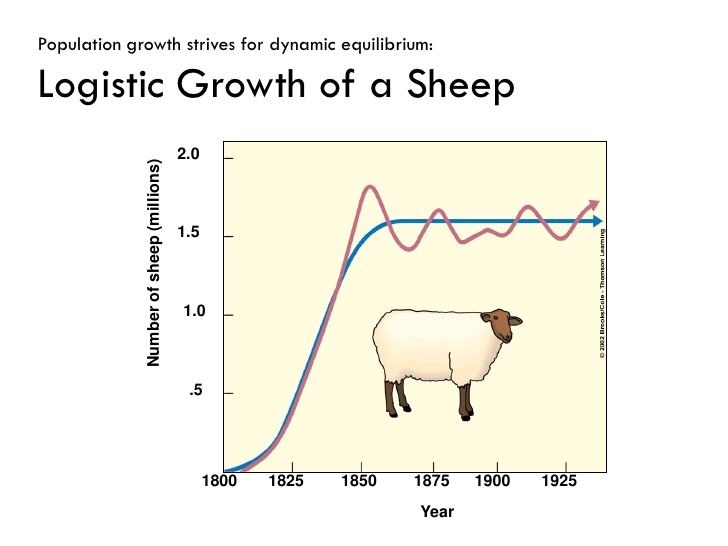
What is the carrying capacity for this sheep population?
a)
1.8 million
b)
1.25 million
c)
1.6 million
d)
1.o million
9.
Groups of different species living in the same area at the same time
a)
ecosystems
b)
biosphere
c)
communities
d)
populations
10.

What type of resources are associated with the pattern of growth?

a)

sporadic

b)

limited

c)

unlimited

d)

exponential

11.

During which month were the rabbits in exponential growth?

a)

May

b)

June

c)

August

d)

September

12.
Two or more members of a particular species living and interacting in the same area
a)
Community
b)
Population
c)
Organisms
d)
Biosphere
13.

The largest number of individuals that an environment can support long term is...

a)

carrying capacity

b)

emigration

c)

immigration

d)

population density

14.

What happens if a population grows past its carrying capacity?

a)

The population keeps growing

b)

The population starts to die off

c)

The entire species will go extinct

d)

The carrying capacity just increases

15.

This may cause a population to increase

a)

increase of food supply

b)

removal of predators

c)

removal of disease

d)

all of these

16.

Something that regulates the size of a population is called...

a)

a limiting measure

b)

a limiting factor

c)

carrying capacity

d)

biodiversity

17.

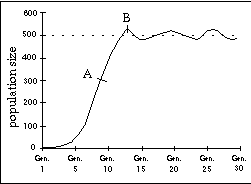
What is the carrying capacity of the graph?

a)

1000

b)

8000

c)

800

d)

600

18.

What are factors that affect carrying capacity?

a)

Biotic only

b)

Biotic and abiotic

c)

Depends on the ecosystem

d)

Abiotic only

19.

What is the carrying capacity of the graph?

a)

around 500

b)

more than 800

c)

less than 300

d)

around 700

20.
If a disease destroying barley plants in a field swept through an ecosystem, what would happen to the barley eating bird population in the the field ?
a)
The bird population would stay the same
b)
The bird population would infinitely increase
c)
The bird population would decrease
21.

Which of the following are density dependent factors? Select all that apply

a)

competition for resources

b)

predation

c)

disease

d)

natural disasters

22.

Which of the following are examples of a density independent factors? Select all that apply

a)

forest fire

b)

seasonal cycles

c)

storms

d)

disease

23.

What is the arrow pointing at?

a)

carrying capacity

b)

biotic potential

c)

density-independent

d)

density dependent

24.

According to the graph, what is causing the deer population to decrease

a)

They got sick

b)

The wolf population is decreasing

c)

The wolf population increased

d)

They ran out of food

25.
What is the carrying capacity of the graph?
a)
around 500
b)
more than 500
c)
less than 500
d)
around 600
26.

In the graph to the right, what is the population of deer at the carrying capacity of the environment?

a)

3

b)

7

c)

70

d)

40

27.
What is the carrying capacity of the following graph?
a)
1000
b)
8000
c)
800
d)
600
28.
What is the carrying capacity for this sheep population?
a)
1.8 million
b)
1.25 million
c)
1.6 million
d)
1.o million
29.
What point on the graph represents the carrying capacity?
a)
A
b)
B
c)
C
d)
D
30.
Food, water, sunlight, shelter, and space are resources that are  __________.
a)
limiting factors
b)
wet
c)
messy
d)
found in rocks