
 Worksheets
Force, Mass and Acceleration Review (HP)
Total questions: 59
Worksheet time: 1hrs 8mins
Newton's 1st Law
Inertia
Newton's 2nd Law
F = mxa
Newton's 3rd Law
Force pairs
None of them


When two equal forces act in opposite directions on an object, they are called ______________________.
frictional force
balanced force
centripetal force
gravitational force
When an unbalanced force acts on an object, the force ______________________.
changes the motion of the object
is cancelled by another force
does not change the motion of an object
is equal to the weight of the object

A cannonball with a mass of 0.5 kg is flying at an acceleration of 10 m/sec/sec. What is its force?
50 Newtons
5 Newtons
20 Newtons
9.5 Newtons
A 50 kg skater pushes off from a wall with a force of 200 N. What is the skater’s acceleration?
Solve this problem
200 / 50 = 4 m/s2
50 / 200 = 4 N
200 x 50 = 10,000 m/s2
200 / 50 = 4 N

The normal force is the ____ force exerted by a surface on another object.
a. perpendicular field
b. parallel contact
c. perpendicular contact
d. parallel field
When the drag force on an object equals the gravitational force, the object attains ____ .
a. acceleration
b. apparent weight
c. terminal velocity
d. maximum mass
You can add the forces acting upon an object by using ____ addition to find the net force.
vector
dot
finger
long

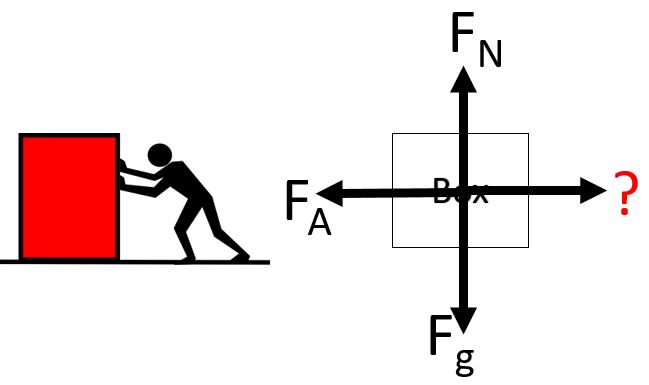

If there are two forces going in opposite directions how would you find the net force?
Subtract
Add
Neither
Multiply


An object contains 8 N to the left , and 4 N to the right. Find the net force of the object. Is this balanced?
12 N Right No
4 N Left No
12 N Right Yes
4 N Left Yes

The net force acting on the object is (a) N. Type the correct answer. Include units and direction.

What is the net force acting on the object?
(a)


What is the net force acting on the box?
60N, Left
40N, Right
0N
60N, Right
True or False. Acceleration of an object is directly proportional to the net force acting on it
True
False
Your 2500 kg car experiences a net force of 5000 N. How fast will it accelerate?
20 m/s2
0.5 m/s2
2 m/s2
120 N

The hockey puck is moving at a constant velocity across the ice. What forces does the puck experience at this moment?
None
Gravity
Gravity and Normal
Gravity, Normal, and Friction
Gravity, Normal, Friction, and Applied
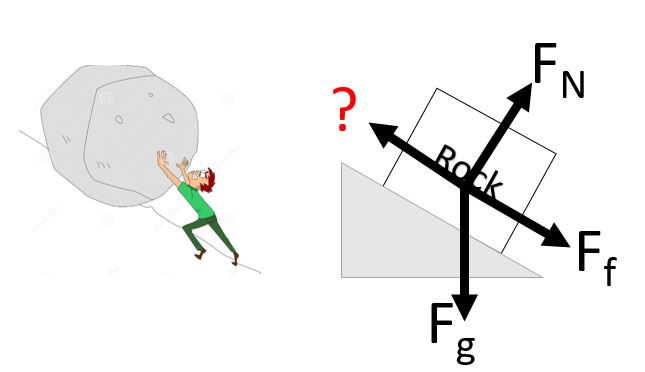
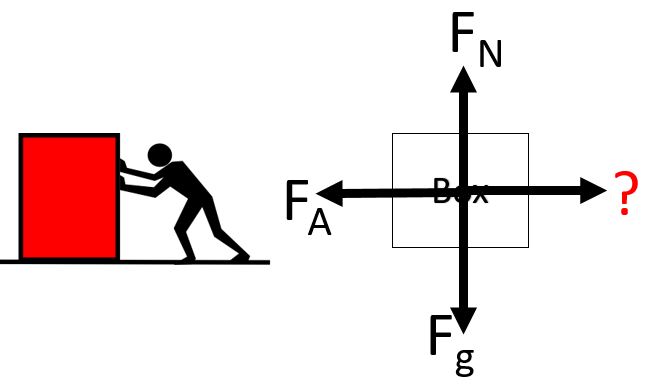

The coffee cup in the picture is at rest on the table. What is true about the Normal force?
The normal force is exactly 15
The normal force is less than 15
The normal force is more than 15
The normal force is -10

A man pushes a box across the floor at a constant velocity. There is a force on the box resisting its motion. This is the ...
force of gravity
normal force
force of friction
applied force

Which free body diagrams show balanced forces? (You can select more than 1)
A
B
C
D
E

Which of the freebody diagrams show unbalanced forces?
A
B
C
D

Use the free-body diagram shown to determine the acceleration of this 91.8-kg object.
150 m/s/s down
1.63 m/s/s down
5.2 m/s/s down
110 ms/s/s up
An object is experiencing a constant acceleration of
2.11 m/s/s. It is being pushed along a horizontal surface by a 600-Newton force and experiences an opposing force of 475 Newtons. What is the mass of the object?
125 kg
59.2 kg
24.2 kg
10.4 kg
While skydiving, Dee Selerate opens her parachute and her 53.4-kg body immediately accelerates upward for an instant at 8.66 m/s/s. Determine the upward force experienced by Dee during this instant.
986.3 N
321.4 N
53.6 N
1045.2 N
A rightward force is applied to a 6-kg object to move it across a rough surface at constant velocity. The object encounters 15 N of frictional force. What is the applied force on the object?
0 N
25 N
75 N
15 N

(Use Fnet=ma). Use the diagram to determine the net force, assume the object is accelerating at a rate of 2 m/s2 and determine the mass of the object.
2 kg
4 kg
6 kg
8 kg

(Use Fnet=ma). Use the diagram to determine the net force, assume the object is accelerating at a rate of 3 m/s2, and determine the object's mass?
3 kg
5 kg
60 kg
75 kg
(Use Fnet=ma). What is the mass of a falling rock if it produces a force of 147 N? (Acceleration due to gravity = 9.8 m/s2)
15 kg
1,440.6 kg
156.8 kg
137.2 kg
(Use Fnet=ma). Use the diagram to determine the net force, assume the object is accelerating at a rate of 2 m/s2 and determine the mass of the object.
2 kg
4 kg
6 kg
8 kg

What is the slope of the line?
mass =(F/A)
acceleration=(F/m)
force = (ma)
a relationship between acceleration and force

What is the formula for solving for mass in Newtons second law?
mass =(F/A)
acceleration=(F/m)
force = (ma)
a relationship between acceleration and force
Using the slope of the line in the graph provided, determine how much FORCE was required to accelerate this object by a rate of 2m/s2.
0.5 N
2N
2.5 N
Using Newtons 2nd Law of F=MA, and using the slope of the line in the graph provided, How much mass does this object have when it is accelerated at a rate of 4m/s2? (Hint: find the amount of force from the slope first. )
0.5 N
0.25 N
235 N
What is the formula for solving for mass in Newtons second law, F=ma?
mass =(F/A)
acceleration=(F/m)
force = (ma)
a relationship between acceleration and force
Determine the mass of a cart from the slope of the graph
Slope = m = F/a
= 4kg
slope = m = Fxa
= 40 kg
slope = m = a/f
= 0.25 kg
a relationship between acceleration and force

