
 Worksheets
Dynamics Quiz
Total questions: 60
Worksheet time: 46mins
A 'newton' is a unit of
force
acceleration
distance
speed
energy
1 newton is equivalent to the force required to
accelerate a 1 kg mass by 1 m/s/s
move a 1 kg mass 1 metre
accelerate a 1 kg mass to a speed of 1 m/s
A 100 kg object which has a 100 newton force applied to it for 1 second. 10 seconds later, it will be moving at a speed of . . .
1 m/s
10 m/s
0 m/s
30 m/s
Two objects with unequal mass. The object with more mass has
more inertia
less inertia
Gravity is
an acceleration
a force
In physics, weight is a
force
mass
If the acceleration due to earth's gravity is 9.8 m/s/s, then the force due to gravity on a 10 kg mass is
-98 newtons
-9.8 newtons
-.98 newtons
-19.8 newtons
A curling stone has a mass of 20 kg and it leaves the player's hand at a speed of 2 m/s. It travels for 20 seconds before stopping.
Assuming friction is constant, what is the average acceleration of the curling stone?
-0.1 m/s/s
-40 m/s/s
-20 m/s/s
A curling stone has a mass of 20 kg and it leaves the player's hand at a speed of 2 m/s. It travels for 20 seconds before stopping - an acceleration of -0.1 m/s/s
What is the average force of friction on the curling stone?
-0.2 newtons
-2 newtons
-1 newton


Suppose that an astronaut throws a baseball in outer space at a location far from significant influences of gravity and air resistance. One would expect that the baseball would ____.
eventually stop since all objects ultimately "lose their steam"
eventually stop as its inertia slowly becomes used up
continue in motion with the same speed and direction
either a, b, or c -- depending on whether the astronaut continues to push it
Inertia depends on ______
Velocity
Speed
Distance
Mass
Inertia is the tendency of an object to resist a change in its ___________.
temperature
shape
size
motion
the tendency of an object to resist a change in its motion
acceleration
inertia
mass
frame of reference
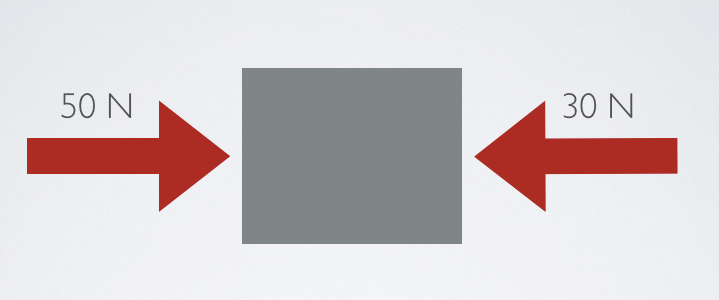
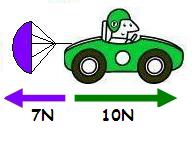
What is the net force?
3 N
3 N, right
17 N, right
3 N, left

If a horse pulls on a wagon at rest, the wagon pulls back equally on the horse. Can the wagon be set into motion?
Yes, because there is a net force acting on the wagon.
Yes, because there is a time delay between action and reaction.
No, because the forces cancel each other.
Yes, because the horse's pull on the wagon is larger than the wagon's pull on the horse.

A large truck and a small car traveling at the same speed have a head-on collision. The vehicle to undergo the greater change in velocity will be
the small car
the large truck
neither, both are the same.

According to Newton's third law, if you push gently on something, it will push
gently on something else.
on you only if you aren't moving.
gently on you
on something only under the right conditions.

A man pulls on a rope in a tug-of-war with an elephant . Each pulls with 500N of force. What is the tension in the rope?
0N
250N
25.0N
500N

A fighter hits a punching bag and brings it from rest up to a speed of 40 m/s in 0.08 s. What is the force of impact on the punching bag if its mass is 100 kg?
32.0 N
320 N
3,200 N
0.032
Friction always...
Resists motion
Is negative
Goes against the applied force
Is determined by weight
There are 25N of friction that keep a 10kg brick moving at a constant rate. What is the coefficient of friction?
0.25
0.25N
4
4N
The mass of a brick is 5kg, and it is stationary. What is the maximum static friction if the coefficient is 0.66?
3.3
33
3.3N
33N
What is the most difficult part of the quiz?
Calculating the amount of force exerted using F=ma
Calculating the amount of friction resisting motion
Determing the net force from a diagram.
inertia
types of friction
A force acts horizontally on a 10-N block that is sliding across a horizontal surface. The coefficient of static friction between the block and the surface is 0.50. What is the magnitude of the frictional force that acts on the block?
(a)
There are 25N of friction that keep a 10kg brick moving at a constant rate. What is the coefficient of friction?
0.25
0.25N
4
4N

A crate filled with delicious junk food rests on a horizontal floor. Only the force of gravity and the normal force act on it.
The net force on the crate is ___________
zero
greater than zero
What is the frictional force of an object that slides along a horizontal surface if its weight is 10 N and the coefficient of friction is 0.25?
40 N
9.75 N
2.5 N
25 N
What is the coefficient of friction for an object with a weight of 20 N that experiences a frictional force of 15 N?
5
1.33
0.75
7.5

FN=100N, Ff=20N
μ=5.0
μ=0.2
μ=1.2
μ=0.1

A block is pulled along a rough level surface at constant speed by the force . The figure shows the free-body diagram for the block. FN represents the normal force on the block; and f represents the force of kinetic friction. What is the magnitude of FN?
P
f
2mg
mg

A 27.6 kg block is pulled along a rough level surface at constant velocity by the force . The figure shows the free-body diagram for the block. FN represents the normal force on the block; and f represents the force of kinetic friction. The coefficient of kinetic friction is 0.30, what is the strength of P?
4.0 N
81 N
270 N
27.6 N
A force acts horizontally on a 20-N block that is sliding across a horizontal surface. The coefficient of static friction between the block and the surface is 0.75. What is the magnitude of the frictional force that acts on the block?
(a)
A force acts horizontally on a 30-N block that is sliding across a horizontal surface. The coefficient of static friction between the block and the surface is 0.6. What is the magnitude of the frictional force that acts on the block?
(a)
A force acts horizontally on a 25-N block that is sliding across a horizontal surface. The coefficient of static friction between the block and the surface is 0.2. What is the magnitude of the frictional force that acts on the block?
(a)
A force acts horizontally on a 100-N block that is sliding across a horizontal surface. The coefficient of static friction between the block and the surface is 0.2. What is the magnitude of the frictional force that acts on the block?
(a)
A force acts horizontally on a 100-N block that is sliding across a horizontal surface. The frictional force that is caused is 30-N. What is the coefficient of friction?
(a)
A force acts horizontally on a 90-N block that is sliding across a horizontal surface. The frictional force that is caused is 18-N. What is the coefficient of friction?
(a)
A force acts horizontally on a 68-N block that is sliding across a horizontal surface. The frictional force that is caused is 17-N. What is the coefficient of friction?
(a)
The frictional force caused by an object sliding across a horizontal surface is 15N. The coefficient of friction for the materials is 0.3. What is the weight of the object?
(a)
The frictional force caused by an object sliding across a horizontal surface is 9N. The coefficient of friction for the materials is 0.12. What is the weight of the object?
(a)

