wayground logo

Free Printable Worksheets

NEW

Font size

S
M
L
XL
Worksheets

S2 Circuits End of unit Test

Total questions: 58

Worksheet time: 31mins

Name
Class
Date
1.
If two balloons have the same charge, what will happen if you place them close to each other?
a)
Nothing
b)
They will be attracted
c)
They will pop
d)
They will push each other away.
2.

How can objects become electrified?

a)

By plugging them in to a socket

b)

Adding acid to them

c)

Rubbing with a woollen cloth

d)

Shaking them in the air

3.
Two like charges
a)
 neutralize each other.
b)
repel each other. 
c)
must be neutrons. 
d)
attract each other.
4.
The charge of an electron is 
a)
positive. 
b)
negative. 
c)
Electrons have no charge
5.
Which of the following is not a good conductor of electricity?
a)
copper
b)
silver
c)
Glass
d)
aluminum
6.
Which of the following is not a good insulator?
a)
Copper
b)
Glass
c)
rubber
d)
wool
7.
Two like charges:
a)
 neutralize each other.
b)
repel each other. 
c)
must be neutrons. 
d)
attract each other.
8.
Plastic is an example of _______.
a)
an insulator
b)
a conductor
9.
A metal spoon is an example of _____.
a)
a conductor
b)
an insulator
10.
What types of charges attract?
a)
Positive and Positive
b)
Positive and Neutral
c)
Negative and Neutral
d)
Positive and Negative
11.
What is the difference between a conductor and an insulator?
a)
An insulator allows electricity to flow through it easily and a conductor does not
b)
A conductor allows electricity to flow through it easily and an insulator does not.
c)
An insulator is magnetic and a conductor is not
d)
A conductor is magnetic and an insulator is not
12.
All of the following are conductors except _______.
a)
metal spoon
b)
wire
c)
iron nail
d)
plastic spoon
13.
The plastic covering is there to:
a)
Provide a conductor for electrical energy to flow.
b)
Provide an insulator so that electrical energy will not pass outside of the wires.
c)
Provide a conductor so that electrical energy can NOT flow.
d)
Provide an insulator so that electrical energy can flow.
14.
A material in which electrons are able to move easily
a)
Circuit
b)
Insulator 
c)
Resistance 
d)
Conductor 
15.

A material in which electrons are NOT able to move easily

a)

Circuit

b)

Insulator

c)

Resistance

d)

Conductor

16.
this is the symbol for a _____?
a)
switch
b)
light 
c)
battery
d)
wires
17.
what is this symbol for?
a)
light bulb
b)
cell
c)
battery
d)
resistor
18.
This is the symbol for a ...
a)
Wire
b)
Battery
c)
Buzzer
d)
Fuse
19.
This is the circuit symbol for ...
a)
an AC current source
b)
a DC current source
c)
an ammeter
d)
a voltmeter
20.
This is the circuit symbol for ...
a)
an AC current source
b)
a DC current source
c)
an ammeter
d)
a voltmeter
21.
This is the symbol for 
a)
An Ammeter
b)
A Voltmeter
c)
A Meter
d)
A Motor
22.
This is the symbol for a _____?
a)
Lamp
b)
Water wheel
c)
Loudspeaker
d)
Motor
23.
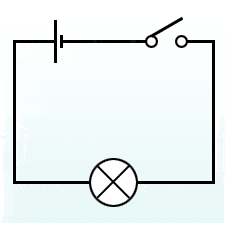
This circuit is _________.
a)
open
b)
parallel
c)
closed
d)
The cutest little circuit evah!
24.

This is the symbol for a...

a)

Resistor

b)

Voltmeter

c)

Bulb

d)

Fuse

25.

This symbol represents a ..........

a)

Bulb

b)

Battery

c)

Buzzer

d)

Microphone

26.
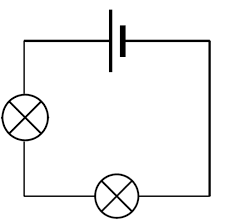
Does this diagram represent a series or parallel circuit?
a)
series circuit
b)
parallel circuit
27.
What kind of circuit is this?
a)
Series
b)
Consecutive
c)
Parallel
d)
Training
28.
This circuit has a battery, buzzer, and switch.
When the switch is closed the buzzer will sound because -
a)
the switch gives energy to the battery
b)
the buzzer is made of special plastic
c)
the wires are cooled by the surrounding air
d)
electricity can flow in a complete path
29.
An incomplete circuit is shown.
To complete the circuit, a wire should be placed from —
a)
Point D to Point C
b)
Point B to Point C
c)
Point A to Point D
d)
Point B to Point D
30.
A student attached the parts as shown here and the bulb did not light.
The most likely reason the bulb does not light is because -
a)
batteries can’t provide electric energy
b)
the flow of electricity can’t make a bulb light
c)
the switch must be open for electricity to flow
d)
yarn does not conduct electricity
31.
This lamp produces light.
When the lamp produces light, it demonstrates that the lamp must have a –
a)
powerful magnet
b)
rechargeable battery
c)
complete circuit
d)
plastic cord
32.
Will this configuration of a complete circuit and light a bulb?
a)
yes
b)
no
33.
Will this configuration of a complete circuit light a bulb?
a)
yes
b)
no
34.
Pick the correct sentence.
a)
This circuit will work because it is a closed circuit.
b)
Energy will freely flow in this circuit.
c)
This circuit will not work because there is no energy source.
d)
This circuit will not work because there is no switch.
35.
The picture shows an electrical circuit. This circuit is a series circuit because: 
a)
It has 3 light bulbs.
b)
The same current flows through all three light bulbs.
c)
It uses a single battery.
d)
The electrical current is divided between the three light bulbs.
36.
What will happen if one light bulb is removed from this circuit?
a)
The other bulbs will go out.
b)
The other bulbs will stay on
c)
The other bulbs will get dimmer.
d)
The battery will become stronger.
37.
When you remove a bulb from a three bulb circuit, and the other two bulbs go off, then the bulbs must have been connected in __________.
a)
parallel
b)
series
c)
open
d)
closed
38.

Current in a series circuit is __________ at all positions in the circuit?

a)

different

b)

the same

c)

variable

39.

Voltage in a series circuit __________ ?

a)

splits up over all the components

b)

stays the same over all the components

c)

is zero at all times

d)

changes all the time

40.

The unit of current is?

a)

Volt

b)

Ohm

c)

Amp

d)

Bingabong

41.
This is the symbol for a ...
a)
Wire
b)
Battery
c)
Buzzer
d)
Fuse
42.
This is the circuit symbol for ...
a)
an AC current source
b)
a DC current source
c)
an ammeter
d)
a voltmeter
43.
This is the circuit symbol for ...
a)
an AC current source
b)
a DC current source
c)
an ammeter
d)
a voltmeter
44.
This is the symbol for a _____?
a)
Fuse
b)
Resistor
c)
Heater
d)
Strip light
45.

This is the symbol for a...

a)

Fuse

b)

Wire

c)

Light Emitting Diode

d)

Heater

46.
The picture shows an electrical circuit. This circuit is a series circuit because: 
a)
It has 3 light bulbs.
b)
The same current flows through all three light bulbs.
c)
It uses a single battery.
d)
The electrical current is divided between the three light bulbs.
47.
What size resistor would produce a 3 Amp current flow with a 12 Volt battery
a)
1 Ohm
b)
3 Ohms
c)
4 Ohms
d)
12 Ohms
48.

Where would you place a voltmeter in the circuit?

a)

Green ?

b)

Red ?

49.

In a series circuit, there are multiple paths for current to flow.

a)

True

b)

False

50.
Pick the correct sentence.
a)
This circuit will work because it is a closed circuit.
b)
Energy will freely flow in this circuit.
c)
This circuit will not work because there is no energy source.
d)
This circuit will not work because there is no switch.
51.

What does L.E.D stand for?

a)

Light Emitting Diode

b)

Long Everlasting Diode

c)

Let's Eat Doritos

d)

Light Emitting Device

52.

Which one of these represents a RESISTOR? (look closely for the number)

a)

1

b)

2

c)

3

d)

4

53.

Where in a circuit is an ammeter added?

a)

In parallel

b)

In series

54.

If one of the bulbs in this circuit breaks, the other one will...

a)

Go off

b)

Stay on

55.

If one of the bulbs in this circuit breaks, the other one will...

a)

Go off

b)

Stay on

56.

Where would you put a switch if you wanted to switch both bulbs on and off together?

a)

A

b)

B

c)

C

57.
This circuit does not work because…
a)
the bulbs are not connected properly
b)
two cells are not powerful enough
c)
there is a break in the circuit
d)
the cells are facing each other
58.
This circuit does not work because…
a)
the bulbs are not connected properly
b)
the single cell is not powerful enough
c)
there is a break in the circuit
d)
there is a short crcuit