
 Worksheets
Wave Properties
Total questions: 59
Worksheet time: 4hrs 41mins
A wave that has the vibration parallel to the direction of the wave is called:
Longitudinal
Transverse
A wave that has the vibration perpendicular to the direction of the wave is called:
Longitudinal
Transverse

What does point C represent?
Amplitude
Trough
Crest
Wavelength

What does point A represent?
Amplitude
Wavelength
Crest
Trough

What do all waves transfer?
Matter
Heat
Electricity
Energy

Which of the following can waves transfer energy through?
solid
liquid
gas
empty space
all of the above

What are the two types of waves?
longitudinal and transverse
sound and light

What is the frequency of this wave? You must count the number of complete waves.
1 Hz
5 Hz
10 Hz

Period of a wave refers to...
how long it takes for the event to repeat.
how strong a wave is.
how long a wave is.
how much energy a wave has.

Which type of waves have the longest wavelength?
Visible light
Radio waves
X-rays
Gamma-Rays

Wavelengths are usually measured in ....
seconds
Hz
inches
meters

Shorter wave lengths can carry more energy. Which of these probably carries the MOST energy:
Infrared light
Visible light
X-rays
UV light

What is the distance between the calm sea and the highest wave called?
Wave
Frequency
Amplitude
Magnitude

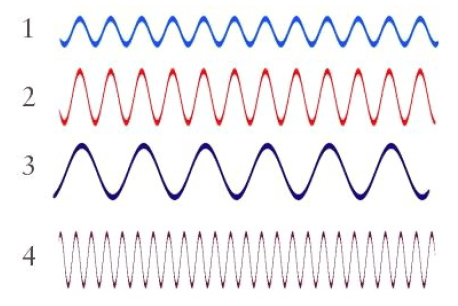
What does #1 represent?
Period
Frequency
Wavelength
Amplitude

What does #2 represent?
Period
Frequency
Wavelength
Amplitude

What does #3 represent?
Period
Frequency
Wavelength
Amplitude
A wave with a high frequency has...
a long wavelength
a short wavelength
Waves transfer
Matter
Energy
Particles
Water
A wave whose particles move parallel to the direction the wave travels is a...
transverse mechanical wave
longitudinal mechanical wave
Which waves require a medium (matter) to travel?
Radio waves
Ocean waves
Sound Waves
X-Rays
Visible Light

Which letter is represents the crest?
A
B
C
D
E
Which letter is represents amplitude?
A
B
C
D
E

Which points represent one wavelength? Select all that apply.
E --> J
D--> I
B --> E
A --> D
A --> F
A wave with a high frequency has...
a long wavelength
a short wavelength

In a longitudinal wave, a ____ is an area where the particles are spread apart and a ____ is an area where the particles are close together.
crest, trough
compression, rarefaction
rarefaction, compression
trough, crest

Examples of ________ waves include visible light, xrays, ultraviolet, and radio waves.
transverse
longitudinal
Waves that can travel through empty space are called _____ waves. Waves that require a medium to travel, such as air or water, are called _____ waves.
mechanical, electromagnetic
electromagnetic, mechanical
crest, trough
compressional, rarefactional

In the diagram of a compressional wave, A is showing a ___ while B is showing a ___.
compression, rarefaction
trough, crest
rarefaction, compression
crest, trough

In this diagram of a transverse wave, A is showing the wave's _____ and B is showing the wave's _____.
amplitude, trough
amplitude, crest
wavelength, trough
wavelength, crest

In this diagram of a transverse wave, C is showing the wave's _____ and D is showing the wave's _____.
crest, amplitude
trough, amplitude
crest, wavelength
trough, wavelength


You can't hear sounds in outer space because there is no
medium
light
energy
heat

All waves carry ________ as they travel from one place to another.
matter
space
energy
water

A wave that can travel through matter and empty space is a:
electromagnetic wave
longitudinal wavy
transverse wave
Which are properties of a mechanical wave?
can be longitudinal or transverse
can move through space
must have matter to move
carries energy
Electromagnetic waves include the following except
radio waves
X-rays
ocean waves
microwaves
How are musical instruments grouped?
by frequency
by pitch
by wavelength
by amplitude
High pitched waves would have wavelengths that are...
at a rarefaction
far apart
close together
at the trough
6. Which of the following can act as media for a wave? (a)

