
 Worksheets
Science Exam Semester 1 Review
Total questions: 60
Worksheet time: 2hrs 58mins
What is the basic unit of length in the metric system?
gram
meter
Liter
cm3
What is the basic unit of mass in the metric system?
gram
meter
Liter
cm3
The metric system is based or scaled on units of:
ten
100
1000
inches
A unit of length in the metric system is the:
liter
gram
meter
Newton
Which unit would be best to measure the length of a pencil?
meters
centimeters
kilometers
decimeters
A car travels 120 miles in 12 hours. What is the car's speed?
10 mph
10 m/s
240 mph
240 m/s
Speed in a given direction
acceleration
speed
velocity
average speed
Miles per hour north is an example of
average speed
acceleration units
velocity units
calculating speed
Mr. Smith is traveling from Houston, TX to Dallas, TX. It takes 4 hours to make the 224
mile trip. What is his velocity?
56.5 miles per hour
56 miles per hour
55.65 yards per second
56 yards per second

If Sally is speeding through the parking lot at 18m/hr, and she travels 9 m, how long did it take her?
2 m/hr
0.5 hr
2 m
0.5 m
Acceleration means that your object is _____.
doing nothing
moving in circles
changing speed
Match the graph to the description:
"The car is traveling at a constant speed."
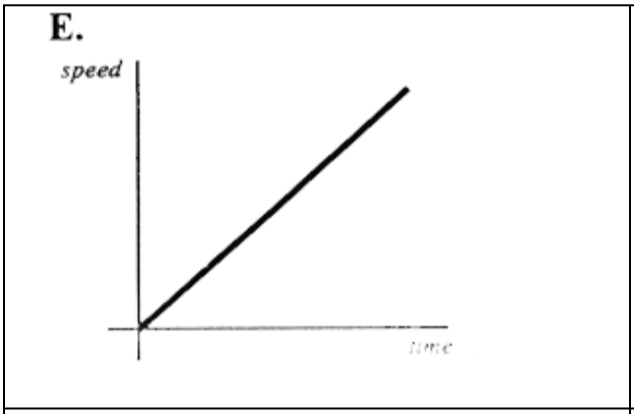
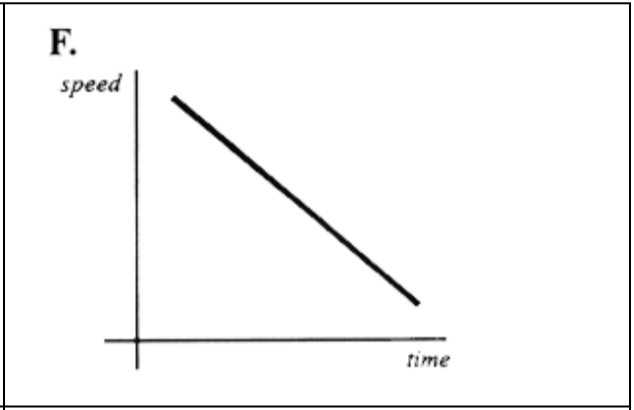
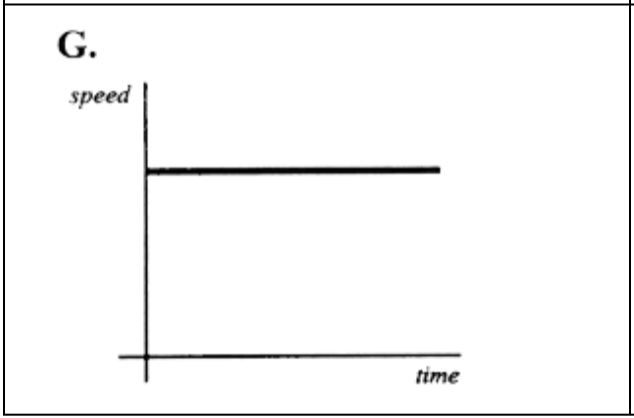
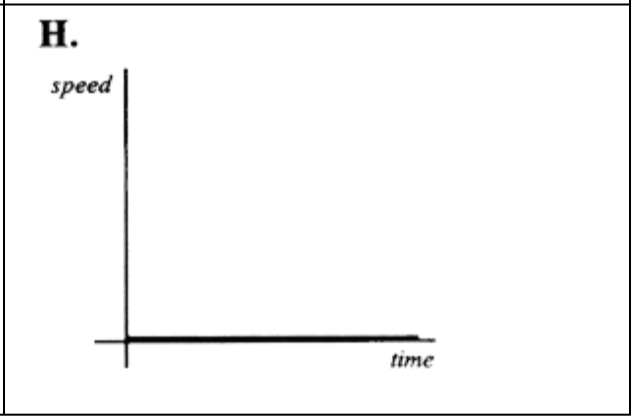

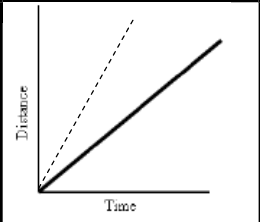

What is this graph showing?
At rest
Acceleration
Constant speed of 1 m/s
Gradually speeding up
grams
newtons
kg/ m2


When two equal forces act in opposite directions on an object, they are called ______________________.
frictional force
balanced force
centripetal force
gravitational force
When an unbalanced force acts on an object, the force ______________________.
changes the motion of the object
is cancelled by another force
does not change the motion of an object
is equal to the weight of the object
1st
Law of Motion
2nd
Law of Motion
3rd
Law of Motion
1st
Law of Motion
2nd
Law of Motion
3rd
Law of Motion
What is the acceleration of a 50 kg object pushed with a force of 500 newtons?
100 m/s2
25,000 m/s2
10 m/s2
25 m/s2

This is an example of a -------- circuit.
Series
Parallel
Combination

This is an example of a -------- circuit.
Series
Parallel
Combination

In this circuit, the bulb(s) that light up are:
1 only
2 only
1 and 2
None of them
In series circuit, there is only _____ path for electrons to flow.
One
Two
Three
Four
If one of the light bulb in series circuit is taken off, what will happen to the other light bulb?
The other light bulb will be on
The other light bulb will be off
The other light bulb will stay on
Both light bulb will be on
In a parallel circuit, if we remove one of the light bulb, what will happen to the other light bulb?
The other light bulb will stay on.
The other light bulb will be off
Both light bulb will be on
Both light bulb will be off
What type of magnet that can turned on and off?
electromagnet
permanent magnet
electricity
battery
Magnets on refrigerator cannot be turned off. Which type of magnets are they?
electromagnets
battery
permanent magnets
copper wire

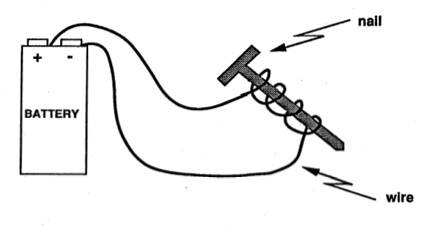
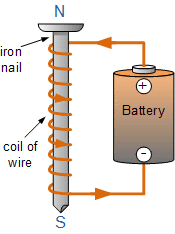
Why does the compass needle move when the electricity flows through the coiled wire?
Because a magnetic field is not produced, which do not attract to the needle.
Because a magnetic field is produced, which attracts the compass needle.
Because the battery produced magnetic field.

What is the role of the battery in the electromagnet?
It provides light energy for the electromagnet.
It provides magnetic field for the electromagnet.
It provides sound energy for the electromagnet.
It provides the power source for the electromagnet.
How can we control an electromagnet?
By turning the electricity on and off.
By turning the kinetic energy on and off.

What do waves carry and transfer?
Nothing
Only Sound
Only sunlight
Energy

The highest part of the wave is called the _______________.
Amplitude
Wavelength
Trough
Crest

The bottom part of the wave is called trough.
True
False

_________________________ is the distance between a point on one wave and the identical point of the next wave.
Amplitude
Frequency
Crest
Wavelength

When the amplitude of a sound wave increases _______.
the sound gets louder
the sound gets lower
the sound doesn't change

Which transverse wave has the highest frequency?
1
2
3
4
The number of waves that passes a certain point in a set period of time
Frequency
Amplitude
Wavelength
Amplength

Which one is an example of a transverse wave
Punching a bag
Loud Music
Sneezing
Water Waves
Which one shows the amplitude of a wave?


A wave in which the wave’s medium is compressed in the same direction as the movement of the wave
Transversal wave
Transverse wave
Frequency wave
compressional wave
What is the effect of two negatively charged objects coming near each other.
The objects repel each other.
The objects attract each other.

