
 Worksheets
Energy Midterm
Total questions: 56
Worksheet time: 33mins


Conduction requires
Electricity
the electromagnetic spectrum and particles
air or water flow
direct contact
If you walk barefoot on hot asphalt, energy is transferred by which process?
Convection
Radiation
Conduction
Reflection

Which of the following is an application of convection?
The movement of heat through a metal pan to the food.
The use of ice box to keep drinks cool.
The sea breeze that blows from sea to land.
The use of wool blanket to keep the body warm.
By which process is thermal energy transferred through a vacuum?
conduction only
convection only
conduction and convection only
radiation only
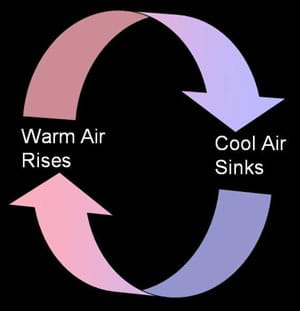
Near the ceiling of a room the air is warmer. The warm air rises because of
conduction
convection
radiation
The total kinetic and potential energy of all particles in an object is called...
mechanical energy
kinetic energy
potential energy
thermal energy
The energy that is transferred from a warmer object to a cooler object is called...
thermal energy
heat
force
temperature
As ice cream melts, its particles
Gain energy, move faster and farther apart
Gain energy, move slowly and get closer together
Lose energy, move faster and farther apart
Lose energy, move slowly and get closer together
In which state does water have the highest kinetic energy?
Gas
Solid
Liquid
Each state has the same kinetic energy
What type of heat transfer is the following?
The outside of a bowl of soup gets hot.
Convection
Conduction
Radiation
None of the above
What type of heat transfer is the following?
Solar panels are used to collect sunlight for energy.
Convection
Conduction
Radiation
None of the above
What term describes the transfer of thermal energy between substances of different temperatures?
Temperature
Conduction
Heat
Thermal Equilibrium
What is an example of an insulator?
Styrofoam
Metal
Aluminum
Saltwater
Method of heat transfer through direct contact is...
Convection
Conduction
Radiation
None of the above
A substance has a freezing point of 0 degrees and a boiling point of 100 degrees. At what temperature below, would the substance be in its liquid form?
142 degrees
275 degrees
-10 degrees
21 degrees
What type of heat transfer is the following?
The roof of your car gets hot in the sun?
Convection
Conduction
Radiation
None of the above
What type of heat transfer is the following?
Smoke and hot air go up the chimney.
Convection
Conduction
Radiation
None of the above
Heat and temperature are the same thing, defined as the transfer of thermal energy from substances of different temperatures.
True
False
Temperature is a measure of the ______ of the molecules in a substance. Increased temperature means a greater _____ of the molecules in a substance.
*Same answer for both*
Average kinetic energy
Average molecular number
Total kinetic energy
None of the above
Atoms and molecules are perpetually in motion. In solids, they vibrate close together and in liquids/gases, they vibrate more freely.
True
False
Heat always transfers from the "hotter" object to the "cooler" object in a system.
True
False
In the following example, identify where the heat is coming from AND the type of heat transfer.
You hold an ice cube in your hand and it begins to melt.
Ice cube, Radiation
Ice Cube, Conduction
Hand, Conduction
Hand, Radiation
In the following example, identify where the heat is coming from AND the type of heat transfer.
You are roasting a marshmallow over a fire.
Fire, Conduction
Fire, Convection
Metal poker, Conduction
Metal poker, Convection
In the following example, identify where the heat is coming from AND the type of heat transfer.
The handle of a pot is hot and burns your hand.
Hand, Convection
Hand, Conduction
Pot handle, convection
Pot handle, conduction
What is the unit for heat?
Celsius
Kelvin
Joule
Fahrenheit
The conversion of Celsius to Kelvin is done by adding 273.15 to the Celsius temperature. What is the Kelvin temperature for the following Celsius temperature?
25 degrees Celsius
301.15 K
298.15 K
293.15 K
250.15 K
To find Kelvin from Celsius you add 273.5. What would be the following Kelvin temperature for the Celsius temperature below?
-10 degrees
263.15 K
255.15 K
285.15 K
274.15 K
In which state does water have the highest kinetic energy?
Gas
Solid
Liquid
Each state has the same kinetic energy
Temperature is a measure of the ______ of the molecules in a substance. Increased temperature means a greater _____ of the molecules in a substance.
*Same answer for both*
Average kinetic energy
Average molecular number
Total kinetic energy
None of the above
Moving a book to a lower shelf decreases its potential energy
True
False
Depends on how fast you move it
It depends on the genre of the book
A compressed spring is an example of ____
Gravitational Potential Energy
Chemical Potential Energy
Elastic Potential Energy
Electrical Potential Energy
A kite stuck in a tree has ______ energy due to its position.
Potential
Kinetic
Chemical
Thermal
Differences in gravitational potential energy depend on an object's _________.
mass and speed
mass and height
height and speed
mass only
Which type or types of energy does a blimp circling above a sporting event have?
kinetic energy and gravitational potential energy
kinetic energy and elastic potential energy
potential energy only
kinetic energy only
If an object is on top of a hill or in a position raised above the ground, it must have __________.
kinetic energy
gravitational potential energy
elastic potential energy
chemical potential energy


Which passenger has the most potential energy?
A
B
C
D

A 1 kg bird flies south at 4 m/s. What is its KE?
2 m/s
8 J
2 J
4 J
Check off all the direct variables you need to find kinetic energy:
Speed
Distance
Time
Mass

What is the temperature in degrees Celsius?
5
7
9
3

What is the temperature in degrees Celsius?
-14
14
-12
12

