wayground logo

Free Printable Worksheets

NEW

Font size

S
M
L
XL
Worksheets

Benchmark IV Review

Total questions: 60

Worksheet time: 1hrs 7mins

Name
Class
Date
1.
What kind of wave is pictured below?
a)
compressional wave
b)
transverse wave
c)
sound wave
d)
mechanical wave
2.
What do we call the bottom of a transverse wave?
a)
crest
b)
trough
c)
wavelength
d)
amplitude
3.
What do we call the top of the wave?
a)
crest
b)
trough
c)
amplitude
d)
frequency
4.

What do we call the part of a compressional wave that is when the waves are squeezed together?

a)

compression

b)

rarefaction

c)

crest

d)

trough

5.

What do we call the part of a compressional wave that is spread a part?

a)

compression

b)

rarefaction

c)

crest

d)

trough

6.
Waves are a transfer of what?
a)
Heat
b)
Light
c)
Energy
d)
Food
7.
All waves carry
a)
energy
b)
light 
c)
matter
d)
particles
8.
Which letter represents the wave crest?
a)
A
b)
B
c)
C
d)
D
9.
Which letter represents the wave trough?
a)
A
b)
B
c)
C
d)
D
10.
Which letter represents amplitude?
a)
A
b)
B
c)
C
d)
D
11.
Which wave has a greater frequency?
a)
A
b)
B
12.
If an object allows most all light to pass through it then it is...
a)
transparent
b)
opaque 
c)
translucent
d)
cold
13.

An object that blocks all of the light from passing through is...

a)

transparent

b)

clear

c)

opaque

d)

translucent

14.

This type of object lets some light through, but not all. It is not easy to see through this type of material.

a)

transparent

b)

translucent

c)

co-parent

d)

opaque

15.
A block of wood is opaque.
a)
true
b)
false
16.
A clear window is opaque
a)
true
b)
false
17.
The windows that you can easily see through is transparent.
a)
true
b)
false
18.

Why do you see lightning from a distant storm before you hear thunder?

a)

The thunder is produced after the lightening

b)

Your eyes react faster than your ears.

c)

Sound travels faster than light.

d)

Light travels faster than sound.

19.

Lowering the temperature of air will cause a sound wave to _______.

a)

travel faster

b)

travel slower

c)

stay the same

20.

The material through which a wave travels is called a ____.

a)

frequency

b)

medium

c)

crest

d)

vibration

21.

Sound is a disturbance that travels through a medium as a

a)

mechanical wave

b)

transverse wave

c)

electromagnetic wave

d)

compressional wave

22.
The pictures shows what a student observed when he looked through a hand lens at a penny.
What happens to light passing through a hand lens that makes the image of the penny appear larger? The light is-
a)
absorbed
b)
reflected
c)
refracted
d)
stopped
23.
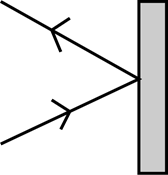
The illustration shows a light ray striking an object.
In the illustration, the light ray striking the object is-
a)
absorbed
b)
stopped
c)
reflected
d)
refracted
24.
A student placed a pencil in a cup of water.  The pencil appears broken because light-
a)
always travels in a straight line
b)
bends when it passes through water
c)
makes the water in the glass evaporate
d)
reflects the pencil on the water's surface
25.
a)
Reflection
b)
Refraction
26.
a)
Reflection
b)
Refraction
27.
a)
Reflection
b)
Refraction
28.
a)
Reflection
b)
Refraction
29.
a)
Reflection
b)
Refraction
30.

Which of the statements below accurately compares Wave A and Wave B.

a)

Wave A has a greater amplitude than Wave B

b)

Wave B has a greater amplitude than Wave A

c)

Wave A has a greater wavelength than Wave B

d)

Wave B has a greater wavelength than Wave A

31.
_____ is a lens that is thicker in the middle and makes an object appear bigger.
a)
prism
b)
convex lens
c)
concave lens
d)
mirror
32.
______ is a lens that is thicker on its edges and makes an object appear smaller?
a)
mirror
b)
convex lens
c)
concave lens
d)
prism
33.
What Does a Concave Lens Do?
a)
Make things bigger
b)
Make things smaller
c)
Make things closer
d)
Make things happy
34.
What Does a Convex Lens Do?
a)
Make things bigger
b)
Make things smaller
c)
Make things closer
d)
Make things sader
35.

Magnetic poles that are alike repel each other.

a)

True

b)

False

36.

What happens if you break a magnet in half?

a)

One half will have a north pole only and one half will have a south pole only.

b)

Neither half will have a pole.

c)

Each half will be a new magnet with both a north and south pole.

d)

Neither half will be able to attract or repel.

37.
Which of the following is not a primary color of light?
a)
Red
b)
Green
c)
Blue
d)
Yellow
38.
Which color is the absence of all colors of light?
a)
White
b)
Black
c)
Red
d)
Blue
39.
Blue light and red light make 
a)
black
b)
purple
c)
orange
d)
white
40.
What are the three primary colours of light?
a)
Red,Yellow,Blue
b)
Red,Green,Yellow
c)
Red,Green,Blue
d)
Yellow,Blue,Green
41.
Which pair of colours do NOT combine to make the correct secondary colours?
a)
Red + Blue = Magenta
b)
Blue + Green = Yellow
c)
Blue + Green = Cyan
d)
Red + Green = Yellow
42.
What type of lens or mirror is shown as figure (a) in  this picture?
a)
Convex Mirror
b)
Concave Mirror
c)
Convex Lens
d)
Concave Lens
43.
a)
Series Circuit
b)
Parallel Circuit
44.
a)
Series Circuit
b)
Parallel Circuit
45.
What type of circuit is pictured?
a)
A. alternating
b)
B.overloaded
c)
C.parallel
d)
D. series
46.
What kind of circuit is this?
a)
parallel
b)
series
c)
open 
d)
chris barton
47.
Parallel circuits are
a)
a circuit that has only one path for current to travel
b)
has more than one path for current to travel
c)
a circuit that does not allow electricity to travel through it
d)
magnets that cause electric current
48.
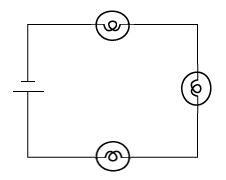
The picture shows an electrical circuit. This circuit is a series circuit because: 
a)
It has 3 light bulbs.
b)
The same current flows through all three light bulbs.
c)
It uses a single battery.
d)
The electrical current has more than one path to flow through
49.
What type of circuit is show in the image?
a)
Series Circuit
b)
Parallel Circuit
50.
What kind of circuit is this?
a)
series
b)
parallel
51.

Where is the magnetic force the strongest on this bar magnet?

a)

Near the north pole of the magnet

b)

Near the south pole of the magnet

c)

Near the middle of the magnet

d)

At the magnet's north and south pole

52.

An object that blocks all of the light from passing through is...

a)

transparent

b)

clear

c)

opaque

d)

translucent

53.

What type of lens or mirror is shown as figure (a) in this picture?

a)

Convex Mirror

b)

Concave Mirror

c)

Convex Lens

d)

Concave Lens

54.

_____ is a lens that is thicker in the middle and makes an object appear bigger.

a)

prism

b)

convex lens

c)

concave lens

d)

mirror

55.

______ is a lens that is thicker on its edges and makes an object appear smaller?

a)

mirror

b)

convex lens

c)

concave lens

d)

prism

56.

This type of object lets some light through, but not all. It is not easy to see through this type of material.

a)

transparent

b)

translucent

c)

co-parent

d)

opaque

57.

Where is the magnetic force the strongest on this bar magnet?

a)

Near the north pole of the magnet

b)

Near the south pole of the magnet

c)

Near the middle of the magnet

d)

At the magnet's north and south pole

58.

What happens if you break a magnet in half?

a)

One half will have a north pole only and one half will have a south pole only.

b)

Neither half will have a pole.

c)

Each half will be a new magnet with both a north and south pole.

d)

Neither half will be able to attract or repel.

59.

Lowering the temperature of air will cause a sound wave to _______.

a)

travel faster

b)

travel slower

c)

stay the same

60.

Why do you see lightning from a distant storm before you hear thunder?

a)

The thunder is produced after the lightening

b)

Your eyes react faster than your ears.

c)

Sound travels faster than light.

d)

Light travels faster than sound.