wayground logo

Free Printable Worksheets

Font size

S
M
L
XL
Worksheets

Heat Transfer + Waves

Total questions: 58

Worksheet time: 1hrs 5mins
Name
Class
Date
1.
Energy can be created.
a)
True
b)
False
2.
What does the Law of Conservation of Energy state?
a)
Energy cannot be created or destroyed
b)
Nothing can exchange energy
c)
Energy will increase over time.
d)
Energy will decrease over time.
3.
Energy of motion is which type of energy?
a)
Potential
b)
Kinetic
c)
Sound
d)
Gravitational
4.
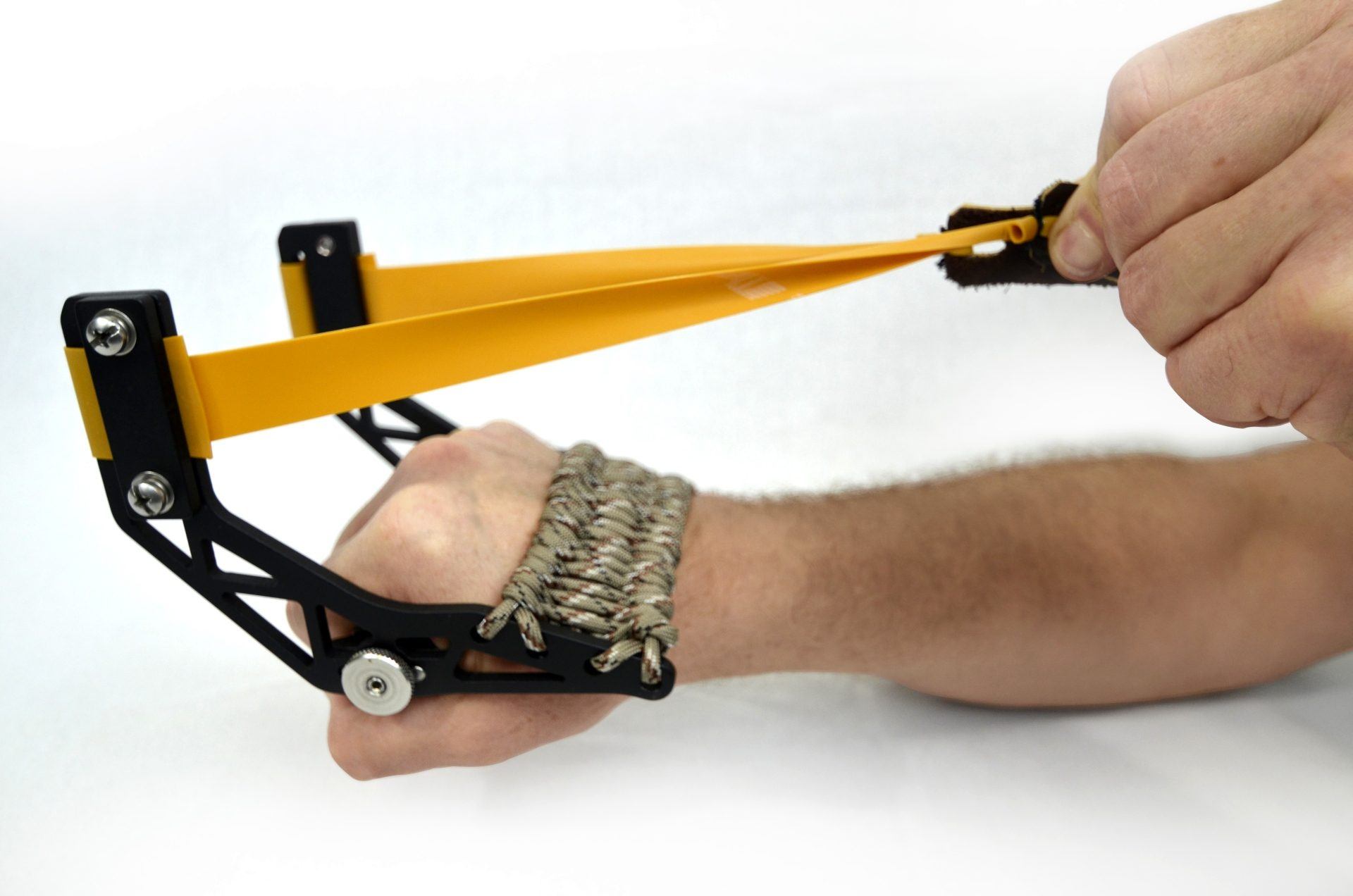
What type of energy is in this picture?
a)
Kinetic
b)
Potential
c)
Chemical
d)
Sound
5.
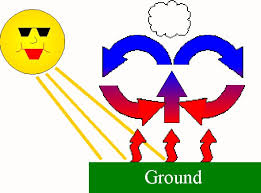
What is the transfer of heat by movement of liquids or gases?
a)
Radiation
b)
Convection
c)
Conduction
d)
Heat
6.
What is a transfer of heat energy by electromagnetic waves?
a)
Radiation
b)
Convection
c)
Conduction
d)
Heat
7.
What is the measurement of the average kinetic energy of a substance?
a)
Kinetic energy
b)
Temperature
c)
Thermal energy
d)
Potential energy
8.
What is the transfer of heat by direct contact?
a)
Convection
b)
Electromagnetic waves
c)
Radiation
d)
Conduction
9.
What is the energy of the movement of particles in a substance?
a)
Potential energy
b)
Kinetic energy
c)
Thermal energy
d)
Temperature
10.
Warm air rises and the cool air sinks. This is...
a)
conduction
b)
convection
c)
radiation
11.
Heat transfers from an area of ________temperature to an area of ______ temperature.
a)
high to low
b)
low to high
c)
high to high
12.
Warm water from the ocean moves to the north while cool waters moves to the south. This is an example of.. 
a)
Conduction
b)
Convection
c)
Radiation
13.
If an object has particles that are moving very quickly, the object 's temperature is probably _____.
a)
cold
b)
slow
c)
big
d)
hot
14.
You're holding hands with your best friend.  Your friend's hands are REALLY warm and yours are really cold.  After a few minutes, this has changed.  How might you explain what happened?
a)
The cold energy from your hand transferred to your friend's hand through conduction.
b)
The heat energy from your friend's hand transferred to your hand through conduction. 
c)
The cold energy from your hand transferred to your friend's hand through convection.
d)
The heat energy from your friend's hand transferred to your hand through convection.
15.
Blow drying your wet hair.
a)
conduction
b)
convection
c)
radiation
16.
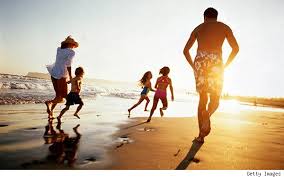
The sun shines down on this family as the play on the beach.
a)
conduction
b)
convection
c)
radiation
17.
Johnny accidentally grabbed the handle of the hot pot.
a)
conduction
b)
convection
c)
radiation
18.
Transfer of thermal energy through "space"
a)
conduction
b)
convection
c)
radiation
19.
What happens when ice cubes melt in a glass?
a)
Heat travels from the ice to the warmer water.
b)
No energy is transferred.
c)
Heat is transferred from the warmer water to the ice cubes.
d)
The water warms up due to the humidity
20.
An insulator . . .
a)
Allows a lot of heat to escape
b)
Makes the temperature of an object rise
c)
Moves heat from one place to another
d)
Traps heat inside an object
21.
 Why do we wear sweaters in cold weather?
a)
a.  To keep cold out.
b)
b.  To generate heat
c)
c.  To reduce heat loss.
d)
d.  All of the above.
22.

As water in a freezer turns into ice

a)

a. the water absorbs heat from the air in the freezer.

b)

b. the water absorbs the coldness from the air in the freezer.

c)

c. the freezer air absorbs heat from the water.

d)

d. the water neither absorbs or releases energy

23.

Which electromagnetic waves have the highest frequencies and the shortest wavelengths?

a)

microwaves

b)

visible light

c)

gamma rays

d)

x-rays

24.

Which electromagnetic waves are used in ovens and cell phone communications?

a)

microwaves

b)

infrared rays

c)

gamma rays

d)

ultraviolet rays

25.

Select the correct order of waves on the EMS from the longest wavelength to the shortest wavelength

a)

Radio, Micro, Infra, Visible, Ultra, X-ray, Gamma

b)

Gamma, X-ray, Ultra, Vis, Infra, Micro, Radio

c)

Vis, Micro, Infra, Ultra, X-ray, Gamma, Radio

d)

Micro, Radio, Vis, Infra, Ultra, X-ray, Gamma

26.

Electromagnetic waves that help your body produce vitamin D are called?

a)

Ultraviolet rays

b)

X-rays

c)

Radio waves

d)

Gamma rays

27.

How are electromagnetic waves different from other waves?

a)

They have very short wavelengths

b)

They transmit energy instead of matter

c)

They can travel through empty space

d)

They can change direction by reflection

28.

Which section of the spectrum is the ONLY one we can see?

a)

Ultraviolet Rays

b)

Gamma Rays

c)

X-Rays

d)

Visible Light

29.

As the frequency of an electromagnetic wave increases, the amount of energy in that wave...

a)

increases.

b)

stays the same.

c)

decreases.

30.

Which electromagnetic waves are used in devices such as heat lamps & TV remote controls?

a)

Ultraviolet Rays

b)

Microwaves

c)

Infrared Rays

d)

Gamma Rays

31.
True or false: as you move along the spectrum, radio to gamma waves, the wavelengths decrease in size (get smaller)
a)
true
b)
false
32.

Reorder the following according to the spectrum

a)

red

b)

orange

c)

yellow

d)

green

e)

blue

1)
2)
3)
4)
5)
33.

X-rays have more energy than

a)

Radio Waves

b)

Microwaves

c)

Light Waves

d)

All of the above

34.

Gamma rays have the ___ wavelength and the ____ frequency of all electromagnetic waves

a)

shortest, highest

b)

longest, highest

c)

shortest, lowest

d)

longest, lowest

35.

Gamma rays are NOT given off by....

a)

radioactive atoms

b)

nuclear explosions

c)

camp fires

d)

the sun

36.

Gamma rays can...

a)

destroy living cells

b)

produce gene mutations

c)

cause cancer

d)

all of the above

37.

An electromagnetic wave travels at the speed of _______.

a)

sound

b)

light

38.
a)
Amplitude
b)
Crest
c)
Trough
d)
Wavelength
39.
a)
Frequency
b)
Amplitude
c)
Wavelength
d)
Trough
40.
a)
Trough
b)
Crest
c)
Amplitude
d)
Wavelength
41.
a)
Crest
b)
Trough
c)
Height
d)
Frequency
42.
A wave transfers:
a)
a. Energy
b)
b. Matter
c)
c. Time
d)
d. Both a and b
43.
Which wave is pictured?
a)
Transverse
b)
Longitudinal
c)
Both
d)
Neither
44.

What kind of wave is pictured below?

a)

compressional wave

b)

transverse wave

c)

sound wave

d)

mechanical wave

45.
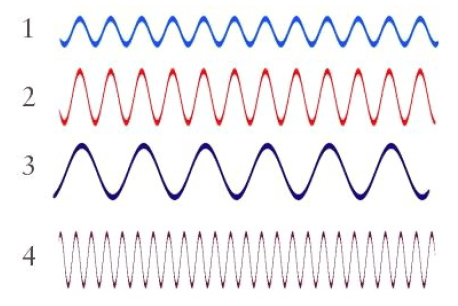
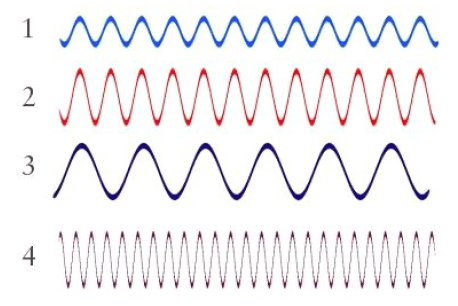
Which wave in the diagram has the greatest frequency?
a)
1
b)
2
c)
3
d)
4
46.
Which wave in the diagram has the greatest wavelength?
a)
1
b)
2
c)
3
d)
4
47.

A disturbance involving the transfer of energy from place to place is called a

a)

Medium

b)

Trough

c)

Wave

48.

Waves that are caused by motion or a vibrating object are called

a)

Potential Waves

b)

Chemical Waves

c)

Nuclear Waves

d)

Mechanical Waves

49.

A wave that vibrates the medium (particles) perpendicular to the direction of the wave is called a

a)

longitudinal wave

b)

transverse wave

c)

surface wave

50.

A wave that vibrates the medium (particles) parallel to the direction of the wave is called a

a)

longitudinal wave

b)

transverse wave

c)

surface wave

51.

Examples of a medium include

CHECK ALL THAT APPLY

a)

Solid

b)

Space

c)

Liquid

d)

Gas

52.

The area where the particles are pressed closely together in a longitudinal wave are called

a)

compression

b)

squished

c)

rarefaction

53.
which material does sound travel the fastest?
a)
solid 
b)
liquid 
c)
gases
54.
When the frequency of a wave increases, what happens to the wavelength if the medium is unchanged?
a)
The wavelength is not directly affected by the frequency of a wave.
b)
The wavelength increases.
c)
The wavelength decreases.
d)
More specific information is needed to form a conclusion about the wavelength.
55.
A mechanical wave cannot travel through...
a)
a vacuum(empty space).
b)
water.
c)
air. 
d)
glass.
56.

What is the wavelength of the wave in the graph above?

a)

16 cm

b)

4 cm

c)

24 cm

d)

8 cm

57.
Amplitude reflects the amount of ____________________ in a wave.
a)
energy
b)
compression
c)
rarefaction
d)
speed
58.
The type of waves that require medium to pass:
a)
Mechanical Waves
b)
Electromagnetic Waves