wayground logo

Free Printable Worksheets

Font size

S
M
L
XL
Worksheets

8th Science Sem1 Review

Total questions: 48

Worksheet time: 39mins

Name
Class
Date
1.
The main reason that we have currents in the ocean and air is
a)
the sun heats the air and ocean evenly everywhere
b)
the heat inside the earth heats the ocean and the ocean heats the air
c)
the sun cannot heat both the air and water, so one must heat the other
d)
the sun heats air and water more at the equator because it receives more direct sunlight
2.
Energy for convection on the Earth comes from...
a)
The sun
b)
The moon
c)
Solar winds
d)
The ocean
3.
High Pressure is associated with this type of weather...
a)
Cloudy/Overcast Weather
b)
Cold Weather
c)
Warm Weather
d)
Fair Weather
4.
This symbol represents
a)
a cold front
b)
an occluded front 
c)
a stationary front
d)
a warm front
5.
A cold front moving into an area can bring this type of weather...
a)
Warmer Temperatures, Clear Skies
b)
Colder Temperatures, Clear Skies
c)
Warmer Temperatures, Clouds
d)
Colder Temperatures, Clouds, and Precipitation
6.

What city will experience decreasing temperatures in the next day?

a)

Denver

b)

El Paso

c)

Memphis

d)

Los Angeles

7.

What happens when a fertilizer runoff happens?

a)

Fish get bigger.

b)

Algae grow rapidly.

c)

The water becomes very clear.

8.

How do humans destroy reefs?

a)

Overfishing

b)

Pollution

c)

Both

9.

In a dead zone, _________ levels are really low such that living organisms are not able survive.

a)

nitrogen

b)

oxygen

c)

fertilizer

d)

carbon dioxide

10.

Where would the Sun need to be in this diagram to cause these phases of the moon?

a)

At the Bottom

b)

At the Left

c)

At the Top

d)

At The Right

11.

What phase of the moon is shown in the picture?

a)

first quarter

b)

new moon

c)

full moon

d)

last quarter

12.

First Quarter

a)
b)
c)
d)
13.
What type of tides would this arrangement of earth-moon-sun create?
a)
neap tide
b)
spring tide
c)
new moon tide
d)
full moon tide
14.
Wha type of tide would this arrangement of earth-moon-sun create?
a)
full moon tide
b)
new moon tide
c)
neap tide
d)
spring tide
15.
Tides are caused mainly by what?
a)
Moon’s gravitational pull
b)
Sun’s gravitational pull
c)
Earth’s gravitational pull
16.
Which season is taking place in the Northern Hemisphere in Position 3?
a)
Winter
b)
Spring
c)
Summer
d)
Fall
17.
Which season is taking place in the Northern Hemisphere in Position 4?
a)
Winter
b)
Spring
c)
Summer
d)
Fall
18.
At position A, which hemisphere would have summer?
a)
Northern hemisphere
b)
Southern hemisphere
19.
What happens when the area in which you live tilts away from the sun?
a)
It is summer.
b)
It is spring.
c)
It is winter.
d)
It is fall.
20.
Why is the Equator warmest?
a)
Because it is closest to the sun.
b)
Because it receives the most direct sunlight
c)
Because no clouds form here.
d)
Because it is far from the sun
21.
Object spinning on its axis. 
a)
revolution
b)
rotation
22.
Day and night on Earth is caused by
a)
The tilt of Earth's axis
b)
Earth's revolution around the sun
c)
Eclipses
d)
Earth's rotation on it's axis
23.

Which EM waves have the longest wavelength?

a)

radio

b)

x-rays

c)

ultraviolet

d)

gamma rays

24.
The frequency of infrared waves is..
a)
1012 Hz
b)
1020 Hz
c)
104 Hz
d)
1015 Hz
25.

Scientists observed a celestial object emitting a wavelength of 3 x 10⁻¹⁰m. What type of telescope did the scientists have to use to view this?

a)

Radio wave

b)

Infrared ray

c)

X-ray

d)

Gamma Ray

26.

Knowing the color of a star also tells us its __________

a)

age

b)

location

c)

temperature

d)

name

27.
Which spectral class does our star, the sun, belong to?
a)
M
b)
K
c)
G
d)
F
28.
As you move from the bottom to the top of the H R diagram the __________ changes.
a)
Temperature
b)
Luminosity or Brightness
29.
Compared to the rest of the stars, our sun is considered...
a)
Extremely Large and Cold
b)
Small with a medium temperature
c)
Medium size with medium temperature
30.
In the diagram given, what happens as we move to the left?
a)
Stars Get Larger
b)
Stars get Colder
c)
Stars get hotter
31.

Which category of stars are very hot, but not very bright?

a)

Blue Giants

b)

Red Giants

c)

White Dwarfs

d)

Red Supergiants

32.

A collection of gas and dust where new stars are born is known as a...

a)

Planetary Nebula

b)

Black Hole

c)

Supernova

d)

Stellar Nebula

33.

Which group of stars is not very hot, but is extremely bright?

a)

White Dwarfs

b)

Blue Giants

c)

Red Supergiants

d)

Main Sequence

34.

What determines the life cycle path that a star will take?

a)

Mass of the star

b)

Temperature of the star

c)

Location of the star

d)

Speed of a star's rotation

35.

What is continental drift?

a)

The theory of Pangaea that the continents drifted AWAY from each other over time

b)

The theory of Pangaea that continents drifted TOWARD each other over time

c)

A theory that fossils were found in Antarctica

d)

A theory that weather predicts the climate in different places

36.

Below is a picture of sea-floor spreading. How are the ocean crusts moving?

a)

Converging

b)

Diverging

c)

Sliding

d)

No movement

37.

The San Andreas Fault in California is known as an active earthquake area. What type of

boundary is it?

a)

Converging

b)

Diverging

c)

Transform

d)

Sea Floor Spreading

38.
Wegener’s proposal of a supercontinent was supported by:
a)
earthquake data
b)
seafloor magnetism
c)
rock, fossil, and climate data.
d)
convection currents in the mantle.
39.
Why did no one believe Wegener's thoery?
a)
He could not explain HOW the continents moved
b)
He didn't have evidence
c)
His data was wrong
d)
He didn't use the right technology to gather data
40.

Mountains are created when....

a)

Two continental plates collide

b)

Two oceanic plates pull apart

c)

An Oceanic plate subducts under a Continental Plate

d)

Two continental plates pull apart

41.

Ocean Ridges are formed by _______ plate boundaries

a)

Convergent Oceanic / Continental

b)

Convergent Continental / Continental

c)

Convergent Oceanic / Oceanic

d)

Divergent

42.
What do the v-shaped contour lines represent?
a)
mountains
b)
steep areas
c)
gradual areas
d)
rivers
43.

Which side is steeper?

a)

The left side of the hill

b)

The right side of the hill

44.
What is the difference in elevation between Point X and Point Y?
a)
120 m
b)
240 m
c)
360 m
d)
340 m
45.

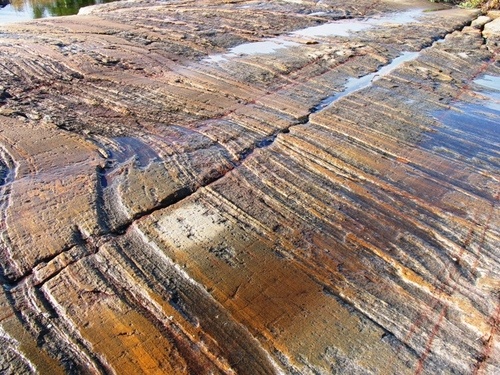
This is a picture of glacier scars found in Africa. What are these evidence for?

a)

Africa has always been near the equator

b)

Africa was once in an area of the Earth that had a very cold climate

c)

The continents have not moved

d)

sea floor spreading

46.

What geologic feature/event would you most likely to find at a divergent boundary between two pieces of oceanic crust?

a)

Rift Valley

b)

Mid-Ocean Ridge

c)

Island Arc

d)

Flat land

47.

Match the topographic map to its profile.

a)
b)
c)
d)
48.
What would be the most likely way this coastline would change over time?
a)
A fire could destroy the vegetation
b)
The waves could erode the beach
c)
The beach would grow due to deposition
d)
The beach will disappear due to plate tectonics