wayground logo

Free Printable Worksheets

Font size

S
M
L
XL
Worksheets

Phase Changes

Total questions: 34

Worksheet time: 34mins
Name
Class
Date
1.
The phase change from water vapor to liquid water is known as...
a)
evaporation
b)
precipitation
c)
condensation
d)
sublimation
2.
2. A change of state from a liquid to a solid is called....
a)
Melting
b)
Freezing
c)
Evaporation
3.
4. What type of state of matter is a gas that has electrons flowing through it?
a)
Gas
b)
Liquid
c)
Plasma
d)
Solid
4.
5. What is it called when a solid turns directly into a gas?
a)
Sublimation
b)
Condensation
c)
Liquid
5.
7. All phase changes (changing states) requires energy to be added or taken away.
a)
True
b)
False
6.
Change from Gas to Solid is called........
a)
Sublimation
b)
Deposition
c)
Fusion
d)
condensation
7.
Change from gas to liquid...
a)
condensation
b)
evaporation
c)
expansion
d)
movement
8.
change from liquid to gas is called....
a)
expansion
b)
evaporation
c)
condensation
d)
sublimation
9.
What happens to particles when they are heated?
a)
They speed up and spread out
b)
They slow down and compress
c)
They stop moving
d)
They move closer together and speed up
10.
What is deposition?
a)
Phase change from gas to solid
b)
phase change from liquid to solid
c)
Phase change from solid to gas
d)
Phase change from liquid to gas
11.
Melting is ...
a)
liquid to solid
b)
solid to liquid
c)
solid to gas
d)
gas to liquid
12.
Freezing is...
a)
Solid to gas
b)
Liquid to solid
c)
Gas to solid
d)
Liquid to gas
13.

A phase change is a chemical or physical change?

a)

Physical

b)

Chemical

14.

This is an example of

(Hint: Dry Ice)

a)

Deposition

b)

Sublimation

c)

Freezing

d)

Melting

15.

The temperature at which a liquid evaporates to a gas is called

a)

freezing point

b)

boiling point

c)

melting point

d)

condensation point

16.

The temperature at which a liquid freezes to a solid is called

a)

Freezing Point

b)

Melting Point

c)

Boiling Point

d)

Condensation Point

17.

The temperature at which a solid melts to a liquid is called

a)

Boiling Point

b)

Freezing Point

c)

Condensation Point

d)

Melting Point

18.

The temperature at which a gas condenses to a liquid is called

a)

boiling point

b)

condensation point

c)

melting point

d)

freezing point

19.
A gas
a)
has a definite shape but no definite volume
b)
has a definite volume but no definite shape
c)
has fast-moving particles
20.

Rank the states of matter from slowest to fastest particle speed.

a)

gas, solid, liquid

b)

solid, liquid, gas

c)

gas, liquid solid

d)

solid, gas liquid

21.

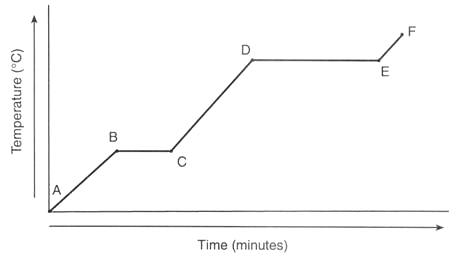
As heat is added to the substance does the temperature always increase?

a)

Yes it always increases

b)

No it does not increase during the phase change

c)

It never increases

d)

It always stays the same.

22.

What is happening to the particles in the substance between points D and E?

a)

Melting

b)

Freezing

c)

Vaporizing

d)

Sublimating

23.

Where on the graph are phase changes taking place?

a)

1

b)

2

c)

3

d)

4

e)

5

24.
No Definite Shape and No Definite Volume
a)
Gas
b)
Liquid
c)
Solid
25.
No definite shape, but has a definite volume
a)
Gas
b)
Liquid
c)
Solid
26.
The graph shows a cooling curve for an unknown substance.  What is happening during segment DE?
a)
boiling
b)
condensation
c)
freezing
d)
melting
27.
Vaporization includes _____________ and  _____________.
a)
melting and boiling
b)
condensation and boiling
c)
sublimation and freezing
d)
evaporation and boiling
28.

Which state of matter is shown?

a)

solid

b)

liquid

c)

gas

29.

During a phase change the temperature of a substance __________

a)

Stays constant

b)

Increases

c)

Decreases

d)

Vanishes

30.

the energy that an object has because it is moving

a)

kinetic energy

b)

freedom of movement

c)

refute

d)

scale

31.

When kinetic energy increases, temperature & speed of the molecules _________.

a)

increases

b)

decreases

32.

When kinetic energy decreases, temperature & speed of the molecules _______.

a)

increases

b)

decreases

33.

When you add energy INTO a substance, the molecules move and what are the phase changes that occur?

a)

faster: Solid -> Liquid -> Gas

b)

slower: Gas -> Liquid -> Solid

34.

When you take energy OUT of a substance, the molecules move and what are the phase changes that occur?

a)

faster: Solid -> Liquid -> Gas

b)

slower: Gas -> Liquid -> Solid