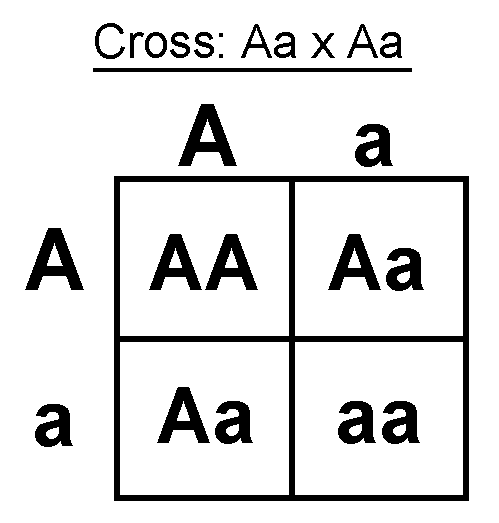
wayground logo

Free Printable Worksheets

Font size

S
M
L
XL
Worksheets

Punnett Square Quiz

Total questions: 114

Worksheet time: 3hrs 38mins
Name
Class
Date
1.
Aa, DD, bB, yy are all examples of
a)
genotypes
b)
phenotypes
2.
AA and Aa always show up as
a)
dominant
b)
recessive
3.
What ratio of the offspring from the cross shown will be homozygous recessive for the  trait of tallness? 
a)
0 in 4
b)
1 in 4
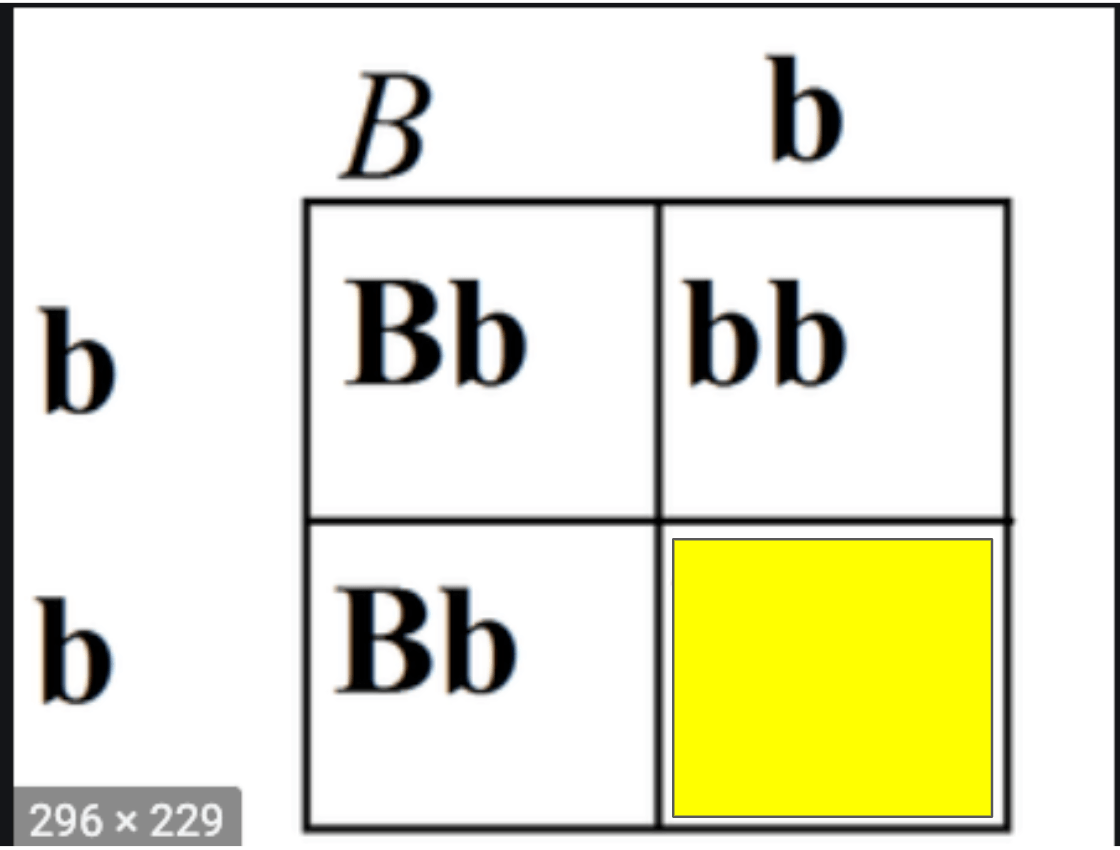
c)
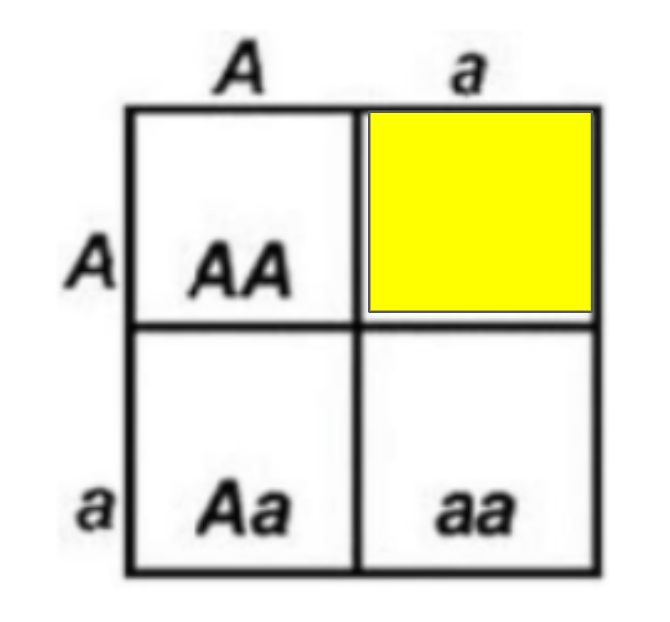
2 in 4
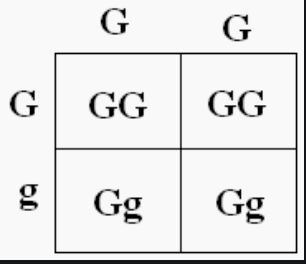
d)
4 in 4
4.
Which of the following genotypes is homozygous dominant?
a)
A
b)
Aa
c)
AA
d)
aa
5.
Which of the following genotypes is heterozygous?
a)
Bb
b)
BB
c)
bb
d)
B
6.
Which of the characteristics is a lion least likely to pass on to its offspring?
a)
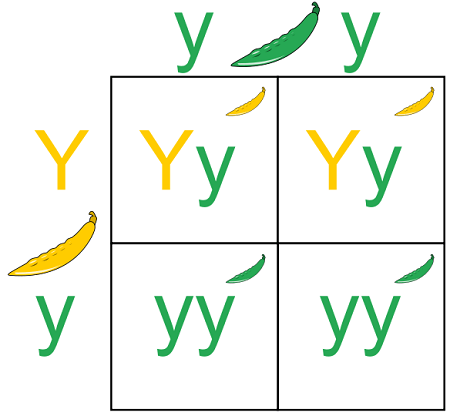
fur color
b)
length of tail
c)
scars on leg
d)
body size
7.
In a heterozygous genotype, the ___________ allele takes over in the phenotype.
a)
recessive
b)
dominant
c)
lower case letter
d)
both 
8.
What you see, or the physical appearance.
a)
Genotype
b)
Phenotype
c)
Homozygous
d)
Heterozygous
9.
B = brown eyes
b = blue eyes
What is true about these two brothers that have brown eyes?
One has genotype BB the other Bb.
a)
they have same phenotype and genotype
b)
they have different genotypes and phenotypes
c)
they have same phenotype but different genotypes
d)
they have same genotype but different phenotypes
10.
aa always shows up as
a)
dominant
b)
recessive
11.
Aa is
a)
homozygous
b)
heterozygous
12.
In pea plants, the tall allele is dominant to the short allele. What key would demonstrate this?
a)
Tall = T
Short = S
b)
Tall = T
Short = t
c)
Tall = t
Short = T
d)
Tall = TT
Short = tt
13.
A heterozygous long-tusked elephant is crossed with a homozygous recessive short-tusked elephant. What is the probability of the offspring having short tusks?
a)
0%
b)
25%
c)
50%
d)
75%
14.
What is the probability of a purple-horned unicorn if a heterozygous pink-horned unicorn is crossed with a heterozygous pink-horned unicorn?
a)
0%
b)
25%
c)
50%
d)
75%
15.
Leonardo bet his friend Olivet that two heterozygous green-eyed sea monsters could not have a recessive blue-eyed baby sea monster. Olivet said they can have a blue-eyed sea monster.
Who wins the bet?
a)
Leonardo
b)
Olivet
c)
Both
d)
Neither
16.
Dominant alleles are represented by a:
a)
Male gene
b)
lowercase letter
c)
recessive trait
d)
capital letter
17.
What chance does the offspring have of showing a dominant trait?
a)
100%
b)
75%
c)
50%
d)
0%
18.
What chance does the offspring have of showing a recessive trait?
a)
50%
b)
75%
c)
100%
d)
25%
19.
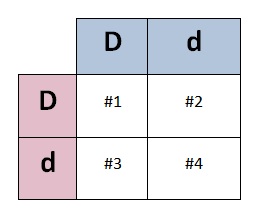
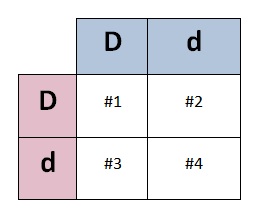
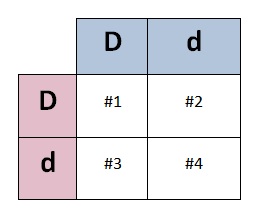
What is the allele combination for square 1?
a)
Dd
b)
DD
c)
dd
d)
D
20.
What is the possibility of this offspring having a dominate trait?
a)
50%
b)
75%
c)
25%
d)
0%
21.
What is the chance of this offspring having a recessive trait?
a)
25%
b)
100%
c)
50%
d)
0%
22.
What is the missing allele?
a)
a
b)
A
c)
AA
d)
aa
23.
What is the genotype for the black chickens?
a)
BB
b)
Bb
c)
bB
d)
bb
24.
What is the phenotype for Bb?
a)
Black chicken
b)
Blue Chicken
c)
Dominant
d)
Red spot
25.
Why are there no white rabbit babies?
a)
The white gene is not present in any of the babies.
b)
It takes two recessive genes to show the trait.
c)
Grey is a better color.
d)
Baby five will be white.
26.

Which of the following genotypes is homozygous dominant?

a)

aa

b)

Aa

c)

AA

27.

Which of the following alleles is purebred recessive?

a)

Tt

b)

tt

c)

TT

28.

What type of Genotype is this: DD?

a)

Homozygous

b)

Heterozygous

29.

What type of Genotype is this: Aa?

a)

Homozygous

b)

Heterozygous

30.

What type of Genotype is this: AA?

a)

Homozygous

b)

Heterozygous

31.

How chance the offspring born from this cross will have a homozygous dominant genotype?

a)

25%

b)

50%

c)

75%

d)

100%

32.

Fill in the Yellow Box

a)

Bb

b)

BB

c)

bb

33.

Fill in the Yellow Box

a)

AA

b)

Aa

c)

aa

34.

Which of the following is a heterozygous genotype?

a)

Gg

b)

UU

c)

pp

35.

Which of the following is a Homozygous Dominant Genotype?

a)

Yy

b)

XX

c)

zz

36.
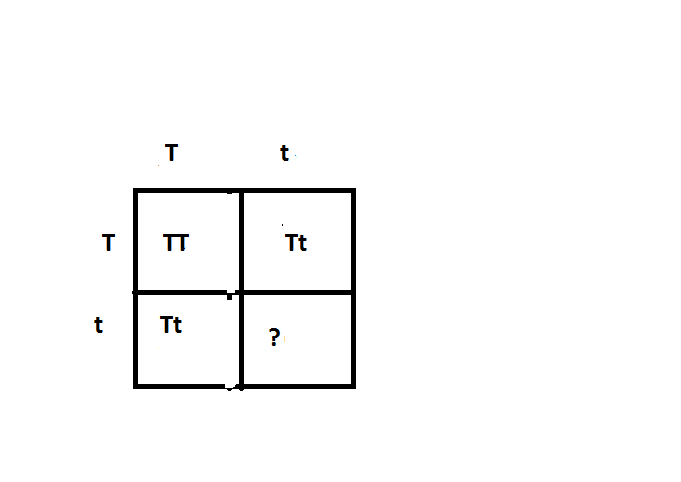
T - tall and t = short
In the punnett square below, what belongs in the missing square
a)
tt
b)
Tt
c)
Bb
d)
TT
37.
What you see, or the physical appearance.
a)
Genotype
b)
Phenotype
c)
Homozygous
d)
Heterozygous
38.
What is the probability of heterozygous offspring?
a)
25%
b)
50%
c)
0%
d)
100%
39.
What allele combination should go in the missing box?
a)
AA
b)
Aa
c)
aa
d)
none of these
40.
Each one of the boxes on the Punnett Square represents what probability of an offsprings' genotype?
a)
25%
b)
1%
c)
10%
d)
0%
41.
Which choice best represents the genotype of this cross?
a)
1 Yy: 2 yy: 0 YY
b)
2 Yy: 2 yy: 0 YY
c)
3 Yy: 1 yy: 0 YY
d)
1 Yy: 3 yy: 0 YY
42.
What is the phenotype of the offspring? (A-Brown hair; a-blond hair) 
a)
50 % Brown Hair and 50% Blond Hair 
b)
25 % Brown Hair and 75% Blond Hair 
c)
75 % Brown Hair and 25% Blond Hair 
d)
0% Brown Hair and 100% Blond Hair 
43.
Which of the following genotypes is homozygous dominant?
a)
A
b)
Aa
c)
AA
d)
aa
44.
Which of the following genotypes is heterozygous?
a)
Bb
b)
BB
c)
bb
d)
B
45.
Which of the following is homozygous recessive?
a)
Tt
b)
tt
c)
TT
d)
T
46.
Which of the following is an example of phenotype?
a)
bb
b)
blue eyes
47.
Which of the following genotypes are purebred?
a)
Pf
b)
Pp
c)
PP
d)
pP
48.
If you are purebred dominant for a trait, your genotype would be...
a)
Tt
b)
TT
c)
tt
d)
tall
49.
Which of these is homozygous recessive?
a)
Rr
b)
rR
c)
RR
d)
rr
50.

This trait is hidden whenever the dominant allele is present

a)

dominant allele

b)

codominance

c)

recessive allele

d)

Punnett Square

51.

This trait always shows up in an organism when the allele is present

a)

dominant allele

b)

codominance

c)

probability

d)

recessive allele

52.

A chart that shows all the possible combinations of alleles that can result from a genetic cross

a)

dominant allele

b)

codominance

c)

probability

d)

Punnett Square

53.

An organism's physical appearance or visible traits. (what it looks like)

a)

phenotype

b)

genotype

54.

An organism's genetic makeup, or allele combination. The letters we use to show the allele combination.

a)

phenotype

b)

genotype

55.

B = brown fur b = white fur

In the Punnett square, what is the probability for white fur?

a)

0%

b)

25%

c)

50%

d)

75%

56.

What is the probability of having bb?

a)

0%

b)

25%

c)

50%

d)

75%

e)

100%

57.

T - tall and t = short

In the Punnett square, what belongs in the missing square?

a)

tt

b)

Tt

c)

TT

58.

What is the probability of having BB?

a)

0%

b)

25%

c)

50%

d)

75%

e)

100%

59.
What is the dominant trait?
a)
yellow pea seeds
b)
green pea seeds
c)
there is no dominant seed
d)
Jolly green giant
60.

What does a Punnett Square do?

a)

tell you exactly what your offspring will look like

b)

predict genotypes and phenotypes in offspring

c)

It has no purpose

61.
What is the probability of heterozygous offspring?
a)
25%
b)
50%
c)
0%
d)
100%
62.

What is the probability of having Bb?

a)

0%

b)

25%

c)

50%

d)

75%

e)

100%

63.

What is the probability of having BB?

a)

0%

b)

25%

c)

50%

d)

75%

e)

100%

64.

What is the probability of having Bb?

a)

0%

b)

25%

c)

50%

d)

75%

e)

100%

65.
An allele that is masked when a dominant allele is present. The "weaker" gene. 
a)
Dominant Allele
b)
Recessive Allele
66.
An allele whose trait always shows up in the organism when the allele is present. The "stronger" gene. 
a)
Dominant Allele
b)
Recessive Allele
67.
An organism’s genetic makeup or allele combination.
a)
Genotype
b)
Phenotype
c)
Beanotype
d)
Notype
68.
An organism’s physical appearance, or visible traits. 
a)
Genotype
b)
Phenotype
c)
Beanotype
d)
Notype
69.
What is called when a organism has  two different alleles for a trait. Tt or Rr
a)
Heterozygous
b)
Homozygous
c)
Domozygous
d)
Thermozygous
70.
What is called when a organism has two identical alleles for a trait. TT or tt. RR or rr
a)
Heterozygous
b)
Homozygous
c)
Domozygous
d)
Thermozygous
71.
In a certain species of plant, the color purple (P) is dominant to the color white (p).
According to the Punnett Square, what is the probability of an offspring being purple?
a)
25%
b)
0%
c)
100%
d)
50%
72.
If T=Tall & t=short, what is the genotypic ratio?
a)
1:3
b)
3:1
c)
1:2:1
d)
2:2
73.
A heterozygous yellow pea plant's genotype would be:
a)
YY
b)
yy
c)
Yy
d)
Yg
74.
B - black, b - brownTwo black mice mate and have some black and some brown mice.  What is the genotype of the parents?
a)
BB x Bb
b)
BB x bb
c)
Bb x Bb
d)
Bb x bb
75.
What are the possible genotypes for this cross?
(Click the picture to see it without the text)
a)
TT = 25% Tt= 50% tt=25%
b)
all tall
c)
TT= 75% tt = 25%
d)
Tt = 100%
76.
What is the genotypic ratio here?
a)
25% blue eye 75 % brown eye 
b)
BB = 25% Bb = 50% bb = 25%
c)
BB= 50 % bb = 50%
d)
All brown eye
77.
What genotype would go in box 2?
a)
BB
b)
Bb
c)
bb
78.
What genotype would go in box 3?
a)
BB
b)
Bb
c)
bb
79.
What genotype would go in box 1?
a)
BB
b)
Bb
c)
bb
80.
In pea plants, the tall allele is dominant to the short allele. What key would demonstrate this?
a)
Tall = T
Short = S
b)
Tall = T
Short = t
c)
Tall = t
Short = T
d)
Tall = TT
Short = tt
81.
A heterozygous long-tusked elephant is crossed with a homozygous recessive short-tusked elephant. What is the probability of the offspring having short tusks?
a)
0%
b)
25%
c)
50%
d)
75%
82.
A heterozygous long-tusked elephant is crossed with a homozygous recessive short-tusked elephant. What is the probability of the offspring having short tusks?
a)
0%
b)
25%
c)
50%
d)
75%
83.
What is the probability of a purple-horned unicorn if a heterozygous pink-horned unicorn is crossed with a heterozygous pink-horned unicorn?
a)
0%
b)
25%
c)
50%
d)
75%
84.
Leonardo bet his friend Olivet that two heterozygous green-eyed sea monsters could not have a recessive blue-eyed baby sea monster. Olivet said they can have a blue-eyed sea monster.
Who wins the bet?
a)
Leonardo
b)
Olivet
c)
Both
d)
Neither
85.
Identify the homozygous dominant genotype:
a)
FF
b)
Ff
c)
ff
86.

Complex molecule that carries genetic information that defines an organism's traits. It is stored in the nucleus.

a)

Protein

b)

DNA

c)

RNA

d)

Glucose nucleic acid (GNA)

87.
Dominant alleles are represented by a:
a)
Male gene
b)
lowercase letter
c)
recessive trait
d)
capital letter
88.
Aa, DD, bB, yy are all examples of
a)
genotypes
b)
phenotypes
89.
In a heterozygous genotype, the ___________ allele takes over in the phenotype.
a)
recessive
b)
dominant
c)
lower case letter
d)
both 
90.
What you see, or the physical appearance.
a)
Genotype
b)
Phenotype
c)
Homozygous
d)
Heterozygous
91.

T - tall and t = short

In the punnett square below, what belongs in the missing square

a)

tt

b)

Tt

c)

Bb

d)

TT

92.

B = brown eyes

b = blue eyes

One brother has genotype BB and the other brother has genotype Bb.

Which statement is true about these two brothers?

a)

They have same phenotype and genotype

b)

They have different phenotypes and genotypes

c)

They have same phenotype, but different genotypes

d)

They have different phenotypes, but the same genotype

93.

The genotype Aa is called . . .

a)

Homozygous recessive

b)

Hybrid

c)

Purebred

d)

Homozygous dominant

94.

Which of the following would be a phenotype?

a)

Aa

b)

red hair

c)

heterozygous

d)

DNA

95.

Which of the following genotypes is Purebred? Select 2 answers.

a)

aA

b)

Aa

c)

AA

d)

aa

96.
Which of the following genotypes is heterozygous?
a)
Bb
b)
BB
c)
bb
d)
B
97.

Which of the following genotypes is homozygous dominant?

a)

Yy

b)

yY

c)

yy

d)

YY

98.

Which of the following genotypes is homozygous recessive?

a)

Tt

b)

tt

c)

TT

d)

tT

99.

In a flowering plant species, red flower color (R) is dominant over white flower color (r). What is the genotype of any white-flowering plant resulting from this species?

a)

rr

b)

rR

c)

RR

d)

Rr

100.

Having dimples is a dominant trait (D). Not having dimples is recessive (d). Which of the following is a cross between a parent that doesn't have dimples and a parent that is homozygous dominant for dimples?

a)

Dd x Dd

b)

dd x DD

c)

dd x Dd

d)

DD x Dd

101.

For some cattle species, having black hair (B) is dominant to red hair (b). Which of the following is a cross between two heterozygous parents?

a)

BB x bb

b)

BB x BB

c)

Bb x Bb

d)

Bb x bb

102.

Which of the Punnett Squares shows the cross for MM x mm? (Check all that apply.)

a)
b)
c)
d)
103.

What two letters go in the box highlighted yellow?

(a)  

104.

What two letters go in the box highlighted yellow?

(a)  

105.
How many boxes would say BB?
a)
1
b)
2
c)
4
d)
0
106.

If both parents are heterozygous for cystic fibrosis, the first step is to write the genotypes of the parents. Write them in the format __x__ Remeber we are using the letter A for this trait.

(a)  

107.

In plants, tall (T) is dominant to short (t). Perform the following cross: Tt x Tt. What is the probability of producing a short plant?

a)

0%

b)

25%

c)

50%

d)

75%

108.

If A = red fur and a = white fur, what color fur would Aa be? (COMPLETE DOMINANCE)

a)

red

b)

white

c)

purple

d)

blue

109.

If A = red fur and a = white fur, what color fur would AA be? (COMPLETE DOMINANCE)

a)

red

b)

white

c)

purple

d)

blue

110.
Both parents in this Punnet square
a)
are homozygous dominant
b)
are homozygous recessive
c)
are heterozygous
d)
have blue eyes
111.

What belongs in the last box?

a)

RR

b)

Rr

c)

rr

d)

ff

112.

What is the genotype of the missing parent?

a)

BB

b)

Bb

c)

bb

113.
What is the genotype for the black chickens?
a)
BB
b)
Bb
c)
bB
d)
bb
114.
What is the phenotype for Bb?
a)
Black chicken
b)
Blue Chicken
c)
Dominant
d)
Red spot