wayground logo

Free Printable Worksheets

Font size

S
M
L
XL
Worksheets

Midterm exam review

Total questions: 184

Worksheet time: 15hrs 20mins

Name
Class
Date
1.
f(x) = 9-3x
g(x) = 5x-7
Find f(x)+g(x). 
a)
14x-10
b)
-8x+2
c)
2x+2
d)
2x-2
2.
f(x) = x2+9
g(x) = x-9
Find f(x)-g(x). 
a)
x2+x+9
b)
x2-x+9
c)
x2-x
d)
x2-x+18
3.
f(x)=x2+1
g(x)=2x-5
Find f(x)-g(x)
a)
x2-2x+6
b)
-x2+2x+4
c)
-x2-2x-6
d)
x2-2x-4
4.
f(x) = 4x+8
g(x) = x+3,
Find f(x) * g(x)
a)
4x2+24
b)
4x2+20x+24
c)
4x2+12x+24
d)
4x2+4x+24
5.
f(x)=x3-3x
g(x)=-4x+1
Find f(x)*g(x)
a)
-4x3-5x2-3
b)
-4x3+2x2-3x
c)
-4x4+x3+12x2-3x
d)
-4x4-x3+12x2+3x
6.
f(x) = 3x + 10
g(x) = x - 2
Find f(g(5))
a)
19
b)
23
c)
-10
d)
None of these.
7.
f(x) = 3x + 10
g(x) = x - 2
Find f(g(0))
a)
16
b)
4
c)
-4
d)
None of these.
8.
Given that f(x) = x2 + x and g(x) = 3x + 1, find the value of f(g(4)).
a)
182
b)
40
c)
61
d)
None of the Above
9.
Given
f(x) = 3x2 + 7x and g(x) = 2x2 - x - 1, find (f + g)(x).
a)
11x2 - 1
b)
5x4 + 6x2 - 1
c)
5x2 + 6x - 1
d)
5x2 + 8x - 1
10.

When f(x) = x2 - 9

and g(x) = x + 3 ,

find f(x) / g(x).

a)

x - 3

b)

x + 3

c)

x - 12

d)

x - 6

11.

f(x)=2x + 4

g(x)=3x2 - 1

Find f(x) ⋅ g(x)

a)

6x4 + 12x3 - 4x2 - 8x

b)

-6x3 + 12x2 + 2x - 4

c)

6x3 + 12x2 - 2x - 4

d)

5x2 - 18x + 20

12.

When f(x) = 2x and g(x) = x2 + 3 , find f(g(x)).

a)

x2 + 2x + 3

b)

4x2 + 3

c)

2x2 + 3

d)

2x2 + 6

13.

If f(x) = 2x and g(x) = 2x - 7, find f(x)/g(x).

a)

(2x - 7)/(2x)

b)

-7

c)

(2x)/(2x - 7)

d)

1x - 3.5

14.

Which of the following points is the y-intercept of the graph?

a)

(0, 3)

b)

(0, -3)

c)

(-1.5, 0)

d)

(3, 0)

15.

Where could we say this graph is increasing?

a)

It is increasing from -3 to 0

b)

It is increasing from 0 to 2

c)

It is increasing from 2 to 4

d)

It is increasing from 4 to infinity

e)

It is increasing at the point (0, 3)

16.

What is the domain of the graph?

a)

x ≥ -6

b)

-7 ≤ x ≤ 3

c)

-8 ≤ x ≤ 4

d)

x ≤ -6

e)

All real numbers

17.

What is the range of the graph?

a)

y ≥ -6

b)

-7 ≤ y ≤ 3

c)

-8 ≤ y ≤ 4

d)

y ≤ -6

e)

All real numbers

18.
What is the end behavior as x → -∞ f(x)→ ?
a)
-∞
b)
19.
What is the end behavior as x → +∞, f(x)→ ?
a)
-∞
b)
20.
What are all the x-intercepts?
a)
(-2.55, 0), (2.55, 0)
b)
(-3,0), (-2,0), (2,0), (3,0)
c)
(0, 36)
d)
(-∞,∞)
21.
Identify the increasing interval:
a)
(0, 4)
b)
(1, 0) U (1, 4)
c)
(-1, 1)
d)
(-∞, -1) U (1, ∞)
22.
Over what interval is this function decreasing?
a)
−∞ ≤ x ≤ 2
b)
2 ≤ x ≤ ∞
23.

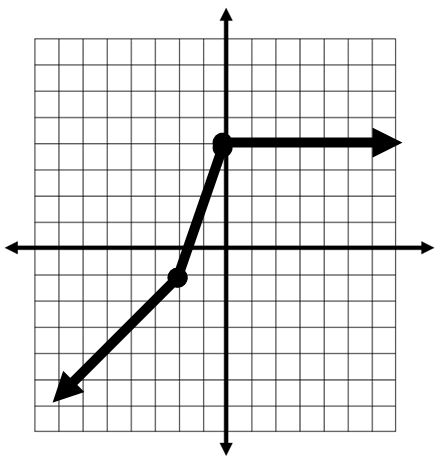
Find the interval(s) of increase of the graph shown.

a)

(-6, -4)

b)

(-4, -2)

c)

(-2, 2)

d)

(2, 5)

e)

(5, 6)

24.

Find the interval(s) of decrease of the graph shown.

(There is more than one answer)

a)

(-6, -4)

b)

(-4, -2)

c)

(-2, 2)

d)

(2, 5)

e)

(5, 6)

25.

Find the interval(s) where the graph remains constant.

a)

(-6, -4)

b)

(-4, -2)

c)

(-2, 2)

d)

(2, 5)

e)

(5, 6)

26.
What are the zeros?
a)
0 and 2
b)
-4 and 0
c)
2 and 3
d)
0 and 4
27.
How many roots does the function have?
a)
None
b)
1
c)
2
d)
3
28.
Where is the function increasing?
a)
(-∞,5]
b)
(-∞,0]
c)
(-∞,2]
d)
[0,2]
29.
What is the y-intercept?
a)
(0,7)
b)
(0,0)
c)
(1,9)
d)
(2,11)
30.
What is the x-intercept?
a)
(12,0)
b)
(0,-3)
c)
(8,-1)
d)
(0,0)
31.

Which function has a maximum at (2, 0)?

a)
b)
c)
d)
32.

What is the interval of increase?

a)

From 0 to 3

b)

From 3 to 7

c)

From 25 to 40

d)

From 50 to 25

33.

What is the interval of decrease?

a)

From 0 to 3

b)

From 3 to 7

c)

From 25 to 40

d)

From 50 to 25

34.

Let's call the graph f(x). Find f(5) = ___

a)

25

b)

30

c)

35

d)

40

35.

Look at the function that is graphed, what are the maximum and minimum values of this function?

a)

maximum 15, minimum -5

b)

maximum 25, minimum -15

c)

maximum 25, minimum -10

d)

maximum 30, minimum -10

36.

Describe the transformation

f(x)+3f\left(x\right)+3  

a)

3 Units Up

b)

3 Units Down

c)

3 Units Left

d)

3 Units Right

37.

Describe the transformation

f(x2)f\left(x-2\right)  

a)

2 Units Up

b)

2 Units Down

c)

2 Units Left

d)

2 Units Right

38.

Describe the transformation

f(x+5)f\left(x+5\right)  

a)

5 Units Up

b)

5 Units Down

c)

5 Units Left

d)

5 Units Right

39.

Describe the transformation

f(x)6f\left(x\right)-6  

a)

6 Units Up

b)

6 Units Down

c)

6 Units Left

d)

6 Units Right

40.

Describe the transformations

g(x+4)6g\left(x+4\right)-6  

a)

4 Units Left

6 Units Up

b)

4 Units Left

6 Units Down

c)

4 Units Right

6 Units Up

d)

4 Units Right

6 Units Down

41.

Describe the transformations

g(x)+2-g\left(x\right)+2  

a)

Reflected across the x-axis

2 Units Up

b)

Reflected across the x-axis

2 Units Down

c)

Reflected across the y-axis

2 Units Up

d)

Reflected across the y-axis

2 Units Down

42.

Describe the transformation

3h(x)3h\left(x\right)  

a)

Vertically Stretched by a factor of 3

b)

Vertically Compressed by a factor of 3

c)

Horizontally Stretched by a factor of 3

d)

Horizontally Stretched by a factor of 3

43.

Describe the transformations

g(x)4g\left(-x\right)-4  

a)

Reflected across the x-axis

4 Units Left

b)

Reflected across the x-axis

4 Units Down

c)

Reflected across the y-axis

4 Units Left

d)

Reflected across the y-axis

4 Units Down

44.
What is f when x equals 0?
a)
-5
b)
0
c)
1/2
d)
1
45.
What is f when x equals 8?
a)
0
b)
5
c)
11
d)
16
46.

What is the RANGE of the function?

a)

All real numbers

b)

y ≤ 4

c)

y < 4

d)

0 ≤ y ≤ 4

47.
Which piecewise function corresponds to this graph? (Take your time)
a)
f(x) = { x  if x < 4;   -x+1  if x ≥ 4
b)
f(x) = { x  if x ≤ 4;  -x+1  if x > 4
c)
f(x) = { -x+1  if x < 4;  x  if x ≥ 4
d)
f(x) = { -x+1  if x ≤ 4;  x if x > 4
48.
What are the domain restrictions for the green piece of this function?
a)
-2 < x ≤ 1
b)
-1 < x ≤ 0.5
c)
x > -2
d)
x ≤ 1
49.
What is the domain restriction of the blue piece of this function?
a)
x > 0
b)
x ≥ 0
c)
x > 2
d)
x ≥ 2
50.
Find f(-2)
a)
-3
b)
6
c)
8
d)
-6
51.

Match the graph with the correct equation.

a)
b)
c)
d)
52.

A house painter charges $12 per hour for the first 40 hours he works, $18 for the ten hours after that, and $24 for all hours after that.


How much does he earn for a 70 hour week?

a)

$1020

b)

$1140

c)

$840

d)

He works for free!

53.
1. What is this type of function called?
a)
Discrete Function 
b)
Segment Function
c)
Step Function
d)
Jump Function
54.
Determine the transformation 
a)
left 3, up 2
b)
right 3, up 2
c)
left 3, down 2
d)
right 3, down 2
55.
Determine the transformation
a)
Left 5, up 1
b)
Left 5, down 1
c)
Right 5, up 1
d)
Right 5, down 1
56.
Determine the transformation
a)
down 2
b)
flip, down 2
c)
flip, left 2
d)
left 2
57.
Determine the transformation
a)
Stretch by factor of 2, left 3
b)
Shrink by factor of 2, left 3
c)
Stretch by factor of 2, right 3
d)
Shrink by factor of 2, right 3
58.
Describe each transformation
a)
stretch by factor of 1/4, right 3, down 1
b)
stretch by factor of 1/4, right 3, up 1
c)
stretch by factor of 1/4, left 3, down 1
d)
stretch by factor of 1/4, left 3, up 1
59.
Determine the vertex for each absolute value function
a)
(-3, -1)
b)
(-3, 1)
c)
(3, -1)
d)
(3, 1)
60.
Determine the vertex of the function
a)
(-2, 5)
b)
(-2, -5)
c)
(2, 5)
d)
(2, -5)
61.
Determine the Range of the function
a)
All Reals
b)
y > 2
c)
x > 3
d)
y < 2
62.
Determine the Range of the function
a)
y > 1
b)
y < 1
c)
y > 2
d)
y < -2
63.
What type of shape is an absolute value function?
a)
Line
b)
V
c)
U
d)
Z
64.
What is the equation of the absolute value function?
a)
f(x)= |x+4|
b)
f(x)= |x-4|
c)
f(x)= |x| + 4
d)
f(x)= |x| - 4
65.
What is the equation of the absolute value function?
a)
f(x)= 4|x+3|
b)
f(x)= 1/4 |x+3|
c)
f(x)= 1/4 |x - 3|
d)
f(x)= 4|x - 3|
66.
What is the range of the absolute value function?
a)
(-infinity, infinity)
b)
[3, infinity)
c)
[0, infinity)
d)
(-infinity, 3]
67.
Which function shows horizontal translation and a vertical stretch?
a)
f(x) = -2|-x | 
b)
f(x) = -3|x| - 7
c)
f(x) = -|-x + 1| + 4
d)
f(x) = 5|x - 4| - 1
68.
Which function shows a horizontal  and vertical reflection?
a)
f(x) = -3|-x + 1| + 4
b)
f(x) = -|x - 1| + 4
c)
f(x) = 3|-x + 1| + 4
d)
f(x) = -3|x - 4| + 1
69.
Which function is graphed?
a)
f(x) = 2|x + 2| -4
b)
f(x) = 2|x - 4| + 2
c)
f(x) = |x + 2| - 4
d)
f(x) = -2|x - 4|
70.
Which function is graphed?
a)
f(x) = -|2x - 3| + 5
b)
f(x) = -|x + 5| - 3
c)
f(x) = -|2x + 6| + 5
d)
f(x) = -2|x + 5| - 3
71.
Which function is graphed?
a)
f(x) = 2|x - 5|
b)
f(x) = |x - 5|
c)
f(x) = |x - 5| + 5
d)
f(x) = |x| + 5
72.
Which function is graphed?
a)
f(x) = -3|-x + 1| + 4
b)
f(x) = -|x - 1| + 4
c)
f(x) = -5|x + 1| + 4
d)
f(x) = -3|x - 4| + 1
73.
What is the axis of symmetry for the following equation?
y=4x2-8x+9
a)
x=-8
b)
x=1
c)
x=-1
d)
x=2
74.
What is the y intercept for the equation:
y = -8x2 + 3x - 7
a)
(0, -8)
b)
(0, 3)
c)
(0, 7)
d)
(0, -7)
75.
If given the equation
y = 3(x + 5)2 - 4, what is the vertex of the parabola?
a)
(5, -4)
b)
(-5, -4)
c)
(-15, -4)
d)
(15, -4)
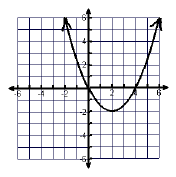
76.
What are the
x-intercepts of the function
f(x)= (x - 2)(x + 3)?
a)
x = - 2 or x = 3
b)
x = 2 or x = -3
c)
The are no real roots
d)
x = 2 or x = 3
77.
What is the range of this function?
a)
(- ∞,+∞)
b)
[0, +∞)
c)
[-2, +∞)
d)
[2, +∞)
78.
Complete the square for
x2 + 12x + ____
a)
x2 + 12x + 144
b)
x2 + 12x + 36
c)
x2 + 12x - 36
d)
x2 + +12x - 144
79.
Solve:
2x2 - 9x = 35
a)
x = 7/2, x = -6
b)
x = -5/2, x =5
c)
x = -3/7, x =6
d)
x = -5/2, x = 7
80.
Which equation best represents the graph?
a)
y = 2(x - 4)2 + 5
b)
y = 2(x + 4)2 + 5
c)
y = -2(x - 4)2 + 5
d)
y = -2(x + 4)2 + 5
81.
Solve:
4x= -4x -1
a)
x = -½
b)
x = -2
c)
x = 0
82.
Find the missing value "c" to create a perfect square trinomial:
x2 – 8x  + ___ 
a)
-4
b)
16
c)
4
d)
8
83.
Solve the equation
(x + 3)2 = 49.
a)
x = -7, 7
b)
x = 4, -10
c)
x = -4 +- √7
d)
x = 10, -4
84.
a)
A
b)
B
c)
C
d)
D
85.
a)
-3, 4
b)
3, 4
c)
-4, -3
d)
-3
86.
Convert to vertex form:
f(x) = x2 + 10x + 24
a)
f(x) = ( x - 5 )2 + 1
b)
f(x) = ( x + 5 )2 - 1
c)
f(x) = ( x - 5 )2 - 1
d)
f(x) = ( x + 5 )2 + 1
87.
Find the vertex of 
f(x) = -x- 4x + 12.
a)
(-2, 16)
b)
(2, 0)
c)
(2, 4)
d)
(-2, 4)
88.
How many solutions does this graph have?
a)
one
b)
two
c)
no solutions
d)
cannot be determined
89.
The solutions of a quadratic equation are known as the _____.
a)
Vertices
b)
Roots
c)
Squares
d)
Formulas
90.
What is the equation for the axis of symmetry of 
f(x)= (x +1)2 + 5
a)
x = 1
b)
x = -1
c)
x = -5
d)
x = 5
91.
What is the vertex form of this quadratic?
a)
f(x) = -(x + 2)- 4
b)
f(x) = (x - 2)+ 4
c)
f(x) = (x - 2)- 4
d)
f(x) = -(x - 2)2 - 4
92.
In the equation f(x)=5(x+3)2-10 what does the 5 do?
a)
Vertical stretch by 5
b)
Horizontal compress by 5
c)
Reflect
d)
Move up 5
93.
If the blue graph is
f(x) = x2 
then the red must be...
a)
g(x) = x- 5
b)
g(x) = x+ 5
c)
g(x) = (x - 5)2
d)
g(x) = (x + 5)2
94.
True or false:
The solution, root, x-intercept, and zero of a problem are all the same thing.
a)
True
b)
False, because the solution and root are the same but the x-intercept and zero are different
c)
False, because the x-intercept and root are the same but the zero and solution are different
d)
False, they are all different
95.
A parabola has a vertex at (-3,2). Where is the axis of symmetry?
a)
y = -2
b)
x = 3
c)
x = -3
d)
y = 2
96.
What is the vertex of y=x2+4x+3?
a)
(2,1)
b)
(-2,1)
c)
(0,0)
d)
(-2,-1)
97.
What is the axis of symmetry for the following equation?
y=4x2-8x+9
a)
x=-8
b)
x=1
c)
x=-1
d)
x=2
98.
If given the equation
y = 3(x + 5)2 - 4, what is the vertex of the parabola?
a)
(5, -4)
b)
(-5, -4)
c)
(-15, -4)
d)
(15, -4)
99.
What are the
x-intercepts of the function
f(x)= (x - 2)(x + 3)?
a)
x = - 2 or x = 3
b)
x = 2 or x = -3
c)
The are no real roots
d)
x = 2 or x = 3
100.
Solve:
2x2 - 9x = 35
a)
x = 7/2, x = -6
b)
x = -5/2, x =5
c)
x = -3/7, x =6
d)
x = -5/2, x = 7
101.
Factor completely: 3x2-36x+96
a)
(x-4)(x-8)
b)
3(x-4)(x-8)
c)
3(x+1)(x+32)
d)
3(x-2)(x+16)
102.
Factor completely: 25x2+60x+36
a)
(25x-6)(x-1)
b)
(5x-6)(5x-6)
c)
(5x+6)2
d)
(25x+4)(x+9)
103.
Factor completely: 2x2+22x+60
a)
(2x+10)(x+6)
b)
(x+5)(x+6)
c)
2(x+1)(x+30)
d)
2(x+5)(x+6)
104.
Factor completely: -5x2+30x-40
a)
-5(x-2)(x-4)
b)
(x-2)(x-4)
c)
-(5x-8)(x-5)
d)
(5x+10)(x+4)
105.
Factor completely: 49x2+28x+4
a)
(49x+4)(x+1)
b)
(7x+2)2
c)
(7x+1)(7x+4)
d)
(7x-2)2
106.
Factor completely: x2-6x+8
a)
(x-2)(x-4)
b)
(x-1)(x-8)
c)
(x+2)(x+4)
d)
(x+1)(x+8)
107.
Factor completely: -3x2-24x-21
a)
(3x-3)(x-7)
b)
(x-7)(x-1)
c)
-3(x+7)(x+1)
d)
(x+21)(x+1)
108.
Factor completely: x2-13x+40
a)
(x-5)(x-8)
b)
(x+5)(x+8)
c)
(x-4)(x-10)
d)
(x-2)(x-20)
109.
Factor:   x+ 1
a)
(x + 1)3
b)
(x+1)(x- x + 1)
c)
(x - 1) (x2 + x - 1)
d)
(x + 1)(x2 - 2x + 1)
110.
Factor: 8x3 - 1
a)
(2x - 1)(4x2 + 2x + 1)
b)
(2x + 1)(4x2 - 2x + 1)
c)
(2x - 1)(4x2 - 2x - 1)
d)
(2x + 1)(4x2 +2x + 1)
111.
Factor
27x³-64
a)
(3x-4)(9x²+12x+16)
b)
(3x-4)(9x²-12x+16)
c)
(3x+4)(9x²-12x+16)
d)
(3x+4)(9x²+12x+16)
112.
Fully Factor the Following
8x3-27
a)
(2x+3)(4x2-6x+9)
b)
(2x-3)(4x2+6x+9)
c)
(2x-3)(4x2+6x-9)
d)
(2x-3)(2x2+6x+9)
113.

3+√-4

a)

1

b)

3-2i

c)

5

d)

3+2i

114.
Simplify: 
(10+ 15i) - (48 - 30i)
a)
58 - 45i
b)
58 - 15i
c)
-38 - 15i
d)
-38 + 45i
115.
Find the sum.
(5-2i) + (-7+8i)
a)
-2+6i
b)
12+6i
c)
-35-16i2
d)
-35 -16i
116.
(1-3i)(2+5i)
a)
22-i
b)
16-i
c)
17-i
117.
(3+8i)(-2-i)
a)
2-19i
b)
23-i
c)
34+5i
d)
23-i
118.
(2i)(3i)
a)
5i
b)
-5
c)
6i
d)
-6
119.
(1-3i)(2+5i)
a)
22-i
b)
16-i
c)
17-i
120.
Simplify: 
(10+ 15i) - (48 - 30i)
a)
58 - 45i
b)
58 - 15i
c)
-38 - 15i
d)
-38 + 45i
121.

2 - √-9

a)

2-3i

b)

2+3= 5

c)

2+3i

d)

2 - 3= -1

122.

Which is the conjugate of (34i)\left(3-4i\right)  ?

a)

(34i)\left(3-4i\right)  

b)

(3+4i)\left(3+4i\right)  

c)

(34i)\left(-3-4i\right)  

d)

i-i  

123.

Solve  7x242=35x7x^2-42=-35x  

a)

{-6, 1}

b)

{6, 1}

c)

{-6, -1}

d)

{6, -1}

124.
a)
10
b)
-10
c)
10i
d)
-10i
125.

What does i2 equal?

a)

-1

b)

√-1

c)

1

d)

-√1

126.
√-36
a)
6
b)
-6
c)
-6i
d)
6i
127.
3i + 2i
a)
5i
b)
5i2
c)
6i
d)
-5
128.

3i+5i+2i+10

a)

10

b)

10i+10

c)

10i

d)

100i

129.

Where is point C located?

a)

2 + i

b)

-3

c)

2i

d)

-1 - i

130.
The expression (2 + 3i)2 is equal to
a)
-5
b)
-5 + 12i
c)
13
d)
13 + 12i
131.

Simplify

a)

(-10+6i)/17

b)

(1+50i)/61

c)

(-23+36i)/25

d)

(-21+33i)/34

132.

Simplify.

a)
b)
c)
d)
133.
Simplify   i23
a)
i
b)
-1
c)
1
d)
-i
134.
a)
A
b)
B
c)
C
d)
D
135.
a)
A
b)
B
c)
C
d)
D
136.
What is the degree classification of this polynomial?
x²+4x-8
a)
binomial
b)
trinomial
c)
quadratic
d)
cubic
137.
What is the term classification of the following polynomial?
x³-7x²+3
a)
monomial
b)
binomial
c)
trinomial
d)
polynomial
138.
What is the leading coefficient of the following polynomial?
5x²-3x+6
a)
2
b)
-3
c)
5
d)
6
139.
Add the following polynomials:
(x³-2x²+3)+(2x³+3x²-1)
a)
3x³-2x²+3x+2
b)
3x³+x²+2
c)
3x³-5x²-2
d)
3x³-x²+1
140.
Subtract the following polynomials:
(3x²-3x+2)-(x²-2x+1)
a)
2x²+x+1
b)
2x²-5x+3
c)
2x²-x+1
d)
4x²-5x+3
141.
What is the GCF in this polynomial?
3x²+6x-18
a)
2
b)
3
c)
6
d)
18
142.
Add the following polynomials:
 (5x + 2) + (4x + 5)
a)
9x -7
b)
-9x-11
c)
9x+7
d)
x+7
143.
Add the following polynomials:
(6n- 7n4+8) +  (6 + 8n + 4n4)
a)
-3n4+ 6n2+8n+14
b)
-n4-2n2+8n+7
c)
-n4 + 6n2+8n+7
d)
-3n4+ 6n2+8n+7
144.
(4a + 2)(6a2 − a + 2)
a)
24a3 + 16a2 + 6a + 4
b)
24a3 + 8a2 + 10a + 4
c)
24a3 + 8a2 + 6a + 4
d)
24a3 - 8a2 - 6a + 4
145.

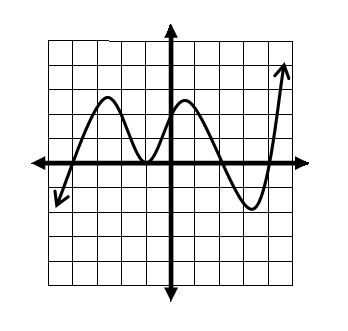
What are the x and y intercepts of the graph?

a)

x-intercepts = -4, -1, 2, 1 multiplicity 2

y-intercept = -8

b)

x-intercepts = -4, -1, 1, 2

y-intercept = 0

c)

y-intercepts = -4, -1, 2, 1 multiplicity 2

x-intercept = -8

d)

x-intercepts = 4, 1, -2, -1 multiplicity 2

y-intercept = -8

146.

What are the zeros and y-intercept of the function?

a)

x-intercepts = 4,1

y-intercept = 3

b)

x-intercepts = 3,1,-2,-5

y-intercept = 3.5

c)

x-intercepts = -3, -1, 2, 5

y-intercept = 3

d)

x-intercepts = -2,4

x-intercepts = -7

147.
What is the equation in factored form of this graph?
a)
f(x) = (x-4)(x-1)2(x+2)(x+4)
b)
f(x) = (x-4)(x+1)2(x+2)(x+4)
c)
f(x) = (x-4)(x-1)2(x-2)(x+4)
d)
f(x) = (x+4)(x+1)2(x-2)(x-4)
148.

What are the zeros and y-intercepts of the function graphed above?

a)

x-intercepts = 1,4

y-intercept = 0

b)

x-intercepts = 0, 1, 4

y-intercept = 0

c)

x-intercepts = 1,4

y-intercept = 6

d)

x-intercepts = 0, 1, 4

y-intercept = 6

149.

What are the x and y intercepts of the graph? 

a)

x-intercepts = -2, 1, 3
y-intercept = 3

b)

x-intercepts = 2, -1, -3
y-intercept = 3

c)

x-intercepts = -2, 1, 3
y-intercept = -2

d)

x-intercepts = -2, 1, 3
y-intercept = -2

150.

Based on the zeros, which of the following could be the equation of the graph in factored form?

a)

y=(x4)(x2)(x+1)(x+3)y=-\left(x-4\right)\left(x-2\right)\left(x+1\right)\left(x+3\right)

b)

y =(x+4)(x+2)(x+1)(x+3)y\ =-\left(x+4\right)\left(x+2\right)\left(x+1\right)\left(x+3\right)

c)

y=(x+4)(x+2)(x1)(x3)y=-\left(x+4\right)\left(x+2\right)\left(x-1\right)\left(x-3\right)

d)

y = (4x+1)(2x+1)(x1)(x3)y\ =\ -\left(4x+1\right)\left(2x+1\right)\left(x-1\right)\left(x-3\right)

151.

If the graph of a function crosses the x-axis, what does that mean about the multiplicity of that zero?

a)

Even

b)

Odd

c)

None

152.
What are the
zeros of the polynomial
y = 3(x + 4)(x + 1)(x - 3)?
a)
-4, -1, 3
b)
3, -3, 4, 1
c)
4, 1, -3
d)
3, -4, -1, 3
153.
What are the zeros of the polynomial function?
y = x(x - 6)(x + 5)
a)
0, 6, -5
b)
6, -5
c)
0, -6, 5
d)
1, -6, 5
154.
What are the roots of the polynomial function?
y = (x + 2)(x - 7)3
a)
-2, 7 multiplicity 3
b)
-2, 7, 3
c)
2, -7 multiplicity 3
d)
2, -7, 3
155.
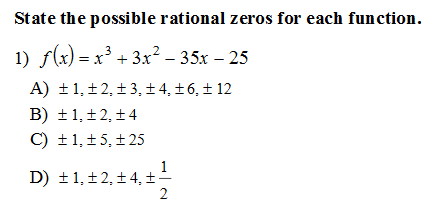
Use the Rational Root Theorem to list the possible rational zeros.
a)
A
b)
B
c)
C
d)
D
156.
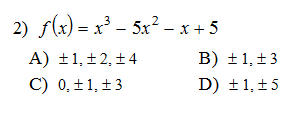
Use the Rational Root Theorem to list the possible rational zeros.
a)
A
b)
B
c)
C
d)
D
157.
Use the Complex Conjugate Root Theorem to state another complex solution. Given that 3+5i is a root. 
a)
-3+5i
b)
-3-5i
c)
-5i
d)
3-5i
158.
Use the Complex Conjugate Root Theorem to state another complex solution. Given that -2-5i is a root. 
a)
-2-5i
b)
-2+5i
c)
2+5i
d)
5i
159.
Use the Complex Conjugate Root Theorem to state another complex solution. Given that -7i is a root. 
a)
7i
b)
-7i+1
c)
1-7i
d)
1+7i
160.
Find the zeros of polynomial given one zero.
a)
A
b)
B
c)
C
d)
D
161.
Find all the zeros of the polynomial. 
a)
A
b)
B
c)
C
d)
D
162.
Find the zeros of the polynomial.
a)
A
b)
B
c)
C
d)
D
163.
Find the zeros of the polynomial.
f(x) = (x-5)(2x+3)(7x-4)(x+6)
a)
x = 5, (2/3), 6, (7/4)
b)
x= -5, (3/2), (-4/7), 6
c)
x= 5, (-3/2), (4/7), -6
d)
x= 6, 5, -2/3, -4/7
164.
Find the zeros of the polynomial given one factor.
a)
X= 3,4,5
b)
x=-3,-4,-5
c)
x=-3,4,5
d)
x= 3, -4, -5
165.
Given one complex zero use the conjugate root theorem to find another.  Zero is 7-5i
a)
-7+5i
b)
7-5i
c)
-7-5i
d)
7+5i
166.
Find all zeros.
a)
x= 3,1,1/3
b)
x= -3, -1, -1/3
c)
x = -3, 1, 1/3
d)
x = 3, -1, -1/3
167.
What are the zeros of the function?
a)
4,1
b)
3,1,-2,-5
c)
-3, -1, 2, 5
d)
-2,4
168.
Find all rational zeros, one zero has been given.
f(x) = x3-3x2-x+3;   3
a)
2,4,3
b)
-1,1,3
c)
3,2,1
d)
4,5,6
169.

Solve for x.

a)

x = -75

b)

x = 75

c)

x = -175

d)

x = 175

170.

Solve for k.

a)

k = -180

b)

k = 90

c)

k = 180

d)

k = 360

171.

Solve for x.

a)

x = 12

b)

x = 4

c)

x = 6

d)

no solution

172.

Simplify.

a)

2a2

b)

16a3

c)

8a6

d)

32a30

173.

Solve for n.

a)

n = 25

b)

n = 5

c)

n = -25

d)

n = -5

174.

Solve for x.

a)

x = 27

b)

x = 81

c)

x = -3

d)

x = 3

175.

Solve for x. Check for extraneous solutions.

a)

x = 1

b)

x = -2

c)

x = 1 & x = -2

d)

both extraneous (no solution)

176.

Solve for x. Check for extraneous solutions.

a)

both are extraneous (no solution)

b)

x = 6 & x = -7

c)

x = 6

d)

x = -7

177.

Simplify.

a)

3n2

b)

9n6

c)

18n6

d)

9n3

178.
a)
A
b)
B
c)
C
d)
D
179.
a)
A
b)
B
c)
C
d)
D
180.
a)
A
b)
B
c)
C
d)
D
181.
a)
A
b)
B
c)
C
d)
D
182.
a)
A
b)
B
c)
C
d)
D
183.
a)
A
b)
B
c)
C
d)
D
184.
a)
A
b)
B
c)
C
d)
D