wayground logo

Free Printable Worksheets

Font size

S
M
L
XL
Worksheets

G-CHAPTER 7 TEST 2025-26

Total questions: 185

Worksheet time: 7hrs 38mins

Name
Class
Date
1.
How is trapezoid ABCD translated to trapezoid A'B'C'D'?
a)
Translated 5 units down and 5 units to the right
b)
Translated 5 units down and 1 to the right
c)
Translated 8 units down and 5 units to the right
d)
Translated 5 units down and 4 units to the right
2.
How would you translate point P to P'?
a)
Translate 2 units to the right and  8 units down
b)
Translate 3 units down and 2 units to the right
c)
Translate 4 units down and 4 units to the left
d)
Translate 8 units to the right and 2 units down
3.
The result of a transformation.
a)
Pre-image
b)
Image
4.
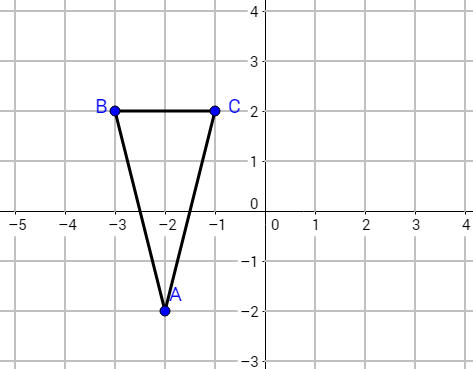
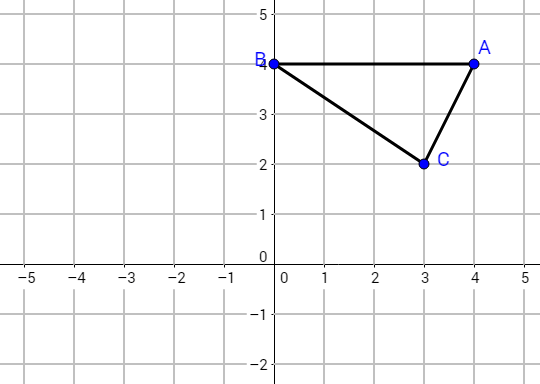
Determine how to translate triangle ABC to triangle A'B'C'.
a)
left 2, up 9
b)
right 2, down 9
c)
left 2, down 9
d)
left 2, up 5
5.

The original point that is to be transformed is called the:

a)

Pre-Image

b)

Image

c)

Post-Image

d)

Transformation

6.

Translate the blue shape to the pink shape...

a)

5 Right

2 Down

b)

5 Left

2 Up

c)

3 Right

1 Down

d)

3 Left

1 Up

7.

Translate the pink shape to the blue shape...

a)

5 Right

2 Down

b)

5 Left

2 Up

c)

3 Right

1 Down

d)

3 Left

1 Up

8.

Translate the blue shape to the green shape...

a)

3 Left

3 Down

b)

3 Right

3 Up

c)

2 Right

3 Up

d)

2 Left

3 Down

9.
How is trapezoid ABCD translated to trapezoid A'B'C'D'?
a)
Translated 5 units down and 5 units to the right
b)
Translated 5 units down and 1 to the right
c)
Translated 8 units down and 5 units to the right
d)
Translated 5 units down and 4 units to the right
10.
A transformation in which a graph or geometric figure is picked up and moved to another  location without any change in size or orientation.
a)
Translation
b)
Rotation
c)
Reflection
d)
Dilation
11.
Determine how to translate triangle A'B'C' to triangle ABC.
a)
right two, down five
b)
right two, down 9
c)
left two, down 9
d)
left two, down 5
12.
How is triangle ABC being translated to triangle A'B'C'?
a)
up 3, left 8
b)
up 9, left 4
c)
down 3, right 8
d)
down 9, right 4
13.
How is Quadrilateral EFGH translated to E'F'G'H'?
a)
6 down
b)
6 down, 1 right
c)
6 down, 3 left
d)
8 down, 1 right
14.
What does a translation do to an image?
a)
Turns it 90* clockwise
b)
Mirrors it
c)
Shrinks it
d)
Slides it
15.

After a translation, figures are no longer congruent.

a)

True

b)

False

16.

Describe the translation that maps point Q to Q'.

a)

7 units up, 2 units right

b)

3 units left, 8 units right

c)

7 units right, 2 units up

d)

3 units right, 8 units left

17.

After a translation, figures face the same direction but have a different size and shape.

a)

True

b)

False

18.

Describe the translation that maps point C to C'

a)

8 units right and 4 units up

b)

9 units right and 4 units up

c)

4 units right and 8 units up

d)

4 units right and 9 units up

19.

What is a translation?

a)

Changing quadrants in the coordinate plane

b)

Transformation that changes the size of a figure

c)

Transformation that changes the color of a figure

d)

Transformation that changes the position of a figure

20.

After a translation, figures face the same direction but have a different size and shape.

a)

True

b)

False

21.

Describe the translation that maps point Q to Q'.

a)

7 units up, 2 units right

b)

3 units left, 8 units right

c)

7 units right, 2 units up

d)

3 units right, 8 units left

22.

After a translation, figures are no longer congruent.

a)

True

b)

False

23.

Describe the translation that maps point C to C'

a)

8 units right and 4 units up

b)

9 units right and 4 units up

c)

4 units right and 8 units up

d)

4 units right and 9 units up

24.

Tell me the coordinates for point R' after a translations 5 units right and 3 units up.

a)

(3,0)

b)

(0,3)

c)

(1,2)

d)

(2,1)

25.

Describe the translation that maps triangle IRT to triangle I'R'T'.

a)

4 units up, 6 units left

b)

6 units right, 4 units down

c)

6 units up 4, units left

d)

4 units right, 6 units down

26.

Joe translates a triangle 4 units right and 3 units up. Check all things that will change about the triangle.

a)

Size

b)

Color

c)

Orientation

d)

Location

e)

Congruence

27.
How is Quadrilateral EFGH translated to E'F'G'H'?
a)
6 down
b)
6 down, 1 right
c)
6 down, 3 left
d)
8 down, 1 right
28.

Select the picture showing a translation of:

2 squares right and 1 square up

a)
b)
c)
d)
29.

Select the picture showing a translation of:

1 square right and 2 squares up

a)
b)
c)
d)
30.

Select the picture showing a translation of:

3 squares right and 2 squares up

a)
b)
c)
d)
31.

Select the picture which shows a translation:

4 squares right and 5 squares down

a)
b)
c)
d)
32.

Select the picture which shows a translation:

2 squares right and 4 squares down

a)
b)
c)
d)
33.

Select the picture which shows a translation:

4 squares right and 2 squares down

a)
b)
c)
d)
34.
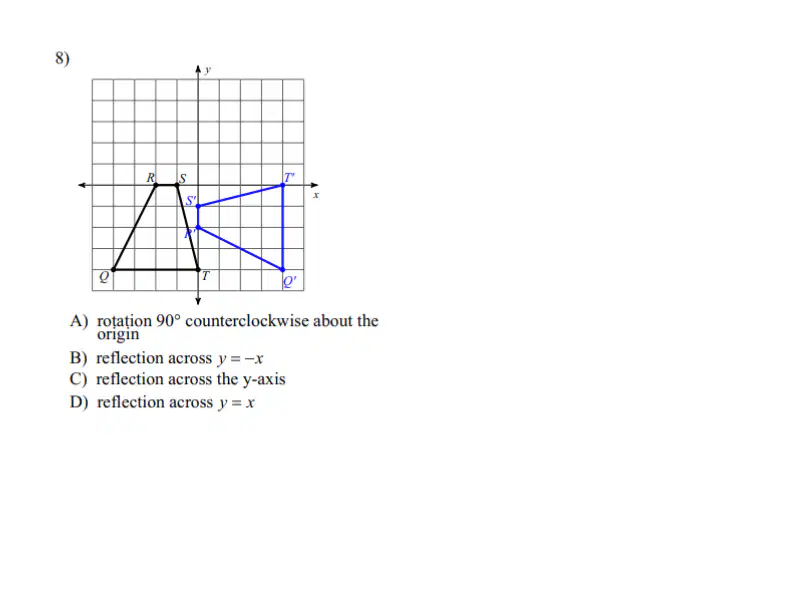
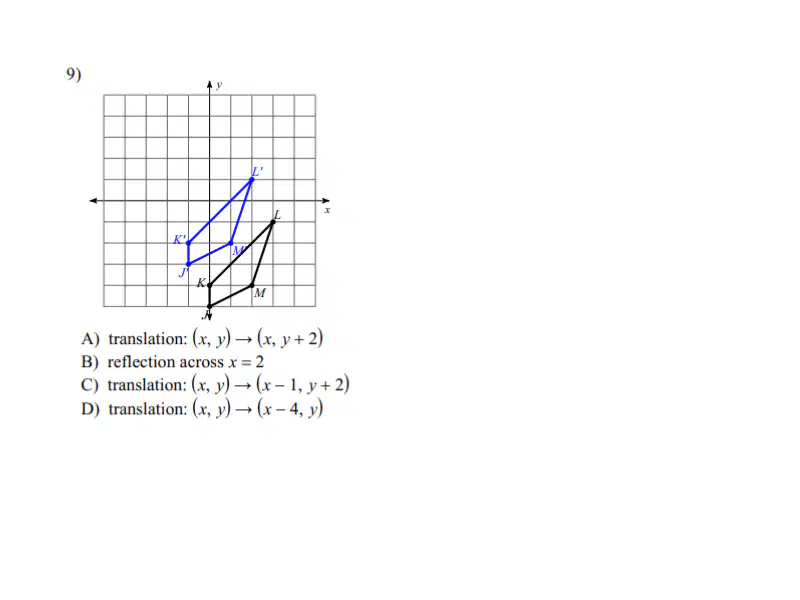
Identify the transformation.
a)
Reflection across y-axis
b)
90 Rotation counter clockwise
c)
Translation 5 units left, 1 unit up.
d)
Translation 5 units right, 1 unit down
35.

Level 2: Where would point J' be if you translated point J 5 units to the left and 2 units up?

a)

(5, 3)

b)

(3, -5)

c)

(-5, 3)

d)

(-3, 5)

36.

Level 2: What is true about the image and pre-image in a translation?

a)

The image is larger than the pre-image

b)

The image is smaller than the pre-image

c)

The image and pre-image are congruent (or the same size)

37.
How do you write an ordered pair?
a)
(X,X)
b)
(Y,X)
c)
(X,Y)
d)
(Y,Y)
38.
Determine where X' would be if you translated X 3 units to the left and 9 units down.
a)
(-4, 4)
b)
(-10, 2)
c)
(-4, -5)
d)
(-1, 5)
39.

Point A located at (8 , 5) is translated -7 units in the x-direction and -5 in the y-direction. What are the new coordinates?

a)

(1 , 1)

b)

(1 , 0)

c)

(2 , 0)

d)

(3 , -2)

40.

Point W located at (-5 , -5) is translated -5 in the x-direction and +5 in the y-direction. What are the new coordinates?

a)

(0 , -10)

b)

(0 , 0)

c)

(-10 , -10)

d)

(-10 , 0)

41.

Triangle XYZ has vertices at (5, -3) (3, 2) and (-3, -8).

List the vertices after a translation 5 units left.

a)

(-3, 0) (2, -2) (-8, -8)

b)

(0, -3) (-8, 1) (-8, -2)

c)

(5, -8) (3, -3) (-3, -13)

d)

(0, -3) (-2, 2) (-8, -8)

42.

Tell the coordinates for point C after a translation of 5 units right and 5 units down.

a)

(3, 3)

b)

(7, -2)

c)

(3, -3)

d)

(7, -2)

43.

Translate the blue shape to the pink shape...

a)

5 Right

2 Down

b)

5 Left

2 Up

c)

3 Right

1 Down

d)

3 Left

1 Up

44.

Translate shape B to shape A...

a)

5 Right

3 Up

b)

5 Left

3 Down

c)

3 Right

3 Up

d)

3 Left

3 Down

45.
The original figure prior to a transformation.
a)
Pre-image
b)
Image
46.
The result of a transformation.
a)
Pre-image
b)
Image
47.
Determine where T' would be if you translated T 3 units to the right and 6 units up.
a)
(5, 1)
b)
(2, -5)
c)
(-1, 1)
d)
(8, -2)
48.
Write the rule for this translation:
Slide 3 up and 2 right
a)
(x, y)---->(x + 3, y + 2)
b)
(x, y)-----> (x+2, y + 3)
c)
(x, y)----> (x - 2, y + 3)
49.
Identify the transformation from ABC to A'B'C'.
a)
(x+8, y+4)
b)
(x-8, y-4)
c)
(x+4, y+8)
d)
(x-4, y-8)
50.

When translating up or down on a coordinate plane, what coordinate is affected?

a)

x-coordinate

b)

y-coordinate

51.
What does this transformation say to do?
(x, y) -----> (x, y +4) 
a)
slide down 4
b)
slide up 4
c)
slide right 4
d)
slide left 4
52.

Determine how to translate triangle ABC to triangle A'B'C' ?

a)

(x + 2, y - 5)

b)

(x + 2, y - 9)

c)

(x - 2, y - 9)

d)

(x - 2, y + 9)

53.

What is the algebraic representation of a figure is Translated 9 units right and 3 units down?

a)

(x, y) -->

(x - 9, y + 3)

b)

(x, y) -->

(x + 9, y - 3)

c)

(x, y) -->

(x + 3, y - 9)

d)

(x, y) -->

(9x, 3y)

54.
Point M (-3, 5) is translated using this rule. 
(x, y) ----> (x - 1, y) 
What are the coordinates of M'?
a)
(-4, 5)
b)
(-2, 5)
c)
(-4, 4)
d)
None of these
55.
What happens to (-9, 3) when it is translated 4 units down and 3 units right?
a)
(-6, -1)
b)
(-13, 6)
c)
(-5, 6)
d)
(-6, 7)
56.

What does the word translation mean in math?

a)

To change an object by flipping it

b)

To change an object by turning it

c)

To change an objects by sliding it

57.

Select the picture showing a translation of:

4 squares right and 1 square up

a)
b)
c)
d)
58.

Select the picture which shows a translation:

4 squares right and 5 squares down

a)
b)
c)
d)
59.

What color is the pre-image?

a)

blue

b)

purple

60.

What color is the image?

a)

red

b)

blue

61.
Where would A' be if you translated A 3 units to the right and 4 units down?
a)
(-4, 4)
b)
(-1, 0)
c)
(0, -1)
62.
What transformation is happening?
(x, y) ----> (x + 2, y - 3) 
a)
slide up 2, left 3
b)
slide right 2, up 3
c)
slide right 2, down 3
d)
slide left 3, right 2
63.
What is the algebraic notation of a figure is Translated 6 units right and 5 units up?
a)
(x, y) --> (x - 6, y + 5)
b)
(x, y) --> (x + 6, y + 5)
c)
(x, y) --> (x + 5, y - 6)
d)
(x, y) --> (6x, 5y)
64.

A triangle is drawn on the coordinate plane. It is translated 4 units right and 3 units down. Which rule describes the translation?

a)

(x, y) → (x + 3, y – 4)

b)

(x, y) → (x + 3, y + 4)

c)

(x, y) → (x + 4, y – 3)

d)

(x, y) → (x + 4, y + 3)

65.
What is the algebraic notation of a figure is Translated 9 units right and 3 units down?
a)
(x, y) --> (x - 9, y + 3)
b)
(x, y) --> (x + 9, y - 3)
c)
(x, y) --> (x + 3, y - 9)
d)
(x, y) --> (9x, 3y)
66.
What is the algebraic notation of a figure is Translated 8 units left and 2 units up?
a)
(x, y) --> (x - 8, y + 2)
b)
(x, y) --> (x + 8, y - 2)
c)
(x, y) --> (x + 2, y - 8)
d)
(x, y) --> (8x, 2y)
67.
What is the algebraic notation of a figure is Translated 2 units right and 5 units up?
a)
(x, y) --> (x - 2, y - 5)
b)
(x, y) --> (x + 2, y + 5)
c)
(x, y) --> (x + 5, y - 2)
d)
(x, y) --> (5x, 2y)
68.
The dashed figure is the image of the solid figure.  What is the Algebraic Notation for the Translation?
a)
(x, y) --> (x - 7, y + 4)
b)
(x, y) --> (x + 7, y - 4)
c)
(x, y) --> (x + 4, y - 7)
d)
(x, y) --> (7x, 4y)
69.
The dashed figure is the image of the solid figure.  What is the Algebraic Notation for the Translation?
a)
(x, y) --> (x - 6, y + 8)
b)
(x, y) --> (x + 6, y - 8)
c)
(x, y) --> (x + 8, y + 6)
d)
(x, y) --> (6x, 8y)
70.
The dashed figure is the image of the solid figure.  What is the Algebraic Notation for the Translation?
a)
(x, y) --> (x - 5, y + 4)
b)
(x, y) --> (x + 5, y - 4)
c)
(x, y) --> (x + 4, y + 5)
d)
(x, y) --> (5x, 4y)
71.
A positive integer describes a translation that moves
a)
down
b)
right
c)
left
72.
A positive integer describes a translation that moves... 
a)
down
b)
left
c)
up
73.
A negative integer describes a translation that moves
a)
up
b)
right
c)
left
74.
Write a rule for the translation:
Move 2 right and 1 down
a)
 (x -1, y  + 2)
b)
 (x -2, y  + 1)
c)
 (x +2, y  - 1)
d)
(x +1, y  -  2)
75.
What is the algebraic representation of translating a figure 3 units left and 5 units down?
a)
(x+5, y-3)
b)
(x-5, y+3)
c)
(x-3, y+5)
d)
(x-3, y-5)
76.
What does this transformation say to do?
(x, y) -----> (x, y +4) 
a)
slide down 4
b)
slide up 4
c)
slide right 4
d)
slide left 4
77.

If the Rule states (x + 1, y+2) then how would I move?

a)

1 unit to the right and 2 up

b)

1 unit to the left and 2 up

c)

1 unit to the right and 2 down

d)

1 unit to the left and 2 down

78.

If the rule states (x-2, y+5) how would I move?

a)

2 units to the left and 5 units up

b)

2 units to the right and 5 units up

c)

2 units to the left and 5 units down

d)

2 units to the right and 5 units down

79.

In the equatino (x+3, y-4) the x value tells me what kind of movement?

a)

3 to the right

b)

3 to the left

c)

3 Up

d)

3 Down

80.

If the rule states (x+5, y-6) how would I move?

a)

5 to the right and 6 down

b)

5 to the left and 6 down

c)

5 to the left and 6 up

d)

5 to the right and 6 up

81.

If the rule states (x + 0, y+4) how would you move?

a)

4 to the right

b)

4 to the left

c)

4 up

d)

4 down

82.

If the rule states (x - 4, y-2) how would I move?

a)

4 to the right and 2 down

b)

4 to the left and 2 down

c)

4 up and 2 to the left

d)

4 to the left and 4 up

83.
When Translating an image, if you move a figure to the right , you will have _____ a number.
a)
x +
b)
x -
c)
y +
d)
y -
84.
Reflect the point (2, -4) over the y-axis.
a)
(-4, 2)
b)
(-2, 4)
c)
(-2, -4)
d)
(2, 4)
85.
Reflect (6, -3) over the line x-axis.
a)
(6, 3)
b)
(-6, -3)
c)
(-3, 6)
d)
(3, -6)
86.
Which answer shows a reflection across the x-axis?
a)
d
b)
c
c)
b
d)
a
87.
Point C (-5, 4) is reflected over the x-axis. What are the coordinates of C'? 
a)
(5, 4)
b)
(-5, -4)
c)
(5, -4)
d)
(-5, 4) 
88.
∆QRS contains the points: Q(4, 2) R(5, 1) S(3,7). If the triangle is reflected across the y-axis, what will S' be?
a)
S'(3, 7)
b)
S'(-3, 7)
c)
S'(-3, -7)
d)
S'(3, 7)
89.
∆BCD contains the points: B(2,3) C(2,1) D(5,1). If the triangle is reflected across the x-axis, what will B' be?
a)
B'(2, -3)
b)
B'(-2, 3)
c)
B'(-2, -3)
d)
B'(2, 3)
90.
Reflect Point C over the y-axis:
a)
(-3, 2)
b)
(3,2)
c)
(-2,3)
d)
(3,0)
91.
Flipping a figures is a ...
a)
Rotation
b)
Reflection
c)
Dilation
d)
Translation
92.
Reflect over the x axis and find K'.
a)
(4, 1))
b)
(-1, -4)
c)
(1, -4)
d)
(1, 4)
93.
Identify the transformation from ABC to A'B'C'.
a)
90o clockwise rotation
b)
90o counter clockwise rotation
c)
Reflection across the y-axis
d)
Reflection across the x-axis
94.

The point (a, b) is reflected over the x-axis, then the y-axis, then the y-axis again, and then the x-axis again. What are the coordinates of the new point?

a)

(−a, b)

b)

(−a, −b)

c)

(a, −b)

d)

(a, b)

95.
Reflecting over the y-axis changes the ____-_____________. 
a)
x-axis
b)
x-coordinate
c)
y-coordinate
d)
y-axis
96.
B(-2, -4)
Reflect over the line y = x
a)
(2, -4)
b)
(-4, 2)
c)
(-4, -2)
d)
(4, 2)
97.
Reflect (6, -3) over the line x-axis.
a)
(6, 3)
b)
(-6, -3)
c)
(-3, 6)
d)
(3, -6)
98.
Reflect the point (2, -4) over the y-axis.
a)
(-4, 2)
b)
(-2, 4)
c)
(-2, -4)
d)
(2, 4)
99.
If the dotted figure is the image, the original figure was reflected over the ...
a)
x-axis
b)
y-axis
100.
The point (a, b) is reflected over the y-axis, then the x-axis, then the y-axis again, and then the y-axis again. What are the coordinates of the new point?
a)
(−a, b)
b)
(−a, −b)
c)
(a, −b)
d)
(a, b)
101.

Flipping a figure is a ...

a)

Rotation

b)

Reflection

c)

Dilation

d)

Translation

102.
Reflecting over the y-axis changes the ____-_____________. 
a)
x-axis
b)
x-coordinate
c)
y-coordinate
d)
y-axis
103.

Reflect the point (3,4) over the y-axis

(a)  

104.

Reflect the point (4,5) over the x-axis

(a)  

105.

Reflect the point (-1,7) over the x-axis

(a)  

106.

Reflect the point (-2,-9) over the y-axis

(a)  

107.

Reflect the point (8,-6) over the y-axis

(a)  

108.

Describe the transformation in the image

a)

Translation

b)

Reflection

c)

Rotation

109.
Reflect Point C over the y-axis:
a)
(-3, 2)
b)
(3,2)
c)
(-2,3)
d)
(3,0)
110.

The point (2,-2) is reflected to it's image, which is at (2,2). What axis did it reflect across?

a)

x-axis

b)

y-axis

111.

The point (-4,1) is reflected to it's image, which is at (4,1). What axis did it reflect across?

a)

x-axis

b)

y-axis

112.

Reflect Point C over the line x = 1

a)

(-1, 2)

b)

(3, 0)

c)

(0, 2)

d)

(3, -1)

113.

Reflect the shape over the line y = x. Where is A'?

a)

(7, 2)

b)

(-2, 7)

c)

(2, -7)

d)

(-7, -2)

114.

Flipping a figure is a ...

a)

Rotation

b)

Reflection

c)

Dilation

d)

Translation

115.
Which answer shows a reflection across the x-axis?
a)
d
b)
c
c)
b
d)
a
116.
Is the picture being reflected in the y-axis or x-axis?
a)
y-axis
b)
x-axis
117.
Which answer shows a reflection across the y-axis?
a)
a
b)
b
c)
c
d)
d
118.
What is a reflection?
a)
When you turn an object around a point.
b)
When you slide an object form one place to another.
c)
When you flip or mirror an object across a line.
d)
When you resize an object.
119.
Where is point E located?
a)
( 2, 0 )
b)
( 2 , 2 )
c)
( 0 , 2 )
d)
( 0 , 0 )
120.
Identify the transformation from ABC to A'B'C'.
a)
90o clockwise rotation
b)
90o counter clockwise rotation
c)
Reflection across the y-axis
d)
Reflection across the x-axis
121.
If the dotted figure is the image, the original figure was reflected over the ...
a)
x-axis
b)
y-axis
122.

Which graph shows the pre-image reflected over y-axis?

a)
b)
c)
d)
123.

Which graph shows the pre-image reflected over x-axis?

a)
b)
c)
d)
124.

Which graph is showing the pre-image reflected over the y-axis?

a)
b)
c)
d)
125.

Look at the graph. Which shape is the pre-image?

a)

triangle GIH

b)

triangle G'I'H'

126.

Look at the graph. Choose the correct statement.

a)

Δ CDE and Δ C'D'E' are similar

b)

Δ CDE and Δ C'D'E' are congruent

c)

Δ CDE and Δ C'D'E' are not related

127.

What would be the coordinates of point K if it was reflected over the x-axis?

a)

(-5, -2)

b)

(-5, 2)

c)

(5, -2)

128.
Dilations only enlarge figures.
a)
True
b)
False
129.
A scale factor of 1/2 reduces a figure.
a)
True
b)
False
130.
A dilation creates a similar figure.
a)
True
b)
False
131.
If a line segment has a length of 12 units and after a dilation the image length is 4 units, what was the scale factor?
a)
3
b)
1/3
c)
8
132.
The "image" is the shape before the dilation.
a)
True
b)
False
133.
The __________ is the ratio of a length of the new figure to the corresponding length on the original figure.
a)
reduction
b)
enlargement
c)
scale factor
d)
center of dilation
134.
A dilation can produce a smaller figure also known as a ______
a)
reduction
b)
enlargement
c)
scale factor
d)
center of dilation
135.
 A dilation can produce a larger figure also known as a ______
a)
reduction
b)
enlargement
c)
scale factor
d)
center of dilation
136.
If a dilation produces a congruent figure, then the scale factor was equal to _____.
a)
1/2
b)
2
c)
10
d)
1
137.
Dilate the figure by a scale factor of 3 with the origin as the center of dilation. What are the coordinates of the image?
A(3,3) B(6,6) C(9,3)
a)
A'(9,9) B'(18,18) C'(27,9)
b)
A'(6,6) B'(9,9) C'(12,6)
c)
A'(0,0) B'(3,3) C'(6,0)
d)
A'(1,1) B'(2,2) C'(3,1)
138.
The point (8, 12) was dilated to become point (2, 3). What was the scale factor?
a)
½
b)
¼
c)
4
d)
2
139.
Dilate Point B by a scale factor of 1/2
a)
(1.5,-4)
b)
(-1.5,1)
c)
(-1,-1.5)
d)
(-2,-2)
140.
Triangle ABC will be dilated by a scale factor of 1/2.  What will be the coordinates of C'?
a)
(-1, -2.5)
b)
(12, 6)
c)
(3, -1.5)
d)
(0, 1.5)
141.

An image is dilated at a scale factor of 1.5. This means the dilation is an enlargement and the dilated image will be bigger.

a)

True

b)

False

142.
Dilate Point B by a scale factor of 3:
a)
(12,0)
b)
(12,12)
c)
(4,3)
d)
(0,12)
143.
If you were to rotate ABCD 180°  about the origin, what would the coordinate of A' be?
a)
(-5, 5)
b)
(-3, -5)
c)
(-5, 3)
d)
(-3, 3)
144.
If you were to rotate ABCD 180° about the origin, what would the coordinates of B' be?
a)
(0, 0)
b)
(-6, -5)
c)
(-1, 3)
d)
(-6, 2)
145.
Rotate the point (-3,-4) around the origin 180 degrees. State the image of the point.
a)
(-4,-3)
b)
(-4,3)
c)
(4,-3)
d)
(3,4)
146.
What is this picture an example of? 
a)
An angle
b)
A cat vertex 
c)
Rotation 
d)
Dilation
147.

Rotation Rules (clockwise):

90o rotation: (x, y)→(y, -x)

What are the coordinates for A' after a 90rotation clockwise?

a)

(1, 3)

b)

(3, 1)

c)

(3, -1)

d)

(1, -3)

148.

Rotation Rules (clockwise):

180o rotation: (x, y)→(-x, -y)

What are the coordinates of C' after a rotation of 180° clockwise?

a)

(-3, -1)

b)

(3,1)

c)

(1,3)

d)

(-1, -3)

149.

Rotation Rules (clockwise):

270o rotation: (x, y)→(-y, x)

What are the coordinates of B' after a 270° clockwise?

a)

(4, 4)

b)

(4, -4)

c)

(-3, 4)

d)

(-4, 4)

150.

A counterclockwise rotation of 90° is equivalent to how many degrees of rotation clockwise?

a)

90°

b)

180°

c)

270°

d)

360°

151.

A rotation counterclockwise of 120° is equivalent to a clockwise rotation of how many degrees?

a)

60°

b)

120°

c)

180°

d)

240°

152.

Rotate the point (-5,8) around the origin 270 degrees counterclockwise. State the image of the point.

a)

(-8,5)

b)

(8,-5)

c)

(8,5)

d)

(5,-8)

153.

Triangle RST was transformed using the rule (x, y) → (–x, –y). The vertices of the triangles are shown.

R (1, 1)S (3, 1)T (1, 6) R' (–1, –1)S' (–3, –1)T' (–1, –6)


Which best describes the transformation? 

a)

The transformation was a 90° rotation about the origin.

b)

The transformation was a 180° rotation about the origin.

c)

The transformation was a 270° rotation about the origin.

d)

The transformation was a 360° rotation about the origin.

154.

If point (5,2) is rotated counterclockwise 90° about the origin, its image will be point.

a)

(2,5)

b)

(2,-5)

c)

(-2,5)

d)

(-5,-2)

155.
What is the only rule that will flip the order of x and y?
a)
180 degree rotation
b)
90 degree or 270 degree rotation
c)
Reflection over the y-axis
d)
Reflection over the x-axis
156.

If I rotate a picture by a full circle, how far has it gone?

a)

90°90\degree

b)

180°180\degree

c)

270°270\degree

d)

360°360\degree

157.

How many degrees has this shape been rotated

a)

90°90\degree

b)

180°180\degree

c)

270°270\degree

d)

360°360\degree

158.

Which word can be used to describe a rotation?

a)

Flip

b)

Turn

c)

Slide

d)

Stretch

159.

What type of rotation does this represent (from red to blue)?

a)

270⁰ clockwise

b)

180⁰

c)

90⁰ clockwise

160.

How many quadrants are there on a coordinate plane?

a)

1

b)

2

c)

3

d)

4

161.

How many degrees is a quadrant worth?

a)

90 degrees

b)

180 degrees

c)

270 degrees

d)

360 degrees

162.

Rotate the point (5,5) around the origin 180 degrees counterclockwise. State the image of the point.


Rule: (x, y) ---- ( -x, -y)

a)

(5,-5)

b)

(5,5)

c)

(-5,5)

d)

(-5,-5)

163.

Rotate the point (-3,-4) around the origin 180 degrees. State the image of the point.


Rule: (x, y) ---- ( -x, -y)

a)

(-4, -3)

b)

(-4, 3)

c)

(4, -3)

d)

(3, 4)

164.

Rotate the point (-5,8) around the origin 90 degrees clockwise. State the image of the point.


Rule: (x, y) ----- (y, -x)

a)

(-8,5)

b)

(8,-5)

c)

(8,5)

d)

(5,-8)

165.

Rotate the point (7,8) around the origin 90 degrees counter clockwise. State the image of the point.


Rule: (x, y) ---- ( -y, x)

a)

(-7,-8)

b)

(8,-7)

c)

(-8,7)

d)

(8,7)

166.

What is the rule for reflecting a point over the x-axis?

a)

Change the sign of both x and y coordinates

b)

Change the sign of the x-coordinate

c)

Change the sign of the y-coordinate

d)

Add the y-coordinate to the x-coordinate

167.

What is the rule for reflecting a point over the y-axis?

a)

Add the x-coordinate to the y-coordinate

b)

Multiply the x-coordinate by 2

c)

Change the sign of the y-coordinate

d)

Change the sign of the x-coordinate

168.

What is the rule for reflecting a point over the line y=x?

a)

Swap the x and y coordinates of the point

b)

Add the x and y coordinates of the point

c)

Multiply the x and y coordinates of the point

d)

Divide the x and y coordinates of the point

169.

What is the rule for rotating a point 90 degrees counterclockwise?

a)

Switch the x and y coordinates and then negate the new x-coordinate.

b)

Subtract the x and y coordinates and then negate the new x-coordinate.

c)

Add the x and y coordinates and then negate the new x-coordinate.

d)

Multiply the x and y coordinates and then negate the new x-coordinate.

170.

What is the rule for rotating a point 90 degrees clockwise?

a)

Multiply the x and y coordinates and then negate the new x-coordinate.

b)

Add the x and y coordinates and then negate the new x-coordinate.

c)

Switch the x and y coordinates and then negate the new x-coordinate.

d)

Divide the x and y coordinates and then negate the new x-coordinate.

171.

If a point is reflected over the x-axis, what happens to its y-coordinate?

a)

It becomes its reciprocal

b)

It becomes its opposite (negation)

c)

It becomes its absolute value

d)

It becomes zero

172.

If a point is reflected over the y-axis, what happens to its x-coordinate?

a)

It becomes zero

b)

It becomes squared

c)

It becomes positive

d)

It becomes negated or multiplied by -1.

173.

If a point is reflected over the line y=x, what happens to its x and y coordinates?

a)

Both increase

b)

Swapped

c)

Remain the same

d)

Both decrease

174.

What is the result of rotating a point 180 degrees?

a)

90 degrees

b)

45 degrees

c)

180 degrees

d)

360 degrees

175.

What is the result of rotating a point 270 degrees?

a)

The result of rotating a point 270 degrees is equivalent to rotating it 180 degrees in the clockwise direction.

b)

The result of rotating a point 270 degrees is equivalent to rotating it 360 degrees in the clockwise direction.

c)

The result of rotating a point 270 degrees is equivalent to rotating it 90 degrees in the clockwise direction.

d)

The result of rotating a point 270 degrees is equivalent to rotating it 270 degrees in the clockwise direction.

176.

CHOOSE BEST ANSWER

a)

A

b)

B

c)

C

d)

D

177.

CHOOSE BEST ANSWER

a)

A

b)

B

c)

C

d)

D

178.

CHOOSE BEST ANSWER

a)

A

b)

B

c)

C

d)

D

179.

CHOOSE BEST ANSWER

a)

A

b)

B

c)

C

d)

D

180.

CHOOSE BEST ANSWER

a)

A

b)

B

c)

C

d)

D

181.

CHOOSE BEST ANSWER

a)

A

b)

B

c)

C

d)

D

182.

CHOOSE BEST ANSWER

a)

A

b)

B

c)

C

d)

D

183.

CHOOSE BEST ANSWER

a)

A

b)

B

c)

C

d)

D

184.

CHOOSE BEST ANSWER

a)

A

b)

B

c)

C

d)

D

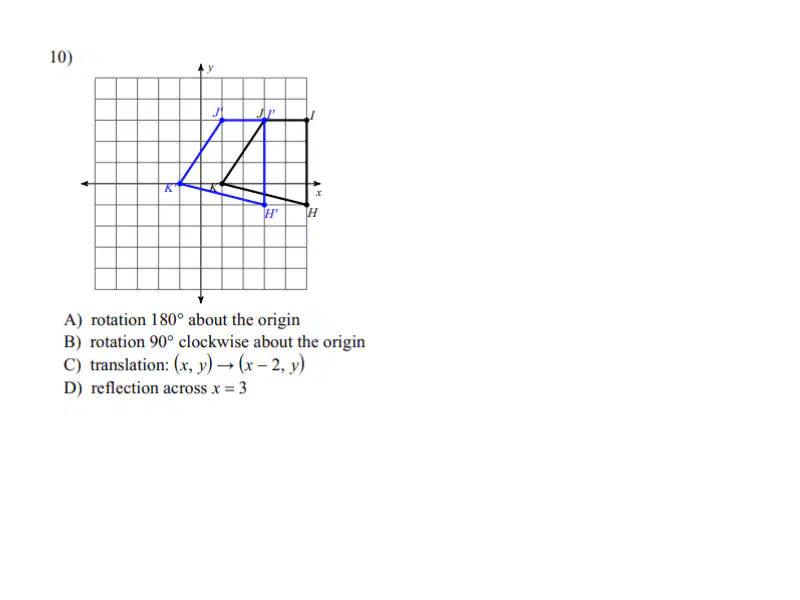
185.

CHOOSE BEST ANSWER

a)

A

b)

B

c)

C

d)

D