wayground logo

Free Printable Worksheets

Font size

S
M
L
XL
Worksheets

Energy Quiz Part. 1

Total questions: 30

Worksheet time: 19mins

Name
Class
Date
1.
The equation:
6CO+ 6H2O + Sunlight --> C6H12O+ 6O2
is the equation for which of the following processes?
a)
endocytosis
b)
cellular respiration
c)
photosynthesis
d)
fermentation
2.

Which substance in green plants needs to absorb sunlight during photosynthesis?

a)

chlorophyll

b)

cytoplasm

c)

oxygen

d)

water

3.

The sum of all chemical reactions that take place in a living thing is known as

a)

feedback

b)

metabolism

c)

dynamic equilibrium

d)

biological adaptation

4.

What is the chemical formula for glucose?

a)

C6H12O6

b)

CH4

c)

H2O2

d)

NaHCO3

5.

Where does almost all the energy on Earth originate?

a)

the Sun

b)

the moon

c)

hurricanes

d)

fossil fuels

6.

What type of biomolecule is glucose?

a)

carbohydrate

b)

lipid

c)

protein

d)

nucleic acid

7.

Why do photosynthetic organisms preform photosynthesis?

a)

to make glucose to use in cellular respiration for themselves

b)

to make glucose so other organisms can perform cellular respiration

c)

to prepare for winter months

d)

to reproduce

8.

Through what structure does CO2 enter the leaves of green plants?

a)

stomata

b)

roots

c)

stem

d)

buds

9.

What are the products of photosynthesis?

a)

C6H12O6 and O2

b)

H2O and CO2

c)

H2O and CH4

d)

O2 and CO2

10.

True or False: Plants do not need oxygen.

a)

True

b)

False

11.

What do plants get from the soil?

a)

water and minerals

b)

water only

c)

glucose

d)

nothing, it just holds them in place

12.

What types of organisms are seen clearly in the picture

a)

heterotrophs only

b)

autotrophs only

c)

both heterotrophs and autortophs

d)

neither heterotrophs or autotrophs

13.
Which of the following is not needed to make glucose during photosynthesis?
a)
Light Energy
b)
O2
c)
CO2
d)
H2O
14.

The arrows in a food chain or web represents what?

a)

They point to the organism that is being eaten.

b)

It shows how sunlight flows within an ecosystem.

c)

They show the direction the energy is flowing between organisms.

d)

They represent how water is transferred within a habitat.

15.
Why is a shark a carnivore.
a)
because it eats seaweed
b)
because it eats dead animals
c)
because it eats sand 
d)
because it eats other animals
16.
What does a food web represent?
a)
All connections of energy flow throughout all organisms in a habitat.
b)
The specific ways that mutualism is carried out.
c)
A single pathway or energy flow between organisms. 
d)
How carnivores get their food. 
17.
The image provided is an example of a(n):
a)
Producer
b)
Autotroph
c)
Consumer
d)
Insect
18.
A wolf eats a rabbit, that just ate some berries.  What would you call the rabbit?
a)
Producer
b)
Omnivore
c)
Primary Consumer
d)
2nd order Heterotrph
19.
An organism that gets energy from breaking down dead organisms, non-living material or waste is a(an) ___________.
a)
producer
b)
consumer
c)
decomposer
d)
autotroph
20.
An organism that obtains energy by consuming plants and animals.
a)
Omnivores
b)
Carnivores
c)
Herbivores
d)
Humans 
21.

Consumers that eat only plants

a)

Carnivores

b)

Omnivores

c)

Herbivores

d)

Scavengers

22.
An organism that obtains energy by consuming plants and animals.
a)
Omnivores
b)
Carnivores
c)
Herbivores
d)
Humans 
23.

In the food web above, what organism is a tertiary consumer?

a)

Fox

b)

Frog

c)

Vole

d)

Grass

24.
What is a substance called if it speeds up a chemical reaction?
a)
reusable
b)
catalyst
c)
specific
d)
fragile
25.
Enzymes are...
a)
nucleic acids
b)
proteins
c)
lipids
d)
carbohydrates
26.
What is the function of an enzyme?
a)
enzymes break themselves into small pieces
b)
enzymes slow down chemical reactions
c)
enzymes speed up chemical reactions
d)
enzymes combine products to form reactants 
27.
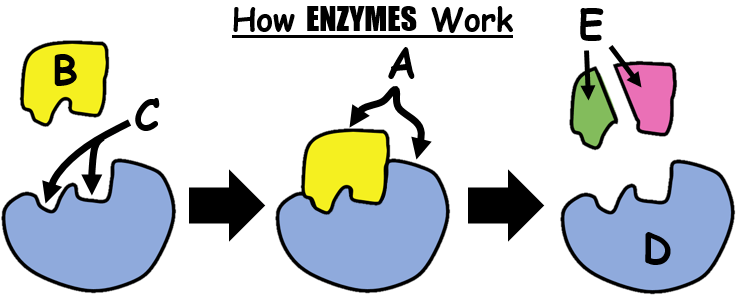
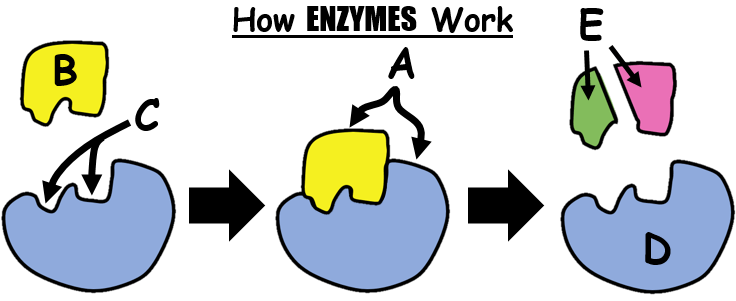
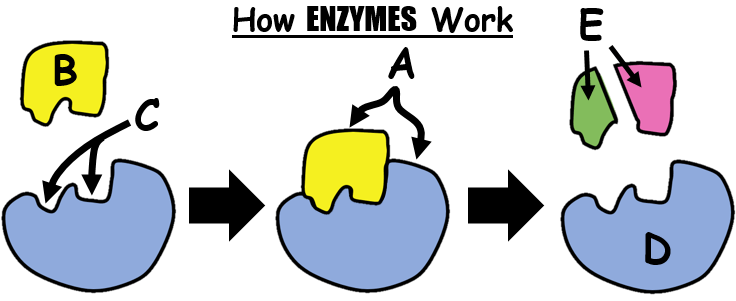
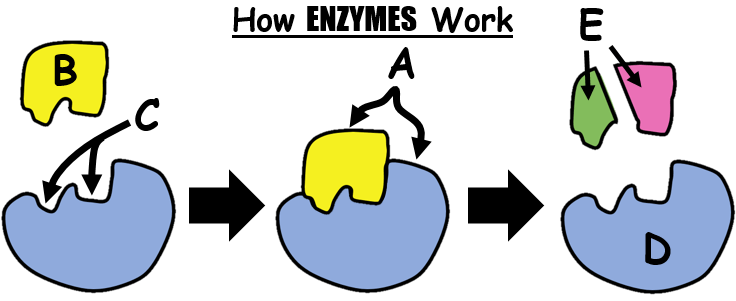
Letter D...
a)
active site
b)
enzyme
c)
substrate
d)
products
28.
Letter B...
a)
active site
b)
enzyme
c)
substrate
d)
products
29.
Letter C...
a)
active site
b)
enzymes
c)
substrate
d)
products
30.
Letter E...
a)
active site
b)
enzyme
c)
substrate
d)
products