
Font size
 Worksheets
Six Weeks Test Review
Total questions: 15
Worksheet time: 13mins
As a fertilized egg divides, the cells differentiate because they
contain a lipid bilayer
can clump together
metabolize sugars rapidly
have specific genes activated

Some cells involved in the process of reproduction are represented in the diagram to the left. The process of meiosis formed
Cell 3 only
Cell 1 only
Cells 1 and 2
Cells 2 and 3
In pumpkins, the gene for white color is dominant over the gene for yellow color. If a homozygous yellow plant is crossed with a heterozygous white plant, what is the expected distribution of color produced in the offspring? Select TWO correct answers.
50 % Yellow
100 % White
25 % Yellow
50 % White
From a single fertilized ovum undergoing a series of rapid cell divisions, a human infant develops. The embryonic cells become specialized for a variety of functions. Which of these statements best describes how different cell types develop?
Each cell type contains only the active parts of the DNA needed for that cell type.
Each cell type has only one chromosome containing the DNA needed for that cell type
Each cell has an identical copy of DNA with enzymes controlling the expression of specific genes, leading to a variety of cells
Each cell has multiple copies of DNA that are affected in different ways by the environment to change the function of the cell at regular intervals

The Himalayan rabbit's habitat has cold snowy winters and mild summers. The body is typically covered in white fur except for the nose, feet, tail and ears, which are covered in black fur. A scientist shaved an area of white fur on the back of a Himalaya rabbit and placed an ice pack over the shaved area. The shaved area grew black fur. Which of these best explains why the hair that grew back where the ice pack was placed was black and not white?
The genes for black hair were activated by specific temperatures.
The white hair mutated to black hair as the rabbit's body temperature decreased
The coat color changed from white to black with the age of the rabbit
White hair only grows during certain times of the year

A biological process is shown. Which two parts of this process help increase the genetic variation in the gametes of the population? Select TWO correct answers
Step 1
Step 2
Step 3
Step 4

In 1917 the biologist Thomas Hunt Morgan conducted studies in which he kept some caterpillars in the dark and placed some others under red, green, or blue lights. Exposure to red light produced butterflies with brightly colored wings. Exposure to green light resulted in dark colored wings. Exposure to blue light or no light resulted in pale-colored wings. What was most likely the cause of variation in the butterflies wing colors?
The pigment in butterfly wings absorbs light from the environment
The phenotypic expression of wing shape depends on color pigmentation in butterflies.
The genes regulating wing color in butterflies are influenced by environmental factors
Caterpillars exposed to red and green light are healthier than caterpillars exposed to no light or blue light
Which of the following is Homozygous?
KK
Kk
KKK
Which of the following is heterozygous genotype?
Tt
tt
TT
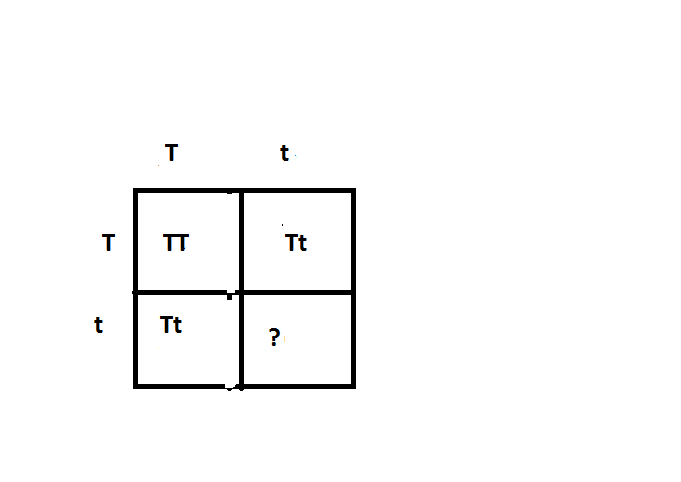
In the punnett square below, what belongs in the missing square

In the punnett square, what is the probability for white fur?
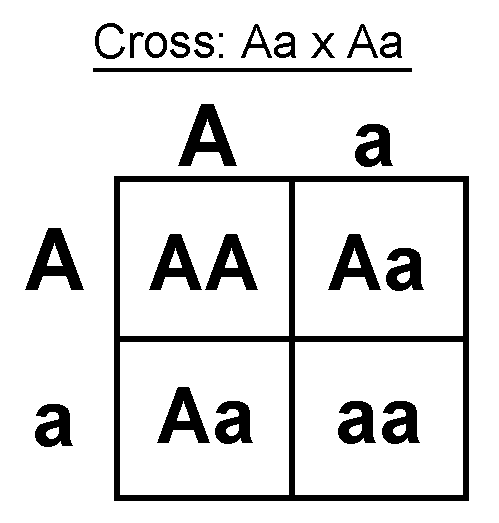

Look at the punnett square shown. What is the probability that the offspring will show the dominant trait?
100%
75%
50%
25%
0%

Look at the punnett square. What is the probability of the offspring showing the recessive trait?
100%
75%
50%
25%
0%

Look at the punnett square. What is the probability that the offspring's alleles will be homozygous dominant?
100%
75%
50%
25%
0%

