wayground logo

Free Printable Worksheets

Font size

S
M
L
XL
Worksheets

Final Physical Science Exam

Total questions: 251

Worksheet time: 5hrs 1mins

Name
Class
Date
1.
A quantity that is has magnitude and  direction is referred to as a
a)
vector quantity
b)
scalar quantity
2.
An object can be moving for 10 seconds and still have zero displacement.
a)
True
b)
False
3.
You run from your house to a friend's house that is 3 km away. You then walk home. The distance you traveled is 6 km. What is your displacement? 
a)
6  km
b)
0 km
4.
A _________ quantity is completely described by magnitude alone. A _________ quantity is
completely described by a magnitude with a direction.
a)
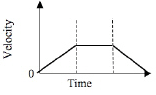
vector, scalar
b)
scalar, vector
5.
Speed is a __________ quantity and velocity is a __________ quantity.
a)
scalar, vector
b)
vector, scalar
6.
A hummingbird averages a speed of about 45 km/hour (Cool facts: They visit up to 1000 flowers per day, and reach maximum speed, while diving, up to 160 km/hour!). Ruby-throated hummingbirds take a non-stop trip across Gulf of Mexico in which they fly for 18 hours straight! How far is the trip across the Gulf of Mexico at their average speed?
a)
810 km
b)
2.5 km
c)
3.6 km
d)
360 km
7.
An object is NOT accelerating if it is moving
a)
in a circle
b)
at constant velocity 
c)
at increasing speed
d)
only as influenced by gravity
8.
A car slows down from +32 m/s to +8 m/s in 4 s. The acceleration is 
a)
6 m/s/s opposite the motion
b)
2m/s/s in the direction of motion
c)
8 m/s/s opposite the motion
9.
A cheetah travels 75 m in 3 s. What is her velocity over the interval?
a)
225 m/s
b)
25 m/s 
c)
0.04 m/s
10.

What is the average velocity of the object between 10 and 15 seconds?

a)

6 m/s

b)

1.5 m/s

c)

-4 m/s

d)

0 m/s

11.
Speed =
a)
distance / time
b)
time / distance
c)
distance * time
12.
When something has speed in a certain direction it is called ___________.
a)
motion
b)
position
c)
velocity
d)
speed
13.

An airplane accelerates down a runway at 3.20 m/s/s for 32.8 s until is finally lifts off the ground. Determine the distance traveled before takeoff.

a)

1720m

b)

104.96m

c)

1270m

d)

2704m

14.

A car is traveling to the right with a speed of 29​​m/s when the rider slams on the accelerator to pass another car. The car passes in 110 m with constant acceleration and reaches a speed of 34m/s. We want to find the acceleration of the car as it sped up. What equation should you choose?

a)

v=vo+at

b)

d=vot+1/2at2

c)

v2=vo2+2ad

d)

d=1/2(v+vo)t

15.

A ball is dropped from a building. How fast is it traveling after falling for 1.77 s? (Hint: It's a free falling object)

a)

14.76 m/s

b)

17.35 m/s

c)

18.91 m/s

d)

20.03 m/s

16.

A car starts from rest and accelerates uniformly over a time of 5.21 seconds for a distance of 110 m. Determine the acceleration of the car. Choose the appropriate equation.

a)

v=vo+at

b)

d=vot+1/2at2

c)

v2=vo2+2ad

d)

d=1/2(v+vo)t

17.

Rocket-powered sleds are used to test the human response to acceleration. If a rocket-powered sled is accelerated to a speed of 444 m/s in 1.83 seconds, then what is the distance that the sled travels?

Choose the appropriate equation.

a)

v=vo+at

b)

d=vot+1/2at2

c)

v2=vo2+2ad

d)

d=1/2(v+vo)t

18.

If Michael Jordan has a vertical leap of 1.29 m, then what is his takeoff speed if his acceleration is -9.8 m/s2 and his velocity at the top of his leap i 0 m/s?

a)

v=vo+at

b)

d=vot+1/2at2

c)

v2=vo2+2ad

d)

d=1/2(v+vo)t

19.

An engineer is designing the runway for an airport. Of the planes that will use the airport, the lowest acceleration rate is likely to be 3 m/s2. The takeoff speed for this plane will be 65 m/s. All airplanes will start from rest. Assuming this minimum acceleration, what is the minimum allowed length for the runway?

a)

v=vo+at

b)

d=vot+1/2at2

c)

v2=vo2+2ad

d)

d=1/2(v+vo)t

20.

The unit we use to measure speed is ___.

a)

m/s

b)

m

c)

s

d)

m/s2

21.

Consider a ball thrown up from the surface of the earth into the air at an angle of 30° above the horizontal. Air friction is negligible. Just after the ball is released, its acceleration is:

a)

0 m/s2

b)

Upwards at 9.8 m/s2

c)

Downwards at 9.8 m/s2

d)

Upwards at 4.9 m/s2

e)

None of these

22.

How long will it take a running horse to travel 260 m and attain a speed of 12 m/s from rest?

a)

1200 seconds

b)

1.2 hours

c)

43 Hours

d)

43 seconds

23.
A car is traveling at 21.0 m/s. It slows to a stop at a constant rate over 5.00 s. How far does the car travel during those 5.00 seconds before it stops? 
a)
4.20 m
b)
52.5 m
c)
105 m
d)
158 m
24.
A roller coasters accelerates from an initial velocity of 6.0 m/s to a final velocity of 70 m/s over 4 seconds.  What's the acceleration?
a)
24 m/s2
b)
18 m/s2
c)
16 m/s2
d)
16 m/s
25.
How much time would it take for an object to fall 4.7 meters?
a)
0.959 s
b)
4.79 s
c)
0.979 s
26.
If a car is traveling forward at 15 m/s, how fast will it be going in 1.2 seconds if the acceleration is -10 m/s2?
a)
27 m/s
b)
3 m/s
c)
-27 m/s
d)
-3 m/s
27.
An object with an initial velocity of 3.50 m/s moves east along a straight and level path. The object then undergoes a constant acceleration of 1.80 m/s2 east for a period of 5.00 s. How far does the object move while it is accelerating?
a)
6.30 m
b)
17.5 m
c)
27.2 m
d)
40.0 m
28.
A golf ball accelerates off a tee at 8 800 m/s2, changing its velocity from 0m/s to 44 m/s down the fairway. How long did it take the golf ball to accelerate?
a)
0.22 seconds
b)
200 seconds
c)
14 seconds
d)
0.0050 seconds
29.
A ball is thrown upward with an initial velocity of 20 m/s. How long will the ball take to reach its maximum height?
a)
19.6 s
b)
9.8 s
c)
6.3 s
d)
2.04 s
30.
An airplane lands on a runway with a velocity of 150 m/s. How far will it travel until it stops if its rate of deceleration is constant at -3 m/s2?
a)
525 m
b)
3750 m
c)
6235 m
d)
9813 m
31.
A rocket is propelled upward with an acceleration of 25 m/s2 for 5 s. After that time, the engine is shut off, and the rocket continues to move upward. The  maximum height, in meters, that the rocket will reach is
a)
900
b)
1000
c)
1100
d)
1200
32.

What shape does a projectile make?

a)

Parabola

b)

Hyperbola

c)

Linear Line

d)

Projectiles do not follow a predictable path

33.

Two objects are released at the same time. One object is dropped in the vertical direction and one is launched horizontally into projectile motion. Which object hits the ground first?

a)

Both hit the ground at the same time

b)

The object dropped hits the ground first

c)

The object launched horizontally hits the ground first

d)

Unable to determine without further information

34.

A rock is thrown in the air as shown in the picture. At which point does vy = 0 msv_y\ =\ 0\ \frac{m}{s}  ?

a)

A

b)

B

c)

C

d)

D

e)

E

35.

When vectors form a right angle, we can find the resultant vector by using:

a)

The quadratic equation

b)

Addition

c)

The Pythagorean Theorem

d)

Subtraction

36.

Describe the motion.

a)

at rest/not moving

b)

constant speed

c)

constant acceleration

d)

constant deceleration

37.

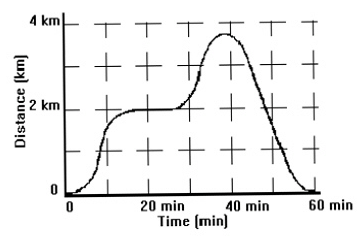
Above is a graph of the distance vs. time for car moving along a road. According the graph, at which of the following times would the automobile have been accelerating positively?

a)

5, 29, & 57 min.

b)

5, 12, 29, & 35 min.

c)

12, 35, & 41 min.

d)

0, 20, 38, & 60 min

38.

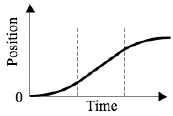
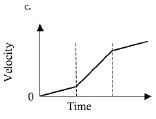
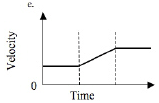
The graph given here shows the position vs. time for an object traveling along the x-axis. Which graph below shows the velocity vs. time for this same object during the same time period?
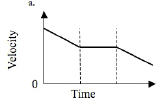
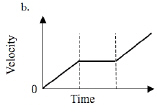
a)
b)
c)
d)
e)
39.

A ball is tossed straight up and later returns to the point from which it was launched. If the ball is subject to air resistance as well as gravity, which of the following statements is correct?

a)

The speed at which the ball returns to the point of launch is less than its speed when it was initially launched.

b)

The net work done by air resistance on the ball during its flight is zero.

c)

The time for the ball to fall is the same as the time for the ball to rise.

d)

The force of air resistance is directed down-ward both when the ball is rising and when it is falling.

e)

The net work done by gravity on the ball during its flight is greater than zero.

40.

What is the displacment of this object?

a)

0m

b)

4m

c)

8m

d)

12m

e)

-4m

41.

A 'newton' is a unit of

a)

force

b)

acceleration

c)

distance

d)

speed

e)

energy

42.

1 newton is equivalent to the force required to

a)

accelerate a 1 kg mass by 1 m/s/s

b)

move a 1 kg mass 1 metre

c)

accelerate a 1 kg mass to a speed of 1 m/s

43.

A 100 kg object which has a 100 newton force applied to it for 1 second. 10 seconds later, it will be moving at a speed of . . .

a)

1 m/s

b)

10 m/s

c)

0 m/s

d)

30 m/s

44.

Two objects with unequal mass. The object with more mass has

a)

more inertia

b)

less inertia

45.

Gravity is

a)

an acceleration

b)

a force

46.

In physics, weight is a

a)

force

b)

mass

47.

If the acceleration due to earth's gravity is 9.8 m/s/s, then the force due to gravity on a 10 kg mass is

a)

-98 newtons

b)

-9.8 newtons

c)

-.98 newtons

d)

-19.8 newtons

48.

A curling stone has a mass of 20 kg and it leaves the player's hand at a speed of 2 m/s. It travels for 20 seconds before stopping.

Assuming friction is constant, what is the average acceleration of the curling stone?

a)

-0.1 m/s/s

b)

-40 m/s/s

c)

-20 m/s/s

49.

A curling stone has a mass of 20 kg and it leaves the player's hand at a speed of 2 m/s. It travels for 20 seconds before stopping - an acceleration of -0.1 m/s/s

What is the average force of friction on the curling stone?

a)

-0.2 newtons

b)

-2 newtons

c)

-1 newton

50.
What is the name of the units that we measure force in?
a)
Einsteins 
b)
Newtons
c)
Kg
d)
Metres
51.
What will cause an object to move?
a)
Applied forces
b)
Balanced forces
c)
Unbalanced forces
52.
What is the net force?
a)
20 N 
b)
0 N 
c)
400 N 
d)
40 N 
53.
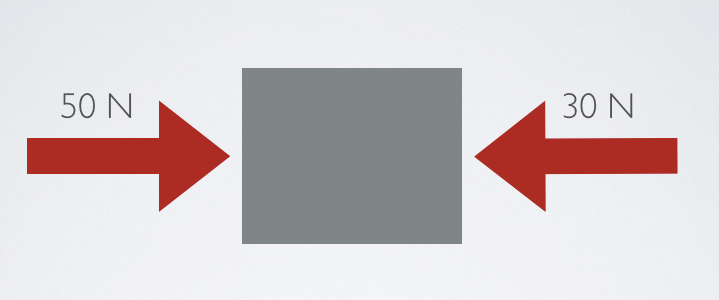
What is the net force?
a)
10 N
b)
0 N
c)
25 N
d)
1 N
54.
You and your dad are moving the couch from one side to another. Your dad pushes with a force of 35 N to the right and you push with a force of 25 N right. What is the net force on the couch?
a)
60 N right
b)
10 N left
c)
60 n right
d)
50 N left
55.

Suppose that an astronaut throws a baseball in outer space at a location far from significant influences of gravity and air resistance. One would expect that the baseball would ____.

a)

eventually stop since all objects ultimately "lose their steam"

b)

eventually stop as its inertia slowly becomes used up

c)

continue in motion with the same speed and direction

d)

either a, b, or c -- depending on whether the astronaut continues to push it

56.

Inertia depends on ______

a)

Velocity

b)

Speed

c)

Distance

d)

Mass

57.

Inertia is the tendency of an object to resist a change in its ___________.

a)

temperature

b)

shape

c)

size

d)

motion

58.

the tendency of an object to resist a change in its motion

a)

acceleration

b)

inertia

c)

mass

d)

frame of reference

59.
How will this object move? 
a)
It won't move. 
b)
It will move to the right. 
c)
It will move to the left. 
d)
It will move up. 
60.
Which of the following is a unit for acceleration?
a)
km/s
b)
m/s2
c)
mi/hr
d)
ft
61.
When a car goes around a corner at 20 mph, why do we say it  accelerates?
a)
The car is accelerating because of the velocity is constant
b)
The car accelerates because it's going 20 mph
c)
Cars always accelerate when they are in motion
d)
The car is accelerating because it's changing direction
62.

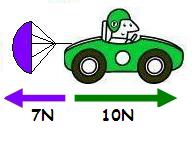
What is the net force?

a)

3 N

b)

3 N, right

c)

17 N, right

d)

3 N, left

63.

If a horse pulls on a wagon at rest, the wagon pulls back equally on the horse. Can the wagon be set into motion?

a)

Yes, because there is a net force acting on the wagon.

b)

Yes, because there is a time delay between action and reaction.

c)

No, because the forces cancel each other.

d)

Yes, because the horse's pull on the wagon is larger than the wagon's pull on the horse.

64.

A large truck and a small car traveling at the same speed have a head-on collision. The vehicle to undergo the greater change in velocity will be

a)

the small car

b)

the large truck

c)

neither, both are the same.

65.

According to Newton's third law, if you push gently on something, it will push

a)

gently on something else.

b)

on you only if you aren't moving.

c)

gently on you

d)

on something only under the right conditions.

66.

A man pulls on a rope in a tug-of-war with an elephant . Each pulls with 500N of force. What is the tension in the rope?

a)

0N

b)

250N

c)

25.0N

d)

500N

67.

A fighter hits a punching bag and brings it from rest up to a speed of 40 m/s in 0.08 s. What is the force of impact on the punching bag if its mass is 100 kg?

a)

32.0 N

b)

320 N

c)

3,200 N

d)

0.032

68.
What is a friction force acting upon an object on wheels?
a)
Static 
b)
Sliding 
c)
Rolling 
d)
Fluid 
69.
What is a friction force  acting on an NON- moving object.
a)
Static friction 
b)
Fuild friction 
c)
Rolling friction 
d)
Sliding Friction 
70.

Friction always...

a)

Resists motion

b)

Is negative

c)

Goes against the applied force

d)

Is determined by weight

71.

There are 25N of friction that keep a 10kg brick moving at a constant rate. What is the coefficient of friction?

a)

0.25

b)

0.25N

c)

4

d)

4N

72.

The mass of a brick is 5kg, and it is stationary. What is the maximum static friction if the coefficient is 0.66?

a)

3.3

b)

33

c)

3.3N

d)

33N

73.

What is the most difficult part of the quiz?

a)

Calculating the amount of force exerted using F=ma

b)

Calculating the amount of friction resisting motion

c)

Determing the net force from a diagram.

d)

inertia

e)

types of friction

74.

A force acts horizontally on a 10-N block that is sliding across a horizontal surface. The coefficient of static friction between the block and the surface is 0.50. What is the magnitude of the frictional force that acts on the block?

(a)  

75.

There are 25N of friction that keep a 10kg brick moving at a constant rate. What is the coefficient of friction?

a)

0.25

b)

0.25N

c)

4

d)

4N

76.
The rougher the surface, the faster an object will travel over the surface.
a)
True
b)
False
77.
How does friction affect speed?
a)
more friction decreases speed
b)
more friction increases speed
c)
less friction decreases speed
78.
A puck slides along an icy surface. What makes it slow down?
a)
It runs out of push
b)
It rubs against the ice
c)
It runs out of electricity
79.
 What is the force of friction between a block of ice that weighs 950 N and the ground if μ = .12? 
a)
65 N
b)
226 N
c)
175 N
d)
114 N
80.
Friction is a force that acts in an ___________ direction of movement.
a)
similar
b)
opposite
c)
parallel
d)
west
81.

A crate filled with delicious junk food rests on a horizontal floor. Only the force of gravity and the normal force act on it.

The net force on the crate is ___________

a)

zero

b)

greater than zero

82.

What is the frictional force of an object that slides along a horizontal surface if its weight is 10 N and the coefficient of friction is 0.25?

a)

40 N

b)

9.75 N

c)

2.5 N

d)

25 N

83.

What is the coefficient of friction for an object with a weight of 20 N that experiences a frictional force of 15 N?

a)

5

b)

1.33

c)

0.75

d)

7.5

84.
What is the net force?
a)
20 N 
b)
0 N 
c)
400 N 
d)
40 N 
85.
What is the net force?
a)
30 N 
b)
25 N 
c)
5 N 
d)
55 N 
86.
What is the coefficient of static friction if it takes 44 N of force to move a box that weighs 86 N? 
a)
0.78
b)
0.51
c)
0.78 N
d)
0.58 N
87.
What direction does friction act relative to motion?
a)
in the same direction
b)
in the opposite direction 
c)
need more information
d)
depends on the force
88.

FN=100N, Ff=20N

a)

μ=5.0

b)

μ=0.2

c)

μ=1.2

d)

μ=0.1

89.
A box takes 40 N to start moving when the coefficient of static friction is .54. What is the weight of the box? 
a)
81 N
b)
18 N
c)
98 N
d)
74 N
90.

A block is pulled along a rough level surface at constant speed by the force . The figure shows the free-body diagram for the block. FN represents the normal force on the block; and f represents the force of kinetic friction. What is the magnitude of FN?

a)

P

b)

f

c)

2mg

d)

mg

91.

A 27.6 kg block is pulled along a rough level surface at constant velocity by the force . The figure shows the free-body diagram for the block. FN represents the normal force on the block; and f represents the force of kinetic friction. The coefficient of kinetic friction is 0.30, what is the strength of P?

a)

4.0 N

b)

81 N

c)

270 N

d)

27.6 N

92.

A force acts horizontally on a 20-N block that is sliding across a horizontal surface. The coefficient of static friction between the block and the surface is 0.75. What is the magnitude of the frictional force that acts on the block?

(a)  

93.

A force acts horizontally on a 30-N block that is sliding across a horizontal surface. The coefficient of static friction between the block and the surface is 0.6. What is the magnitude of the frictional force that acts on the block?

(a)  

94.

A force acts horizontally on a 25-N block that is sliding across a horizontal surface. The coefficient of static friction between the block and the surface is 0.2. What is the magnitude of the frictional force that acts on the block?

(a)  

95.

A force acts horizontally on a 100-N block that is sliding across a horizontal surface. The coefficient of static friction between the block and the surface is 0.2. What is the magnitude of the frictional force that acts on the block?

(a)  

96.

A force acts horizontally on a 100-N block that is sliding across a horizontal surface. The frictional force that is caused is 30-N. What is the coefficient of friction?

(a)  

97.

A force acts horizontally on a 90-N block that is sliding across a horizontal surface. The frictional force that is caused is 18-N. What is the coefficient of friction?

(a)  

98.

A force acts horizontally on a 68-N block that is sliding across a horizontal surface. The frictional force that is caused is 17-N. What is the coefficient of friction?

(a)  

99.

The frictional force caused by an object sliding across a horizontal surface is 15N. The coefficient of friction for the materials is 0.3. What is the weight of the object?

(a)  

100.

The frictional force caused by an object sliding across a horizontal surface is 9N. The coefficient of friction for the materials is 0.12. What is the weight of the object?

(a)  

101.

Convert 62 miles/hour to feet/second

a)

5,456 feet/second

b)

0.003 feet/second

c)

90.9 feet/second

d)

909 feet/second

102.

Convert 50 decimeters/week to kilometers/year

a)

0.026 kilometers/year

b)

2.6 kilometers/year

c)

0.26 kilometers/year

d)

26 kilometers/year

103.

Convert 70,000 quarts/year to pints/day

a)

383.6 pints/day

b)

767.1 pints/day

c)

1,534.2 pints/day

d)

191.8 pints/day

104.
Balance this equation
_N+ _H--> _NH3
a)
1,2,3
b)
1,3,2
c)
1,1,2
d)
2,1,1
105.
How many atoms of aluminum are on each side of the following equation: 4Al + 3O--> 2AlO3
a)
2
b)
6
c)
1
d)
4
106.
Balance this equation
_Zn+_HCl-->_ZnCl+_H2
a)
1,1,2,1
b)
1,1,1,2
c)
1,2,1,1
d)
2,1,1,1
107.
Balance this equation.
_Mg + _Cl--> _MgCl2
a)
1, 2,1
b)
already balanced
c)
2,1,1
d)
1,1,2
108.
Balance this equation:
P4+O2  -->  P2O3
a)
3 P4+ O--> 2 P2O3
b)
 P4+ O--> 2 P2O3
c)
 P4+ 3 O2 --> 2 P2O3
d)
 P4+ 2 O--> 3 P2O3
109.
The following is what type of reaction:
PbCl2 + AgNO3 → Pb(NO3)2 + AgCl
a)
Synthesis
b)
Decomposition
c)
Single Replacement
d)
Double Replacement
110.
The following is what type of reaction:
NH3 + HCl  → NH4Cl
a)
Synthesis
b)
Decomposition
c)
Single Replacement Replacement
d)
Double Replacement Replacement
111.
What type of chemical reaction is this?
Al(OH)3 → Al2O3  + H2O
a)
Decomposition
b)
Combustion
c)
Synthesis
d)
Single Replacement 
112.
3Ca + 2AlCl3 --> 3CaCl2 + 2Al
a)
Synthesis
b)
Decomposition
c)
Single Displacement
d)
Double Displacement
113.

Identify the type of chemical reaction

a)

Synthesis

b)

Decomposition

c)

Single replacement

d)

Double replacement

e)

Combustion

114.

What is the left part of a chemical equation called?

2H2 + O2 ---> 2H2O

a)

Reactants

b)

Yields

c)

Products

d)

Chemical equation

115.

What is the right part of a chemical equation called?

2H2 + O2 ---> 2H2O

a)

Reactants

b)

Yields

c)

Products

d)

Chemical Equation

116.

What is the total number of atoms present in 5Na3PO4?

a)

5

b)

55

c)

40

d)

8

117.

How many Mn atoms are found in the following compound?

2MnO4

a)

1

b)

2

c)

4

d)

8

118.

What is the little number after an element in a chemical equation called?

Example: H2

a)

Coefficient

b)

Atom

c)

Subscript

d)

Equation

119.

Is the following equation balanced?

Al + O2 ---> 2Al2O3

a)

YES

b)

NO

120.

What is the number before a chemical formula called?

Example: 2H2 + O2 ---> 2H2O

a)

Coefficient

b)

Atom

c)

Subscript

d)

Equation

121.

Which of the following equations are correctly balanced?

a)

12CO2 + H2O ---> C6H12O6 + O2

b)

CO2 + H2O ---> 3C6H12O6 + O2

c)

CO2 + 9H2O ---> C6H12O6 + O2

d)

6CO2 + 6H2O ---> C6H12O6 + 6O2

122.

Balance this equation:

H2 + Cl2 ---> HCl

a)

It is balanced.

b)

H2 + Cl2 ---> 2HCl

c)

3H2 + Cl2 ---> 6HCl

d)

H2 + 3Cl2 ---> 6HCl

123.

Balance this equation:

HgO ---> 2Hg + O2

a)

It is balanced.

b)

2HgO ---> 2Hg + O2

c)

2HgO ---> Hg + O2

d)

HgO ---> Hg + 2O2

124.

Complete the sentence.


During a chemical reaction, atoms ________.

a)

can appear

b)

can disappear

c)

get rearranged

d)

stop moving and vibrating

125.
What is a coefficient?
a)
The small number on the right of the chemical symbol.
b)
The large number in front of a chemical formula.
c)
The number in between the chemical symbols.
d)
The number behind a chemical formula.
126.

What is the Law of Conservation of Mass?

a)

It states that matter cannot be created or destroyed.

b)

It states that energy cannot be created or destroyed.

c)

It states that matter can be created or destroyed.

d)

It states that sound can be created or destroyed.

127.
How many HCl molecules do you need to balance this equation? 
Mg +  __HCl --->  MgCl2 + H2
a)
1
b)
2
c)
3
d)
4
128.

What are the numbers that you CANNOT change in a chemical equation? 

a)
Coefficient
b)
Products
c)
Reactants
d)

Subscripts

129.

Balance the following equation:

___ H2+ ___ O2→___ H2O

a)

1, 1, 3

b)

2, 2, 2

c)

1, 2, 1

d)

2,1, 2

130.

What is the right ratio of chemicals for the balanced chemical equation?__Na + __H2O --> __NaOH + __H2

a)
2,2 --> 2,1
b)
4,4 --> 4,1
c)
1,2 --> 2,4
d)
1,2 --> 2,1
131.

What is the right ratio of chemicals for the balanced chemical equation?

__Ca + __H2O --> __Ca(OH)2 + __H2

a)
2,1 --> 2,1
b)
1,2 --> 1,1
c)
1,2 --> 2,4
d)
1,2 --> 2,1
132.

What is the right ratio of chemicals for the balanced chemical equation?

__CO + __Fe2O3--> __Fe + __CO2

a)
3,1 --> 2,3
b)
3,2 --> 1,1
c)
3,2 --> 2,4
d)
3,2 --> 2,1
133.
What is the right ratio of chemicals for the BCE (Balanced Chemical Equation)?__CH4 + __O2 --> __CO2+ __H2O
a)
2,1 --> 2,1
b)
1,2 --> 1,1
c)
1,2 --> 1,2
d)
1,2 --> 2,1
134.

What is the right ratio of chemicals for the balanced chemical equation?

__AgNO3 + __H2S --> __Ag2S+ __HNO3

a)
2,1 --> 1,2
b)
1,2 --> 1,1
c)
1,2 --> 1,2
d)
1,2 --> 2,1
135.

What is the right ratio of chemicals for the balanced chemical equation?

__H2 + __S --> __H2S

a)
1,1 --> 1
b)
2,2 --> 2
c)
1,2 --> 1
d)
1,2 --> 2
136.

What is the right ratio of chemicals for the balanced chemical equation?

__H2SO3 + __KOH--> __H2O+ __K2SO3

a)
2,1 --> 2,1
b)
1,2 --> 1,1
c)
1,2 --> 1,2
d)
1,2 --> 2,1
137.

What is the right ratio of chemicals for the balanced chemical equation?

__MnO2 + __HCl --> __MnCl2 + __H2O __Cl2

a)
4,1 --> 2,1,2
b)
1,2 --> 1,1,4
c)
1,4 --> 1,2,1
d)
1,4 --> 2,2,1
138.

What is the right ratio of chemicals for the balanced chemical equation?

__FeCl3 + __Ca(OH)2 --> __Fe(OH)3 + __CaCl2

a)
4,3--> 2,1
b)
3,2 --> 3,1
c)
2,3 --> 2,2
d)
2,3 --> 2,3
139.

Find the enthalpy of formation for the following chemical reaction.

2Al (s) + Fe2O3 (s) --> Al2O3 (s) + 2Fe (s)

a)

-847.6 kJ

b)

847.6 kJ

c)

2492 kJ

d)

-2492 kJ

140.
ΔH value in an endothermic reaction is a positive number.
a)
True
b)
False
141.

Define the term exothermic by picking all the correct statements

a)

products have less energy than the reactants

b)

ΔH is negative

c)

ΔH is positive

d)

Energy is given out to the surroundings (temperature goes up).

e)

products have more energy than the reactants

142.

Define endothermic by picking all the correct statements

a)

ΔH is positive

b)

Energy is taken in from the surroundings (temperature goes down).

c)

Energy is given out to the surroundings (temperature goes up).

d)

Products have less energy than the reactants

e)

Products have more energy than the reactants

143.
What type of reaction is shown in the reaction pathway?
a)
endothermic reaction
b)
exothermic reaction
144.

The products of complete combustion are

a)

(a) Carbon dioxide and water

b)

(b) Oxygen and water

c)

(c) Only carbon dioxide

d)

(d) Only oxygen

145.
The following is what type of reaction:
PbCl2 + AgNO3 → Pb(NO3)2 + AgCl
a)
Synthesis
b)
Decomposition
c)
Single Replacement
d)
Double Replacement
146.
The following is what type of reaction:
NH3 + HCl  → NH4Cl
a)
Synthesis
b)
Decomposition
c)

Single Replacement

d)

Double Replacement

147.
The following is what type of reaction:
PbCl2 + AgNO3 → Pb(NO3)2 + AgCl
a)
Synthesis
b)
Decomposition
c)
Single Replacement
d)
Double Replacement
148.
The following is what type of reaction:
NH3 + HCl  → NH4Cl
a)
Synthesis
b)
Decomposition
c)

Single Replacement

d)

Double Replacement

149.
What is decomposition?
a)
putting substances together
b)
breaking substances apart
c)
element replacing another element in a compoud
d)
burning of a subtance
150.
What type of chemical reaction is this?
Al(OH)3 → Al2O3  + H2O
a)
Decomposition
b)
Combustion
c)
Synthesis
d)
Single Replacement 
151.

Ca + AlCl3 --> CaCl2 + Al

a)
Synthesis
b)
Decomposition
c)

Single Replacement

d)

Double Replacement

152.

In this type of reaction, one element replaces another in a compound.

a)
Synthesis
b)
Combustion
c)
Single Replacement
d)
Double Replacement
153.

In this type of reaction, one reactant turns into several different products.

a)
Decomposition
b)
Synthesis
c)
Combustion
d)
Single Replacement
154.

This reaction always starts with a hydrocarbon that reacts with oxygen and produces carbon dioxide and water. 

a)
Decomposition
b)
Synthesis
c)
Combustion
d)
Single Replacement
155.
Two Reactants and One Product
a)
Decomposition
b)
Synthesis
c)
Combustion
d)
Single Replacement
156.

Si   + S8   -->   Si2S4

a)
Synthesis
b)
Decomposition
c)
Single Displacement
d)
Double Displacement
157.
C4H12 + O2 → CO2 + H2O
a)
Synthesis
b)
Combustion
c)
Single Replacement
d)
Double Replacement
158.

Pb(NO3)2   -->   PbO +  NO2  +  O2

a)
Synthesis
b)
Decomposition
c)
Single Displacement
d)
Combustion
159.

KOH + H3PO4 --> K3PO+ H2O

a)
Synthesis 
b)
Decomposition
c)

Single replacement

d)

Double replacement

160.
At the end of chemical reactions, what is the total mass of the reactants compared to the total mass of the products?
a)
the product is doubled
b)
the product is half the mass of the reactants
c)
the mass is the same
d)
the mass changes depending on the reaction
161.
In chemical reactions, what does the principle of conservation of mass mean?
a)
Matter is not created or destroyed.
b)
The total mass of the reactants is greater than the total mass of the products.
c)
The total mass of the reactants is less than the total mass of the products.
d)
Matter is not changed.
162.
The red numbers in the image below represent ________
a)
subscripts
b)
coefficients
c)
I don't know, and don't want to try
d)
None of the answers are correct
163.
At the end of chemical reactions, what is the total mass of the reactants compared to the total mass of the products?
a)
the product is doubled
b)
the product is half the mass of the reactants
c)
the mass is the same
d)
the mass changes depending on the reaction
164.
In chemical reactions, what does the principle of conservation of mass mean?
a)
Matter is not created or destroyed.
b)
The total mass of the reactants is greater than the total mass of the products.
c)
The total mass of the reactants is less than the total mass of the products.
d)
Matter is not changed.
165.
The red numbers in the image below represent ________
a)
subscripts
b)
coefficients
c)
I don't know, and don't want to try
d)
None of the answers are correct
166.
The blue numbers in the image below represent ________
a)
I don't know, and don't want to try
b)
coefficients
c)
subscripts
d)
none of the answers are correct
167.
The substances at the beginning of a chemical equation are called the ____
a)
product
b)
yield
c)
chemical symbol
d)
reactants
168.

What is the right part of a chemical equation called...

H2 + O2 --> H2O

a)

Reactants

b)

Products

c)

Yields

d)

Chemical Equation

169.
When balancing equations a ____ can be placed to the left of a formula of a substance to make the equations balanced
a)
charge
b)
subscript
c)
random number
d)
coefficient
170.
Number of C's in 2Na₂CO₃
a)
1
b)
2
c)
3
d)
5
171.
How many Elements are in the compound C2H8O ?
a)
2
b)
1
c)
3
d)
0
172.
How many total atoms are in the compound C2H8O ?
a)
11
b)
2
c)
8
d)
1
173.
How many Magnesium are in 10MgCl2?
a)
10
b)
5
c)
20
174.
Balance this equation:
 2Li + Cl2 -> LiCl
a)
2Li + Cl2 -> 4LiCl2
b)
2Li + Cl2 -> LiCl2
c)
2Li + Cl2 -> 2LiCl
175.
Which number should go in the blank?
_ H2 + O2 -> 2 H2O
a)
1
b)
2
c)
3
d)
0
176.
Is the following equation balanced or unbalanced ? 
Al + O2 --> Al2O3
a)
Balanced
b)
Unbalanced
177.

Balance the following equation by filling in the blank:

N2 + 6H2 → _NH3

(a)  

178.
Number of C's in 2Na₂CO₃
a)
1
b)
2
c)
3
d)
5
179.
How many Elements are in the compound C2H8O ?
a)
2
b)
1
c)
3
d)
0
180.
How many total atoms are in the compound C2H8O ?
a)
11
b)
2
c)
8
d)
1
181.
Which number should go in the blank?
_ H2 + O2 -> 2 H2O
a)
1
b)
2
c)
3
d)
0
182.
How many HCl molecules do you need to balance this equation? 
Mg +  __HCl --->  MgCl2 + H2
a)
1
b)
2
c)
3
d)
4
183.
Pb(NO3)2  +  KI --> PbI2 + KNO3
What type of reaction is this? 
a)
Synthesis 
b)
Decomposition 
c)
Single Replacement
d)
Double Replacement 
184.
What type of reaction is this?  
__H2O2 ---->  __H2O + O2
a)
Synthesis
b)
Decomposition 
c)
Single Replacement
d)
Combustion 
185.
What law governs the balancing of chemical equations? 
a)
Law of Energy
b)
Law of Conservation of Matter/Mass
c)
Law of Gravity
d)
Law of Matter Movement 
186.
Is this balanced?
Al + O2 → 2Al2O3
a)
Yes
b)
No
187.

How many water molecules do you need to balance the equation: __H20 --> 2H2 + O2?

a)

1

b)

2

c)

3

d)

0

188.
Which periodic group has the smallest atomic radius?
a)
Alkali metals
b)
Halogens
c)
Noble Gases
d)
Transition metals
189.
Which statement correctly and completely identifies a trend?
a)
Atomic radius decreases across a period and increases down a group.
b)
Electronegativity decreases across a period and decreases down a group.
c)
Ionization energy increases across a period and increases down a group.
d)
Ionic radius increases across a period and increases down a group.
190.
Ionization energy is...
a)
the energy required to add an electron to a specific atom
b)
how much energy it takes to remove an electron from an atom
c)
the energy required to shield the outer electrons from the nucleus
d)
a measure of the ability of an atom to attract electrons
191.
Electronegativity is...
a)
how good an atom is at attracting electrons
b)
the ability of an atom to lose electrons
c)
the energy required to remove an electron from a specific atom
d)
how easy it is to make friends. 
192.
As you move across the periodic table atoms tend to get smaller because, ______________.
a)
the atoms have more mass.
b)
the atoms have less mass
c)
the atoms have more protons.
d)
the atoms have less electrons.
193.
Atoms that have a high electronegativity, _______________.
a)
give up their electrons more easily.
b)
hold on to their electrons more tightly.
c)
have more electron shells.
194.
Which has the greater EN: 
Cl or Al?
a)
Cl
b)
Al
195.
Which has the greater EN: 
N or C?
a)
C
b)
N
196.
Which of the following will have a larger radius than Zinc?
a)
Gallium
b)
Aluminum
c)
Magnesium
d)
Strontium
197.

Which of the following is NOT a trend that varies periodically in the periodic table?

a)

Electronegativity

b)

Ionization energy

c)

Symbols of elements

d)

Atomic radius

198.

ability of atom to attract electrons in bond

a)

Electronegativity

b)

Atomic radius

c)

Atomic number

d)

electron affinity

199.

The atomic radius across period

a)

decrease from left to right

b)

Increase from left to right

c)

decrease from right to left

d)

stay the same

200.

The valence electron of element in group 1 =

a)

11

b)

3

c)

5

d)

1

201.

Ions are formed when atoms gain or lose ___.

a)

electrons

b)

protons

c)

neutrons

d)

atomic mass

202.

Which statement is true?

a)

Cations are negatively charged ions.

b)

Anions are positively charged ions.

c)

Cations are positively charged electrons.

d)

Anions are negatively charged ions.

203.

As you move down a Group on the periodic table, what happens to the size of the atoms?

a)

they stay the same

b)

they get larger

c)

they get smaller

204.

As you move across a row on the periodic table, what generally happens to the atomic radius?

a)

it decreases

b)

it increases

c)

it stays the same

205.

What property is being measured in this diagram?

a)

Density

b)

Ionization Energy

c)

Atomic Radius

d)

Atomic Mass

206.

Which of the following atoms has the greatest atomic radius?

a)

nitrogen

b)

phosphorus

c)

potassium

d)

cesium

207.

If a potassium atom lost one electron, what would be the symbol for that ion?

a)
b)
c)
d)
208.

Momentum is a ____________________ quantity

a)

science

b)

scalar

c)

vector

d)

energy

209.

Momentum is the product of mass and velocity

a)

TRUE

b)

FALSE

210.

The momentum of an object depends upon the object's ___________&_____________.

a)

size and shape

b)

mass and speed

c)

mass and veloctiy

d)

mass and energy

211.
The equation to calculate momentum is
a)
p=mv
b)
p=1/2mv2
c)
p=mgh
d)
p=mg
212.
An object with a mass of 2000 kg at rest has what momentum?
a)
2000 kg m/sec
b)
0 kg m/sec
c)
2000 kg
d)
2000 m/sec
213.

A car is of mass 15kg is travelling east at a velocity of 3m/s. the value of its momentum is:

a)

30kg.m.s-1

b)

45kg.m.s-1

c)

18kg.m.s-1

d)

5kg.m.s-1

214.
A 2 kg cart has a momentum of 10 kg m/s. What is its velocity?
a)
22 m/s
b)
.2 m/s
c)
5.0 m/s
d)
20 m/s
215.
A 10kg toy truck moves at +5m/s. It collides head-on with a 5kg toy car moving at -10 m/s. What is the total momentum of the system?
a)
0 kgm/s
b)
30 kgm/s
c)
50 kgm/s
d)
10 kgm/s
216.

If you double the velocity of an object, then its momentum will ______________.

a)

will double

b)

will half

c)

will quadruple (x4)

d)

will be quartered (x 1/4)

217.
What is the unit for mass?
a)
m/sec
b)
kg/sec
c)
kg
d)
kg m/sec
218.
A 0.250 kg cart moving at 0.400 m/s has how much momentum?
a)
0.1 kg-m/s
b)
1 kg-m/s
c)
10 kg-m/s
d)
100 kg-m/s
219.

The momentum of an object depends upon the object's ___________&_____________.

a)

size and shape

b)

mass and speed

c)

mass and veloctiy

d)

mass and energy

220.
A runner has a momentum of 670 kg m/s and is travelling at a velocity of 9 m/s. What is his mass?
a)
6030 kg
b)
0.0134 kg
c)
74.4 kg
d)
80 kg
221.

A 5 N force is applied to a 3 kg ball to change its velocity from +9 m/s to +3 m/s. The impulse on the ball is ______ N s.

a)

-2.5

b)

-10

c)

-18

d)

-45

222.
A 40-kilogram mass is moving across a horizontal surface at 5.0 m/s.  What is the magnitude of the net force required to bring the mass to a stop in 8.0 seconds?
a)
1 N
b)
40 N
c)
25 N
d)
5 N
223.
The impulse-momentum theorem states that
a)
the impulse on an object is equal to the change in momentum it causes 
b)
the force on a moving object is equal to the magnitude of the impulse.
c)
the impulse on an object is greater than the change in momentum it causes 
d)
the impulse on an object is less than the change in momentum it causes
224.

When the speed of an object is doubled, its momentum...

a)

remains unchanged in accord with the conservation of momentum.

b)

doubles.

c)

quadruples.

d)

decreases.

225.

A boy kicks a football with a force of 20 N, the time the force acts for is 0.3 s.

Calculate the impulse on the ball.

a)

1 N·s

b)

6 N·s

c)

66 N·s

d)

None of these

226.

A bicycle has a momentum of 24 kg•m/s. What momentum would the bicycle have if it had the same mass and was moving with one-half the speed?

a)

twice the momentum; 48 kg*m/s

b)

1/2 the momentum; 12 kg*m/s

c)

4x the momentum; 96 kg*m/s

d)

1/4 the momentum; 6 kg*m/s

227.

A 2 kg cart has a momentum of 16 kg m/s. What is its velocity?

a)

8 m/s

b)

32 m/s

c)

0.125 m/s

d)

18 m/s

228.
If two objects have the same mass, then the faster moving object has ____________ momentum.
a)
more 
b)
less
c)
the same
229.
Which takes more force  to catch, a bowling ball or a ping pong ball?
a)
bowling ball because it has more momentum
b)
ping pong ball because it has more momentum
c)
both require the same amount of force when catching
d)
bowling ball because it has less momentum
230.
A 5 N force is applied to a 3 kg ball to change its velocity from +9 m/s to +3 m/s.  The time for the collision is _____ seconds.
a)
1.8
.
.
b)
2.5
c)
3.6
d)
10
231.
A biker with a mass of 75 kg moves along the path with a constant velocity of 5 m/s. What is the biker's momentum?
a)
25 m/s
b)
375 m/s
c)
25 kg m/s
d)
375 kg m/s
232.
Softer landings tend to
a)
increase impact force
b)
increase force
c)
increase collision time
d)
increase change in momentum
233.

Which of the following has the greatest momentum?

a)

a scurrying cockroach

b)

a parked semi-truck

c)

more information is needed

234.
Which of the following has more momentum? 
a)
a moving SUV
b)
a moving semi-truck
c)
more information is needed
235.

Which of the following is NOT a unit of momentum?

a)

kg*m/s

b)

N*s

c)

kg*mph

d)

kg*m/s2

236.
If a net force is acting on an object, 
a)
its velocity must be constant
b)
its velocity must be changing
c)
its mass must be changing
d)
its acceleration = 0 
237.
Most modern vehicles have padded dashboards. This reduces collision injuries by...
a)
reducing the driver's change in momentum
b)
increasing the driver's change in momentum
c)
increasing the force of impact
d)
increasing the time of impact
238.

In an elastic collision, ______ is conserved.

a)

Momentum only

b)

Kinetic Energy only

c)

Both momentum and energy

239.
In a perfectly inelastic collision, ______ is conserved. 
a)
Momentum only
b)
Kinetic Energy only
c)
Both momentum and kinetic energy
240.
Which of the following collisions is not perfectly elastic nor perfectly inelastic?
a)
a football tackle where both players fall wrapped together
b)
a cue ball hitting a billiards ball
c)
a flower pot breaking over someone's head
d)
an arrow staying in the apple after impact
241.
A person on a stationary skateboard throws a bowling ball with a velocity of 5.0 m/s. What is a possible speed of the person after the throw? 
a)
0 m/s
b)
1.5 m/s
c)
5.0  m/s
d)
7.5 m/s
242.
The recoil speed of a rifle is much less than the exit velocity of a bullet because...
a)
the rifle experiences a smaller force
b)
the rifle experiences a smaller change in momentum
c)
the rifle has a much greater mass
d)
the rifle does not obey the laws of physics
243.
A 50 kg ball rolls down the street at 5 m/s. Calculate the momentum of the ball. 
a)
55 kg*m/s
b)
100 kg*m/s
c)
250 kg*m/s
d)
500 kg*m/s
244.

Two skaters begin at rest. Skater 1 has a smaller mass than Skater 2. After they push off each other,...

a)

Skater 1 experiences a greater change in momentum

b)

Skater 2 experiences a greater change in momentum

c)

Skater 1 has a greater speed than Skater 2

d)

Skater 1 experiences a greater force

245.
What happens to the speed of the wagon as the rain collects inside of it?
a)
it decreases
b)
it remains constant
c)
it increases
246.
A block sliding on a frictionless surface runs into a second block of equal mass at rest. After the two collide, they stick together and travel with a velocity...
a)
that is twice the magnitude of the original velocity
b)
that is half the magnitude of the original velocity
c)
more information is needed
247.
Two blocks begin at rest with an initial momentum of zero. After the spring is sprung, the two blocks move in opposite directions. What is the total final momentum? 
a)
zero
b)
a positive value in the direction of the heavier block
c)
a positive value in the direction of the faster block
d)
more information is needed
248.
Parkour Peter bends his knees upon landing in order to ____
a)
reduce his change in momentum
b)
increase his change in momentum
c)
increasing his landing time
d)
increasing his landing force
249.
Both students experience the same ____
a)
force of impact
b)
time of impact
c)
change in momentum
d)
all of the above
250.

A ball of mass m is thrown at a wall with speed u. After it strikes the wall, the ball bounces back with a speed v. What represents the magnitude of the force acting on the ball during the collision?

a)

m(u-v) / t

b)

m(v-u) / t

c)

m(u+v) / t

d)

0

251.

A block of mass M slides across a frictionless surface with velocity v until collides with a stationary block of mass m. If the two blocks stick together, what is their velocity after the collision?

a)

(M+m)v / m

b)

(M-m)v

c)

Mv / (M+m)

d)

(M-m)v / M