wayground logo

Free Printable Worksheets

Font size

S
M
L
XL
Worksheets

DNA and protein synthesis

Total questions: 250

Worksheet time: 3hrs 6mins
Name
Class
Date
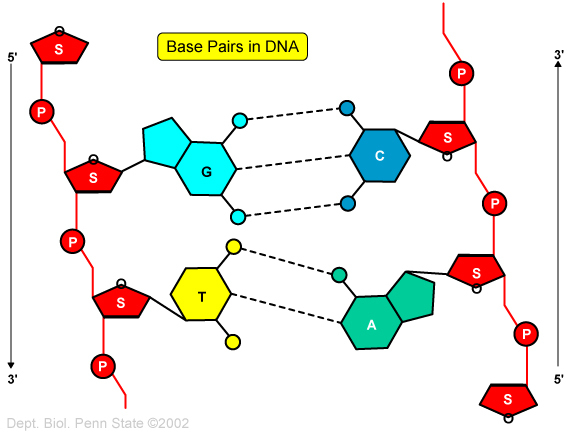
1.
What are the nucleotides made of?
a)
Sugar, Phosphate, nitrogen base
b)
Phosphate, Adenine, nitrogen base
c)
Thymine, Adenine, Cytomine
d)
Phosphate, Nitrogen, Adenine
2.
What are the nucleotides made of?
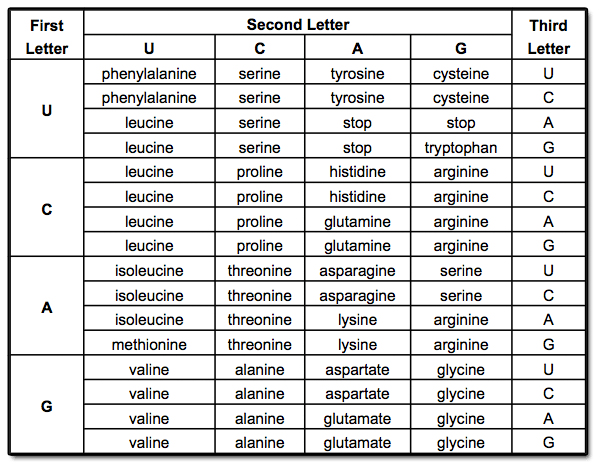
a)
Sugar, Phosphate, nitrogen base
b)
Phosphate, Adenine, nitrogen base
c)
Thymine, Adenine, Cytomine
d)
Phosphate, Nitrogen, Adenine
3.
Why is DNA important?
a)
it is very small and very complicated
b)
it's in everything
c)
it serves as the blueprint for traits of all living things
d)
because we eat it every day for energy
4.
What are the 4 nitrogen bases?
a)
adenine, thymine, cytoplasm, and guanine
b)
adenine, thymine cytosine, and guanine
c)
adenine, thymine, cytosine, and gylcerol
d)
adenine, thymine, cytosine, and glucose
5.
Which sequence of DNA bases would pair with this partial strand
ATG TGA CAG
a)
ATG TGA CAG
b)
TAC ACT GTC
c)
GTA AGT GAC
d)
CAT TCA CTG
6.

In eukaryotes, which organelle is DNA usually found in?

a)

cell membrane

b)

vacuole

c)

chloroplast

d)

nucleus

7.
Which shows the correct complementary base pairing for DNA?
a)
C-A, T-G
b)
A-G, C-T
c)
C-G, U-A
d)
T-A, G-C
8.
The building block of nucleic acids are nucleotides.  Nucleotides are composed of a sugar, a phosphate group, and a _________________ base.
a)
oxygen
b)
hydrogen
c)
nitrogen
d)
carbon
9.
The sugar in DNA is ?
a)
sucrose
b)
glucose
c)
deoxyribose
d)
fructose
10.
Which of the following monomers are repeatedly joined together to form a strand of DNA?
a)
amino acids
b)
nucleotides
c)
fatty acids
d)
polysaccharides
11.
What determines the code, or information, of a DNA molecule?
a)
the shape (structure) of the nitrogen bases
b)
the order (sequence) of the nitrogen bases
c)
the color of the nitrogen bases
d)
the frequency (number) of nitrogen bases
12.
Which 2 molecules form the sides (backbone) of the DNA ladder?
a)
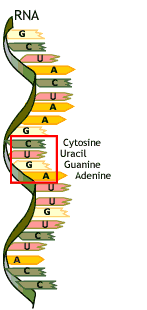
deoxyribose sugar and adenine
b)
deoxyribose sugar and a hydrogen bond
c)
deoxyribose sugar and the nucleus
d)
deoxyribose sugar and phosphate
13.
The two strands of nitrogenous bases in DNA are joined by which type of bond?
a)
polar bonds
b)
ionic bonds
c)
covalent bonds
d)
hydrogen bonds
14.
The drawing shows the structure of what molecule?
a)
A DNA molecule
b)
A lipid molecule
c)
A carbohydrate molecule
d)
A protein molecule
15.
X outlines a(n) ___________.
a)
amino acid
b)
nitrogen base 
c)
nucleotide
d)
nitrogen base pair
16.
If a DNA molecule consists of 29% Guanine, how much cytosine will it contain?
a)
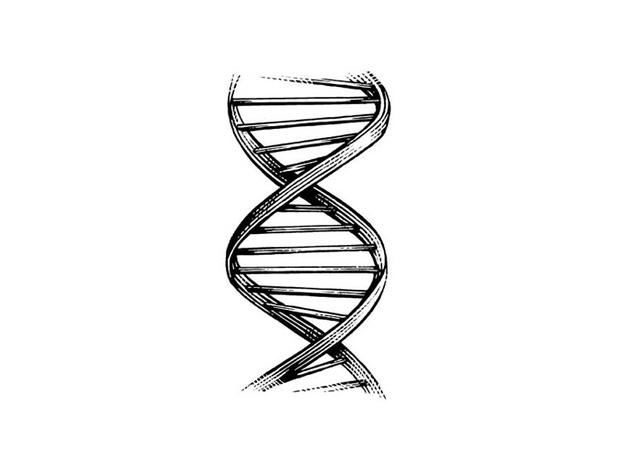
29%
b)
58%
c)
21%
d)
I have no idea.
17.

What makes up the SIDES of a DNA ladder?

a)

nitrogen bases

b)

sugars & phosphates

c)

genes & chromosomes

d)

RNA

18.
Nitrogenous bases are joined by which type of bond?
a)
polar bonds
b)
ionic bonds
c)
covalent bonds
d)
hydrogen bonds
19.
What are the three components of a nucleotide?
a)
sugar, hydrogen, nitrogen base
b)
sugar, oxygen, nitrogen base
c)
sugar, phosphate, nitrogen base
d)
sugar, phosphate, protein
20.
Guanine bonds with ______________.
a)
Adenine
b)
Guanine
c)
Cytosine
d)
Thymine
21.
Cytosine always pairs with
a)
Adenine
b)
Thymine
c)
Uracil
d)
Guanine
22.
In RNA, Uracil pairs with ______. 
a)
cytosine
b)
adenine
c)
guanine
d)
thymine
23.
The process to go from DNA to mRNA is _______
a)
translation
b)
transcription
c)
replication
24.
The process to go from mRNA to a protein is called ____
a)
transcription
b)
rRNA
c)
replication
d)
translation
25.
The main function of tRNA is to...
a)
carry a message that, when translated, forms proteins
b)
form a portion of ribosomes
c)
string together complementary RNA and DNA strands
d)
bring amino acids from the cytoplasm to the ribosomes
26.
What amino acid is represented by the codon UUA?
a)
Phenylalanine
b)
Tyrosine
c)
Leucine
d)
Stop codon
27.
Which component of DNA determines the traits of an organism? 
a)
Nitrogen Bases
b)
Sugar-Phosphate Backbone
c)
Hydrogen bonds
28.
What is the location in the cell for translation?
a)
nucleus
b)
mitochondria
c)
ribosome
d)
chloroplast
29.
What is the three base sequence of mRNA that codes for a single amino acid?
a)
Anticodon
b)
Codon
c)
Protein
30.
What is the location in the cell for transcription?
a)
nucleus
b)
cytoplasm
c)
ribosome
d)
mitochondria
31.
Which is the mRNA molecule that would be transcribed from this DNA template:
TGGCAAGTACGT
a)
ACCGTTCATGCA
b)
UGGCAAGUACGU
c)
UCCGUUCUUGCU
d)
ACCGUUCAUGCA
32.
DNA has a _____________ structure. 
a)
double helix
b)
single strand
c)
ring 
d)
chain
33.
Translation is the process where
a)
mRNA is created in the Nucleus
b)
mRNA is decoded to form a protein 
c)
glucose molecules are made
d)
is where lipids are synthesised
34.
Does the order of amino acids in a protein matter?
a)
YES!
b)
NO!
35.
How many amino acids are coded for by this sequence of nucleotides:
ATG GGA ACT CCA
a)
4
b)
2
c)
6
d)
12
36.

enzyme that adds new RNA nucleotides to make mRNA

a)

Helicase

b)

RNA Polymerase

c)

DNA Polymerase

d)

Helicase Polymerase

37.

Which organelle is the location where protein is made?

a)

Ribosome

b)

Nucleus

c)

Cytoplasm

d)

Nucleotide

38.

During transcription, this type of ribonucleic acid is responsible for copying the DNA and brining it out of the nucleus.

a)

tRNA

b)

mRNA

c)

rRNA

d)

dRNA

39.

When these bond together, they form a protein

a)

Amino Acids

b)

Peptide Bonds

c)

Ribose

d)

Nucleotides

40.

These building blocks consist of a sugar, phosphate, and nitrogen base.

a)

Ribose

b)

Nucleotide

c)

Gene

d)

Protein

41.

mRNA occurs during this process

a)

Translation

b)

Transcription

c)

Replication

d)

Delivery

42.

Which of the following is the complementary mRNA sequence to this DNA strand: AACTGAA

a)

UUGACUU

b)

TTGACTT

c)

AACTGAA

d)

AACUGAA

43.
What is the term for a three-nucleotide sequence that codes for an amino acid?
a)
base
b)
codon
c)
amine
d)
serine
44.
The process to go from DNA to mRNA is _______
a)
translation
b)
transcription
c)
replication
45.
The process to go from mRNA to a protein is called ____
a)
transcription
b)
rRNA
c)
replication
d)
translation
46.
What amino acid is represented by the codon UUA?
a)
Phenylalanine
b)
Tyrosine
c)
Leucine
d)
Stop codon
47.
A sugar, a phosphate group, and a nitrogen base form the building blocks of which organic compound?
a)
carbohydrates
b)
nucleic acids
c)
lipids
d)
proteins
48.
Which of the following is the template for the production of RNA within a cell?
a)
DNA
b)
protein
c)
ATO
d)
carbohydrate
49.
Genetic info flows in one direction. Which best represents this flow?
a)
DNA-protein-RNA
b)
Protein-RNA-DNA
c)
RNA-protein-DNA
d)
DNA-RNA-protein
50.
In RNA, Uracil pairs with ______. 
a)
cytosine
b)
adenine
c)
guanine
d)
thymine
51.

Why must transcription occur where DNA can be found?

a)

because DNA can't leave

b)

because ribosomes are in the nucleus

c)

because DNA polymerase is found there

d)

because helicase unzips the DNA

52.
What is the location in the cell for transcription?
a)
nucleus
b)
cytoplasm
c)
ribosome
d)
mitochondria
53.
What is the location in the cell for translation?
a)
nucleus
b)
mitochondria
c)
ribosome
d)
chloroplast
54.

This laboratory procedure is known as

a)

CLONING

b)

gel electrophoresis

c)

chromatography

d)

use of a dichotomous key

55.

In preparation for an electrophoresis procedure, enzymes are added to DNA in order to

a)

convert the DNA into gel

b)

cut the DNA into fragments

c)

change the color of the DNA

d)

produce longer sections of DNA

56.

A student performed a gel electrophoresis experiment. The results are represented in the diagram

below. Compared to the fragments at the top of the gel, the fragments at the lower end are

a)

larger, and move slower

b)

larger, and move faster

c)

smaller, and move faster

d)

smaller, and move slower

57.

Which chemicals are used to cut DNA into fragments for a gel electrophoresis procedure?

a)

enzymes

b)

molecular bases

c)

hormones

d)

ATP molecules

58.

This technique used to analyze DNA involves the

a)

synthesis of new DNA strands from subunits

b)

separation of DNA fragments based on size

c)

production of genetically engineered DNA molecules

d)

removal of defective genes from DNA

59.
Based on these results whose blood was found in the blood stain at the crime scene?
a)
Bob
b)
Sue
c)
John
d)
Lisa
60.
Which suspect is likely guilty?
a)
Suspect #1
b)
Suspect #2
c)
Suspect #3
61.
DNA fingerprinting works because
a)
Most genes are dominant
b)
All organisms contain RNA
c)
The most important genes are different among most people
d)
No two people, except identical twins, have exactly the same DNA 
62.
What is the purpose of gel electrophoresis?
a)
helps cut DNA
b)
count the genes in DNA
c)
separates DNA based on size
d)
allows for an exact replicated organism
63.
Why do the fragments of DNA in gel electrophoresis travel away from the negative electrode?
a)
DNA is negatively charged so attracted to the positive end of the unit
b)
DNA is positively charged to attracted to the negative end of the unit
c)
the agarose gel in negatively charged
d)
the agarose gel is positively charged
64.
In gel electrophoresis, the largest DNA fragment will appear
a)
closest to the starting wells
b)
farthest from the starting wells
c)
three quarters away from the starting wells
d)
it depends on how many fragments there are
65.
Which is the primary purpose of using restriction enzymes in gel electrophoresis?
a)
It allows the strands of DNA to be cut into various lengths for testing
b)
It restricts the number of base pairs that can be tested in a sample
c)
It makes the testing simpler by moving the strands into the gel faster
d)
It charges the DNA strands
66.

Once DNA has been extracted from the nucleus of a cell, it is exposed to ______ ______ that act like biochemical scissors to cut the DNA.

a)

restriction enzymes

b)

gel agarose

c)

clotting factors

d)

electric shock

67.
Which two bat species are most closely related?
a)
 Bat 1 and Bat 2
b)
Bat 1 and Bat 3
c)
Bat 2 and Bat 3
d)
There’s no way to tell
68.
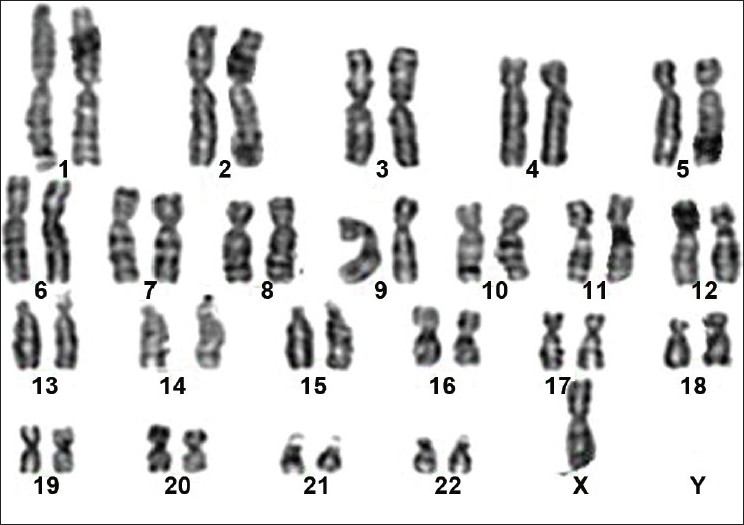
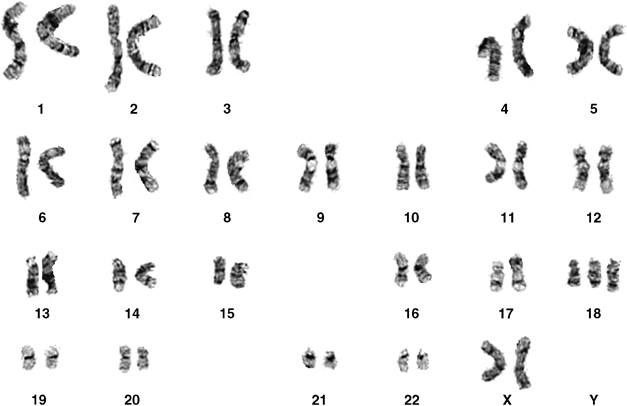
Determine the sex of the individual whose karyotype is displayed in the image.
a)
female
b)
male
69.
Determine the sex of the individual whose karyotype is displayed in the image.
a)
female
b)
male
70.
When chromosomes fail to separate correctly during anaphase of meiosis, what can occur?
a)
extra chromosomes are found in the sex cell
b)
chromosomes of the sex cell are doubled
c)
chromosomes of the sex cell are halved
d)
meiosis never completes
71.
Nondisjunction can result in 
a)
trisomy conditions
b)
monosomy conditions
c)
additional sex chromosomes
d)
all of these
72.
A pair of identical chromosomes shown in a karyotype, one inherited from mom, and one inherited from dad are called
a)
sister chromotids
b)
centromeres
c)
homologous chromosomes
d)
autosomes
73.
A sperm contains
a)
Both an X and a Y chromosome
b)
Two X chromosomes
c)
An X OR a Y chromosome
d)
only a Y chromosome
74.
An egg contains
a)
22 autosomes and an X chromosome
b)
22 autosomes and an Y chromosome
c)
44 autosomes and 2 X chromosomes
d)
44 autosomes and an X and a Y chromosome
75.
What makes this individual's karyotype not normal?
a)
An extra sex chromosome
b)
An extra autosome
c)
A missing sex chromosome
d)
A missing autosome
76.
What is the sex of this individual?
a)
female
b)
male
77.
What is the sex of this individual?
a)
female
b)
male
78.
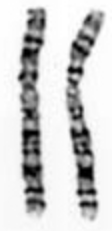
Down's syndrome occurs because of a(n)
a)
missing sex chromosome
b)
extra sex chromosome
c)
additional 21st chromosome
d)
additional 18th chromosome
79.
Chromosome pairs 1-22 are referred to as
a)
sex chromosomes
b)
sister chromatids
c)
a karyotype
d)
autsomes
80.
A picture of paired chromosomes is a
a)
sister chromatid
b)
centromere
c)
syndrome
d)
karyotype
81.
Which would be considered a somatic cell?
a)
Sperm cell
b)
Egg Cell
c)
Skin Cell
d)
All of these
82.
What chromosome is affected by Down's Syndrome?
a)
23
b)
18
c)
13
d)
21
83.
Which of the following would be considered a Gamete cell?
a)
Egg Cell
b)
Sperm Cell
c)
Both of these
d)
None of these
84.
What would indicate a human male?
a)
XX
b)
X
c)
XY
d)
XXY
85.
Which of the following can a karyotype not tell you?
a)
Whether someone has Down syndrome
b)
Whether someone has a monosomy
c)
What gender someone is
d)
Whether someone has Tay-Sachs
86.
a)
This karyotype shows Trisomy 21
b)
This karyotype has no abnormality
c)
This karyotype is missing a sex chromosome (monosomy x)
d)
This karyotype is from a gamete
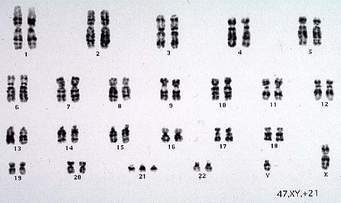
87.
Based on the Karyotype shown, at which chromosome pair can we identify a genetic disorder? 
a)
Chromosome pair 5
b)
sex chromosomes
c)
Chromosome pair 21
d)
There are no chromosomal disorders
88.
What is the chromosomal condition of the individual whose karyotype is seen in the image?
a)
Monosomy X (Turner's Syndrome)
b)
Trisomy 21 (Down's Syndrome)
c)
Trisomy 13 (Patau Syndrome)
d)
Trisomy 18 (Edwards's Syndrome)
89.
A pair of identical chromosomes shown in a karyotype, one inherited from mom, and one inherited from dad are called
a)
sister chromotids
b)
centromeres
c)
homologous chromosomes
d)
autosomes
90.
Nondisjunction can result in 
a)
trisomy conditions
b)
monosomy conditions
c)
additional sex chromosomes
d)
all of these
91.
Down's syndrome occurs because of a(n)
a)
missing sex chromosome
b)
extra sex chromosome
c)
additional 21st chromosome
d)
additional 18th chromosome
92.

What would you call the failure of one or more pairs of homologous chromosomes or sister chromatids to separate normally during meiosis?

a)

nondisjunction

b)

anaphase I

c)

nondiploidy

d)

karyotype

93.
Determine the sex of the individual whose karyotype is displayed in the image.
a)
female
b)
male
94.
Determine the sex of the individual whose karyotype is displayed in the image.
a)
female
b)
male
95.
Which structure is labeled as A in the diagram?
a)
Centromere
b)
Chromosome
c)
Sister chromatids
96.
Which structure is labeled as B in the diagram?
a)
Centromere
b)
Chromosome
c)
Sister chromatids
97.
A sperm contains
a)
Both an X and a Y chromosome
b)
Two X chromosomes
c)
An X OR a Y chromosome
d)
only a Y chromosome
98.
An egg contains
a)
22 autosomes and an X chromosome
b)
22 autosomes and an Y chromosome
c)
44 autosomes and 2 X chromosomes
d)
44 autosomes and an X and a Y chromosome
99.
What makes this individual's karyotype not normal?
a)
An extra sex chromosome
b)
An extra autosome
c)
A missing sex chromosome
d)
A missing autosome
100.
What is the sex of this individual?
a)
female
b)
male
101.
What is the sex of this individual?
a)
female
b)
male
102.
What is the sex of this individual?
a)
female
b)
male
103.

Turner's Syndrome, as shown in this karyotype, has a karyotype notation of

a)

47XX+21

b)

47XXY

c)

45XO

d)

44XX

104.

Klinefelter's Syndrome as shown in this karyotype has a notation of

a)

47XX+21

b)

47XXY

c)

45XO

d)

44XX

105.

Chromosome pairs 1-22 are referred to as

a)

sex chromosomes

b)

sister chromatids

c)

a karyotype

d)

autosomes

106.
A picture of paired chromosomes is a
a)
sister chromatid
b)
centromere
c)
syndrome
d)
karyotype
107.

In what process is mRNA synthesized?

a)

Transcription

b)

Translation

c)

DNA Replication

d)

Mitosis

108.

Where does TRANSCRIPTION occur?

a)

Nucleus

b)

Ribosome

c)

Cytoplasm

d)

Mitochondria

109.

Why must transcription occur where DNA can be found?

a)

because DNA can't leave

b)

because ribosomes are in the nucleus

c)

because DNA polymerase is found there

d)

because helicase unzips the DNA

110.

How many nucleotides equal 1 amino acid?

a)

1

b)

2

c)

3

d)

4

111.

TRANSCRIBE this DNA sequence: TACGTTACT

a)

AUGCAAUGA

b)

ATGCAATGA

c)

AUGGATUGA

d)

TACGTTACT

112.

Which of the following are differences in the structure between RNA and DNA

a)

DNA uses deoxyribose sugar, RNA uses sugar ribose

b)

DNA pairs Adenine with Uracil, RNA pairs Adenine with Thymine

c)

DNA is a double helix, RNA is a single helix

d)

DNA pairs Adenine with Thymine, RNA pairs Adenine with Uracil

113.

Which organelle is the location where protein is made?

a)

Ribosome

b)

Nucleus

c)

Cytoplasm

d)

Nucleotide

114.

When these bond together, they form a protein

a)

Amino Acids

b)

Peptide Bonds

c)

Ribose

d)

Nucleotides

115.
What is the term for a three-nucleotide sequence that codes for an amino acid?
a)
base
b)
codon
c)
amine
d)
serine
116.
The process to go from DNA to mRNA is _______
a)
translation
b)
transcription
c)
replication
117.
The process to go from mRNA to a protein is called ____
a)
transcription
b)
rRNA
c)
replication
d)
translation
118.
Which two processes are involved in protein synthesis?
a)
Replication and Transcription
b)
Replication and Translation
c)
Transcription and Translation
119.
Which of the following molecules is made during transcription?
a)
DNA
b)
tRNA
c)
protein
d)
mRNA
120.
Which of the following bases is found only in RNA?
a)
Adenine
b)
Guanine
c)
Thymine
d)
Uracil
121.
Which form of RNA carries amino acids from the cytoplasm to the ribosome?
a)
amino RNA
b)
ribosomal RNA
c)
transfer RNA
d)
messenger RNA
122.
Which organelle is DNA usually found in?
a)
cell membrane
b)
vacuole
c)
ribosome
d)
nucleus
123.
What happens during transcription?
a)
DNA is made into amino acids
b)
DNA is made into mRNA
c)
DNA is made into a protein
124.
The three bases in mRNA, are called codons, what are corresponding bases in tRNA?
a)
codon
b)
anticodon
c)
transcriptase
d)
hydrogen bonds
125.
Which of the following bases is found only in RNA?
a)
Adenine
b)
Guanine
c)
Thymine
d)
Uracil
126.
Where are codons located?
a)
tRNA
b)
DNA
c)
mRNA
127.

rRNA makes up what organelle of the cell?


a)

Nucleus

b)

Cytoplasm

c)

Ribosome

d)

Mitochondria

128.

What is the structure shown in the middle of the pink box?

a)

tRNA

b)

Amino Acid

c)

Anticodon

d)

Codon

129.

What is the structure shown in the middle of the pink box?

a)

tRNA

b)

Amino Acid

c)

Anticodon

d)

Codon

130.

What is the structure shown in the middle of the pink box?

a)

tRNA

b)

Amino Acid

c)

Anticodon

d)

Codon

131.

What is the structure shown in the image?

a)

tRNA

b)

mRNA

c)

rRNA

d)

xRNA

132.

Which codon below is the code for Leucine?

a)

UUA

b)

UUC

c)

AUU

d)

CUA

133.
Guanine bonds with ______________.
a)
Adenine
b)
Guanine
c)
Cytosine
d)
Thymine
134.

Which of the following statements is correct about the differences between DNA and RNA?

a)

RNA contains the same bases as DNA, except uracil is present instead of guanine

b)

DNA is not present in prokaryotes, while RNA is

c)

DNA is present as a single-stranded molecule while RNA is double-stranded

d)

The sugar molecule in RNA has one more hydroxyl group than the sugar molecule in DNA

135.
What type of RNA carries the DNA message out of the nucleus to the ribosomes?
a)
mRNA
b)
tRNA
c)
RNA
d)
DNA
136.
When transferring tRNA to amino acids, the process cannot begin until it reaches a...
a)
Beginning codon
b)
Start codon 
c)
Initiator codon
d)
Anticodon
137.
What process is occurring in this photo?
a)
Transcription
b)
DNA unwinding
c)
Translation
d)
Transfer RNA is creating bases
138.
What is the correct amino acid sequence for the mRNA code AUGCCAGUAUGA?
a)
 Met-Pro-Val-Stop
b)
Met-Pro-Arg-Stop
c)
 Tyr-Gly-His
d)
Tyr-Gly-Arg-His
139.
Normal-
GAG-CTC-GAC-AGA
Mutant
GAG CTC-CAC-AGA
a)
no mutation
b)
substitution
c)
insertion
d)
deletion
140.
DNA molecule segment is : TTACGCAAG
The mutated DNA segment is TTCGCAAG. This is an example of ___ mutation.
a)
Substitution
b)
Deletion
c)
Insertion
d)
Inversion
141.
If you are missing or have an extra base  at the end of your mutated DNA . What type of mutation occurred?
a)
Substitution
b)
Frameshift
c)
Duplication 
d)
Insertion
142.
mRNA is read in chunks of three, called...
a)
quadralets
b)
anticodons
c)
codons
d)
capsids
143.
Original: ATC CAT
Mutation: ATC GCAT
What mutation occurred?
a)
deletion
b)
insertion
c)
silent
d)
transverse
144.
A frameshift mutation can occur with either _________ or __________ mutations.
a)
Addition, division
b)
Deletion, substitution
c)
Addition, substitution
d)
Addition, deletion
145.
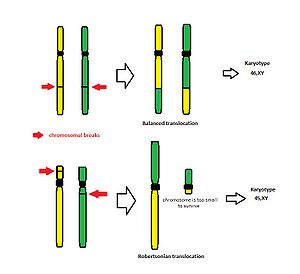
What type of chromosomal mutation is this?
a)
Inversion
b)
Translocation
c)
Deletion
d)
Duplication
146.
What is the definition of DNA mutation? 
a)
The original DNA strand
b)
The strand with four pairs 
c)
A change in the DNA strand
d)
The strand in a double helix 
147.
Identify the SUBSTITUTION mutation from the following DNA sequence: 
ATG CCA AAT
a)
ATG TCA AAT
b)
ATG CCT AAA T
c)
ATC CA  AT
d)
ATG CCA AAT
148.

Original DNA: CAT GAT CCA

New DNA: CAT TGA TCC A

What mutation occurred? (one has been added)

a)

deletion

b)

substitution

c)

tranverse

d)

insertion

149.

In DNA, A goes with __ and C goes with __

a)

T, G

b)

G, T

c)

C, A

150.
What type of chromosomal mutation is this?
a)
Translocation
b)
Inversion
c)
Deletion
d)
Duplication
151.
Which of the following would result in a frameshift mutation?
a)
Insertions only
b)
Substitution only
c)
Deletion only
d)
Insertions and Deletions
152.
In DNA, Adenine bonds with ______________.
a)
Guanine
b)
Thymine
c)
Cytosine
d)
Adenine
153.
Guanine bonds with ______________.
a)
Adenine
b)
Guanine
c)
Cytosine
d)
Thymine
154.
What does DNA stand for?
a)
Deoxyribonucleic acid
b)
Denitrogenous acid
c)
Deribonucleic acid
d)
Diribonucleic acid
155.
Which sequence of DNA bases would pair with this partial strand
ATG TGA CAG
a)
ATG TGA CAG
b)
TAC ACT GTC
c)
GTA AGT GAC
d)
CAT TCA CTG
156.
Which organelle is DNA usually found in?
a)
cell membrane
b)
vacuole
c)
ribosome
d)
nucleus
157.
Why is DNA important?
a)
it is very small and very complicated
b)
it's in everything
c)
it serves as the blueprint for traits of all living things
d)
because we eat it every day for energy
158.

Why is it crucial that living things are able to replicate their DNA?

a)

Each new cell must have an exact copy of DNA

b)

Less copies of DNA are needed when a new cell is created

c)

A cell needs multiple copies of DNA

d)

Only muscle cells need DNA

159.
Which of the following units are repeatedly joined together to form a strand of DNA?
a)
amino acids
b)
nucleotides
c)
fatty acids
d)
polysaccharides
160.
Which 2 molecules form the sides (backbone) of the DNA ladder?
a)
deoxyribose sugar and adenine
b)
deoxyribose sugar and a hydrogen bond
c)
deoxyribose sugar and the nucleus
d)
deoxyribose sugar and phosphate
161.
What part of DNA is different between individuals?
a)
Sugar
b)
Phosphate
c)
Order of nitrogen bases
162.
The sugar in DNA is ?
a)
sucrose
b)
glucose
c)
deoxyribose
d)
fructose
163.
The two strands of nitrogenous bases in DNA are joined by which type of bond?
a)
polar bonds
b)
ionic bonds
c)
covalent bonds
d)
hydrogen bonds
164.
What are the three components of a nucleotide?
a)
sugar, hydrogen, nitrogen base
b)
sugar, oxygen, nitrogen base
c)
sugar, phosphate, nitrogen base
d)
sugar, phosphate, protein
165.
What determines the code, or information, of a DNA molecule?
a)
the shape (structure) of the nitrogen bases
b)
the order (sequence) of the nitrogen bases
c)
the color of the nitrogen bases
d)
the frequency (number) of nitrogen bases
166.
Assume that you have straight hair and your sibling has curly hair. What accounts for this difference?
a)
You have DNA and your sibling does not.
b)
The your sequence of nitrogen bases is different than your sibling.
c)
Your sibling has a weave. 
d)
Your sibling has a genetic mutation. 
167.

Challenge- How many TOTAL NUCLEOTIDES are there in the DNA molecule pictured?

a)

5

b)

10

c)

2

d)

20

168.

Which of the following best describes the shape of a DNA molecule

a)

ladder

b)

twisted ladder

c)

Double helix

d)

Helix

169.

What is the function of DNA?

a)

Store genetic information

b)

Store energy

c)

Form enzymes

d)

Form the cell membrane

170.

What is this a picture of?

a)

DNA

b)

mRNA

c)

rRNA

d)

tRNA

171.

What process is occurring in this picture?

a)

DNA Replication

b)

DNA Transcription

c)

DNA Translation

d)

DNA Synthesis

172.

What process is occurring in this image?

a)

DNA transription

b)

DNA replication

c)

DNA translation

d)

Mitosis

173.

Each section of DNA that codes for a protein is called a...

a)

Chromosome

b)

RNA

c)

Gene

d)

Enzyme

174.
Fill in the complementary bases according to the base-pair rule in DNA: A T C C A G
a)
T U G G T C
b)
T A G G T C
c)
T A C G T G
d)
T A C C A C
175.
DNA replication results in two DNA molecules,
a)
each one with two original strands
b)
each one with two new strands
c)
each one with one new strand and one original strand
d)
one with two new strands and the other with two original strands
176.
DNA codes for...
a)
cholesterol
b)
proteins
c)
fatty acids
d)
a sandwich
177.
Which is a difference between DNA and RNA
a)
RNA is double stranded
b)
RNA is not made of nucleotides
c)
RNA contains Uracil instead of Thymine
d)
RNA does not contain a sugar
178.
In order for DNA instructions to move from the nucleus to the ribosomes in the cytoplasm of a cell, an RNA copy of a DNA strand must be made. This process, which takes place in the cell nucleus, is called
a)
translation
b)
mutation
c)
DNA replication
d)
transcription
179.
Which RNA bases would pair with TACGAA in transcription
a)
AUGCUU
b)
ATGCTT
c)
GCATCC
d)
GCAUCC
180.

Where does Transcription take place?

a)

Inside the nucleus

b)

Inside the cytoplasm

c)

Inside the Ribosome

d)

Inside the Rough ER

181.

What happens to the mRNA sequence after it has been synthesized?

a)

stays in the nucleus

b)

leaves the cell

c)

leaves the nucleus

d)

separates into smaller pieces

182.

DNA is confined to the nucleus.

a)

True

b)

False

183.
What does mRNA do?
a)
provides information from DNA to ribosomes
b)
transfers amino acids to the ribosomes
c)
makes up ribosomes
d)
builds proteins
184.
What does rRNA do?
a)
provides information from DNA to ribosomes
b)
transfers amino acids to the ribosomes
c)
makes up ribosomes
d)
builds proteins
185.
What does tRNA do?
a)
provides information from DNA to ribosomes
b)
transfers amino acids to the ribosomes
c)
makes up ribosomes
d)
builds proteins
186.

Where are proteins made?

a)

ER

b)

nucleus

c)

cytoplasm

d)

mitochondria

187.
What are the three components of a nucleotide?
a)
sugar, hydrogen, nitrogen base
b)
sugar, oxygen, nitrogen base
c)
sugar, phosphate, nitrogen base
d)
sugar, phosphate, protein
188.

What is the correct complimentary strand for the following DNA?

ATCGAG

a)

TACGAG

b)

TAGCTG

c)

ATCGAG

d)

TAGCTC

189.
Which sequence of DNA bases would pair with this partial strand
ATG TGA CAG
a)
ATG TGA CAG
b)
TAC ACT GTC
c)
GTA AGT GAC
d)
CAT TCA CTG
190.
Which of the following best describes a DNA molecule?
a)
double helix
b)
contains ribose
c)
made of amino acids
d)
contains Uracil
191.
Which of the following units are repeatedly joined together to form a strand of DNA?
a)
amino acids
b)
nucleotides
c)
fatty acids
d)
polysaccharides
192.
In a molecule of double-stranded DNA, the amount of Adenine present is always equal to the amount of
a)
cytosine
b)
guanine
c)
thymine
d)
uracil
193.
Adenine bonds with ______________.
a)
Guanine
b)
Thymine
c)
Cytosine
d)
Adenine
194.
Guanine bonds with ______________.
a)
Adenine
b)
Guanine
c)
Cytosine
d)
Thymine
195.
Why is DNA important?
a)
it is very small and very complicated
b)
it's in everything
c)
it serves as the blueprint for traits of all living things
d)
because we eat it every day for energy
196.
What determines the code, or information, of a DNA molecule?
a)
the shape (structure) of the nitrogen bases
b)
the order (sequence) of the nitrogen bases
c)
the color of the nitrogen bases
d)
the frequency (number) of nitrogen bases
197.
Which 2 molecules form the sides (backbone) of the DNA ladder?
a)
deoxyribose sugar and adenine
b)
deoxyribose sugar and a hydrogen bond
c)
deoxyribose sugar and the nucleus
d)
deoxyribose sugar and phosphate
198.
Which organelle is DNA usually found in?
a)
cell membrane
b)
vacuole
c)
chloroplast
d)
nucleus
199.
Replicate the following strand of DNA: 
AATCATGGA
a)
AATCATGGA
b)
TTAGTACCT
c)
UUAGUACCU
d)
GGATAUCUA
200.

What is the correct complimentary strand for the following DNA? ATCGAG

a)

TACGAG

b)

ATCGAG

c)

TAGCTG

d)

TAGCTC

201.
The drawing shows the structure of what molecule?
a)
A DNA molecule
b)
A lipid molecule
c)
A carbohydrate molecule
d)
A protein molecule
202.
What are the three components of a nucleotide?
a)
sugar, hydrogen, nitrogen base
b)
sugar, oxygen, nitrogen base
c)
sugar, phosphate, nitrogen base
d)
sugar, phosphate, protein
203.
Which of the following best describes a DNA molecule?
a)
double helix
b)
contains ribose
c)
made of amino acids
d)
contains Uracil
204.
A nucleotide includes...?
a)
pentose sugar
b)
nitrogenous base
c)
phosphate group
d)
all of the above
205.
What does DNA stand for?
a)
Deoxyribonucleic acid
b)
Denitrogenous acid
c)
Deribonucleic acid
d)
Diribonucleic acid
206.
Which of the following units are repeatedly joined together to form a strand of DNA? (This is the MONOMER of DNA.) 
a)
amino acids
b)
nucleotides
c)
fatty acids
d)
polysaccharides
207.
The traits of an organism are passed to its offspring on small coded strands of DNA material called
a)
meiosis
b)
recessive traits
c)
genes
d)
heredity
208.

Amount of A=T and G=C

a)

Chargaff

b)

Franklin

c)

Watson and Crick

d)

Hershey and Chase

209.

Came up with the term 'transforming principle'

a)

Mendel

b)

Griffith

c)

Avery

d)

Hershey and Chase

210.

Won the Nobel Prize

a)

Chargaff

b)

Franklin

c)

Watson and Crick

d)

Hershey and Chase

211.

Was the first to say that DNA was the 'transforming principle'

a)

Mendel

b)

Griffith

c)

Avery

d)

Hershey and Chase

212.

Compared S-bacteria extract with protein and saw that they had very little in common

a)

Mendel

b)

Griffith

c)

Avery

d)

Hershey and Chase

213.

Created models of DNA

a)

Chargaff

b)

Franklin

c)

Watson and Crick

d)

Hershey and Chase

214.

Studied bacteriophages

a)

Mendel

b)

Griffith

c)

Avery

d)

Hershey and Chase

215.

Used x-rays to take pictures of DNA

a)

Chargaff

b)

Franklin

c)

Watson and Crick

d)

Hershey and Chase

216.

Worked with pea plants

a)

Mendel

b)

Griffith

c)

Avery

d)

Hershey and Chase

217.

(Secretly) took a look at Franklin's image of DNA

a)

Chargaff

b)

Franklin

c)

Watson and Crick

d)

Hershey and Chase

218.

Figured out the amount of A, T, G, and C that many different organisms have

a)

Chargaff

b)

Franklin

c)

Watson and Crick

d)

Hershey and Chase

219.

Created radioactive viruses to see what their genetic material was made of

a)

Mendel

b)

Griffith

c)

Avery

d)

Hershey and Chase

220.

Known as the "Father of Genetics"

a)

Mendel

b)

Griffith

c)

Avery

d)

Hershey and Chase

221.

Conducted research on bacteria that cause pneumonia

a)

Mendel

b)

Griffith

c)

Avery

d)

Hershey and Chase

222.

Did NOT win the Nobel Prize, though her work was stolen and used to win it!

a)

Chargaff

b)

Franklin

c)

Watson and Crick

d)

Hershey and Chase

223.

The shape of DNA is a triple helix.

a)

true

b)

false

224.

Alone, R-bacteria caused pneumonia.

a)

true

b)

false

225.

Microscopic models were used to show DNA's structure to the world.

a)

true

b)

false

226.

Chargaff did NOT understand what his own data meant.

a)

true

b)

false

227.

Bacteria can steal genes from other bacteria.

a)

true

b)

false

228.

What organism(s) did Frederick Griffith study? There may be 2!

a)

mice

b)

bacteriophage

c)

bacteria

229.

Who discovered that bacteria could be changed by the process of transformation?

a)

Griffith

b)

Hershey & Chase

c)

Avery

d)

Franklin

230.

Who discovered that genes were composed of DNA?

a)

Oswald Avery

b)

Frederick Griffith

c)

Hershey & Chase

d)

Erwin Chargaff

231.

Who discovered that the genetic material in a bacteriophage was DNA?

a)

Hershey & Chase

b)

Griffith

c)

Avery

d)

Watson & Crick

232.

Who worked with Hershey?

a)

Chase

b)

Watson

c)

Franklin

d)

Crick

233.

Who discovered that A = T and C = G?

a)

Chargaff

b)

Franklin

c)

Watson & Crick

d)

Griffith

234.

Who took a picture of DNA using X-ray diffraction?

a)

Rosalind Franklin

b)

Watson & Crick

c)

Oswald Avery

d)

Hershey & Chase

235.

Who developed the double-helix model of DNA?

a)

Watson & Crick

b)

Avery

c)

Hershey & Chase

d)

Franklin

236.

Who did Crick do his research with?

a)

Watson

b)

Avery

c)

Hershey

d)

Chase

237.

What is a virus that infects bacteria called?

a)

bacteriophage

b)

infectious virus

c)

transformation

d)

gene change

238.
DNA contains the instructions for 
a)
lipids
b)
proteins
c)
saturated fats
d)
carbohydrates
239.
DNA is
a)
ribonucleic acid
b)
deoxyribonucleic acid
c)
deoxyribonucleic atom
d)
dinitrogenous acid
240.
The basic building blocks of DNA are 
a)
amino acids
b)
lipids
c)
carbohydrates
d)
nucleotides
241.
Deoxyribose is a 
a)

a lipid

b)

5-carbon sugar

c)

a phosphate

d)

nitrogen

242.
In DNA, nucleotides are held together by
a)
ionic bonds
b)
weak hydrogen bonds
c)
carbonic bonds
d)
oxygenated bonds
243.
Adenine bonds with
a)
adenine
b)
thymine
c)
guanine 
d)
cytosine
244.
Guanine bonds with
a)
Adenine 
b)
Thymine
c)
Guanine
d)
Cytosine
245.

The structure of our DNA can be described as

a)

a ladder

b)

a double helix

c)

a circle

d)

an infinite chain

246.

DNA provides the code for proteins such as (choose 3)

a)

enzymes

b)

hormones

c)

cell membranes

d)

antibodies

e)

digestive acids

247.

DNA's ribbon-like backbone is made of

a)

deoxyribose sugar and phosphate groups

b)

carbon atoms

c)

enzymes and hormones

248.

I am a nucleic acid.

a)

DNA

b)

RNA

c)

Both DNA and RNA

249.

In eukaryotic cells, I travel out of the nucleus to a Ribosome.

a)

RNA

b)

DNA

c)

Both DNA and RNA

250.

I have the nitrogen base, thymine.

a)

RNA

b)

Both DNA and RNA

c)

DNA