
 Worksheets
Sorensen Waves
Total questions: 75
Worksheet time: 15mins

What do all waves transfer?
Matter
Heat
Electricity
Energy

Which of the following can EM waves transfer energy through?
solid
liquid
gas
empty space
all of the above

What are the two types of waves?
longitudinal and transverse
sound and light

What is the number of complete waves passing a fixed point in a given amount of time?
Amplitude
Intensity
Wavelength
Frequency

What is frequency measured in?
Milliseconds
Miles
Hertz
Kilograms

Period of a wave refers to...
how long it takes for the event to repeat.
how strong a wave is.
how long a wave is.
how much energy a wave has.

Which type of waves have the longest wavelength?
Visible light
Radio waves
X-rays
Gamma-Rays

Wavelengths are usually measured in ....
seconds
Hz
inches
meters

Shorter wave lengths can carry more energy. Which of these probably carries the MOST energy:
Infrared light
Visible light
X-rays
UV light

What is the distance between the calm sea and the highest wave called?
Wave
Frequency
Amplitude
Magnitude

What does #1 represent?
Period
Frequency
Wavelength
Amplitude

What does #2 represent?
Period
Frequency
Wavelength
Amplitude
In longitudinal waves, the parts where the particles are spread apart are called what?
rarefactions
compressions
mechanicals
longitudes


Amplitude reflects the intensity, or amount of ____________________ in a wave.
energy
compression
rarefaction
speed


A wave that can only travel through matter is called:
solid waves
longitudinal waves
transverse waves
mechanical waves
Which wave travels in outer space?
light
sound
What type of wave is sound?
transverse
longitudinal
Sound travels fastest through:
air
water
wood
saltwater
At which temperature would sound move fastest?
40 degrees
-20 degrees
60 degrees
90 degrees
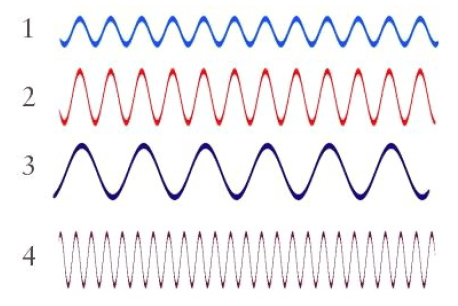
Which wave in the diagram has the greatest frequency?
1
2
3
4
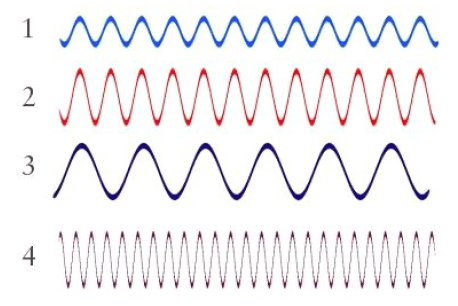
Which wave in the diagram has the greatest wavelength?
1
2
3
4

How fast the wave is moving through a medium
wave speed
wavelength
amplitude
frequency
when a wave is bent by traveling from one medium to another
reflection
refraction
absorption
propagation
Examples of this type of waves include water waves, waves on a string/jump rope, and light waves.
transverse
longitudinal
Examples of _____ waves include sound waves and earthquake P-waves.
transverse
longitudinal
_______ is the distance between waves, measured from one crest to the next crest.
Wavelength
Frequency
Amplitude
Frequency is how many waves pass a point in 1 second. If 100 waves pass a given point in 4 seconds, what is the wave's frequency?
25 Hz
100 Hz
4 Hz
400 Hz

In a longitudinal wave, a ____ is an area where the particles are spread apart and a ____ is an area where the particles are close together.
crest, trough
compression, rarefaction
rarefaction, compression
trough, crest
Waves that can travel through empty space are called _____ waves. Waves that require a medium to travel, such as air or water, are called _____ waves.
mechanical, electromagnetic
electromagnetic, mechanical
crest, trough
compressional, rarefactional

In the diagram of a compressional wave, A is showing a ___ while B is showing a ___.
compression, rarefaction
trough, crest
rarefaction, compression
crest, trough

Which word is used to identify the distance between points C & G?
Amplitude
Crest
Frequency
Wavelength
What is the speed of a wave that has a wavelength of 2 and a frequency of 3?
2.5 m/s
6 m/s
4.5 m/s
1 m/s


Cell phones (also have microwaves) and televisions use this type of EM wave. It has the longest wavelength with the lowest frequency.
Radio Wave
TV Wave
Gamma wave
Ultraviolet Wave

Which portion of the electromagnetic spectrum includes the range of light that can be detected by the human eye?
ultraviolet light
visible light
infrared light
x-rays

If the wavelength of an electromagnetic wave is increasing, what is true about the energy?
Energy is increasing
Energy is decreasing
Energy is not dependent on wavelength.
energy is cancelled out

Which part of the electromagnetic spectrum has high enough energy to cause sunburn?
infrared light
visible light
ultraviolet light
microwaves

The type of wave with the shortest wavelength and highest frequency. This type of wave is extremely harmful.
radio
infrared
gamma
x ray

The type of EM wave that is used to cook food. It has a higher frequency (and shorter wavelength) than radio waves.
radio
microwave
gamma
visible light

These are the waves that are used absorbed by our bones and are used to create medical images.
visible light
gamma rays
x rays
microwaves

Which type of visible light has the highest energy?
Red
Yellow
Green
Violet

absorption
diffraction
reflection
refraction
transmission

absorption
diffraction
reflection
refraction
transmission

