
 Worksheets
BSCH 2411: QUIZ 3
Total questions: 10
Worksheet time: 20mins
The migratory aptitude for groups attached to a ketone or aldehyde carbonyl during the Baeyer-Villiger oxidation is:
H > Ph- > 3° alkyl > 2° alkyl > 1° alkyl > methyl
Ph- > H > 3° alkyl >2° alkyl >1° alkyl > methyl
3° alkyl > 2° alkyl > 1° alkyl > methyl > H > Ph-
H > 3° alkyl > 2° alkyl > 1° alkyl > methyl >Ph-
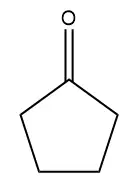
Which is the structure of the enol tautomer of the compound given.


Give the significant resonance structures of the possible enolate(s) that result from the deprotonation of the compound shown below.


Which of the following statements is INCORRECT for aldol condensation reaction?
The first step is deprotonation at the α-Hydrogen position
An aldol reaction occurs between two aldehydes or ketones, and at least one reactant must contain an α-Hydrogen atom
The product of an aldol reaction between two aldehydes is a β-diketone
An aldol reaction is a C–C bond-forming reaction

Which is the aldol addition product of the compound shown below.


How can the following compound be prepared beginning with an aldol addition?


Give the major product of the reaction below.


Is it possible for heptane-3,5-dione to undergo intramolecular aldol addition? Why or why not?
Yes, it will undergo an intramolecular aldol addition because it will create a stable ring structure.
No, it will not undergo an intramolecular aldol addition because it will create a stable ring structure.
Yes, it will undergo an intramolecular aldol addition because it will create a stable six-membered ring.
No, it will not undergo an intramolecular aldol addition because it will lead to a strained four-membered ring.

Show the plausible mechanism of the following Dieckmann condensation. [Ignore stereochemistry.]


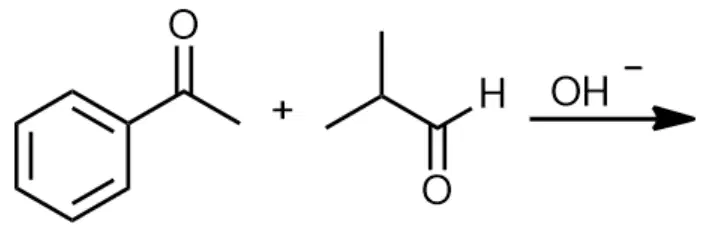
Determine the plausible product(s) for the crossed aldol condensation reaction below, showing both the products before and after dehydration. (Ignore stereochemistry.)



