
 Worksheets
Science Interim 2
Total questions: 65
Worksheet time: 2hrs 10mins
Which food chain is in the correct order?
grasshopper → grass → snake → frog → hawk
grasshopper → frog → hawk → snake → grass
grass → grasshopper → frog → snake → hawk
grass → grasshopper → snake → frog → hawk
How have desert plants adapted to their environment?
by limiting the use of sunlight
by storing water
by distributing certain nutrients
by releasing water

This diagram represents a food web. What role is the owl in the food web?
consumer
decomposer
herbivore
producer
Why can frogs and snakes live in the same garden?
Both keep weeds out of the garden.
Both help different plants to grow
Both occupy different niches.
Both compete for water.
What prevents plant growth beneath the trees in thick forests?
The trees limit the amount of sunlight that is able to reach the ground.
The roots of the trees make it difficult for plants to grow.
Little water reaches the ground under the trees.
The temperature of the soil under the trees does not allow plants to grow.
Which is the best example of habitat reduction caused by humans?
Birds and animals flee a forest fire caused by lightning
Birds become sick from eating insects new to their area.
Fish swimming to breeding grounds are blocked by dams.
A new species of fish migrates up a river, competing with native fish for food.
All of the landforms on Earth are constantly changing shape. What is most responsible for the changes in the landforms?
earthquakes
water erosion
pollution
oceans
How does water help to break apart rock?
by freezing and expanding
by melting and contracting
by condensing and expanding
by evaporating and contracting
What do meterologist depend on to forcast an approaching storm?
air pressure
temperature
humidity
wind speed

This diagram shows a light bulb. The bottom of the light bulb is shaped so that the bulb fits securely into a light socket.
Which type of simple machine is the bottom of the bulb?
lever
pulley
screw
wedge
Two people are each pulling on the opposite ends of a rope. If they are pulling on the rope with equal but opposite forces, what will happen to the rope?
It will stay in place between the two people.
It will move toward the right.
It will move toward the left.
It will fall to the ground.
Which of the following statements best describes the climate of an area rather than its weather conditions?
The summers are hot and humid.
The temperature at noon was 86°F.
Total rainfall on April 9 was 2 inches
Strong winds are expected tomorrow evening

This graph shows the motion of an animal.
When does the animal remain still?
between second 1 and second 2
between second 2 and second 3
between second 3 and second 4
between second 4 and second 5
Which statement best describes what must happen in order for a person to lift an object?
The force of gravity must be greater than the mass of the object
The mass of the object must be greater than the force of gravity.
The force of gravity must be greater than the upward pull or push on the object.
The upward pull or push on the object must be greater than the force of gravity.
This diagram shows a ramp with a toy car at the bottom. A string is attached to the front of the car and the string goes over a pulley at the top of the ramp. A weight is attached to the other end of the string. What would be most responsible for the toy car being pulled up the ramp?
friction
gravity
kinetic energy
momentum
What increases as a rock falls to the ground?
the density of the rock
the pull of gravity on the rock
the inertia of the rock
the momentum of the rock
Which best affects the motion of an object?
Color of the object
Strength of the force applies
Volume of sound
Water vapor in the air
Compared to summer, winter is much
warmer
colder
wetter
drier
Your mother is heating a pan on the stove. To remove the pan from the stove, she must use a pot holder to grab the handle. How does the handle get hot?
radiation from the sun
radiation from the burner on the stove
convection from the burner on the stove
conduction from the burner on the stove
Which factor will decrease precipitation rates?
increase in sunlight
decrease in sunlight
increase in evaporation
decrease in condensation
The heart is part of the _______ system.
respiratory
circulatory
digestive
skeletal
The digestive process begins where?
In your stomach
In your esophagus
In your mouth
In your small intestine
A medicine ball is a large, heavy ball. A beach ball is a large, light ball. If Thomas rolls both balls with the same force, which one will travel farther?
The medicine ball
The beach ball
They will travel the same distance
Neither ball will move
Durning a hockey game, a player uses his stick to push the puck. How does this force affect the motion of objects inside the ice rink?
The puck stays in place.
The hockey player moves.
The ice moves.
The puck moves a distance.
Which part of the water cycle directly increases the risk of flooding?
transpiration
condensation
evaporation
precipitation
Somari washed her mother's car in the driveway. Three hours later, the driveway was dry. What happened?
The water evaporated.
The water condensed.
The water was soaked up by the concrete.
The water chemically changed into air.

Aniyah tears a piece of paper and then sets it on fire. Describe what is happening.
The paper undergoes two physical changes.
The paper undergoes a physical change followed by a chemical change.
The paper undergoes a chemical change followed by a physical change.
The paper undergoes two chemical changes.
A liquid sample was given to Aiden in the science lab. Before the lab it was a clear, calm liquid. After the lab it was a blue and bubbly liquid. Based on this information, what conclusion can be drawn?
The liquid sample has not changed.
The liquid sample physically changed.
The liquid sample chemically changed.
The liquid dissolved and became a solid.


when matter has a change in its physical properties but not its chemical properties; only state, shape, size, color change; there is no new substance created
chemical change
physical change
inherited physical traits
acquired physical traits
happens when matter breaks down into two or more substances or when more than one substance is combined to form a new substance; it can not be reversed
chemical change
physical change
inherited physical traits
acquired physical traits
the smallest unit of life and make up all living things
microorganism
plant
cell
structure
A system used by scientists to help them group and study organisms by similarities, or things that the organisms have in common
constructive processes
destructive processes
classification
magnetism


Which are the 3 states of matter?
Cardboard
Solid
Liquid
Juice
Gas

Another name for water vapour is...
(a)

Water boils at 100°C
True
False

Particles in solids are...
Free to move
Closely packed together
No so packed together

Particles in gas state are...
Closely packed together
Free to move / spread
Not so closely packed together

What is CONDENSATION?
The change from liquid to solid
The change from gas to liquid
The change from liquid to gas

What is EVAPORATION?
The change from solid to liquid
The change from gas to liquid
The change from liquid to gas

What is FREEZING?
The change from gas to liquid
The change from liquid to solid

Which is the water thet we CAN drink?
FRESH WATER
SALT WATER

Choose 4 uses of steam.
To cook
To make machines work
To build a house
To sterilize in a hospital
To make electricity

Where can we find fresh water? (choose more than 1)
LAKES
RIVERS
OCEANS
ICE CAPS / GLACIERS

Which are the 3 processes in the WATER CYCLE?
Precipitation
Elaboration
Condensation
Evaporation

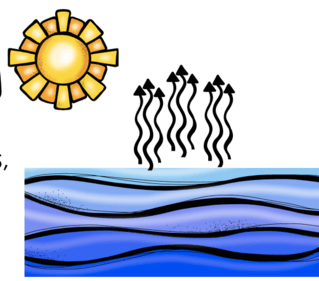

Which are the 3 forms of precipitation?
Dust
Hail
Snow
Rain

Plants form part of the water cycle
True
False

What are the clouds?
Cotton
Water in gas form + dust and gases
Water in solid form

