
NEW
Font size
 Worksheets
1st Semester Final Review: Units 1, 2
Total questions: 49
Worksheet time: 1hrs 14mins
What is the domain of a relation?
the set of all x-values
the set of all y-values

What is the DOMAIN of the graph shown?
(-4, 2]
[-4, 2)
[2, 5)
(2, 5]

What is the RANGE of the following graph?
[0, ∞)
[0, 3]
(-∞, ∞)
Given h(x)=3x2−2x+8 what is h(−1)?
13
8
16
answer not here

Find f(4)
1
2
3
4

What are the extrema of the graph?
Max = (2, -3), (1, 2)
Min = (-3, -1), (-1, 4)
Max = (-3, -1), (-1, 4)
Min = (2, -3), (1, 2)
Max = (-1, -3), (4, -1)
Min = (-3, 2), (2, 1)
Max = (-3, 2), (2, 1)
Min = (-1, -3), (4, -1)

Find the relative maximum and minimum
Rel. max at x = -3
Rel. min at x = -3
Rel. max at x = 1
Rel. min at x = -3
Rel. max at x = -3
Rel. min at x = 1
(−∞, ∞)

What is the location of the absolute maximum for the graphed function?
x = 1
x = 3
x = 4
x = 5
Does Not Exist

What is the increasing interval for the function below?
(−∞,∞)
(−∞,2]
(−∞,6]
(−6,6)

What is the decreasing interval on the function shown?
(−∞, −3)
(−∞, −4)
(−4, ∞)
(−3, ∞)

What is the increasing interval(s) on the function shown?
(−∞, −15) and (9, −15)
(−2, 9) and (2, ∞)
(−∞, −2) and (0, 2)
(−2, 0) and (2, ∞)

What is the y-intercept?
(0, 5)
(5, 0)
(0, -5)
(-5,0)


Describe the end behavior of the graph.
x → -∞, f(x) → ∞ and x→∞, f(x) →⁻∞
x → -∞, f(x) → ∞ and x→∞, f(x) →∞
x → -∞, f(x) → ∞ and x→∞, f(x) → 0
x → -∞,f(x) → -∞and x→ ∞, f(x) → ∞

As x --> -∞, f(x) --> ____
As x --> +∞, f(x) --> ____
-∞
-∞
+∞
+∞
The slope between the points (3, 5) and (8, 4) is _______.
−51
51
5
−5
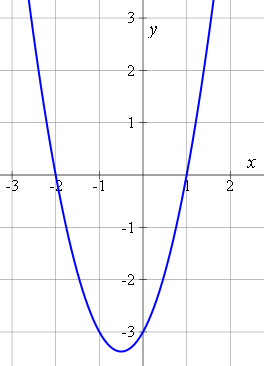
What is the average rate of change of f(x) on the interval [-3, -2].
y = g(x) to y = - g(x + 6) - 10
Shifted down 10 units
Shifted left 6 units
Shifted up 10 units
Shifted left 6 units
Shifted up 10 units
Shifted right 6 units
Shifted down 10 units
Shifted left 6 units

Evaluate the function when x = 4
f(4) = 2(4) - 5 = 3
f(4) = 2(4) - 5 = -1
f(4) = ½(4) + 1 = 3
f(4) = 4

Find f(0)
-3
18
4
0

(f + g) (x)
5x2 + 3x
4x2 + 3x
5x2 - 3x
4x2 - 40x

(f - g)(x)
5x2 + 3x
-3x2 - 13x
3x2 + 3x
-3x2 + 3x
f(x)=4x+1 and g(x)=4x−3. Find f(x)⋅g(x)
16x2+8x−3
16x2−8x+3
16x2−8x−3
16x2−16x−3

When f(x) = 2x and g(x) = x2+3 , find f(g(x)).
x2+2x+3
4x2+3
2x2+3
2x2+6
h(x)=3x-1
Find (g∘h)(x)


What is the degree of the polynomial?
3y2 + y4 + 4
2
3
4
5


x→ ∞, y→⁻∞
x→⁻∞, y→∞
x→∞, y→⁻∞


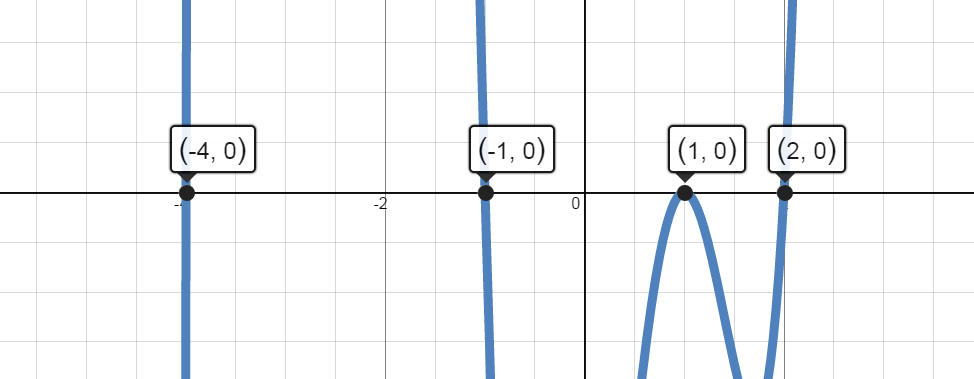
Find and select each real zero and its multiplicity
If the graph of a function crosses the x-axis, what does that mean about the multiplicity of that zero?
Even
Odd
None
If the there is a turning point on the x-axis, what does that mean about the multiplicity of that zero?
Even
Odd
None
Solve using long division (2x2+6x−20)÷(2x−4)
x+5+2x−42
x−8
x−5+2x−43
x+5

What is the proper way to write the answer for the following problem?
2x3-x2-25x+12
2x4-x3-25x2-12x+0
2x3-x2-25x-12
2x4-x3-25x2-12x-0
x+9x2+12x+27 Divide using synthetic division.
x+3
x+9
x-3
x-9

What is the remainder of (x3 - 5x2 - 8x +1) ÷ (x + 1)?
-13
1
3

