wayground logo

Free Printable Worksheets

Font size

S
M
L
XL
Worksheets

Honors Midterm Review

Total questions: 124

Worksheet time: 27hrs 19mins

Name
Class
Date
1.
You and your dad are moving the couch from one side to another. Your dad pushes with a force of 35 N to the right and you push with a force of 25 N right. What is the net force on the couch?
a)
60 N right
b)
10 N left
c)
60 N right
d)
50 N left
2.
Peanut ran 50 meters in 10 seconds.  What was Peanut's average speed?
a)
2 m/s
b)
5 km/h
c)
5 m/s
d)
5 m/s North
3.
What is the net force?
a)
17 N Right
b)
3 N Right
c)
3 N Left
d)
17 N Left
4.

Does upward movement of an object have a negative or positive velocity?

a)

Negative

b)

Positive

5.

What is the correct unit for distance in kinematics?

a)

m

b)

ft

c)

mi

d)

km

6.

What is the correct unit for velocity in kinematics?

a)

m/min

b)

mi/hr

c)

d/t

d)

m/s

7.

What is the correct unit for acceleration in kinematics?

a)

m/s

b)

m/min2

c)

m/s/t

d)

m/s2

8.

The highest point of an object's vertical motion where it changes direction to come back down.

a)

Final velocity

b)

Apex

c)

Displacement

d)

Height

9.

Change in velocity each second that goes by

a)

Velocity

b)

Displacement

c)

Acceleration

d)

Apex

10.
What is this graph representing?
a)
Constant Speed
b)
Acceleration (speeding up)
c)
Deceleration (slowing down)
d)
No motion
11.
You run from your house to a friend's house that is 3 km away. You then walk home. The distance you traveled is 6 km. What is your displacement? 
a)
6  km
b)
0 km
12.

Horse A is running East at a speed of 6 m/s. Horse B is running at a speed of 8 m/s East as it passes Horse A. What is Horse B's velocity relative to Horse A?

a)

14 m/s

b)

-2 m/s

c)

2 m/s

d)

48 m/s

13.

The equation for the force of friction is _______.

a)

Ff = µFg

b)

Ff = µFN

c)

Ff = µFT

d)

Ff = µFs

14.

Momentum is the product of _________________ and velocity.

a)

weight

b)

mass

c)

diretion

15.

Because it is a measure of two quantities, momentum is a ____________________.

a)

scalar

b)

vector

c)

both vector and scalar

16.

If an eagle and a bumble bee are both traveling at 10 km/hr, which has the greater momentum?

a)

eagle

b)

bumble bee

c)

both

17.

Which has more momentum: a 5-kg fish swimming at 100 m/hr or a 25-kg fish at rest?

a)

5-kg fish

b)

25-kg fish

c)

both

18.

In a game of pool, when the cue ball breaks the rack, momentum is _____from the cue ball to the rack, which is why cue ball stops moving.

a)

shared

b)

stationary

c)

transferred

19.

A bowling ball has 9 kg m/s of momentum when it is rolled 6 m/s. What is the mass of the bowling ball?

a)

54kg

b)

15kg

c)

3kg

d)

1.5kg

20.

The equation to calculate momentum is

a)

p = m x v

b)

p = 1/2 m x v2

c)

p = m x g x h

d)

p = m x g

21.
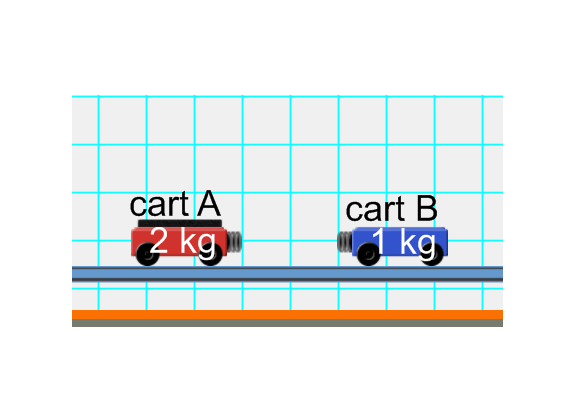
Cart A is pulled with a 2 Newton force for 2 seconds, and Cart B is pulled with a 1 Newton force for 3 seconds.  Which cart experiences the greatest impulse?
a)
Cart B
b)
Cart A
c)
they are the same
22.

A boy kicks a football with a force of 20 N, the time the force acts for is 0.3 s.

Calculate the impulse on the ball.

a)

1 N·s

b)

6 N·s

c)

66 N·s

d)

None of these

23.

A 5 N force is applied to a 3 kg ball to change its velocity from +9 m/s to +3 m/s. The impulse on the ball is ______ N·s.

a)

-2.5

.

.

b)

-10

c)

-18

d)

-45

24.
The impulse-momentum theorem states that
a)
the impulse on an object is equal to the change in momentum it causes 
b)
the force on a moving object is equal to the magnitude of the impulse.
c)
the impulse on an object is greater than the change in momentum it causes 
d)
the impulse on an object is less than the change in momentum it causes
25.

A constant force of 4.5 N acts on a 7.2-kg object for 10.0 s. What is the change in the object's momentum?

a)

45 kg m/s

b)

72 kg m/s

c)

32.4 kg m/s

d)

0.45 kg m/s

26.
can a bullet have the same momentum a truck?
a)
yes
b)
no
27.
In a physics experiment, two carts of mass 1.5 kg each are rolled towards each other.  The orange cart has a velocity of 2 m/s and the blue cart has a velocity of -1m/s.  The carts stick together when they collide.  Calculate their final speed.
a)
0.5 m/s
b)
1.0 m/s
c)
0.33 m/s
d)
0.67 m/s
28.

The momentum of an object depends upon the object's ___________&_____________.

a)

size and shape

b)

mass and speed

c)

mass and veloctiy

d)

mass and energy

29.
If two objects have the same mass, then the faster moving object has ____________ momentum.
a)
more 
b)
less
c)
the same
30.
While playing pool, the white cue ball strikes the 8 ball. Before the collision, the cue ball's velocity was 10 m/s and the 8 ball was at rest. If both ball's have a mass of 0.15 kg and the cue ball's velocity after the collision is 2 m/s, what is the 8 ball's velocity?
a)
2 m/s
b)
8 m/s
c)
-2 m/s
d)
1.5 m/s
31.
The total momentum before a collision is _________ the total momentum after a collision.
a)
equal to 
b)
less than 
c)
more than
d)
It depends on the type of collision
32.

A force of 8 Newton’s is applied to a crate so that it moves at a constant velocity of 1.5 m/s. What is the net force?

a)

1.5 N

b)

8 N

c)

12N

d)

0 N

33.

A forward force of 15 N is counteracted by a backwards frictional force of 6 N. The mass of the object is 2 kg. what is the acceleration?

a)

it cannot be determined

b)

4.5 m/s/s in the direction of the larger force

c)

7.5 m/s/s in the direction of the larger force

d)

3 m/s/s in the direction of the smaller force.

34.

A student has a weight of 155 lb. What is this in Newtons?

a)

70.5 N

b)

690 N

c)

155 N

d)

none of these is corrected

35.
A girl on a motorbike passes by at a speed of 15 m/s. Her mass is 40 kg. What is her kinetic energy
a)
300 Joules
b)
600 Joules
c)
950 Joules
d)
4500 Joules
36.
Calculate the potential energy of a roller coaster at the top of a 72 m hill that has a mass of 112 kg.
a)
79,027 J
b)
790,720 J
c)
7,020 J
d)
790,700 J
37.
At what position does the pendulum have the greatest gravitational potential energy?
a)
Position D
b)
Position C
c)
Position B
38.
At what position does the pendulum have the greatest kinetic energy?
a)
Position D
b)
Position C
c)
Position B
39.
Barry Bonds swings a bat which has a mass of 1.5 kg at a velocity of 55 m/s. How many joules of kinetic energy could he give to a baseball?
a)
2269 Joules
b)
83 Joules
c)
41 Joules
d)
4 Joules
40.

Two factors that determine work are

a)

force

b)

acceleration

c)

mass

d)

distance

e)

velocity

41.

units for work are

a)

newtons

b)

joules

c)

meters

d)

seconds

42.

if you push a cart with a force of 60 N for 2 m... how much work have you done

a)

120 J

b)

30 J

c)

120 N

d)

30 N

43.
What is the formula for work?
a)
Force = work x distance
b)
Distance = force x work
c)
Work = force x distance
d)
Work = force x mass
44.
You do 90 joules of work in 30 seconds. How much power have you generated?
a)
30 watts
b)
3 watts
c)
120 watts
d)
270 watts
45.
Which of the following would produce the most power?
a)
A mass of 10 kilograms lifted 10 meters in 10 seconds 
b)
A mass of 10 kilograms lifted 10 meters in 5 seconds
c)
A mass of 5 kilograms lifted 10 meters in 5 seconds
d)
A mass of 5 kilograms lifted 5 meters in 10 seconds
46.

At which point of the roller coaster is potential energy the greatest?

a)

W

b)

X

c)

Y

d)

Z

47.

The faster an object moves, the ________ kinetic energy it has.

a)

more

b)

less

48.

When two identical cars, one traveling twice as fast as the other, brake to a stop using old-fashioned brakes, the faster car will skid

a)

the same distance

b)

twice as far

c)

four times as far

d)

more than four times as far

49.

A model airplane moves three times as fast as another identical model airplane. Compared with the kinetic energy of the slower airplane, the kinetic energy of the faster airplane is

a)

the same for level flight

b)

twice as much

c)

more than four times as much

50.

500 J of work is done by a person who uses a force of 50N to move a box, how far does it go?

a)

10 m

b)

0.1 m

c)

25,000 m

d)

10 J

51.

Newtons are the unit for _____________.

a)

Work

b)

Distance

c)

Acceleration

d)

Force

52.

_____________ is the rate of doing work.

a)

Conservation of energy

b)

Joules

c)

Energy

d)

Power

53.

As a pendulum gets longer, what happens to the period?

a)

doesn't change

b)

decreases

c)

increases

54.

Which of these does not affect the period of a pendulum?

a)

length

b)

gravity

c)

mass

55.

A pair of trapeze performers at the circus is swinging from ropes attached to a large elevated platform. Suppose that the performers can be treated as a simple pendulum with a length of 16 m. Determine the period for one complete back and forth cycle. (Useful equations are on the board).

a)

2 sec

b)

12 sec

c)

8 sec

d)

10 sec

56.

Which would have the longest period?

Pendulum A: A 200-g mass attached to a 1.0-m length string

Pendulum B: A 400-g mass attached to a 0.5-m length string

a)

A

b)

B

c)

Same

57.

Your Mom wishes to make a simple pendulum that serves as a timing device. She plans to make it such that its period is 1.00 second. What length must the pendulum have? (Useful formulas are on the board)

a)

1 m

b)

.5 m

c)

.25 m

d)

More than 1 meter

58.

A pendulum has a length of 4 meters. Determine the period for one complete back and forth cycle. (Useful formulas are on the board)

a)

16 s

b)

4 s

c)

8 s

d)

6 s

59.

The number of cycles that are completed per second is called the _ and is measured in _.

a)

frequency, cycles/second

b)

wavelength, meters

c)

amplitude, meters

d)

period, seconds

60.

The period of an ocean wave is 10 s. What is its frequency?

a)

10 cycle/second

b)

1 cycle/second

c)

0.5 cycle/second

d)

0.1 cycle/second

61.

Which of the following affects the period of a pendulum?

a)

What planet you're on

b)

What material is used to make the pendulum

c)

Which direction the pendulum starts swinging

d)

The frequency of the mass weight force grams

62.

Which of the following affects the period of a pendulum?

a)

mass

b)

length of the string

c)

tension of the string

d)

shape of the mass on the string

63.

What is the period of a pendulum

a)

how many times the pendulum swings before it stops

b)

how many times the pendulum passes a point in one second

c)

one complete cycle (complete to and fro motion)

d)

the time it takes to complete one full cycle

64.

What is the frequency of a pendulum

a)

how many times the pendulum swings before it stops

b)

how many times the pendulum passes a point in one second

c)

one complete cycle (complete to and fro motion)

d)

one complete cycle bouncing up and down

65.
Which of the following is not an example of SHM?
a)
A simple pendulum
b)
A vibrating spring
c)
A marble on a concave surface
d)
Bouncing on a trampoline
66.
According to Hooke's law, the force exerted by a spring on an object is proportional to...
a)
the displacement of the spring
b)
the mass of the spring
c)
the length of the spring
d)
the volume of the spring
67.
In any system in SHM, the restoring force acting on the mass in the system is proportional to
a)
the displacement
b)
the length of the pendulum
c)
the mass
d)
the frequency
68.
The period of a pendulum may be decreased by
a)
Increasing the mass of the bob
b)
moving the equilibrium point
c)
decreasing the mass of the bob
d)
shortening the length of pendulum
69.
The angle between the string of a pendulum at its equilibrium position and at its maximum displacement is the pendulum’s
a)
period.
b)
frequency.
c)
vibration.
d)
amplitude.
70.
Which position shows the spring with maximum elastic potential energy?
a)
A
b)
B
c)
C
d)
D
71.
In simple harmonic motion, the displacement is maximum when the: 
a)
acceleration is zero 
b)
velocity is maximum 
c)
velocity is zero 
d)
kinetic energy is maximum 
72.
A mass attached to a spring vibrates back and forth. At the equilibrium position, the
a)
acceleration reaches a maximum.
b)
velocity reaches a maximum.
c)
net force reaches a maximum.
d)
velocity reaches zero.
73.
Suppose that a pendulum has a period of 4.0 s at Earth’s surface. If the pendulum is taken to the moon, where the acceleration due to gravity is much less than on Earth, will the pendulum’s period increase, decrease, or stay the same? 
a)
Increase
b)
Decrease
c)
Stays the same
d)
Need more information
74.
An object oscillating in simple harmonic motion has a time period T. The first graph shows how its displacement varies with time. Which of the subsequent graphs, A to D, show how the kinetic energy, Ek, of the object varies with time? 
a)
A
b)
B
c)
C
d)
D
75.

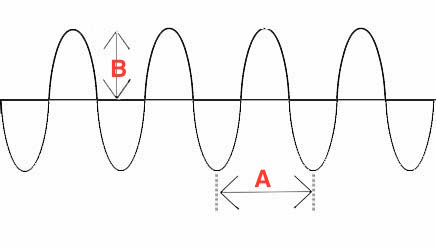
What property of this wave is represented by the letter "A"

a)

amplitude

b)

crest

c)

trough

d)

wavelength

76.
What property of the wave is represented by the letter "B"?
a)
amplitude
b)
crest
c)
trough
d)
wavelength
77.
The highest point on a wave is:
a)
the crest
b)
the trough
c)
the top
d)
the coast 
78.
The lowest point on a wave is the:
a)
Amplitude
b)
Crest
c)
Trough
d)
Wavelength
79.
The number of wavelengths that pass a point each per second is:
a)
frequency
b)
period
c)
longitudinal 
d)
transverse wave 
80.
The units for frequency are measured in _____________.
a)
hertz
b)
seconds
c)
m/s
d)
m
81.
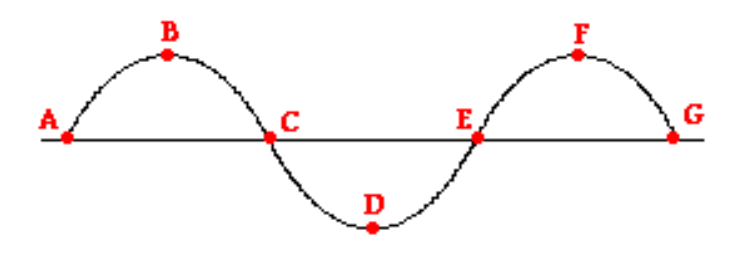
Which vocabulary term is used to identify the distance between points C & G?
a)
Amplitude
b)
Crest
c)
Frequency
d)
Wavelength
82.
Which letter(s) represent the crest of the wave?
a)
A
b)
B & D
c)
B & F
d)
F
83.
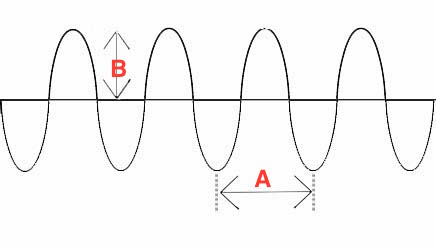
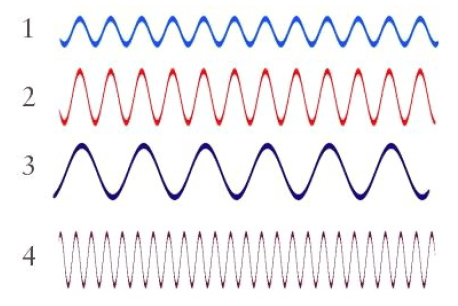
Which wave in the diagram has the greatest frequency?
a)
1
b)
2
c)
3
d)
4
84.
Waves are a transfer of what?
a)
Heat
b)
Light
c)
Energy
d)
Food
85.
What is vibration?
a)
how loud a sound is
b)
the back and forth movement of matter
c)
how high or low a sound is
d)
the loudness or softness of a sound
86.
The type of waves that require medium to pass:
a)
Mechanical Waves
b)
Electromagnetic Waves
87.
How are frequency and period related in simple harmonic motion?
a)
They are directly related.
b)
They are inversely related.
c)
Their sum is constant.
d)
Both measure the number of cycles per unit of time.
88.
In which direction is the pictured spring's restoring force acting?
a)
To the right.
b)
To the left.
c)
There is no restoring force.
d)
Both left and right.
89.
A stiff ideal spring has a:
a)
high spring constant
b)
low spring constant
c)
a varying spring constant depending on displacement
d)
spring constant which is difficult to predict
90.

_____ waves have vibrations that run parallel to the direction the wave travels, and _____ waves have vibrations that run perpendicular to the direction the wave travels.

a)

transverse, longitudinal

b)

longitudinal, transverse

91.

Examples of this type of waves include water waves, waves on a string/jump rope, and light waves.

a)

transverse

b)

longitudinal

92.

Examples of _____ waves include sound waves and earthquake P-waves.

a)

transverse

b)

longitudinal

93.

Frequency is how many waves pass a point in 1 second. If 100 waves pass a given point in 4 seconds, what is the wave's frequency?

a)

25 Hz

b)

100 Hz

c)

4 Hz

d)

400 Hz

94.

In a longitudinal wave, a ____ is an area where the particles are spread apart and a ____ is an area where the particles are close together.

a)

crest, trough

b)

compression, rarefaction

c)

rarefaction, compression

d)

trough, crest

95.

Waves that can travel through empty space are called _____ waves. Waves that require a medium to travel, such as air or water, are called _____ waves.

a)

mechanical, electromagnetic

b)

electromagnetic, mechanical

c)

crest, trough

d)

compressional, rarefactional

96.

In the diagram of a compressional wave, A is showing a ___ while B is showing a ___.

a)

compression, rarefaction

b)

trough, crest

c)

rarefaction, compression

d)

crest, trough

97.
What happens to frequency when the energy increases?
a)
it increases
b)
it decreases
c)
it stays the same
98.
What is the frequency of this wave?
a)
3 Hertz
b)
4 Hertz
c)
5 Hertz
d)
6 Hertz
99.
When wavelength increases, what happens to the frequency?
a)
it increases
b)
it decreases
c)
it stays the same
100.
What is the speed of a wave that has a wavelength of 2 and a frequency of 2.5?
a)
2.5 m/s
b)
5 m/s
c)
4.5 m/s
d)
6 m/s
101.
Which wave has a longer wavelength?
a)
wave C
b)
wave D
102.
Which wave has a greater frequency?
a)
wave B
b)
wave C
103.
Which wave has the most energy?
a)
top wave
b)
bottom wave
104.
The moving black dot is called:
a)
a node
b)
an anti-node
c)
an anti-amplitude
d)
the wangy bit
105.
The stationary dot is called:
a)
a node.
b)
an anti-node.
c)
the amplitude.
d)
the not moving bit.
106.

Standing waves are created by

a)

Two identical waves reflecting off each other

b)

Two identical waves being diffracted together

c)

Two identical waves move through each other in opposite directions

d)

Two identical waves are diffracted from two identical sources

107.

In the diagram which letters represent the nodes

a)

A B C

b)

A C E

c)

B D

d)

B D E

e)

A C D

108.
What are the boundary conditions for these standing waves?
a)
Anti-nodes at each end.
b)
The surface of the string is smooth.
c)
The string is free at both ends.
d)
There is a node at each end.
109.

When will gravity be the strongest?

a)

The further away you are from an object

b)

The closer you are to an object

c)

The faster your relative speed is to an object

d)

None of the above

110.
Two asteroids exert a gravitational force, F, on each other. Some time later, the asteroids are now three times as far from each other as before. Which of the following represents the gravitational force at this distance? 
a)
F/3
b)
F/2
c)
F/6
d)
F/9
111.
Force of gravity is inversely proportional to
a)
Mass
b)
Weight
c)
Distance
d)
Time
112.

Calculate the gravitational force between two objects when they are 0.750m apart. Each object has a mass of 5.00kg.

a)

2.96x10⁻⁷N

b)

3.00x10⁻⁶N

c)

2.22x10⁻⁹N

d)

2.23x10⁻⁸N

113.
What is the Universal law of gravitation equation? 
a)
G=F ⋅ m⋅m2/r2
b)
F=G ⋅ m⋅m2/(r)2
c)
F=G ⋅ r2/m⋅m2
d)
G=F ⋅ r2/m⋅m2
114.

What is the gravitational force between two identical 50,000 kg asteroids whose centers of mass are separated by 1000 m?

a)

2500 N

b)

3.3 x 10⁻¹² N

c)

1.67 x 10⁻⁴ N

d)

1.67 x 10⁻⁷ N

115.

Two spherical objects have masses of 8000 kg and 1500 kg. Their centers are separated by a distance of 1.5 m. Find the gravitational attraction between them

a)

5.4 X 10⁻⁴ N

b)

1.2 X 10⁷ N

c)

3.6 X 10⁻⁴ N

d)

5.33 N

116.

According to Kepler law sun is situated at

a)

center of orbit

b)

anywhere in the orbit of planet

c)

any of foci of elliptical orbit

d)

Can be any wherr

117.
Planets orbit the Sun in a shape called a(n)
a)
circle
b)
ellipse
c)
focus
d)
perihelion
118.
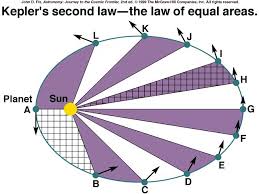
Where is the planet moving faster
a)
Position A to B
b)
Position B to C
c)
Position H to I
d)
Position I to J
119.
What is true about the area between points A, B and the Sun, and the area between points H, I and the Sun?
a)
The area between A, B and the Sun is the largest.
b)
The area between H, I and the Sun is the largest
c)
Both areas are equal in size
d)
There is not enough information to determine the areas
120.
A horse gallops around a circular arena.  The centripetal force on the horse is ___.
a)
directed outward
b)
tension
c)
directed toward the center of the arena
d)
9.8 N
121.
Calculate the amount of centripetal force it takes for a softball pitcher to rotate a ball with a velocity of 3 m/s if the ball weighs .12 kg and her arm is .65 meters long.
a)
.38
b)
1.23
c)
.55
d)
1.66 N
122.

A spring with spring constant 16 N/m is compressed by 0.5 m. How much energy is stored in the spring?

a)

1 J

b)

0.25 J

c)

2 J

d)

16 J

123.

Calculate the force a spring with a spring constant of 16 N/m that is compressed by 0.5 m will exert.

a)

32 N

b)

- 32 N

c)

- 8 N

d)

16 N

124.

As the person pulls the block from O to B, the spring potential energy of the system

a)

increases

b)

decreases

c)

remains the same