
NEW
Font size
S
M
L
XL
 Worksheets
1.2 Periodic Table Quiz
Total questions: 21
Worksheet time: 11mins
Name
Class
Date
1.
The ________________________ is an arrangement of the elements showing the repeating pattern of their physical and chemical properties
a)
atomic number
b)
chemical symbol
c)
periodic table
d)
atomic mass
2.
The Periodic Table was developed in 1869 by a man named ________________ who was a Russian chemist and inventor.
a)
James Chadwick
b)
Dmitri Mendeleev
c)
Thomas Rutherford
d)
John Dalton
e)
3.
The very first Periodic Table back in 1869 was organized and displayed by increasing ______________.
a)
atomic number
b)
atomic mass
c)
chemical symbols
d)
blocks of pretty colors
4.
The original Periodic Table of 1869 had _______________ elements than the Periodic Table of today.
a)
many more
b)
the same amount of
c)
much less
d)
invisible
5.

In the diagram, the element box for oxygen is shown, which includes several pieces of information. The number 8 on the top of the box is the ___________________, which is how the modern day Periodic Table is organized.
a)
atomic mass
b)
atomic number
c)
atomic symbol
d)
name of the element
6.

Below the element box for nitrogen is shown, which includes several pieces of information. The letter N in the middle of the box is the ___________________.
a)
atomic mass
b)
atomic name
c)
atomic number
d)
chemical symbol
7.

The diagram below shows the element box for helium, which includes several pieces of information. The number 4.003 at the bottom of the box is the ___________________.
a)
chemical symbol
b)
atomic number
c)
atomic mass
d)
atomic speed
8.
The atomic mass of an element, such as 15.999 for oxygen, is shown as an average because most elements are made up of a mixture of _____________ .
a)
protons
b)
neutrons
c)
isotopes
d)
electrons
9.

The Periodic Table is organized by horizontal rows and vertical columns. The rows on the Periodic Table are also knows as ____________, and the columns are also know as __________.
a)
groups, periods
b)
periods, groups
c)
groups, families
d)
none of the above
10.

On the Periodic Table there is a zigzag line, or staircase, that mostly separates the ____________________.
a)
metals from the nonmetals
b)
solids from the liquids
c)
periods from the families
d)
chemical symbols from the chemical names
11.
Directly ALONGSIDE the zigzag line, or staircase, of the Periodic Table you will find a special group of elements called the __________________ that have properties of both the metals and nonmetals.
a)
metals
b)
nonmetals
c)
noble gases
d)
metalloids
12.

Group 1, shown here in bright red on the far left side of the Periodic Table, is also known as the _____________________. They are the most reactive of all the metals as they have just one valence electron.
a)
Noble gases
b)
Halogens
c)
Alkali Metals
d)
Transition Metals
13.
The Alkaline Earth Metals are also know as Group # _____, as they are very reactive with water, but less so than Group 1.
a)
2
b)
3
c)
4
d)
5
14.

Gold, silver, nickel, copper, and iron are all part of this large group of commonly known metals in the middle of the Periodic Table, shown here in grey, called the _____________________. They are hard and shiny, and are good conductors of heat and electricity.
a)
Alkali Metals
b)
Alkaline Earth Metals
c)
Metalloids
d)
Transition Metals
15.

Group 13, also known as the _________ Family, is named after an element that is used in materials that have to be of high strength but also lightweight, such as fiberglass.
a)
Hydrogen
b)
Helium
c)
Nitrogen
d)
Boron
16.
This group has the most reactive nonmetals because they have 7 valence electrons. Also known as Group 17, these are simply known as _______________.
a)
the Transition Metals
b)
the Halogens
c)
the Alkali Metals
d)
the Noble Gases
17.
This group of non-metal elements do not bond with any other elements, and since they are completely non-reactive, they never form compounds. Also known as Group 18, these are the _______________.
a)
Noble Gases
b)
Halogens
c)
Hydrogen
d)
Alkaline Earth Metals
18.
Jailah needs a replacement for lithium for a science experiment. She tries silicon, but it does not work. Using what you know about patterns in the periodic table, which advice would you give Jailah?
a)
Try a lanthanide series element.
b)
Try a non-metal from the halogen group.
c)
Try an element in the same group as lithium.
d)
Try an element that is a metal.
19.
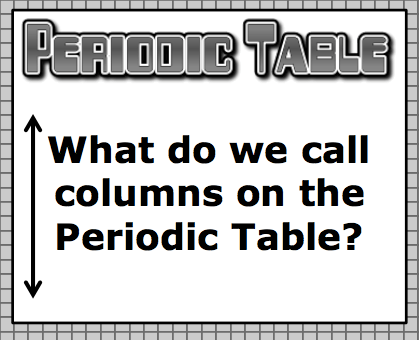
a)
Periods
b)
Groups
20.
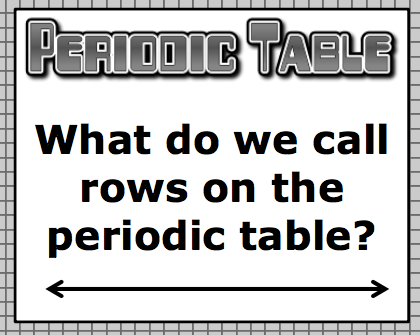
a)
Periods
b)
Groups
21.

How many Protons are in Magnesium?
a)
24.305
b)
24
c)
12
d)
6
Reset

