Wayground logo

Free Printable Worksheets

Font size

S
M
L
XL
Worksheets

Chemistry Sem 1 Final Review

Total questions: 35

Worksheet time: 3hrs 55mins

Name
Class
Date
1.
15.6 L = ___________ mL
a)
15,600
b)
156,000
c)
1,560,000
d)
15,600,000
2.
32.9 km = ___________ cm
a)
32,900
b)
329,000
c)
3,290,000
d)
32,900,000
3.

How many gallons are in a pool that holds 758,000 Liters?

(1 gallon = 3.79 Liters)

a)

2.00 x 10⁵ gallons

b)

200,000. gallons

c)

200,000 gallons

d)

2 gallons

4.
What conversion factor would you use to solve this problem?
a)
2.20 lbs / 1 kg
b)
1 kg / 2.20 lbs
c)
0.002 lbs / 1 g
d)
1 g / 0.002 lbs
5.

Convert this number into scientific notation: 0.068

a)

6.9 x 10⁶

b)

6.8 x 10⁻⁹

c)

6.8 x 10⁻²

d)

None of the above

6.

Which number is the least in value

a)

5.0 x 10⁻⁹

b)

5.0 x 10⁻⁴

c)

5.0 x 10⁶

d)

5.0 x 10⁸

7.
A student is planning an experiment to find out how the height from which he drops a ball affects how high the ball bounces. The dependent variable is the _____.
a)
Diameter of the ball
b)
Force acting on the ball
c)
Height that the ball bounces
d)
Height from which the ball is dropped
8.

What would my constants be? (select all that apply)


Independent: type of music

Dependent: test scores

a)

type of music

b)

gender of students

c)

test scores

d)

textbook

9.
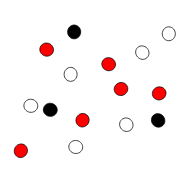
This picture represents: 
a)
Element
b)
Compound
c)
Mixture of Elements
d)
Mixture of Compounds
10.
A mixture in which different materials can be identified easily
a)
element
b)
heterogeneous mixture
c)
homogeneous mixture
d)
solution
11.
Changing the phase, size or shape of something....
a)
Chemical change
b)
Physical Change
c)
Suspension
d)
Colloid
12.
If you change a substance into a new substance...
a)
Partial Change
b)
Physical Change
c)
Chemical Change
d)
Freezing
13.
This picture represents: 
a)
Element
b)
Compound
c)
Mixture of Elements
d)
Mixture of Compounds
14.
What is the reactant in the following equation?
2NaHCO3  -> Na2CO3  +  CO2  + H2O
a)
NaHCO3
b)
Na2CO3
c)
CO2
d)
H2O
15.

How many grams of OXYGEN would be needed to show conservation of mass in the example below?

a)

100 g

b)

93 g

c)

7 g

d)

0 g

16.

In an endothermic reaction, heat is ...

a)

taken in

b)

given out

17.
What is the number of protons that the element in this image contain?
a)
14
b)
7
c)
15
d)
18
18.
If an atom has 12 positively charged subatomic particles, which of the following must it also have to be considered a neutral atom?
a)
12 neutrons
b)
12 electrons
c)
12 protons
d)
24 protons and neutrons
19.
An atom has 10 protons, 15 neutrons and 10 electrons what is its mass number.
a)
20
b)
10
c)
5
d)
25
20.
Which of the following is the missing product for this reaction?
a)
Sc-42
b)
Ca-20
c)
Sc-42
d)
Ca-42
21.

In the symbol 167N what the 7 stand for?

a)

Mass number

b)

Atomic number

c)

Atomic mass

d)

Number of neutrons

22.

What type of atom is this?

a)

Neutral atom

b)

Cation

c)

Anion

d)

Isotope

23.

How many electrons does this magnesium ion have?

a)

24

b)

12

c)

10

d)

14

24.
Calculate the average atomic mass of silver.
a)
106.38649amu
b)
111.91896amu
c)
107.8677amu
d)
121
25.
If 10 mg of iodine 131 is given to a patient, how much is left after 24 days? The half-life of iodine-131 is 8 days.
a)
1.25mg
b)
1.25g
c)
10g
d)
10mg
26.

Which of the following element is an example of Halogen

a)

Sodium

b)

Magnesium

c)

Fluorine

d)

Carbon

27.

Which family(group) of metals have two electrons in the outer most energy level?

a)

Lanthanides

b)

Halogens

c)

Oxygen family

d)

Alkaline earth metals

28.
Which of these elements has the greatest atomic radius? 
a)
H
b)
N
c)
Cl
d)
Cs
29.
Fluorine, chlorine, bromine, and iodine all have the same number of valence electrons and have a tendency to gain electrons. Which element has the greatest ionization energy and electronegativity?
a)
fluorine
b)
chlorine 
c)
bromine 
d)
iodine 
30.
How are frequency and energy related? 
a)
lower frequency = more energy
b)
lower frequency = less energy
c)
Frequency and energy are the same
d)
Frequency and energy are not related
31.

A microwave oven emits radiation at a wavelength of .005 m. What is the frequency of this radiation?

a)

6.67 x 10⁻⁷ Hz

b)

2.00 Hz

c)

1.50 x 10⁶ Hz

d)

6.00 x 10¹⁰ Hz

32.
Find the energy, in joules per photon, of microwave radiation with a frequency of 7.91 × 10 10 1/s.
a)
6.63 x 10⁻³⁴ J
b)
5.25 x 10¹⁴ J
c)
5.24 x 10⁻²³ J
d)
1.19 x 1044 J
33.
What atom matches this electron configuration?
1s2 2s2 2p6 3s2
a)
Neon
b)
Magnesium
c)
Aluminum
d)
Potassium
34.
How many electrons can the d sublevel hold?
a)
8
b)
10
c)
2
d)
4
35.
What is the shorthand electron configuration for Sulfur atom?
a)
[Ar] 3p4
b)
[He] 3s23p4
c)
[Ne] 3s23p4
d)
[Na] 3s23p3