wayground logo

Free Printable Worksheets

NEW

Font size

S
M
L
XL
Worksheets

Microscopes 🔬 & Cell Theory

Total questions: 35

Worksheet time: 52mins

Name
Class
Date
1.
What is the total magnification of a microscope with two lenses when one lens has a magnification of 10x, and the other lens has a magnification of 30x?
a)
15x
b)
30x
c)
40x
d)
300x
2.
A microscope is an instrument that.
a)
makes faraway objects look closer.
b)
makes small objects appear larger.
c)
decreases the size of small objects.
d)
increases the size of small objects.
3.
If the eyepiece of your scope has a power of 10, and the selected objective lens has a power of 20,what is the total magnification?
a)
20x
b)
30x
c)
200x
d)
2000x
4.
When should the fine adjustment knob always be used?
a)
with the low power objective only
b)
with the medium power objective only
c)
with the high power objective only
d)
with both the medium and high power objectives
5.
When you focus on a new specimen, always begin with
a)
low power and coarse adjustment.
b)
low power and fine adjustment
c)
high power and coarse adjustment
d)
high power and fine adjustment
6.
If your teacher asks you to move a microscope to table, how do you carry it?
a)
by the body tube and the eyepiece
b)
with one hand
c)
one hand on the arm and the other under the base
d)
with one hand on the base and the other on the eyepiece.
7.
Which part of the microscope controls the amount of light available?
a)
coarse adjustment knob
b)
diaphragm
c)
objective lens
d)
revolving nosepiece
8.
Which part lets you turn up the power of magnification, such increasing from 40x to 100x?
a)
coarse adjustment knob
b)
diaphragm
c)
field-of-view
d)
revolving nosepiece
9.
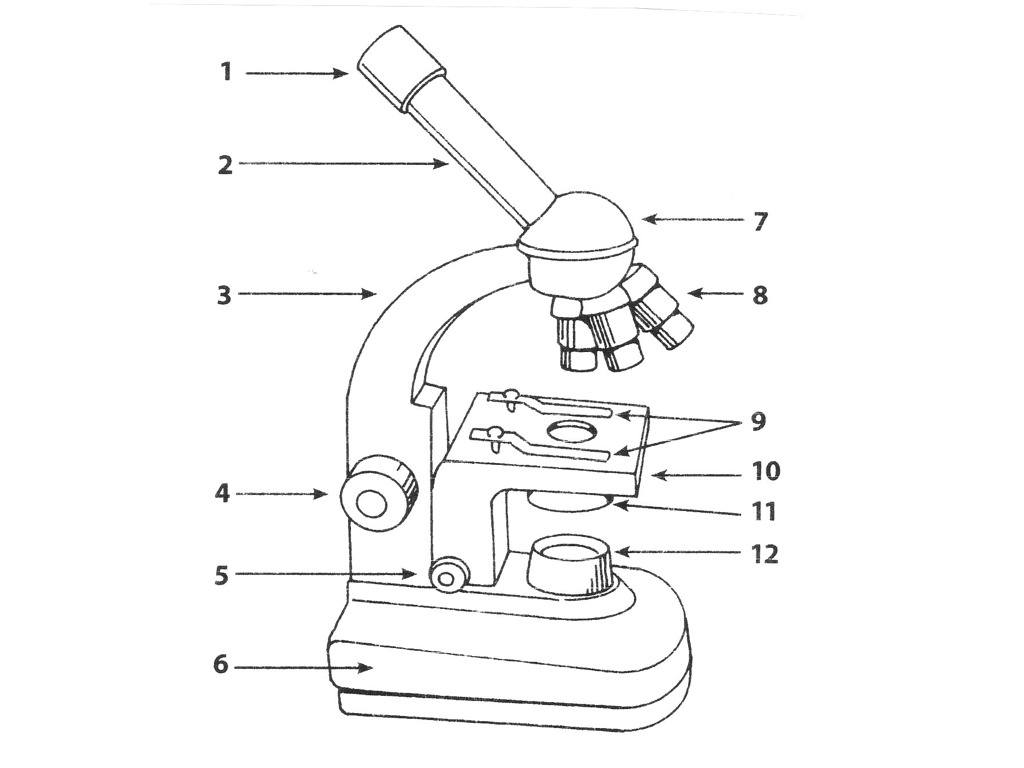
What is part 1?
a)
eye piece
b)
body tube
c)
arm
d)
coarse adjust
10.
What part is 3?
a)
eye piece
b)
base
c)
arm 
d)
coarse adjust
11.
What part is 5?
a)
coarse adjustment
b)
fine adjustment
c)
diaphragm
d)
stage
12.
What is part 6?
a)
arm 
b)
base
c)
body tube
d)
illuminator
13.
What part is marked with the letter "A".
a)
Ocular Lens
b)
Base
c)
Low Objective Lens
d)
Stage
14.
What part is marked with the letter "B"?
a)
Coarse Adjustment Knob
b)
Fine Adjustment Knob
c)
Body Tube
d)
Stage Clips
15.
What part is marked with the letter "C"?
a)
Body Tube
b)
Light Source
c)
Diaphragm
d)
Objective Lens
16.
What part is marked with the letter "D"?
a)
Coarse Adjustment Knob
b)
Fine Adjustment Knob
c)
Base
d)
Low Objective lens
17.
What part is marked with the letter "E"?
a)
Nosepiece
b)
Diaphragm
c)
Ocular Lens
d)
Medium Objective Lens
18.
What part is marked with the letter "F"?
a)
Medium Objective Lens
b)
High Objective Lens
c)
Low Objective Lens
d)
Ocular Lens
19.
What piece is labeled "G"?
a)
Arm
b)
Base
c)
Body Tube
d)
Stage
20.
What part is labeled "H"
a)
High Objective Lens
b)
Medium Objective Lens
c)
Low Objective Lens
d)
Ocular Lens
21.
What part is labeled with "I"?
a)
Stage
b)
Stage Clips
c)
Light Source
d)
Nose Piece
22.
What part is labeled with "J"?
a)
Stage Clips
b)
Stage 
c)
Diaphragm
d)
Light Source
23.
What part is labeled with letter "K"?
a)
Diaphragm
b)
Light Source
c)
Coarse Adjustment Knob
d)
Ocular Lens
24.
What part is labeled with the letter "L"?
a)
Base
b)
Nose Piece
c)
Arm
d)
Fine Adjustment Knob
25.
What part is labeled with the letter "M"?
a)
Light Source
b)
Diaphragm
c)
Ocular Lens
d)
Arm
26.
What part is labeled with the letter "N"?
a)
Low Objective Lens
b)
High Objective Lens
c)
Medium Objective Lens
d)
Ocular Lens
27.
Why are microscopes important when studying most cells?
a)
Most cells are very large.
b)
Most cells are very small.  
c)
Most cells move very quickly.
d)
Most cells are dead.  
28.
Which of the following is NOT one of the basic points of Cell Theory?
a)
All living things are made of cells.
b)
The cell is the smallest living thing that can perform all the functions of life.
c)
Cells are too small to see without a microscope.  
d)
All cells must come from pre-existing cells.
29.
What tool do you use to view the cells?
a)
metric ruler
b)
centrifuge
c)
microscope
d)
pipette
30.
The best way to carry a microscope is
a)
with two 2 hands, close to your body
b)
swinging it with one arm, by your side
c)
running with it
d)
why carry it, when you can throw it?
31.

Who discovered and named cells while looking at cork?

a)

Captain Hook

b)

Robert Hooke

c)

Matthais Schleiden

d)

Rudolf Virchow

32.

What was Schleiden convinced of?

a)

All plants are made of cells

b)

All animals are made of cells

c)

All cells are prokaryotic

d)

None of the above

33.

This early cell theory scientist looked in a microscope and discovered "animalcules" in the gunk from his teeth and pond water.

a)

Schleiden

b)

Leeowenhoek

c)

Hooke

d)

Virchow

e)

Schwann

34.

Who noted that all animals are made of cells and helped write the first two parts of cell theory?

a)

Rudolf Virchow

b)

Anton van Leeuwenhoek

c)

Theodor Schwann

d)

Robert Hooke

35.

Who discovered that all cells come from other living cells and had research that lead to the last major principle of cell theory?

a)

Matthias Schleiden

b)

Theodore Schwann

c)

Robert Hooke

d)

Rudolf Virchow