
 Worksheets
Topic 3 review
Total questions: 109
Worksheet time: 6hrs 38mins

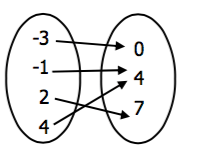
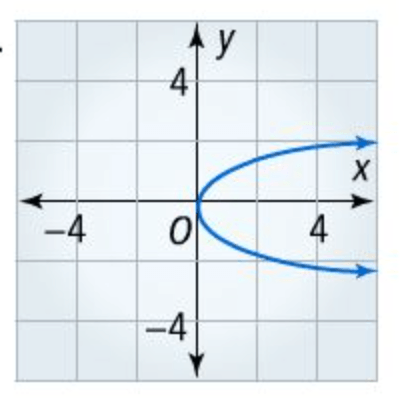
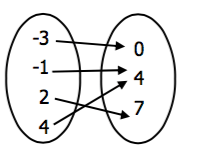
What is the domain of this graph?
D = { 2,3,-5,-3,-3,-5}
D = {-5, -3, 2 }
D = {-5, -3, 3}
D = {-5, -3}
What is the range of this graph?
R = { 2,3,-5,-3,-3,-5}
R = {-5, -3, 2 }
R = {-5, -3, 3}
R = {-5, -3}

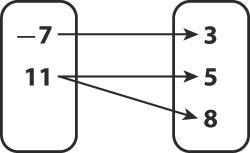
The left grouping in a mapping is the...
domain.
range.
y-axis.
relation.
The right grouping in a mapping is the...
domain.
range.
x-axis.
coordinate system.

The faster you drive your car, the longer it will take to stop.
What is the dependent variable?
the car
the speed of the car
the length of the car.
stopping distance of the car




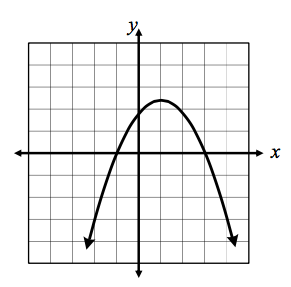
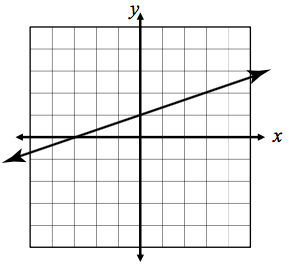
Write an equation for this relation.
y = -5x
y = -5x + 1
y = 5x
y = 5x - 1
The relation that is represented by the equation y = 20 - 2x has the domain
{3 , 4, 5, 6}. Which of the following sets is the range of the relation?
{3, 4, 5, 6}
{8, 10, 12, 14}
{12, 13, 14, 15}
{14, 16, 18, 20}


{ (3, -2) , (4, -3), (5, -4), (6, 0) }



8
-24
24
-22

27
21
24
72

24
-6
32
36

9
13
21
-9

0
5
1
60

84
92
116
64


What is the linear parent function?
y = x
y = mx + b
f(x) = 2x
Not here
down, which of the following equations would the new graphed
line represent?
A student graphed f(x) = x and g(x) = f(x + 4). Which statement is true?
The graph of f is steeper than the graph of g.
The graph of f is less steep than the graph of g.
The graph of f is shifted 4 units up to create the graph of g.
The graph of f is shifted 4 units to the left to create the graph of g.
A student graphed f(x) = x and g(x) = f(x) - 12. Which statement is true?
The graph of f is shifted 12 units to the right to create the graph of g.
The graph of f is shifted 12 units down to create the graph of g.
The graph of f is shifted 12 units up to create the graph of g.
The graph of f is shifted 12 units to the left to create the graph of g.
A student graphed f(x) = x and g(x) = 2f(x). Which statement is true?
The graph of g is steeper than the graph of f.
The graph of g is less steep than the graph of f.
The graph of f is shifted 2 units up to create the graph of g.
The graph of f is shifted 2 units to the right to create the graph of g.
A student graphed f(x) = x and g(x) = ⅓f(x). Which statement is true?
The graph of f is steeper than the graph of g.
The graph of f is less steep than the graph of g.
The graph of f is shifted 2 units up to create the graph of g.
The graph of f is shifted 2 units to the right to create the graph of g.
A student graphed f(x) = x and g(x) = f(x) - ½. Which statement is true?
The graph of f is steeper than the graph of g.
The graph of f is less steep than the graph of g.
The graph of f is shifted ½ unit up to create the graph of g.
The graph of f is shifted ½ unit down to create the graph of g.
The function f(x) = x is graphed. A new line is formed by changing the slope to 3 and the y-intercept to -2. Which is true?
The graph of the new line is steeper and the y-intercept has been translated down.
The graph of the new line is less steep and the y-intercept has been translated down.
The graph of the new line is steeper and the y-intercept has been translated up.
The graph of the new line is less steep and the y-intercept has been translated up.

Which transformation will occur if f(x) = x is replaced with 2f(x)?
Vertical stretch by a factor of 2
Vertical compression by a factor of 1/2
Vertical translation up by 2 units.
Horizontal compression by a factor of 1/2
How did the equation shift from the parent function?
y = f(x) + c
Shifted up "c" units
Shifted down "c" units
Stretches vertically
Shifted right "c" units
How did the equation shift from the parent function? y = f(x - 4)
Shift right by 4
Shift left by 4
Horizontal Stretch by 4
Vertical Stretch by 4
Shift down by 4
How did the equation f(x) = x change if
g(x) = 1/2f(x) + 11
Vertical stretch and shift up 11
Horizontal shrink and shift down 11
Vertical shrink and shift up 11
Horizontal stretch and shift down 11
5, 8, 11, ...
2, 8, 14, ...
(Hint: Write your formula and then simplify it.)
a14=68
d=3
97, 86, 75, 64, ...
3, 7, 11, 15, ...
34, 37, 40, 43, ...
25, 21, 17, 13,...
Write the explicit equation that models the sequence. (Hint: Simplify your equation.)
What is a1 in the following sequence?
-6, -14, -22, -30, ...
-6
-14
-22
-30
What is the common difference of the following sequence?
7, 27, 47, 67,...
10
20
3
-20
Which sequence is NOT an arithmetic sequence?
12, 18, 24, 30,...
10, 3, -4, -11,...
2, 4, 8, 16,...
16, 20, 24, 28,...
Which sequence is NOT an arithmetic sequence?
-7, -13, -19, -25,...
-10, -6, -2, 2,..
6, 8, 10, 12,...
3, 15, 75, 375,...
Define arithmetic sequences.
A sequence whose terms change by adding the same number each time.
A sequence whose terms change by multiplying the same number each time.
A sequence whose terms change by dividing the same number each time.
A list of numbers that often (but not always) form a pattern.
Given the sequence:
25, 21, 17, 13,...
Write the explicit equation that models the sequence.
an = 25 + (n-1)4
an = 29 + (n-1)(-4)
an = 25 +(n-1)(-4)
an = 29 +(n-1)(4)
an = an-1 + 5
a1 = -16
Write the explicit formula for the sequence.
9, 5, 1, -3, ...
an=9+5(n−1)
an=9−4(n−1)
an=4+9(n−1)
an=9⋅4(n−1)
Write the explicit formula for the sequence.
15, 22, 29, 36, 43, ...
an=15+22(n−1)
an=15⋅7(n−1)
an=15+7(n−1)
an=29−14(n−1)
Use the explicit formula to find the first four terms of the sequence.
an=3+5(n−1)
3, 15, 75, 375
3, 8, 13, 18
5, 8, 11, 14
5, 15, 45, 135
Use the explicit formula to find the 7th term of the sequence.
an=22−3(n−1)
4
1
18
114
Which of the following recursive formulas represents the given sequence.
4, 12, 20, 28, 36, ...
a1=4 , an=a(n−1)⋅3
a1=4 , an=a(n−1)+8
a1=4 , an=a(n−1)−8
undefined , an=a(n−1)⋅9
a1=6
a1=6
a1=6
a1=6
15, 12, 9, 6, 3 ....
un = un-1 + 3
un = un-1 + 3
un = un-1 - 3
un = un-1 - 3
Given the recursive formula below, find the first five terms.
u1 = 3
un = un-1 + 2
3, 5, 7, 9, 11
5, 7, 9, 11, 13
2, 4, 6, 8, 10
1, 3, 5, 7, 9
Which of the following recursive formulas represents the given sequence.
4, 12, 20, 28, 36, ...
a1=4 , an=a(n−1)⋅3
a1=4 , an=a(n−1)+8
a1=4 , an=a(n−1)−8
undefined , an=a(n−1)⋅9
a1 = 100; an = an-1 - 8

Find the common difference.
d=−3
d=3
d=−2
d=−4

Find the first five terms.
−8,−17,−26,−35,−44
−18,−26,−34,−42,−50
−18,−28,−38,−48,−58
−8,−18,−28,−38,−48

Find the first five terms.
−18,−11,−4, 3, 10
−24,−18,−12,−6, 0
−20,−13,−6, 1, 8
−18,−12,−6, 0, 6
Find the recursive formula. 2, 32, 62, 92, ...


Find the recursive formula. −4,−12,−20,−28, ...


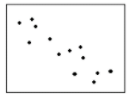
Estimate the correlation coefficient for this scatterplot.
A) r = 1.2
B) r = 0.89
C)r = 0
D) r = -0.89
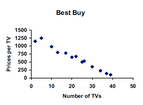
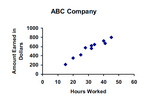
Estimate the correlation coefficient for this scatterplot.
A) r = -0.9
B) r = 1
C) r = 0.9
D) r = -1

Describe the relationship between the variables.
A) Weak positive correlation
B) Weak negative correlation
C) Strong positive correlation
D) Strong negative correlation


Which value below could be the correlation of the scatterplot?
-0.923
-0.478
0.006
0.777
Is r = -0.87 strong, moderate, or weak?
strong
moderate
weak
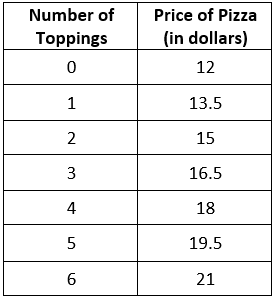

Above is a table that represents the distance in miles vs. the cost of a plane ticket. What does the slope mean in the regression equation y=0.136x+74
A plane ride costs $0.136 (13 cents)
For every 1 mile flown, the cost goes up $ 0.136 dollars (13 cents)
For every 1 mile flown, the cost goes up $74

