
 Worksheets
EPF Final Test Review
Total questions: 72
Worksheet time: 37mins
Jane wants to be a scientists, but her family have always been farmers, so she becomes a farmer
Traditional
Captialism
Socialism
Communism
Economies try to answer these fundamental economic questions:
What goods and services are to be produced?
How are goods and services to be produced?
For whom are goods and services to be produced?
all of these
In a ___________ economy, decisions about production and consumption are made by the government.
market
mixed
command
free enterprise system
Most modern economies today are ______ economies.
market
traditional
command
mixed
The United States is an example of which type of economic system?
Command economy
Traditional economy
Free market economy
Mixed economy
Who owns the factors of production in a command economy?
Individuals and privately owned businesses
Large corporations
The government
Foreign firms
In a mixed economy I decide the hours I am open and whether I am safe to open or not.
True
False
A market structure in which a single seller sells a unique product.
natural monopoly
barrier to entry
oligopoly
monopoly
A market structure in which a large number of small firms sell identical products, and entry into the market is easy.
market structure
perfect competition
price taker
monopoly
A market in which the average cost of production is lowest when only one firm supplies a good or service
natural monopoly
monopoly
barrier to entry
price maker
It is very difficult to enter a perfectly competitive market.
True
False
In monopolistic competition, no single seller has a large enough share of the market to completely control prices.
True
False
A firm operating in a perfectly competitive market is a price taker because
no firm has a significant market share
no firms product is different
setting a price higher than the going price results in zero sales
all of the above
In the perfectly competitive market, all firms in the market are assumed to be producing
identical products
differentiated products
products that are heavily advertised
complementary products
the automobile, steel, and oil markets are all examples of
perfectly competitive markets
monopolies
monopolistically competitive markets
oligopolies
Which best illustrates a perfectly competitive market?
Soft drinks
Automobiles
Electric power
Soybean farmers
The removal of some government controls over a market. It is used to promote competition.
deregulation
antitrust laws
denial
all of the above
laws that encourage competition and break up monopolies/oligopolies in the marketplace
trustworthy laws
antitrust laws
distrust laws
law of the land
The relationship between the price and quantity demanded for a good or service.
Quantity demanded
demand
normal good
demand schedule
table that lists the quantity of a good or service consumers purchase at various possible prices.
demand curve
elastic demand
demand shifters
demand schedule
The amount of goods and services purchased at given price.
quantity demanded
change in demand
market demand curve
elasticity of demand
Inverse relationship between the price of good or service.
change in quantity demanded
law of demand
change in demand
elastic demand
Sum of all possible individual demand curves
individual demand curve
quantity demanded
change in demand
market demand curve
goods that consumers purchase together with another good
total revenue
normal good
complements
substitutes
Formed by the line connecting points that represent possible combinations of price and quantity purchased by consumers.
elastic demand
demand curve
demand shifters
demand schedule
the ratio of the percentage in the quantity demand of a product to a percentage change in its price.
elasticity of demand
inferior good
elastic demand
quantity demanded
For the law of demand, as price rises, what happens to quantity demanded?
it goes up
it goes down
it stays the same
it is not effected
For the law of supply, as price rises, what happens to quantity supplied?
it goes up
it goes down
it stays the same
it is not effected

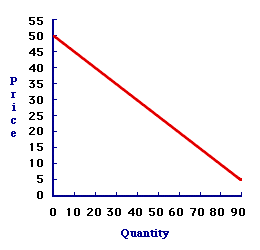

What does the law of demand say
consumers will buy less of something when the price goes down
consumers will buy more of something when price increases.
consumers will buy more of something when prices decrease.
None of the above.
Supply and demand determine
needs and wants
all goods produced
the price for a good or service
All of the above
A new type of television set uses 3-D images. many stores will have large quantities of the older style televisions. What will happen to the price of these older televisions?


Economists use a step by step method for solving problems.
True
False
Everyday decisions involve trade-offs.
True
False
Scarcity means that society's capacity to produce is limited.
True
False
Any point outside the production possibilities curve is impossible.
True
False
Fiscal policy is the use of federal government spending and taxes to achieve economic goals.
True
False
The government uses fiscal policy to try to achieve __________.
full employment
stable prices
economic growth
all of these
Programs such as Social Security, Medicare, and unemployment compensation make up only a small fraction of the federal budget.
True
False
The Sixteenth Amendment to the Constitution gives the federal government the authority to impose an income tax.
True
False
The time period when the account is closed to prepare your monthly statement.
grace period
billing cycle
resolving credit
credit report
what you incur when you spend over your authorized limit.
credit report
credit score
over the limit fee
debt load
When you buy something on the spot without thinking about it.
impulse buying
buying plan
debt load
equity stripping
A written agreement that specifies rights and duties of both the landlord and the tenant.
mortgage
tax shelter
rental agreement
foreclosure
A process of taking away private property to pay for debts levied against it.
mortgage
foreclosure
tax shelter
risk
The amount of money you have to pay before insurance begins to pay for your services.
preapproval
extended warranty
deductible
closing cost
Inflation risk is the chance that the rate of inflation will grow more slowly than the rate of return on your investment.
True
False
Indirect investing lowers your investment risk.
True
False
Silver coins are often worth up to 500 times their face value.
True
False
Philanthropy is the primary source of funding for the fine arts, the performing arts, and most religious and humanitarian causes.
True
False
This type of bond, often called a mortgage bond, is backed by specific assets.
junk bond
debenture
secured bond
serial bond
This type of bond is issued by state or local governments.
savings bond
agency bond
municipal bond
treasury bond
Purchasing rental property _________.
would not usually be considered a speculative investment.
can be financed at a very favorable rate if the income-producing potential is documented.
rarely requires a large down payment of cash.
all of these
Money withdrawn from an IRA before age 59 1/2 is subject to regular tax plus a 10 percent early withdrawal penalty.
True
False
Which of the following forms will determine how much income tax is withheld from an employee’s paycheck?
W2 and W4
W2
W4
I9
State and local governments get most of their revenue from which of the following?
Income tax
Payroll tax
Property tax
Excise tax
There are only two certainties in life, death and (a) .

How does the Federal Deposit Insurance Corporation(FDIC) protect consumers?
It insures consumer deposits even if a banking system fails
It ensures that banks make a profit for investors
It guarantees consumers a livable income
It grants credit to consumers in need
How can taking a training course at a community college benefit someone who is unemployed?
It guarantees a new job
It provides admission into a degree program
It provides more opportunities for work
It guarantees tax reductions for the individual
Which of these can have a negative impact on someone's financial goals?
Dropping out of high school
Getting a low-interest loan for a car
Using credit cards to build a good credit score
Getting a full-time job while attending college
How does increasing minimum wage affect the economy overt time?
It will cause prices to decrease over time
It will cause prices to increase over time
It will cause an increase in poverty rates
It will cause a decrease in employee productivity
How can reducing interest rates during a recession affect a country's economic growth?
It decreases the supply of money in the economy
It increases the supply of money in the economy
It encourages consumers to save money
It discourages consumers from earning money
Which comparison can be made between a monopoly and an oligopoly?
Consumer decisions are more limited in a monopoly
Consumer decisions are more numerous in a monopoly
Consumers lack opportunity to make decisions in a monopoly
Consumers have an equal opportunity to make decisions in a monopoly
What is the relationship between Supply, Demand, and Equilibrium Price?
Equilibrium price is achieved when supply matches demand
Equilibrium price is the average of supply and demand prices
Equilibrium price is determined when a majority of consumers pay a higher price
Equilibrium price is determined when a majority of suppliers lowers prices to increase demand
How can supply affect price?
A surplus leads to a price increase
Scarcity leads to price decrease
Scarcity leads to price increase
Surplus leads to large fluctuations in price
In a market economy, the greatest incentive for entrepreneurship is the opportunity to...
Support projects for the public good
Gain personal prestige & fame
Determine regulatory and tax policies
Earn a profit on investments
What is the relationship between producers and consumers in a market economy?
Consumers are unreliable = constant surplus in market
Consumer demand does NOT regularly affect producer decisions
Producers decide what to produce based on consumer demand for products
Producers decide what to produce based on the stock market
What is the main difference between a command economy & and market economy?
There is more competition in a command economy than in a market economy
There is more government control in a market economy than in a command economy
There are more economic incentives in a command economy than in a market economy
There are fewer economic incentives in a command economy than in a market economy

