wayground logo

Free Printable Worksheets

Font size

S
M
L
XL
Worksheets

Physics Post Test Review

Total questions: 91

Worksheet time: 2hrs 49mins

Name
Class
Date
1.
What does mass mean?
a)
The amount of gravity on an object
b)
How much an object weighs
c)
The amount of matter in an object
d)
Combination of all forces acting on an object
2.
What is the law of universal gravitation?
a)
An object in motion will stay in motion unless acted upon
b)
Gravity acts between all objects in the universe
c)
An object's tendency to resist change in motion
d)
f=m(a)
3.
The product of an object's mass and velocity is called its __________________.
a)
Acceleration
b)
Velocity
c)
Momentum
d)
Inertia
4.
Give an example of sliding friction
a)
Ice Skates
b)
Roller Skates
c)
Bowling Ball
d)
A Fish Swimming
5.
What is the formula for force?
a)
f(x)=n-1
b)
a(n)
c)
f=m(a)
6.
What is net force?
a)
A push or a pull
b)
An object that is thrown
c)
An unbalanced force
d)
Combination of all forces acting on an object
7.
Air resistance is a type of __________________.
a)

Velocity

b)

Motion

c)

Gravity

d)

Friction

8.
Forces can only be added together if they are  __________________________.
a)

On the same object

b)

On different objects

c)

Are in space

d)

Are unbalanced

9.
The SI unit for force is ___________________.
a)
Kilograms
b)
Meters
c)
Einstein
d)
Newton
10.
The force of gravity on a person or object on the surface of the planet is called  __________.
a)
Mass
b)
Weight
c)
Force
d)
Newtons
11.
______________ happens when the only force acting on an object is gravity.
a)
Weight
b)
Mass
c)
Projectile
d)
Free Fall
12.

________ forces on an object DO NOT cause a change in an objects motion.

a)

Balanced

b)

Unbalanced

13.
What happens when two forces act in the same direction?
a)
They cancel each other out
b)
You subtract them
c)
You add them
d)
You multiply them
14.
The momentum of an object is in the same direction as its _________.
a)
velocity
b)
speed
c)
force
d)
acceleration
15.
A push or a pull
a)
inertia
b)
velocity
c)
momentum
d)
force
16.
What is the net force and direction?
a)
0N left
b)
4N left
c)
0N
d)
4N right
17.
What is the net force and direction?
a)
11N left
b)
1N right
c)
6N right
d)
11N right
18.
Does sand increase or decrease friction?
a)
increase
b)
decrease
c)
neither
19.
The force that one surface exerts over another is called _________________.
a)
gravity
b)
friction
c)
force
d)
inertia
20.
For every action there is an opposite and equal reaction is Newton's _______ law.
a)
1st
b)
2nd
c)
3rd
d)
4th
21.
If a force is unbalanced on an object the object  ________________.
a)
moves
b)
does not move
c)
flips
22.
What do the tips of the arrows mean?
a)
nothing
b)
opposite direction
c)
making it fancy
d)
direction
23.
What does the length of the arrow represent (vector)?
a)
how much force
b)
how far
c)
direction
d)
left
24.
How much force and from which direction needs to be added to make this a balanced force?
a)
6N right
b)
9N left
c)
3N left
d)
6N left
25.
F= m(a) is the formula for?
a)
speed
b)
acceleration
c)
mass
d)
force
26.
The force that pulls falling objects toward Earth is called _______________?
a)

force

b)

gravity

c)

Newton

d)

gravey

27.

1. Which of the following statements about speed and velocity is correct?

a)

Velocity only describes an object’s rate of motion.

b)

Speed describes how an object is changing its velocity.

c)

Speed and velocity both describe how an object is speeding up.

d)

Only velocity includes the direction an object is traveling.

28.

The geese fly 23 mph to the south when they migrate for the winter.

a)

speed

b)

velocity

c)

acceleration

29.

The tornado is traveling northwest at 20 mph.

a)

speed

b)

velocity

c)

acceleration

30.

The Olympian swam 200 meters in 20 seconds.

a)

speed

b)

velocity

c)

acceleration

31.

65mi/hr South is an example of...

a)

Speed

b)

Velocity

c)

Acceleration

d)

Direction

32.

A baseball thrown 90 miles per hour toward home plate is an example of ____.

a)

Speed

b)

Velocity

c)

Acceleration

d)

Direction

33.

A truck moving 20 m/s is an example of ...

a)

Speed

b)

Distance

c)

Velocity

d)

Acceleration

34.

Jacob ran a 5k in 24 minutes.

a)

Speed

b)

Velocity

c)

Acceleration

35.

An airplane travels 1260 km from San Francisco northeast to Chicago in 3.5 hours.

a)

Speed

b)

Velocity

c)

Acceleration

36.
Avery likes to walk 30 feet in 10 seconds. What is her speed?
a)
3 feet/sec
b)
6 feet/sec
c)
10 feet/sec
d)
2 feet/sec
37.

Find the velocity of a plane that traveled 3000 miles west in 5 hours.

a)

65 mph

b)

60 mph

c)

600 mph west

d)

600 mph

38.

A helicopter flies south 200 miles in 2 hours. What is its velocity?

a)

99 mph

b)

100 mph south

c)

400 mph south

d)

297 mph south

39.

What two things must you know to determine speed?

a)

distance and direction

b)

direction and time

c)

speed and direction

d)

time and distance

40.

At what speed would a car have to move in order to travel 20 kilometers in 2 hours.

a)

5 km/hr

b)

10 km/hr

c)

20 km/hr

d)

40 km/hr

41.

Motion can be a change in _____.

a)

temperature

b)

distance

c)

position

d)

volume

42.
An object's location is its _____.
a)
force
b)
motion
c)
velocity
d)
position
43.
How is velocity different than speed?
a)
Speed opposes velocity
b)
Velocity is speed with a direction
c)
None of the answers are correct
44.
Which of the following is the closest match to the definition of motion?
a)
An objects change in position relative to a reference point
b)
The change in position of an object
c)
Constant speed
45.

What is a reference point?

a)

A place or object that is staying still, that is used to determine if something else is moving.

b)

A place or spot where something is located

c)

The action of moving or being moved

d)

Shortest distance between starting position and ending position

46.

You should NOT use a moving object as a reference point

a)

True

b)

False

47.

What does the term displacement mean?

a)

The direction of motion

b)

The distance traveled divided by time

c)

The change of position of an object

48.

Displacement is the difference between your

a)

reference point and reference direction

b)

total distance traveled

c)

starting position and your final position

d)

average speed

49.

If you leave home and travel a million miles around the world and stop back home, what is your displacement?

a)

One million miles

b)

0

c)

two million miles

d)

none of the above

50.

Acceleration describes how an object’s velocity is changing. Which of the following scenarios provides the best example of an accelerating object?

a)

A car driving at a constant speed

b)

A book sitting on top of a high shelf

c)

A toy train traveling in a circle

d)

A toy boat floating in a bathtub

51.

When a car goes around a corner at 20 mph, why do we say it accelerates?

a)

The car is accelerating because of the velocity is constant

b)

The car accelerates because it's going 20 mph

c)

Cars always accelerate when they are in motion

d)

The car is accelerating because it's changing direction

52.

Acceleration of an object happens when things ________

a)

slow down

b)

go faster

c)

change direction (turn)

d)

All of the above

53.

A truck slowing down to stop at a red light is an example of ____.

a)

Speed

b)

Velocity

c)

Acceleration (deceleration)

d)

Direction

54.

A car speeding up to get on the highway is an example of...

a)

Speed

b)

Velocity

c)

Acceleration

d)

Direction

55.

Acceleration only takes place when things speed up.

a)

True

b)

False

56.
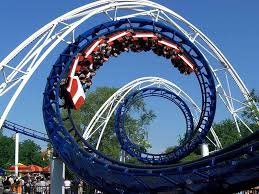
A roller coasters accelerates from an initial velocity of of 6.0 m/s to a final velocity of 70 m/s over 4 seconds.  What's the acceleration?
a)
24 m/s2
b)
18 m/s2
c)
16 m/s2
d)
16 m/s
57.
A box sliding down an inclined plane attains a velocity of 27 m/s in 3 seconds from rest.  Find the acceleration.
a)
30 m/s
b)
24 m/s2
c)
9 m/s2
d)
81 km/hr
58.

In each of the following cases, determine where the car has NO acceleration ?

a)

A car shortly after a stoplight turns green.

b)

A car approaching a red light

c)

A car traveling at a constant speed of 80 km/h

d)

A car turning a curve at a constant speed

59.
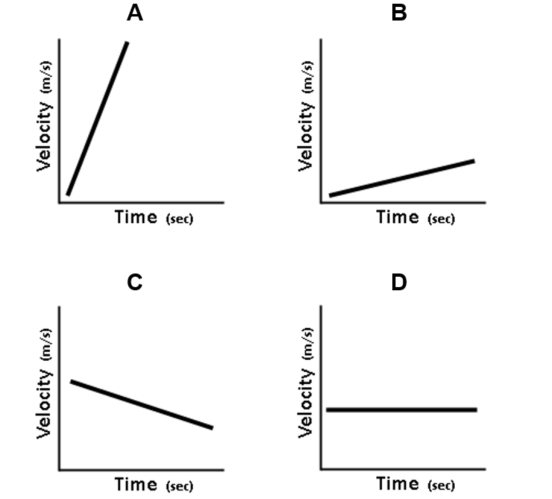
Which graph represents zero acceleration (constant velocity)?
a)
A
b)
B
c)
C
d)
D
60.
Which graph represents the greatest acceleration?
a)
A
b)
B
c)
C
d)
D
61.
Which of the following is a unit for acceleration?
a)
km/s
b)
m/s2
c)
mi/hr
d)
ft
62.

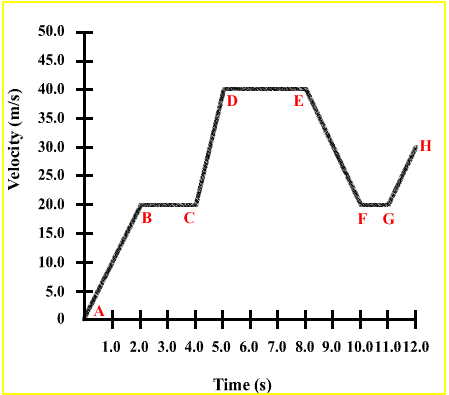
Which section of the graph shows acceleration?

a)

AB

b)

BC

c)

DE

d)

FG

63.

What happened during C to D point?

a)

not moving (at rest)

b)

increasing speed at a constant rate

c)

moving at a constant speed

d)

moving at 0 m/s2 acceleration

64.
Acceleration is defined as the CHANGE in 
a)
time it takes for one place to move to another place. 
b)
velocity of an object.
c)
distance divided by the time interval 
d)
velocity divided by the time interval 
65.
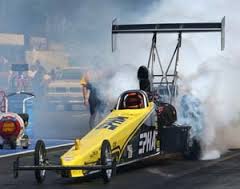
A drag racer accelerated from 0 m/s to 200 m/s in 5 s.  What was the acceleration?
a)
0 m/s
b)
40 m/s2
c)
-40 m/s2
d)
40 m/s
66.
A negative acceleration means that your object is _____. 
a)
not accelerating
b)
not moving
c)
speeding up 
d)
slowing down 
67.

A school bus drives 35 mph down the street and slows as it approaches the stop sign. This is an example of..

a)

acceleration (deceleration)

b)

speed

c)

velocity

d)

force

68.
A rightward-moving motorcycle increases its speed from 5.0 m/s to 25.0 m/s. Is the motorcycle accelerating?
 
a)
Yes
b)
No
69.

final speed minus initial speed, divided by time

a)

acceleration

b)

speed

c)

relative motion

70.

According to the acceleration formula,the starting speed of a car is called its _____speed.

a)

initial speed

b)

final speed

c)

fastest

d)

slowest

71.

To find change in speed, subtract initial speed from ____ speed.

a)

initial

b)

time

c)

final

d)

distance

72.

Slowing down is called

Choose ALL that apply. There may be MORE THAN ONE answer.

a)

negative acceleration

b)

velocity

c)

speed

d)

deceleration

73.

Which of the following are examples of acceleration?

Choose ALL that apply. There may be MORE THAN ONE answer.

a)

A train sitting in the station

b)

A train pulling out of the station

c)

A train traveling consistently at 100km/hr on a straight track

d)

A train going around a curve in the track without changing speed

e)

A train pulling into a station

74.

What is happening at segment D?

a)

acceleration

b)

deceleration

c)

constant speed

d)

no motion/object at rest

75.
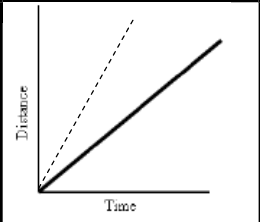
What does this graph represent?
a)
Constant Speed
b)
Acceleration
c)
Not moving
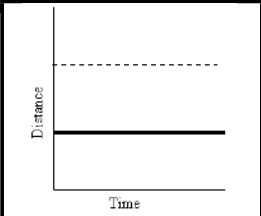
76.
What does this graph represent?
a)
Constant speed
b)
Acceleration
c)
Not moving
77.
What is this graph showing?
a)
Constant Speed
b)
Acceleration (speeding up)
c)
Deceleration (slowing down)
d)
No motion
78.
What is this object doing?
a)
moving at a constant speed away from start and then stops
b)
increasing speed and then stops
c)
decreasing speed and then constant speed
d)
moving at a constant speed away from start and then constant speed
79.
What does this graph represent?
a)
Constant speed
b)
Acceleration
c)
Not moving
80.

Match the description to the graph:

"The car is coming back."

a)
b)
c)
d)
81.

Match the description to the graph:

"The car is traveling at a constant speed."

a)
b)
c)
d)
82.

Match the description to the graph:

"The car is slowing down."

a)
b)
c)
d)
83.
a)
b)
c)
d)
84.
What is happening at D?
a)
Stationary
b)
Accelerating
c)
Fast steady speed; moving away from the starting position
d)
Slower steady speed; moving away from the starting position
85.
What is happening at C?
a)
Stationary
b)
Accelerating
c)
Fast steady speed; moving away from the starting position
d)
Slower steady speed; moving away from the starting position
86.

Segment B-C The bus is _________________.

a)

at rest

b)

returning (to original position)

c)

moving forward

87.

Segment A-B The bus is _________________.

a)

at rest

b)

returning (to original position)

c)

moving forward

88.

Segment C-D The bus is _________________.

a)

at rest

b)

returning (to original position)

c)

moving forward

89.

Segment D-E The bus is _________________.

a)

at rest

b)

returning (to original position)

c)

moving forward

90.

Segment E-F The bus is _________________.

a)

at rest

b)

returning (to original position)

c)

moving forward

91.
What is the person doing from 5 seconds to 10 seconds?
a)
Walking at a constant speed
b)
Running fast
c)
Not moving
d)
Walking slow