wayground logo

Free Printable Worksheets

NEW

Font size

S
M
L
XL
Worksheets

Electricity and Magnets

Total questions: 52

Worksheet time: 39mins

Name
Class
Date
1.
In a neutral atom, the number of electrons is equal to the number of _______.
a)
Neutrons
b)
Orbits
c)
Protons
d)
subatomic particles
2.
If two charges repel each other, the two charges must be
a)
Positive and neutra
b)
Positive and negative
c)
positive and neutral
d)
negative and negative
3.
An object becomes charged when the atoms in the object gain or lose
a)
electrons
b)
protons
c)
neutrons
d)
all of the above
4.
If you rub a glass rod with a piece of silk, the rod becomes positively charged. This means that
a)
friction destroyed electrons in the rod.
b)
the silk has become negatively charged.
c)
protons have moved to the rod.
d)
glass attracts more protons.
5.
If you bring a charged object near an electrically neutral surface without allowing the object to touch the surface, the charges in the surface are rearranged by
a)
friction.
b)
convection.
c)
induction.
d)
conduction.
6.
Objects that have opposite charges
a)
are attracted to each other, and the force between the objects pulls them together.
b)
are attracted to each other, and the force between the objects pushes them apart.
c)
are repelled by each other, and the force between the objects pulls them together.
d)
are repelled by each other, and the force between the objects pushes them apart.  
7.
Charging by ____ occurs when electrons are transferred from one object to another by direct contact.
a)
reduction
b)
induction
c)
conduction
d)
friction
8.

Electricity happens with the flow of

a)

electrons

b)

water

c)

sand

9.

Protons have a ______ charge.

a)

Positive

b)

Negative

c)

Neutral

10.

Electrons have a ______ charge.

a)

Positive

b)

Negative

c)

Neutral

11.

Current electricity is when_________________

a)

electrons jump from one thing to another

b)

magic happens

c)

electrons flow through a circuit

12.

If the balloon has a negative charge, the hair must have what charge?

a)

negative

b)

positive

c)

neutral

13.
True or False, Lighting is a form of static electricity.
a)
True
b)
False
14.
The difference between attract and repel is that to attract is to pull something closer and repel is to push something away.
a)
True
b)
False
15.
If an object has a higher number of protons than electrons on its surface, what type of charge does it have?
a)
A positive charge.
b)
A negative charge.
c)
A neutral charge
d)
No charge at all
16.
Is Wood a conductor or Insulator?
a)
Conductor
b)
Insulator
17.
What is the difference between a conductor and an insulator?
a)
An insulator allows electricity to flow through it easily and a conductor does not
b)
A conductor allows electricity to flow through it easily and an insulator does not.
c)
An insulator is magnetic and a conductor is not
d)
A conductor is magnetic and an insulator is not
18.
What is one type of good conductor that we learned about in class?
a)
Most plastics
b)
Most fruits
c)
Most wood products
d)
Most metals
19.

Which of the following is an example of a conductor?

a)

plastic

b)

copper

c)

glass

d)

rubber

20.

When someone's hair is charged by the person holding onto the Van de Graaf generator, you are observing ___.

a)

friction

b)

conduction

c)

induction

21.
____________ allows electricity to flow.
a)
A conductor
b)
An insulator
c)
A magnet
22.
____________ stops the flow of electricity.
a)
A conductor
b)
An insulator
c)
A magnet
23.

What source of electricity do we get from a wall outlet?

a)

It is a source of alternating current

b)

It is a source of direct current

c)

It is a source of static electricity

d)

It is a source of electromagnetic radiation

24.

Which of the following are sources of mechanical energy?

a)

Wind and fossil fuels

b)

Transmission lines and transfromers

c)

Radios and televisions

d)

Cars and trucks

25.

How can it be explained that someone's hair can stick to a balloon?

a)

There is static electricity.

b)

There is too much dust in the air.

c)

The person needs to wash his hair.

26.

Opposite charges _______________.

a)

attract

b)

repel

c)

nothing changes

27.

The flow of electric charge in a circuit is called _______.

a)

Heat

b)

Sound

c)

Electric Current

d)

Magnetic

28.

Identify the part of the circuit that is labeled 1.

a)

battery

b)

wire

c)

switch

d)

bulb

29.

Identify the part of a circuit that is labeled 3.

a)

battery

b)

wire

c)

switch

d)

bulb

30.

What supplies the energy or power in an electric circuit?

a)

light bulb

b)

wire

c)

battery

31.
Identify the insulator below.
a)
aluminum foil
b)
paperclip
c)
rubber eraser
32.

Identify the conductor below.

a)

cloth

b)

plastic

c)

metal

33.

What will happen to the 2 magnets if they are released?

a)

attract

b)

repel

34.

​Why does the top magnet appear to float above the bottom magnet?

a)

The magnets are made of different materials.

b)

The like poles repel each other.

c)

The opposite poles repel each other.

d)

the magnets have different gravitational pull

35.

True or False: A magnet is attracting when it pushes objects away from each other.

a)

True

b)

False

36.
True or False: All metals stick to magnets.
a)
True
b)
False
37.
Which poles are attracted? 
a)
north and north
b)
south and south
c)
north and south
38.
Which poles repel?
a)
north and south
b)
south and north
c)
south and south
39.
Bob made an electromagnet but it was very weak.  How can he make it stronger?
a)
take away a d-cell
b)
wrap the wire loosely
c)
use thicker wire
d)
use less winds
40.
Which metals are attracted to magnets? 
a)
iron, nickel, cobalt
b)
gold, silver, platinum
c)
copper, magnesium, aluminum
41.
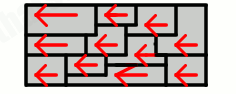
This substance is
a)
magnetized
b)
unmagnetized
c)
positively charged
d)
negatively charged
42.
You know this substance is magnetized because
a)
all the domains have right angles
b)
the arrows are drawn in red
c)
the domains are aligned
d)
the domains are random
43.
Where are the magnetic force the strongest in this picture?
a)
Location 1
b)
Location 2
c)
Location 3
d)
Location 4
44.

What do the lines around this magnet represent?

a)

North Pole

b)

South Pole

c)

Magnetic Declination

d)

Magnetic Field

45.
As the distance between two magnets increases (they get farther apart), the force between them:
a)
Increases
b)
Decreases
c)
Stays the Same
46.
What is the name of a magnet that stays magnetic only while it touches a permanent magnet, or one that is magnetic for a very short time
a)
Temporary magnet
b)
Permanant magnet
c)
Electromagnet
d)
Magnet
47.
The picture is an example of an:
a)
Electric circuit
b)
Electromagnet
c)
Electric nail
d)
Electric power cell
48.
To make this electromagnet stronger you could
a)
use less wire
b)
have fewer wire coils around the nail
c)
have more wire coils around the nail
d)
use a plastic core
49.

Which of the following represents how generators convert energy?

a)

chemical energy -----------> solar energy

b)

mechanical energy ------------> chemical energy

c)

mechanical energy -----------> electrical energy

d)

electrical energy ------------> mechanical energy

50.

An electromagnet is a magnet tat can be turned on or off.

a)

True

b)

False

51.
Electric motors are devices that convert _____ energy into  _____ energy.
a)
electrical; mechanical
b)
mechanical; electrical
c)
chemical; potential
d)
mechanical; kinetic
52.

A magnet is moved through a coil of wire which causes an electric current to pass through the wire.  Which best describes this phenomenon?

a)

Electromagnetism

b)

Electromagnetic induction

c)

Electric Motor

d)

Magnetic electricity