
Font size
S
M
L
XL
 Worksheets
24-25 Energy Review
Total questions: 48
Worksheet time: 24mins
Name
Class
Date
1.
_________ is a measurement of how much force is applied over a certain distance.
a)
Power
b)
Energy
c)
Work
d)
Gravity
2.
What is the unit of measurement of energy?
a)
Newton
b)
Watt
c)
Joule
d)
Meter
3.
If you toss a baton straight up, total energy decreases as the baton rises.
a)
True
b)
False
4.
Potential energy and kinetic energy have a direct relationship, meaning that, as one goes up, the other also goes up.
a)
True
b)
False
5.
Potential energy depends on the ______ and ______ of the object.
a)
Height (position), Speed
b)
Height (position), Mass
c)
Friction, Speed
d)
Mass and speed
6.
Kinetic energy depends on the _____ and _______ of the object.
a)
Height (position), speed
b)
Height (position), mass
c)
Friction, speed
d)
Mass, speed
7.
Choose the answer that does NOT relate to potential energy.
a)
The energy an object has due to its position.
b)
stored energy.
c)
elastic energy.
d)
chemical energy
e)
motion or movement
8.
Energy in motion is an example of what type of energy?
a)
potential
b)
kinetic
c)
chemical
d)
nuclear
e)
electrical
9.
Riding a bike is an example of what kind of energy?
a)
potential
b)
sound
c)
chemical
d)
mechanical
e)
electrical
10.
Hitting a tennis ball is an example of what kind of energy?
a)
potential
b)
sound
c)
chemical
d)
mechanical
e)
electrical
11.
A CD player turns the initial ________ energy into ____________ energy as it spins the disc.
a)
potential, sound
b)
kinetic, thermal
c)
chemical, electrical
d)
mechanical, electrical
e)
electrical, mechanical
12.
Energy from the sunlight is an example of what kind of energy?
a)
radiant
b)
sound
c)
chemical
d)
mechanical
13.
When a basketball has gone through the hoop and is halfway from the goal to the ground, it has what type of energy?
a)
potential energy
b)
kinetic energy
c)
both potential and kinetic energy
14.
Friction turns mechanical energy into what type of energy?
a)
thermal
b)
sound
c)
electrical
d)
radiant
15.
A hairdryer turns electrical energy into what type of energy?
a)
thermal
b)
sound
c)
electrical
d)
radiant
16.
In photosynthesis, a plant uses the sunlight and turns __________ energy into ___________ energy.
a)
thermal ; chemical
b)
potential ; mechanical
c)
nuclear; chemical
d)
radiant ; chemical
17.
According to the law of conservation of energy...
a)
individuals should conserve energy by reducing waste.
b)
turning off water when not being used will help save the earth.
c)
energy is neither created or destroyed.
d)
stored up energy will lose its power over time.
18.
Energy stored in the nucleus of an atom is
a)
radiant energy
b)
thermal energy
c)
chemical energy
d)
nuclear energy
19.
Another word for radiant energy is ___________ energy.
a)
light
b)
electrical
c)
thermal
d)
mechanical
20.
When we sing, we convert the mechanical energy in our vocal chords to __________________.
a)
wasted
b)
potential
c)
sound
d)
electrical
21.
Can an object have both kinetic and potential energy at the same time?
a)
Yes
b)
No
22.
As an object falls, its _____________ energy is decreasing as its ______________ energy is increasing.
a)
potential, kinetic
b)
kinetic, potential
c)
mechanical, thermal
d)
elastic, mechanical
23.
A flock of sheep are grazing in a field. As they eat, the sheep break down the molecules in the grass, which releases energy. Which form of energy is stored in the grass?
a)
Chemical energy
b)
Elastic energy
c)
Nuclear energy
d)
Thermal energy
24.
Edith strikes a match and sets some logs on fire. As the fire burns, which two forms of energy are released?
a)
light(radiant) and thermal
b)
chemical and light
c)
thermal and electrical
d)
electrical and chemical
25.
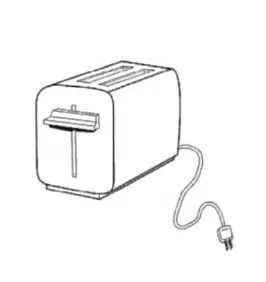
The figure shows a toaster that toasts (cooks) bread. Which energy conversion takes place when a toaster is switched on?
a)
chemical to sound
b)
electrical to sound
c)
chemical to thermal
d)
electrical to thermal
26.

A student is investigating potential and kinetic energy by stretching a spring across a table. When the student lets go, the spring recoils. At which time is potential energy in the spring being converted into kinetic energy?
a)
when the spring is stretching
b)
when the spring is fully stretched
c)
when the spring is recoiling
d)
when the spring is fully recoiled
27.

A student is investigating potential and kinetic energy by stretching a spring across a table. When the student lets go, the spring recoils. Which picture shows the spring when it has the most potential energy?
a)
when the spring is stretching
b)
when the spring is fully stretched
c)
when the spring is recoiling
d)
when the spring is fully recoiled
28.
Two shopping carts are loose in a parking lot. One cart has lots of food in it, so it has a lot of mass. The other cart is empty. The parking lot is on a slight hill, so both carts are moving down the hill towards a parked car. They may cause a dent in the car when they hit it. What additional information do you need to know to figure out which cart will have the greatest KE when they hit the parked car?
a)
The exact mass of each cart
b)
the exact distance away the car is
c)
the density of each cart
d)
the speed (velocity) that each cart is moving
29.
You're watching a movie. In the movie, two huge Big Mack trucks are speeding down the highway. One truck is driven by the bad guy, and the other truck is driven by the really, really bad guy. They are going the exact same speed! Suddenly, a train stops on the tracks right in the roadway. Both trucks are going to hit the train car! What additional information do you need to know to figure out which truck would hit the train with the most kinetic energy?
a)
the type of road surface
b)
the mass of each truck.
c)
the mass of the train car
d)
the speed the train was traveling
30.
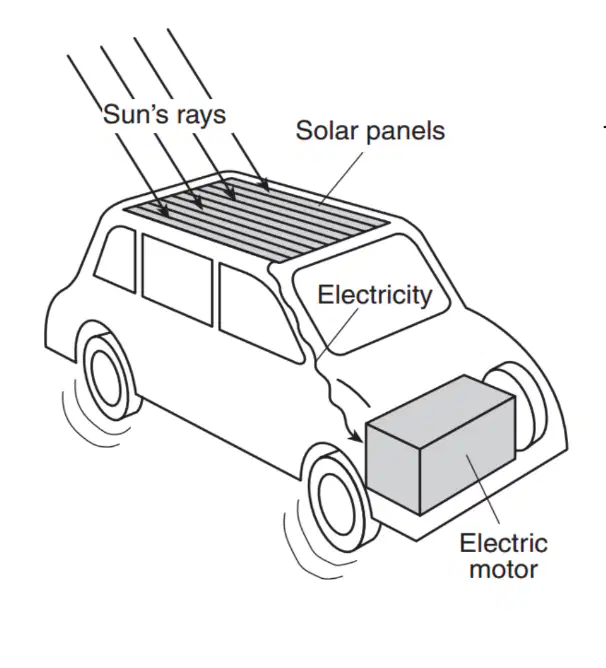
What is the sequence of the energy transformation represented in the diagram?
a)
mechanical to chemical to solar
b)
solar(radiant) to electrical to mechanical
c)
mechanical to electrical to solar
d)
solar to chemical to electrical
31.
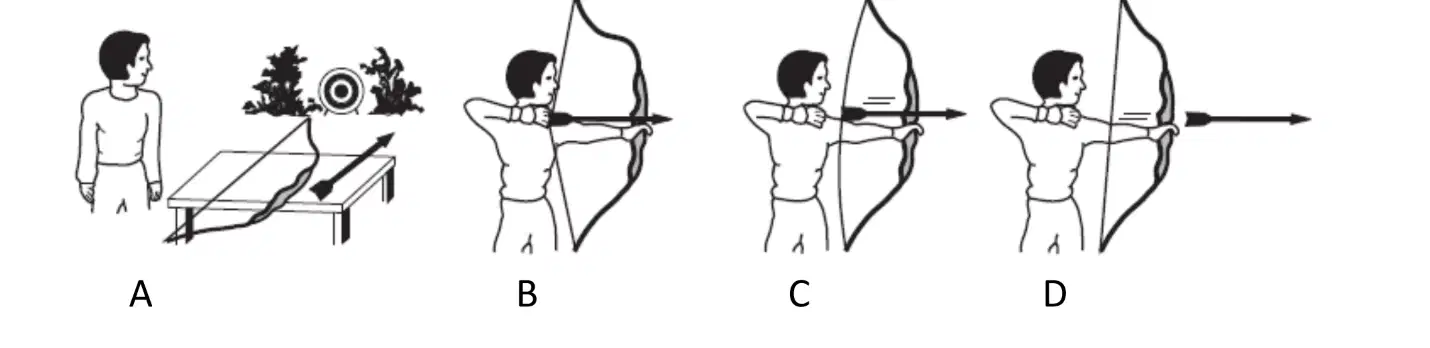
A person uses a bow to shoot an arrow at a target. In which diagram does the bow and arrow have the greatest amount of potential energy?
a)
A
b)
B
c)
C
d)
D
32.
A bowling ball is rolled down a bowling alley towards some pins. If you wanted to make the bowling ball hit the pins with more kinetic energy, what could you change?
a)
Use a bowling ball with a bigger mass
b)
make the bowling alley longer
c)
decrease the speed of the bowling ball
d)
set the bowling pins closer together
33.
Two marbles that both have a mass of 10 grams are dropped to the ground. The green marble is dropped from 1 meter high and the blue marble is dropped from 2 meters high. Which statement best describes the amount of energy when each marble hits the ground?
a)
they will have the same amount of energy because they have the same mass
b)
the green marble will have more energy because it was dropped closer to the ground
c)
the blue marble will have more energy because it has more gravitational potential energy.
d)
None of the above.
34.
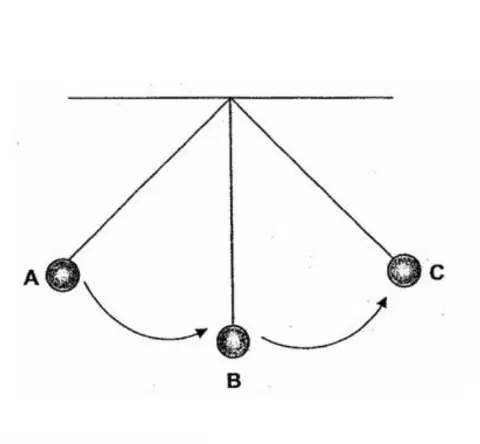
Alice carried out an experiment using the pendulum. She lifted the metal ball and let it swing freely for a period of time. Which of the following graphs shows the change in the potential energy of the metal ball as it was first swung from A to B and then to C?
a)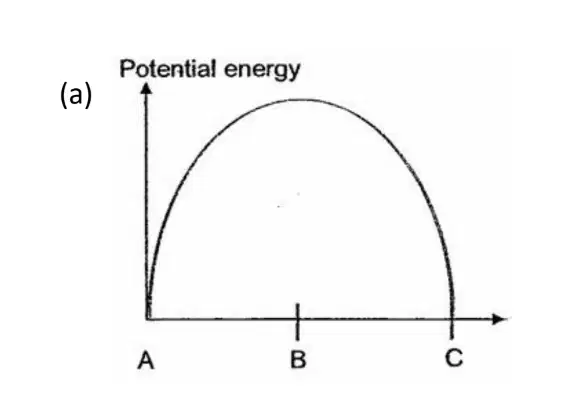
A
b)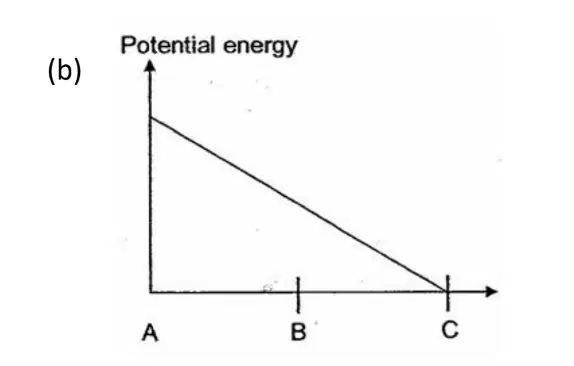
B
c)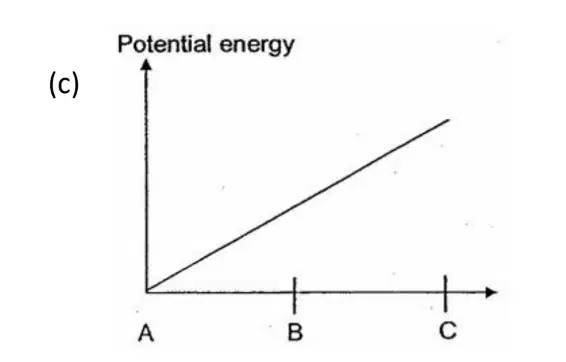
C
d)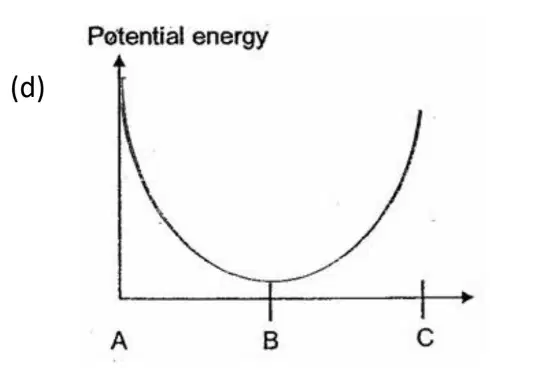
D
35.
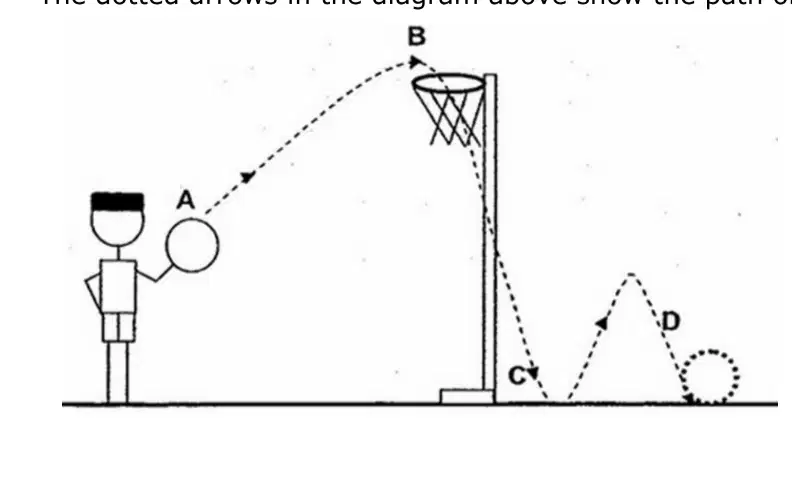
David aims and shoots a basketball into the net. The dotted arrows in the diagram above show the path of the basketball. At which point is the kinetic energy the highest?
a)
A
b)
B
c)
C
d)
D
36.
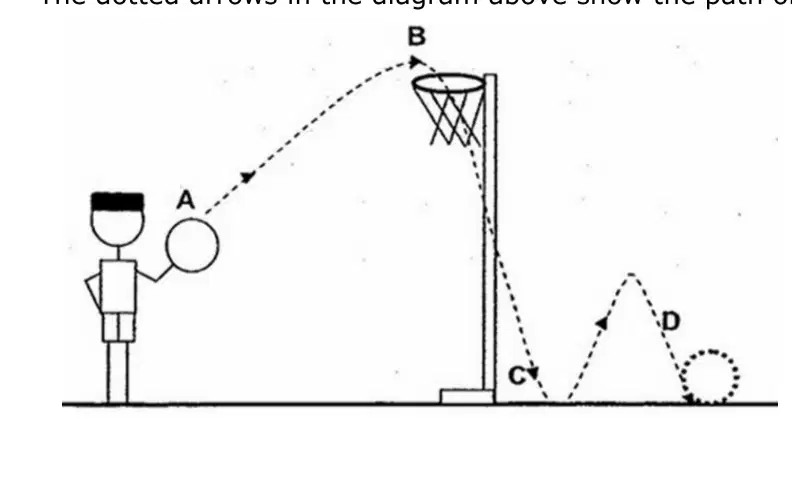
David aims and shoots a basketball into the net. The dotted arrows in the diagram above show the path of the basketball. At which point is the potential energy the highest?
a)
A
b)
B
c)
C
d)
D
37.
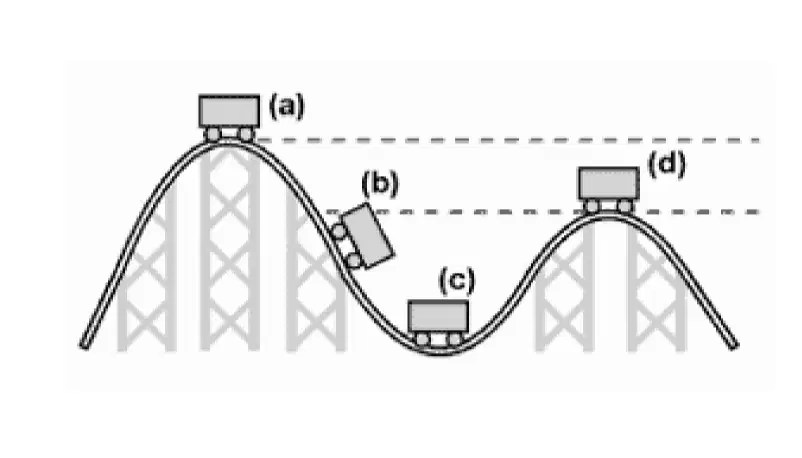
What kind of energy does the car have at point a?
a)
potential
b)
kinetic
38.
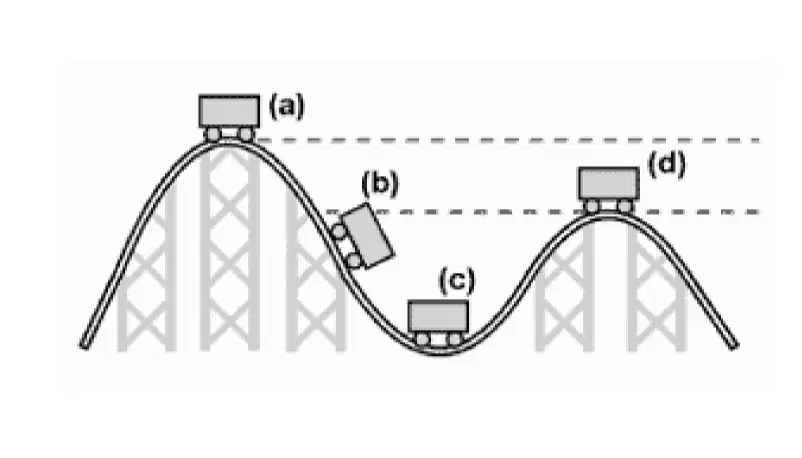
What kind of energy does the car have at point c?
a)
potential
b)
kinetic
39.
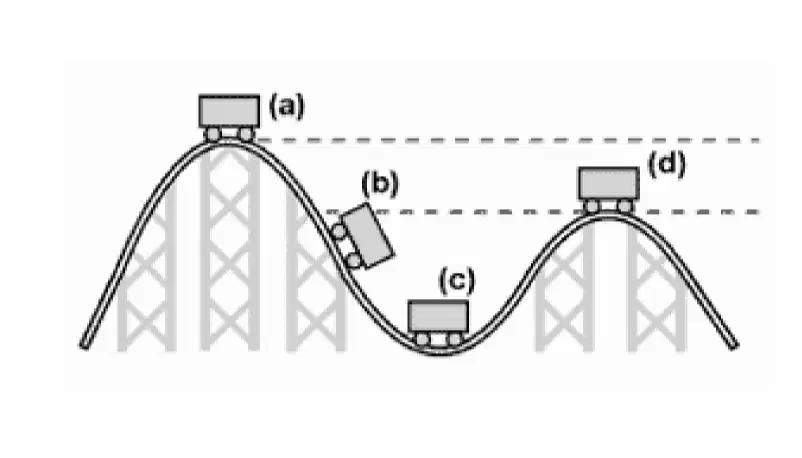
Which point best shows potential energy being converted into kinetic enegry?
a)
a
b)
b
c)
c
d)
d
40.
A runner races in the 100 meter dash. It takes her 10 seconds to finish. What is her average speed?
a)
10 seconds
b)
10 meters/second
c)
100 meters/second
d)
1000 meters/second
41.
There is a bell at the top of a tower that is 45 m high. The bell has a mass of 190 kg. The bell has ____________ energy equal to ______________.
a)
Potential; 83,790 J
b)
Potential; 8,550 J
c)
Potential; 821,142 J
d)
Kinetic; 8,550 J
e)
Kinetic; 83,790 J
42.
A car is traveling with a velocity of 40 m/s and has a mass of 1120 kg. The car has _________ energy equal to ___________.
a)
Potential; 22,400 J
b)
Potential; 896,000 J
c)
Kinetic; 439,040 J
d)
Kinetic; 896,000 J
43.
What is the kinetic energy of a 2,000 kg boat moving at 5 m/s?
a)
5,000 J
b)
10,000 J
c)
25,000 J
d)
98,000 J
44.
You are on rollerblades at the top of a small hill. Your potential energy is equal to 1,000 J. The last time you checked, your mass was 60 kg. What is the height of the hill?
a)
0.17 m
b)
1.7 m
c)
3.4 m
d)
16.7 m
45.

According to the graph below, what was the kinetic energy of the lander when it had a mass of 1200 kg?
a)
1,000 kJ
b)
1,500 kJ
c)
2,000 kJ
d)
2,500 kJ
46.

According to the graph below, what kind of relationship is there between kinetic energy and mass?
a)
Inverse
b)
Exponential
c)
Direct/Linear
d)
There is no relationship between mass and Kinetic Energy
47.

According to the graph below, what was the velocity of the lander when it had ~1750 kJ of Kinetic Energy?
a)
20 m/s
b)
60 m/s
c)
70 m/s
d)
90 m/s
48.

According to the graph below, what kind of relationship is there between kinetic energy and velocity?
a)
Inverse
b)
Exponential
c)
Direct/Linear
d)
There is no relationship between velocity and Kinetic Energy
Reset

