
 Worksheets
Science Diagnostic Recap
Total questions: 40
Worksheet time: 40mins
Cara read an article on why repetition and replication are so important, but she did not understand the difference between them. Which of the following best explains the two terms?
a. Repetition is when a scientist repeats an experiment; replication is when a scientist conducts an experiment on genetic material.
b. Repetition is when a scientist does the same experiment a number of times; replication is when other scientists reproduce a scientist’s experiment.
c. Repetition is when a scientist publishes in more than one scientific periodical; replication is when another scientist reproduces another scientist’s results.
d. Repetition is when a scientist commits an error in an experiment the first time and must repeat it; replication is when a scientist repeats an experiment to make sure it is valid.


What moon phase is occurring in position A?
New moon
Half moon
Waxing Gibbous
Full moon

The greenhouse effect is about
warming the atmosphere because of increased CO2 levels
warming the atmosphere because of decreased CO2 levels
cooing the atmosphere because of increased CO2 levels
cooling the atmosphere because of decreased CO2 levels
How does heat move?
from a warmer to a cooler object
from a cooler to a warmer object
toward a hot object
away from a cold object

When you touch hot sand, heat is transferred by _________ to your skin.
conduction
convection
radiation

What is a "boiling point"?
the temperature at which boiling occurs.
the temperature at which melting occurs.
the temperature at which solidification occurs.
What does "melting point" mean?
the temperature at which a liquid turns into a liquid.
the temperature at which a gas turns into a liquid.
the temperature at which a solid turns into a liquid

In what kind of state are the atoms in the picture?
solid
liquid
gas
What is a mixture?
The combination of two or more substances not chemically combined.
The combination of three or more substances.
A liquid.
A gas.
Cooking an egg
Chemical
Physical
No new substance created
Chemical
Physical
New substance created
Chemical
Physical
What type of energy does a sound wave have?
Mechanical
Radiant
Electrical
Sound
True or False: Sound waves are faster than light.
False
True
The speed of sound depends on these two things:
The type of medium and the temperature of the medium
Speed of the medium and temperature of the medium
Temperature of the medium and sound of the medium
None of the above
An uncovered pot of soup is simmering on Mr. Wright's stove, and there are water droplets on the wall behind it. What sequence can you infer has occurred?
evaporation, then condensation
freezing, then thawing
condensation, then vaporization
Mr. Wright is a mess
Two bar magnets are held close together. They are released and allowed to move freely. The bar magnets quickly come together. Which best explains why this happens?
The poles facing one another are both south poles
The poles facing one another are both north poles
The poles facing one another are opposite poles
One magnet was bigger than the other
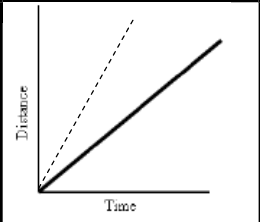
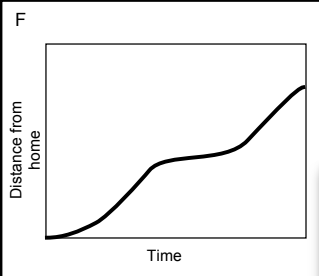
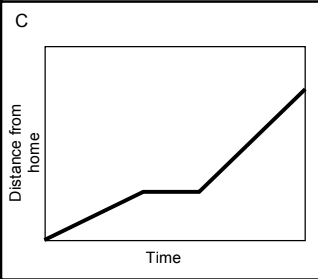
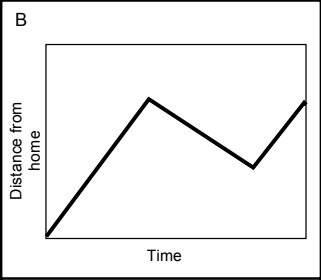
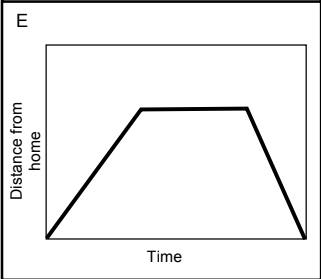
Deb walked to the ice cream shop. Sat and ate her ice cream and then went for a run.
Which graph matches this motion?

1. (T/F) Most protists are unicellular, but a few are multicellular.
True
False

3. Which one of these is not considered a type of Protist?
Animal-like
Plant-like
Fungus-like
Bacteria-like

An exact copy of a cell/organism is produced...
Mitosis
Meiosis

Variation in the cells/organisms produced...
Mitosis
Meiosis

Some bacteria reproduce asexually, so they have...
offspring identical to the parents.
offspring unlike the parents.

Brown Bears reproduce sexually, so all the baby bears are...
different.
the same.
What is natural selection?
process in which helpful traits become more common over time
a trait that helps an organism survive better
Which cell parts are not present in animal cells?
cell membrane & cytoplasm
nucleus & chloroplasts
cell wall & chloroplasts
ribosomes & mitochondria
Which organelle is the location of DNA (genetic material)?
mitochondria
ribosomes
nucleus
Endoplasmic Reticulum
Which statement was NOT included in cell theory?
All living things are composed of cells.
Living cells come only from other living cells.
Each cell contains a cell membrane, cytoplasm, nucleus, mitochondria, and endoplasmic reticulum.
Cells are the smallest structure of living things that can perform the functions necessary for life.

