Font size
 Worksheets
Ch 6. Quiz 1. Review
Total questions: 65
Worksheet time: 2hrs 20mins
Use the change of base rule to rewrite this problem:
log364
log(64)/log(3)
log(3)/log(64)

WRITE ON PAPER
Using the change of base rule, what is this logarithm equivalent to?
A
B
C
D
Use the change of base rule to rewrite this problem:
log575
log(75)/log(5)
log(5)/log(75)


Use the change of base rule to rewrite this problem:
log7729
log(7)/log(729)
log(729)/log(7)
Rewrite logx95 = 2.3
x2.3 = 95
952.3 = x
2.395 = x
x95 = 2.3
WRITE ON PAPER
Rewrite 1.6(x+2) = 14.1
log1.614.1 = x+2
log1.6(x+2) = 14.1
log14.1(x+2) = 1.6
log(x+2)1.6 = 14.1
Without a calculator, determine which of the following yields a negative answer.
log9 (1/30)
log9 3
log9 -81
log9 1
Without a calculator, evaluate log41
1/4
0
-1
not possible
Without a calculator, evaluate log6 -36
not possible
-2
2
1/2
The equation A=1750(1.04)t represents an account balance t years after the account was created. Which is correct?
The account balance will decrease 0.04% each year
The account balance will increase 0.04% each year
The account balance will decrease 4% each year
The account balance will increase 4% each year
The expression 89,000(0.995)t represents the population of a town t years after 1990.
The population is increasing.
The population is decreasing.
The population of deer on an island is given by P(x)=100(0.85)x , where x represents the number of years. What is the percent rate of change for the population of deer?
85% decrease
15% decrease
85% increase
15% increase
A business manager has a starting annual salary of $42,000. Each year, the business manager will get a salary increase of 5.5%. Which function represents the business manager's salary, S, after t years?
S=42,000(1.55)t
S=42,000(1.055)t
S=42,000+1.55t
S=42,000+0.055t
Which functions represent exponential decay? Select ALL that apply.
f(x)=(0.2)x
f(x)=0.2(2)x
f(x)=(2)x
f(x)=2(0.2)x
f(x)=2(2)x
A new website has 25,000 visitors each week when it first launches. The number of visitors increases by 3% each week. Which function, V(t), represents the number of visitors t weeks after the website first launches?
V(t)=25,000+0.03t
V(t)=25,000+1.03t
V(t)=25,000(0.03)t
V(t)=25,000(1.03)t
Which functions represent exponential growth? Select all that apply.
f(x)=5(21)x
f(x)=21(5)x
f(x)=(25)x
f(x)=(52)x
f(x)=2(51)x
An experiment started with 100 bacteria at 10:00am. They double in number every hour. Find the number of bacteria at 2:00pm.
Find the missing value B(?) = 100(2)?
10
2
4
100
Find the answer
Find r (rate of increase)
WRITE ON PAPER
You deposit $1400 in an account that pays 6% interest compounded yearly. Find the balance for 20 years. Find the answer
$2800.31
$3564.22
$4489.99
$5298.26
Find a(initial amount)
Find P(6) = ??
This means find the answer
Solve the radical equation: 11=2+90−x
x = 9
x = 82
x = -9
x = -82
WRITE ON PAPER
Solve the radical equation: 6+6−15x=15
x = -5
x = 1/5
No Solution
x = -1
Which operation is opposite to the operation of cubing a number?
Addition
Division
Square
Cube Root
Which operation is opposite to the operation of taking the Square Root?
Addition
Division
Square
Cube Root
Select the operation that is the opposite operation to Multiplication.
Addition
Division
Squared
Cube Root
WRITE ON PAPPER
Solve and check your solution(s)
3x−9=3
36
18
-18
27
x/3+ 10 = 15
2x3+85=771
WRITE ON PAPER
x=7
x=−7
x=±7
No Solution
5x2=45
x=±9
x=3
x=±3
x=±15
WRITE ON PAPER
(x + 1) 2 = 25
± 5
4 or -6
-4 or 6
± 4
WRITE ON PAPER
Factor completely. k2 -2k - 24
(k+4)(k-6)
(k+4)(k+6)
(k+6)(k-1)
(k-4)(k+6)
3x² + 5x - 12
WRITE ON PAPER!!
Factor 3v2 - 4v - 7
(3v-7)(v+1)
3(v-7)(v-1)
(3v+1)(v-9)
(3v+1)(v-10)
(x - 3)(x - 3)?
WRITE ON PAPER
x2 - 16
Prime
( x - 4) ( x + 4)
( x - 8) ( x + 8)
( x - 4) ( x - 4)
x2 + 7x - 30
Rewrite in exponential form:
log9x=2
9x=2
2x=9
29=x
92=x
Write 6x = 8 in log form.
log6 8 = x
log8 6 = x
log6 x = 8
log8 x = 6
Write 5x =10 in log form
x = log 5
x = log510
x = 5 log10
x = 10 log 5
Write in logarithmic form:
ab = c
log a c = b
log b c = a
log a b = c
log b a = c

Rewrite log28 = 3 in exponential form.
28 = 3
23 = 8
32 = 8
83 = 2
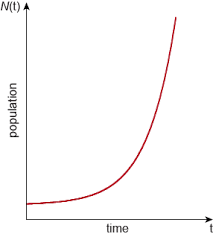
Does the graph represent growth, decay, linear or none?
Exponential Growth
Exponential Decay
Linear
None
Given the equation below determine the y-intercept.
y=3x(0, 1)
(0, 3)
x= 0
y = 0
Given the equation below determine the y-intercept.
y=3(3)x(0, 1)
(0, 3)
x= 0
y = 0

What is the y-intercept of the function?
none
all real numbers
(0, 80)
What is the definition of an asymptote?
a curved line
a curve at the origin
a line that continually approaches a given curve but does not meet it at any finite distance

What is the horizontal asymptote?
y =2
y =-2
x=-2

p(x) = 13x - 5
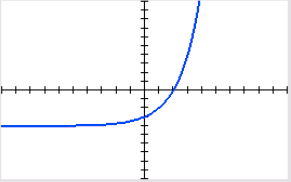
For exponential functions, the asymptotes are always...
a horizontal line
a vertical line
a diagonal line
Which of the following is an example of a graph of an exponential function?


Which table represents the inverse function values of the table above?


True or False? The inverse of (-5,6) is (6,-5)
True
False

Which of the following tables represents the inverse function values of the table above?


Which of the following tables represents the inverse function values of the table above?


Which is the inverse of the table?