
NEW
Font size
S
M
L
XL
 Worksheets
Chromatography
Total questions: 19
Worksheet time: 14mins
Name
Class
Date
1.
The physical separation of mixtures into individual components is..
a)
chromatography
b)
opacity
c)
latent
d)
trace evidence
2.
Two or more substances that are mixed together but not chemically combined is a ___
a)
compound
b)
mixture
c)
keratin
d)
chromatography
3.
Two or more substances that are chemically combined is a ___
a)
compound
b)
mixture
c)
solvent
d)
solute
4.

Ink can be separated by a method of -----------------------------------------------
a)
distillation
b)
filtration
c)
chromatography
d)
sedimentation
5.
chromatography separates the mixture of dyes on the basis of their ----------------------------
a)
density
b)
solubility
c)
gravity
d)
boiling point
6.
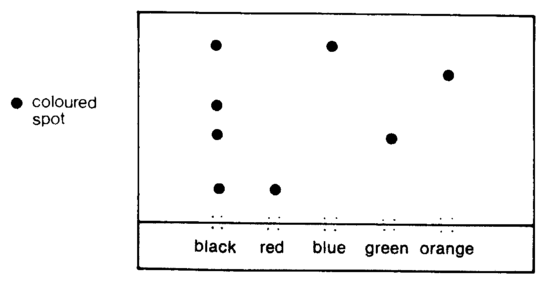
On the chromatogram given -------------- is mixture.
a)
red
b)
orange
c)
green
d)
black
7.
A pure substance shows ------------------ spot on chromat gram
a)
0
b)
1
c)
2
d)
3
8.
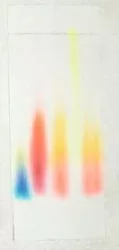
Dyes in water soluble markers may be separated by means of..
a)
crystallization
b)
sublimation
c)
chromatography
d)
sedimentation
9.
A student extracts the colour from some green smarties and uses paper chromatography to separate components colours. She finds blue has a Rf =0.38 and yellow Rf =0.75 this suggests
a)
the yellow is more strongly adsorbed onto the stationary phase and is less solublein the mobile phase.
b)
the yellow is more strongly adsorbed onto the stationary phase and is more soluble in the mobile phase.
c)
the blue is more strongly adsorbed onto the stationary phase and is less solublein the mobile phase.
d)
the blue is more strongly adsorbed onto the stationary phase and is less solublein the mobile phase.
10.
A high Rf value indicates strong
a)
strong affinity to the stationary phase
b)
strong affinity to the mobile phase
c)
no affinity to the stationary phase
d)
no affinity to the stationary phase
11.
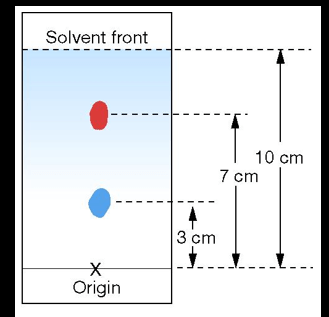
The Rf value for the blue component is
a)
0.3
b)
0.7
c)
10
d)
3
12.
The Rf value for the red component is
a)
0.3
b)
0.7
c)
10
d)
7
13.

Which plant species has plant pigments most similar to those in A?
a)
B
b)
C
c)
D
14.
What is chromatography?
a)
A way to see pretty colors
b)
A laboratory technique used to separate a mixture.
c)
A form of distillation
15.
Why must the base line be drawn in pencil and not pen?
a)
a) Pencil is good at keeping substances in place.
b)
b) Pencil is soluble in water
c)
c) Pencil is insoluble in water
d)
d) Pencil is not coloured
16.
In paper chromatography, the LEAST soluble solute ____.
a)
does not move from the start point
b)
stays closest to the start point
c)
travels furthest away from the start point
d)
can be found in the middle of the chromatogram
17.
In chromatography, if a solute does not separate and remains on the start line ....
a)
the solute is insoluble in the solvent
b)
the solute is soluble in the solvent
c)
the solvent is insoluble in the solute
d)
the solvent is soluble in the solute
18.

Whose blood was found at the crime scene?
a)
John
b)
Lisa
c)
Bob
d)
Sure
19.

Here is chromatography of markers with the paper placed in water. What is true.
a)
Blue dissolves best in water.
b)
Yellow dissolves best in water.
c)
Green dissolves best in water.
d)
Pink dissolves best in water
Reset

