
 Worksheets
Heating Curve and Phase Change Diagram Quiz
Total questions: 29
Worksheet time: 17mins

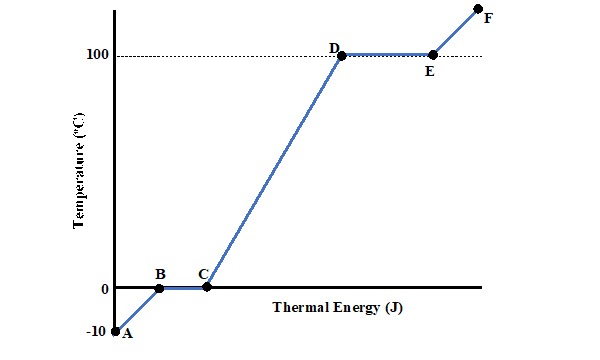
Between which two points is the gas heating up?
A ----> B
B <---- C
C ----> D
D ----> E
E ----> F

A substance's heating curve is shown in the graph. What is its melting point?
-100 C
-60 C
20 C
-20 C
When water freezes, it
gives off energy
absorbs energy
Neither gives off nor absorbs energy
When water boils
It gives off energy
It absorbs energy
Neither gives off nor absorbs energy

What do we call the energy that an object has because it is moving?
kinetic energy
electrical energy
potential energy
temperature
Condensation is ...
a change of state from a gas to a liquid
a change of state from a liquid to a solid
vaporization that occurs throughout the liquid rapidly
Evaporation is ...
a change of state from a liquid to a gas includes boiling and evaporation
a change of state from a solid directly into a gas (gas into a solid)
vaporization that occurs at the surface of a liquid slowly
Freezing is ...
a change of state from a solid to a liquid
a change of state from a liquid to a solid
a change of state from a gas to a liquid
Melting is ...
a change of state from a solid to a liquid
a change of state from a liquid to a gas includes boiling and evaporation
formation of a solid from a solution (forming crystals)
Boiling is ...
a change of state from a liquid to a solid
a change of state from a solid to a liquid
vaporization that occurs throughout the liquid rapidly
Sublimation (deposition) is ...
formation of a solid from a solution (forming crystals)
a change of state from a liquid to a solid
a change of state from a solid directly into a gas (solid into a gas)
Vaporization is ...
a change of state from a liquid to a gas includes boiling and evaporation
a change of state from a gas to a liquid
formation of a solid from a solution (forming crystals)
Endothermic
energy is released (so it feels “hot” to your hand)
energy is absorbed (so it feel “cool” to your hand)
Exothermic means ...
energy is released (so it feels “hot” to your hand)
energy is absorbed (so it feel “cool” to your hand)


What is the normal boiling point of this substance at standard pressure?
150 °C
100 °C
-50 °C
0 °C
What is the normal melting point of this substance at standard pressure?
150 °C
100 °C
-50 °C
0 °C

As temperature rises ___________.
an atom's kinetic energy decreases
an atom's kinetic energy increases
an atom's kinetic energy stays the same

