
 Worksheets
Unit One Review
Total questions: 75
Worksheet time: 2hrs 50mins


Describe the transformation:
(x, y) -> (x+3, y)
Translation 3 units to the left
Translation 3 units up
Translation 3 units to the right
Translation 3 units down
Describe the transformation:
(x, y) -> (x, y-2)
Translation 2 units to the left
Translation 2 units up
Translation 2 units to the right
Translation 2 units down
Describe the transformation:
(x, y) -> (x-2, y+7)
Translation 2 units to the left & 7 units up
Translation 2 units to the left & 7 units down
Translation 2 units to the right & 7 units up
Translation 2 units to the right & 7 units down
Describe the transformation:
(x, y) -> (x-1, y+1)
Translation 1 unit to the left & 1 unit down
Translation 1 unit to the left & 1 unit up
Translation 1 unit to the right & 1 unit down
Translation 1 unit to the right & 1 unit up
Describe the transformation:
(x, y) -> (x, y-10)
Translation 10 units to the left
Translation 10 units up
Translation 10 units to the right
Translation 10 units down
Describe the transformation:
(x, y) -> (x, -y)
reflection across the x-axis
reflection across the y-axis
rotation 90 degrees clockwise
rotation 90 degrees counterclockwise
Describe the transformation:
(x, y) -> (-x, y)
reflection across the x-axis
reflection across the y-axis
rotation 90 degrees clockwise
rotation 90 degrees counterclockwise
Describe the transformation:
(x, y) -> (-y, x)
reflection across the x-axis
reflection across the y-axis
rotation 90 degrees clockwise
rotation 90 degrees counterclockwise
Describe the transformation:
(x, y) -> (y, -x)
reflection across the x-axis
reflection across the y-axis
rotation 90 degrees clockwise
rotation 90 degrees counterclockwise
Describe the transformation:
(x, y) -> (3x, y)
Horizontal translations 3 units to the right
Vertical translation 3 units up
Horizontal stretch 3 times as wide
Vertical stretch 3 times as tall
Describe the transformation:
(x, y) -> (x, 2y)
Horizontal translations 2 units to the right
Vertical translation 2 units up
Horizontal stretch 2 times as wide
Vertical stretch 2 times as tall
A mirror image of a figure
Translation
Reflection
Rotation
Dilation
to slide or move a figure
Translation
Reflection
Rotation
Dilation
Turning around a point
Translation
Reflection
Rotation
Dilation
To change the size of a figure
Translation
Reflection
Rotation
Dilation
What does it mean if two figures are congruent?
The figures are the same shape, but different size
The figures are different size and shape
The figures are the same size and shape
The figures are the same size, but different shape

Are the figures congruent?
(What type of transformation is shown?)
Congruent (rotation)
Congruent (reflection)
NOT Congruent (rotation)
NOT Congruent (reflection)

Are the figures congruent?
(What type of transformation is shown?)
Congruent (rotation)
Congruent (reflection)
NOT Congruent (rotation)
NOT Congruent (reflection)

Are the figures congruent?
(What type of transformation is shown?)
NOT Congruent (dilation)
NOT Congruent (translation)
Congruent (dilation)
Congruent (translation)

Are the figures congruent?
(What type of transformation is shown?)
NOT Congruent (dilation)
NOT Congruent (translation)
Congruent (dilation)
Congruent (translation)
Original figure prior to a transformation.
Pre-image
Image
Original
Pre-transformed
The resulting figure in a transformation is called the
translation
preimage
image
transformation
rigid motion
A transformation that preserves distance and angle measures is called a
rigid motion
preimage
image
transformation
For a dilation, if the scale factor n is greater than 1 then the resulting image is a(n)
reduction
enlargement
scale factor
dilation
A combination of 2 or more transformations is called a
translation
preimage
party
composition of transformations
rigid motion
For a dilation, if the scale factor n is less than 1 then the resulting image is a(n)
reduction
enlargement
scale factor
dilation

Point K is located at (3, –4). What are the coordinates of its reflection over the 𝒙-axis?
(3, 4)
(−3, −4)
(−3, 4)
(4, 3)

If ABC is translated 2 units down and 3 units right, what point is the image of vertex B?
(3, −2)
(−1, −1)
(2, −1)
(−2, −2)

PQRS is rotated 90° clockwise about the origin. What are the coordinates of the image of R?
(2, 4)
(4, 2)
(–2, –4)
(–4, –2)

Under what composition of transformations does triangle ABC map onto triangle A''B''C''
Reflection over x-axis, then Rotation of 90 Degrees
Rotation of -90 Degrees, then Reflection over y-axis
Reflection over y-axis, then Rotation of -90 Degrees
Rotation of 90 Degrees, then Reflection over x-axis

If the red triangle is rotated 180 degrees, then reflected over y=2 what is the final image?
Green Triangle
Blue Triangle
Orange Triangle
Red Triangle

What is the transformation from Triangle ABC to Triangle A''B''C''?
Reflection x-axis, then rotation of 180 Degrees
Reflection over y-axis, then rotation of 90 Degrees
Rotation of 90 Degrees, then reflection over x-axis
Rotation of 180 Degrees, then reflection over y-axis
A transformation in which a second transformation is performed on a image of a first transformation is called
composition of transformation
translation
rigid motion
reflection


is symmetrical
not symmetrical

Symmetrical?
Is symmetrical
not symmetrical



Determine whether the figure has line symmetry, rotational symmetry, both, or neither.
Rotational
Reflectional
Both
Neither



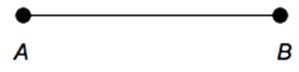


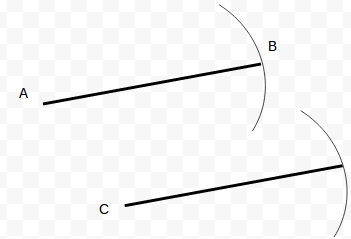
Eric was attempting to construct a perpendicular bisector to the segment AB with a compass and straight edge. Which of the below statements explains what Eric may have done wrong?
Eric should have started by putting the compass needle point at the midpoint of the segment AB.
On the second step, Eric should have placed the compass needle point where the first arc intersected the segment AB.
Erick just needed to open the compass more to create arcs that have a radius of more than half the length of the segment AB.
Erick didn’t do anything wrong he just needs to connect the opposite endpoints of each arc to finish the construction.
What does this symbol mean?
≅
not equal
congruent
equal
half


