wayground logo

Free Printable Worksheets

Font size

S
M
L
XL
Worksheets

8th Grade Standards Test Review

Total questions: 75

Worksheet time: 4hrs 31mins

Name
Class
Date
1.
What is the solution to the system?
a)
(0, 3)
b)
(1, -1)
c)
(-3, 1)
d)
(1, 3)
2.

Solve the system using elimination.

2x + 3y = 12

5x - y = 13

a)

(-3, -2)

b)

(1.5, 2)

c)

(3, 0)

d)

(3, 2)

3.

What is the equation of a line with a slope of 4 and a y-intercept of 2?

a)

y = -4x + 2

b)

y = -2x + 4

c)

y = 4x + 2

d)

y = 2x + 4

4.

What is the equation by looking at this graph?

a)

y= x + 3

b)

y= -x + 2

c)

y= 2x + 2

d)

y= x + 2

5.
Write the equation for the line in slope-intercept form.
a)
y= -1x+3
b)
y= 4x+3
c)
y=1/4x+3
d)
y= -4x+3
6.
What type of slope?
a)
zero slope
b)
undefined
c)
negative
d)
positive
7.

Between what 2 whole numbers is 6\sqrt{6}  ?

a)

1 and 2

b)

2 and 3

c)

3 and 4

d)

4 and 5

8.
Which number is rational below?
a)
√20
b)
√64
c)
d)
√7
9.
Which statement is true? 
a)
The number ⅚ is irrational
b)
The number 0.345345345 is irrational
c)
The number (4π/16π) is irrational
d)
The number (√11)² is rational
10.

Select the irrational numbers

a)

50\sqrt{50}  

b)

2

c)

π\pi  

d)

2.3454128904

11.
includes integers, fractions, terminating and repeating decimals.
a)
Rational Numbers
b)
Irrational Numbers
12.

Find the surface area of the figure. Round your answer correct to one decimal place if necessary.

a)

175.1

b)

198

c)

201.8

d)

91.2

13.

Find the surface area of the figure. Round your answer correct to one decimal place if necessary.

a)

118

b)

164.5

c)

128

d)

156.6

14.

How would we find the length of the green dotted line?

a)

7 - 4

b)

7 + 4

c)

6 + 4

d)

6 - 4

15.

What is the base and the height of T1?

a)

4 and 4

b)

1 and 4

c)

7 and 4

d)

6 and 3

16.

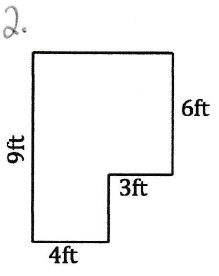
What is the area of the composite shape? (Just type the number)

(a)  

17.

What is the formula for the area of a rectangle?

a)

A = πr2\pi r^2  

b)

A = L⋅W

c)

A = 12\frac{1}{2}  bh

d)

A = π\pi  ⋅d

18.

What is the formula for the area of a triangle?

a)

A = π r2r^2  

b)

A = L⋅W

c)

A = 12×b×h\frac{1}{2}\times b\times h  

d)

A = πd

19.
a)

54 square feet

b)

45 square feet

c)

63 square feet

d)

36 square feet

20.

What is the formula for Pythagorean Theorem?

a)

a^2+b^2=c^2

b)

b-a=c

c)

c^2+b^2=a^2

d)

a+b=c

21.
The Pythagorean Theorem ONLY works on which triangle? 
a)
obtuse
b)
scalene
c)
isosceles
d)
right
22.
What is the opposite of squaring a number?
a)
divide
b)
multiply 
c)
fractions
d)
square root
23.

Find the length of the missing side.

a)

17 cm

b)

22 cm

c)

15 cm

d)

13 cm

24.

Find the length of the missing side.

a)

25 cm

b)

42 cm

c)

52 cm

d)

48 cm

25.

Find the length of the missing side

a)

48

b)

108

c)

83.6

d)

72

26.
Find the missing side
a)
9
b)
41
c)
6.4
d)
6.2
27.
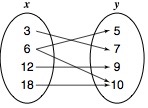
Is this mapping a function or not a function? 
a)
Function
b)
Not a Function
28.
Is this set of ordered pairs a function or not a function? 
a)
Function
b)
Not a Function 
29.
Is this is a function or not a function?
a)
Function
b)
Not a Function
30.
Is this a function or not a function?
a)
Function
b)
Not a Function
31.
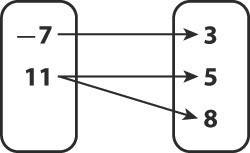
Is the relation a function? Why.
a)
Yes, because the x-value 11 has two y-values pair with it.
b)

Yes, because each y-value has only one x-value paired with it.
c)
No, because the x-value 11 has two y-values pair with it.
d)

No, because each y-value has only one x-value paired with it.

32.
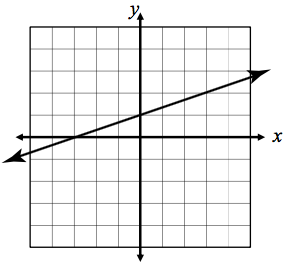
Is this graph a function or not a function? 
a)
Function
b)
Not a Function
33.
Is this table a function or not a function? 
a)
Function
b)
Not a Function
34.

Which of the following is a function?

a)
b)
c)
d)
35.

Which of the following is a function?

a)

A

b)

B

c)

C

d)

D

36.

What is the domain of the relation represented by the ordered pairs

{(-4,1), (-2,3), (0,5), (2,7), (4,9)}?

a)

{-4,-2,0,1,2,3,4,5,7,9}

b)

{1,3,5,7,9}

c)

{0,5}

d)

{-4,-2,0,2,4}

37.

What is the range of the relation represented by the ordered pairs

{(-2,8), (1,6), (4,4), (7,2), (10,0)}?

a)

{-2,0,1,2,4,6,7,8,10}

b)

{0,2,4,6,8}

c)

{-2,13}

d)

{-2,1,4,7,10}

38.
What is the domain?
a)
{-4, -1, 0, 2, 7}
b)
{-5, -4, -1, 0, 1, 2, 4, 7}
c)
{-5, 0, 1, 2, 4}
d)
{5}
39.

What is the range?

a)
{-4, -1, 0, 2, 7}
b)
{-5, -4, -1, 0, 1, 2, 4, 7}
c)
{-5, 0, 1, 2, 4}
d)
{5}
40.

What is the domain of the relation represented by the graph shown?

a)

{-2,0,2,4,6}

b)

{-7,-4,-2,-1,0,2,4,5,6}

c)

{-7,-4,-1,4,5}

d)

{-2,-1,0,2,5}

41.

What is the domain of a relation?

a)

the set of all x-values

b)

the set of all y-values

42.

Which is the set of all y-values or the outputs?

a)

Domain

b)

Range

c)

Relation

d)

Function

43.

What is the probability for the spinner to land on orange?

a)

Impossible

b)

Unlikely

c)

Likely

d)

Certain

44.
You roll a six sided die. What is the probability of rolling an even number three times in a row? 
a)
3/100
b)
1/2
c)
1/6
d)
1/8
45.
Jamie has 3 raffle tickets. One hundred tickets were sold. Her name was not drawn for the first prize. What is the probability that her name will be drawn for the second prize?
a)
1/3
b)
1/33
c)
3/100
d)
2/99
46.
A coin and a number cube with the numbers 1 through 6 are tossed. What is the probability of the coin showing tails and the number cube showing the number 3? 
a)
1/12
b)
1/4
c)
1/8
d)
1/2
47.

What is the probability of spinning a number less than 5?

a)

162316\frac{2}{3} %

b)

33 13\frac{1}{3} %

c)

66 23\frac{2}{3} %

d)

83 13\frac{1}{3} %

48.

Probability is defined as...

a)

...the likelihood that an event will occur.

b)

...a game that involves coins.

c)

...a guarantee.

49.

A quiz contains 5 true or false questions. If you forgot to study and do not know the answer to them and guess, what is the probability of getting them all right? HINT: What is the probability of getting a True or False question correct on a test

a)

1/60

b)

1/32

c)

1/6

d)

1/2

50.
If I flip a coin 10 times, how many times should I get heads?
a)
1
b)
10
c)
3
d)
5
51.
Based on the chart, what is the experimental probability of pulling a green marble?
a)
1/8
b)
8/25
c)
8/100
d)
7/8
52.
How do you find compound probability?
a)
Multiply your probabilities
b)
Add your probabilities
c)
Divide your probabilities
d)
Subtract your probabilities
53.

(4.25  104)  (3.5  103)\left(4.25\ \cdot\ 10^4\right)\ \cdot\ \left(3.5\ \cdot\ 10^3\right)  

a)

148.75  107148.75\ \cdot\ 10^7  

b)

1.4875  1071.4875\ \cdot\ 10^7  

c)

7.75  1017.75\ \cdot\ 10^1  

d)

14.875  10114.875\ \cdot\ 10^1  

54.

(1.2  105)  (2.54  102)\left(1.2\ \cdot\ 10^5\right)\ \cdot\ \left(2.54\ \cdot\ 10^{-2}\right)  

a)

30.48  10830.48\ \cdot\ 10^8  

b)

3.74  1023.74\ \cdot\ 10^2  

c)

3.048  1033.048\ \cdot\ 10^3  

d)

.3048  108.3048\ \cdot\ 10^{-8}  

55.

8  1074  104\frac{8\ \cdot\ 10^7}{4\ \cdot\ 10^4}  

a)

2  1032\ \cdot\ 10^3  

b)

2  10112\ \cdot\ 10^{11}  

c)

4  1032\frac{4\ \cdot\ 10^3}{2}  

d)

00  

56.

12  1083  103\frac{12\ \cdot\ 10^8}{3\ \cdot\ 10^{-3}}  

a)

4  1054\ \cdot\ 10^{-5}  

b)

9  1039\ \cdot\ 10^{-3}  

c)

3  1053\ \cdot\ 10^5  

d)

4  10114\ \cdot\ 10^{11}  

57.

(8  103) + (5  102)\left(8\ \cdot\ 10^3\right)\ +\ \left(5\ \cdot\ 10^2\right)  

a)

8.5  1038.5\ \cdot\ 10^3  

b)

13  10313\ \cdot\ 10^3  

c)

1.3  1021.3\ \cdot\ 10^2  

d)

3 1033\cdot\ 10^3  

58.

(9.4  106) + (2.7  107)\left(9.4\ \cdot\ 10^{-6}\right)\ +\ \left(2.7\ \cdot\ 10^{-7}\right)  

a)

96.7  10696.7\ \cdot\ 10^{-6}  

b)

  9.67  1069.67\ \cdot\ 10^{-6}  

c)

9.67  1069.67\ \cdot\ 10^6  

d)

967  106967\ \cdot\ 10^{-6}  

59.

(5  106)  (3  104)\left(5\ \cdot\ 10^6\right)\ -\ \left(3\ \cdot\ 10^4\right)  

a)

49.7  10649.7\ \cdot\ 10^6  

b)

4.97  10104.97\ \cdot\ 10^{10}  

c)

15  10415\ \cdot\ 10^4  

d)

4.97  1064.97\ \cdot\ 10^6  

60.

  (8.14  105)  (7.8  102)\left(8.14\ \cdot\ 10^5\right)\ -\ \left(7.8\ \cdot\ 10^2\right)  

a)

813.22  103813.22\ \cdot\ 10^3  

b)

8.1322  1058.1322\ \cdot\ 10^5  

c)

81.32  10581.32\ \cdot\ 10^5  

d)

8  1058\ \cdot\ 10^5  

61.
Write a rule for the translation.
a)
 (x -1, y  + 2)
b)
 (x -2, y  + 1)
c)
 (x +2, y  - 1)
d)
(x +1, y  -  2)
62.
Find K' if the figure is reflected across the x-axis
a)
(4, 1))
b)
(-1, -4)
c)
(1, -4)
d)
(1, 4)
63.

Which rule describes rotating 270° clockwise?

a)

( x, y ) → ( y, -x )

b)

( x, y ) → ( -x, -y )

c)

( x, y) → ( x, y )

d)

( x, y ) → ( -y, x )

64.

If (12,-19) if rotated 90 degrees CCW, what will it become?

a)

(12,-19)

b)

(19,12)

c)

(-19,-12)

d)

(-12,19)

65.
Which answer shows a reflection across the y-axis?
a)
a
b)
b
c)
c
d)
d
66.

Which picture shows a TRANSLATION?

a)
b)
c)
d)
67.

What is the rule for reflecting across x-axis

a)

(x,y) -> (-x, y)

b)

(x,y) -> (x, -y)

c)

(x,y) -> (y, x)

d)

(x,y) -> (-y, x)

e)

(x,y) -> (-x, -y)

68.

What is the rule for reflecting across y=x?

a)

(x,y) -> (-x, y)

b)

(x,y) -> (x, -y)

c)

(x,y) -> (y, x)

d)

(x,y) -> (-y, -x)

e)

(x,y) -> (x, y)

69.

Which is equivalent to counter clockwise 270?

a)

clockwise 90

b)

clockwise 180

c)

clockwise 270

d)

clockwise 360

70.

Translated figures are always __________________.

a)

Congruent

b)

Bigger

c)

Smaller

d)

Rotated

71.

Which transformation is shown?

a)

90o counterclockwise rotation

b)

Reflection over the line y = x

c)

Reflection over the line y = - x

d)

90o clockwise rotation

72.

Which of the following images shows a rotation of 180o?

a)
b)
c)
d)
73.

What is the sequence of transformations for the image given? (Remember: The new Image has the prime symbols.)

a)

Reflect over the x-axis, translate (x+8,y)

b)

Reflect over the x-axis then translate (x+6, y)

c)

Reflect over the y-axis then (x+1, y+1)

d)

Translate down 4 (y-4) and to the right 5 (x+5)

74.

If figure WXYZ is rotated 270°counterclockwise around the origin, which figure would it produce?

a)

ABCD

b)

EFGH

c)

JKLM

d)

WXYZ

75.
Identify the transformation from A to B.
a)
90o Clockwise Rotation
b)
180o Rotation
c)
270o  clockwise Rotation
d)
360o Rotation