wayground logo

Free Printable Worksheets

NEW

Font size

S
M
L
XL
Worksheets

Systems by Graphing

Total questions: 70

Worksheet time: 36mins

Name
Class
Date
1.
The solution to a system of equations is any ordered pair that makes both equations true. 
a)
TRUE
b)
FALSE
2.
How can you tell if a point is a solution to a system?
a)
It makes the first equation true.
b)
The (x,y) coordinates satisfy both equations
c)
It makes logical sense
d)
It makes neither equation negative
3.
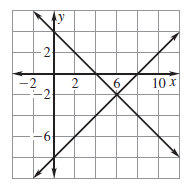
What is the solution? 
a)
1
b)
-2
c)
(1, 2)
d)
(1, -1)
4.
What is the solution to the system?
a)
(0, 3)
b)
(1, -1)
c)
(-3, 1)
d)
(1, 3)
5.


What is the solution?
a)
(2, 2)
b)
(3, 2)
c)
(3, 4)
d)
(2, 3)
6.
Steffen graphed two lines in order to find the solution to a given system of equations.
What is the solution?
a)
(-3,-8)
b)
(-8,-3)
c)
(3,-8)
d)
(8,3)
7.
These two lines intersect at _____.
a)
(4, -2)
b)
(4, 2)
c)
(-2, 4) 
d)
No solution
8.
The solution is:
a)
(4, 3)
b)
(3, 4)
c)
(-4, 3)
d)
No solution
9.
Buzz graphed two lines in order to find the solution to a given system of equations.
What is the solution?
a)
(-1, 4)
b)
(1, -4)
c)
(-4, 1)
d)
(4, -1)
10.
What is the solution to the system?
a)
(0, 3)
b)
(1, -1)
c)
(-3, 1)
d)
(1, 3)
11.

Parallel Lines never intersect because...

a)

they have the same slopes, but different y-intercepts

b)

they have the same y-intercept.

c)

they have different slopes.

d)

they have different y-intercepts and different slopes

12.
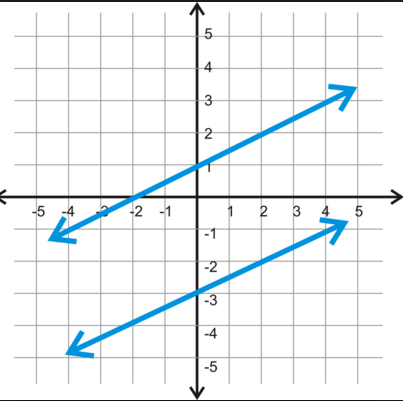
What is the solution to this system of equations?
a)
(4, -1)
b)
(-1, 4)
c)
(-4, 1)
d)
(-4, -1)
13.
This system has _____ solutions
a)
0
b)
1
c)
2
d)
Infinitely many
14.
What is the solution?
a)
One Solution
b)
No solution
c)
Infinitely Many Solutions
15.
If a system of equations has no solution, what does the graph look like? 
a)
intersecting lines
b)
parallel lines
c)
skew lines
d)
intersecting lines
16.
When you graph the exact same equation twice,
a)
you will have no solution. 
b)
you will have one solution.
c)
you will have infinite solutions. 
d)
you will graph a giraffe. 
17.
Give the solution to the system.
a)
(3,1)
b)
(1,3)
c)
(-1,3)
d)
(1, -3)
18.
Where do these two lines intersect?
a)
No solution
b)
(-2, 3)
c)
(3, -2)
d)
(2, 3)
19.
Lesly graphed two lines in order to find the solution to a given system of equations.
What is the solution?
a)
(-3,-8)
b)
(-8,-3)
c)
(3,-8)
d)
(8,3)
20.
What is the solution to this system?
a)
(1, -1)
b)
(-1, 1)
c)
(0, -2)
d)
(2, 0)
21.
When you graph the exact same equation twice,
a)
you will have no solution. 
b)
you will have one solution.
c)
you will have infinite solutions. 
d)
you will graph a giraffe. 
22.
How many solutions will this system have? 
a)
No solution
b)
One Solution
c)
I Don't Know
d)
Infinitely Many Solutions
23.
If a system of linear equations has one solution, what does this mean about the two lines? 
a)
Parallel lines
b)
the same line 
c)
Intersecting lines
24.
If a system of linear equations has infinitely many solutions, what does this mean about the two lines? 
a)
Intersecting lines
b)
Same line
c)
Parallel lines
25.
What is the solution to the system?
a)
(3, -1)
b)
(2, -6)
c)
No Solution 
d)
(6, -2)
26.
This system has _____ solutions
a)
0
b)
1
c)
2
d)
Infinitely many
27.
Which equation matches the graph? (Click me to see the image)
a)
y = 2x
b)
y = (1/4)x + 2
c)
y = 1x + 4
d)
y = -2x
28.
a)
y= -1x-3
b)
y= -3x-1
c)
y=(-1/3)x-1
d)
y= -3x-3
29.

A system of equations is a set of equations that have the ...

a)

same variables

b)

different variables

c)

no variables

d)

a lot of variables

30.

The place where two graphs cross written as an ordered pair.

a)

One Solution

b)

No Solution

c)

Infinitely Many Solutions

31.

When two lines are parallel, they never cross, they have the same slope, but different y-intercepts.

a)

No Solution

b)

One Solution

c)

Infinitely Many Solutions

32.

When the two lines are exactly the same, they have the same slope and same y-intercept, they are basically the same line.

a)

Infinitely Many Solutions

b)

One Solution

c)

No Solution

33.
The solution (x, y) to a system of equations is the point where they...? 
a)
Run off the graph
b)
Don't touch
c)
Intersect
d)
Exist
34.
If a system of equations has no solution, what does the graph look like? 
a)
intersecting lines
b)
parallel lines
c)
skew lines
d)
intersecting lines
35.
What is the solution?
a)
(1, -1)
b)
(-1, 1)
c)
(0, -2)
d)
(2, 0)
36.
What is the solution?
a)
No solution
b)
(0, 2)
c)
(0, -4)
d)
(3, -3)
37.
What is the solution?
a)
(6, 3)
b)
(3, 6)
c)
(-6, 3)
d)
Infinitely many solutions 
38.
Solve the system by graphing.
y = (-12)x + 8
y = (-23)x + 8
a)
(0,8)
b)
(0,-8)
c)
(2,4)
d)
(6,5)
39.
Solve the following system by graphing.  What is the solution?
a)
Infinite number of solutions
b)
(3, 3)
c)
(3, -3)
d)
(-3, 3)
40.
Solve the following system by graphing.  What is the solution?
a)
(-4, 2)
b)
(4, 2)
c)
(2, -4)
d)
(2, 4)
41.
Solve the system by graphing:
y = 6x - 4
y = -x + 3
a)
(1, 2)
b)
(2, 1)
c)
(4, 5)
d)
(2, 4)
42.
How many solutions will this system have?
a)
One
b)
Two
c)
No Solution
d)
Infinitely Many Solutions
43.
What is the solution to the system?
a)
(0, 3)
b)
(1, -1)
c)
(-3, 1)
d)
(1, 3)
44.
Solve by graphing.
y = 2x + 1
y = 4x - 1
a)
(1,3)
b)
(-1,-3)
c)
(-1,3)
d)
(3,1)
45.
Solve this system of equations by graphing. 
y = 2/3x - 2
y = -x + 3
a)
(0,3)
b)
(0,-3)
c)
(3,0)
d)
(-3,0)
46.
Solve this system of equations by graphing. 
y = 1/2x + 2
y = -3x + 9
a)
(2,3)
b)
(-2,-3)
c)
(3, 2)
d)
(-3,2)
47.
Will the solution (-3, -7) make the following system of equations a true statement? 
y = 4x + 5
y = x – 4
a)
YES
b)
NO
48.
A system of linear equations is... 
a)
Math Magic
b)
One Equation
c)
Always more than 2 equations
d)
A set of 2 or more equations
49.
How many solutions will this system have?
a)
No Solution
b)
Infinitely Many Solutions
c)
No Clue
d)
One solution
50.
What is the solution to the system?
a)
(3, -1)
b)
(2, -6)
c)
No Solution 
d)
(6, -2)
51.
What is the solution to the system?
a)
(3, -1)
b)
(2, -6)
c)
No Solution 
d)
(6, -2)
52.
What is the solution to the system?
a)
(0, 3)
b)
(1, -1)
c)
(-3, 1)
d)
(1, 3)
53.
How many solutions does this system of equations have?
a)
One Solution
b)
No solution
c)
Infinitely Many Solutions
d)
Two Solutions
54.

Solve this system of equations by graphing.

y = 4x - 2

y = -x + 3

a)

(-2,-1)

b)

(-1,-2)

c)

(1,2)

d)

(2,1)

55.
Solve the following system by graphing.  What is the solution?
a)
(1, 2)
b)
(-1, 2)
c)
(2, 1)
d)
(2, -1)
56.

2 Lines in the same plane that do not intersect are called?

a)

Parallel Lines

b)

Intersecting Lines

c)

Coincident Lines

d)

Checkout Lines

57.

Lines that cross over each other at one point are called?

a)

Parallel Lines

b)

Intersecting Lines

c)

Coincident Lines

d)

Checkout Lines

58.

Parallel Lines have how many solutions?

a)

One Solution

b)

Infinitely Many Solutions

c)

No Solutions

d)

As many solutions as you want

59.

Which image shows a system of linear equations with no solutions?

a)
b)
c)
d)
60.

Which image shows a system of linear equations with one solution?

a)
b)
c)
d)
61.

Which image shows intersecting lines in a system of linear equations?

a)
b)
c)
d)
62.

Which image shows a system of linear equations with infinitely many solutions?

a)
b)
c)
d)
63.
What is the solution to the system of equations? 
y = 3x - 8
y = 4 - x
a)
(3,1)
b)
(1,3)
c)
(-3,1)
d)
(3,-1)
64.
Write the 2 equations in
y = mx + b form
a)
y =2/3x and
y = 2x -4
b)
y = -2/3x +1
and y = 2/3x - 4
c)
y = 2x - 4 and
y = 1/2x
d)
y = 2x + 3 and
y = 2/3x - 4
65.
How many solutions will this system have? 
a)
No solution
b)
One Solution
c)
I Don't Know
d)
Infinitely Many Solutions
66.
The solution to the system is
a)
(-2, -8)
b)
(-8, -2)
c)
(2, -8)
d)
No solution
67.
What is the solution to this system?
y = 2x + 1
y = 4x - 1
a)
(1,3)
b)
(-1,-3)
c)
(-1,3)
d)
(3,1)
68.
y= 3x-4
y=-1/2x + 3
find the solution 
a)
(1,1)
b)
(2,5)
c)
(1,3)
d)
(2,2)
69.
Solve the following system by graphing.  What is the solution?
a)
(-4, 2)
b)
(4, 2)
c)
(2, -4)
d)
(2, 4)
70.
Solve this system of equations by graphing. 
y = 1/2x + 2
y = -3x + 9
a)
(2,3)
b)
(-2,-3)
c)
(3, 2)
d)
(-3,2)