
 Worksheets
Edgenuity Unit 3 review Radical and Rational Functions
Total questions: 75
Worksheet time: 19hrs 45mins

What is the missing factor?
3
5
6
7
Use a factor tree to find prime factorization of 24.
2 x 3 x 2 x 3
2 x 3 x 2 x 2
6 x 2 x 2
2 x 3 x 4
125
Is a perfect square.
Is not a perfect square.

Which equation is shown graphed? Use Desmos and pay attention to parenthesis.
y = 2√(x)
y = −2√(x)
y = −½√(x)
y = ½√(x)

Name the parent function.
cube root
quadratic
cubic
square root
linear

Which of the following is the function shown in the graph?


4
-4
2
-2
y varies directly with the square of x. If y=40 when x=4, find y when x = 7. Plug the numbers into the direct variation equation to find k, then find y when x=7.
17.5
70
122.5


y = 400/x
Trina's paycheck earnings varies directly as the number of hours she works. If she works 19 hours (x) and earns $187.15 (y), what should she earn if she worked 40 hours?
$394
$443.25
$472.80
$512.20
y varies inversely with x, and y is 0.5 when x is 4. Which equation represents this situation?
y = 2x
y = 2/x
y = 4x
y = x/2
Which number is irrational?
25
9
-34
2

What is the first step when solving the radical equation 4x−7+ 12 = 28
Divide both sides of the equation by 4
Square both sides of the equation
Subtract 12 from both sides of the equation
Add 7 to both sides of the equation
Check your solution


Simplify.


When you add two rational numbers, the sum is...
always rational
sometimes rational, sometimes irrational
always irrational
never rational
When you multiply two rational numbers, the sum is...
always rational
sometimes rational, sometimes irrational
always irrational
never rational
When you add a rational number and irrational number, the sum is...
always rational
sometimes rational, sometimes irrational
always irrational
mostly irrational
When you multiply a rational number and irrational number, the product is...
always rational
sometimes rational, sometimes irrational
always irrational
mostly irrational

Use Desmos.
-0.32
0.32
3.2
-3.2
What is the ∛125 ? Use Desmos.
41.6
-5
5


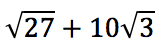
Simplify the radical...
√20a²b⁴
2ab²√5
4ab²√5
5ab²√2
2a²b²√5

Simplify:
1/5
20/100
2/10
1/√25
√80 is equivalent to
√6 ⋅√6

Evaluate: √54p6k5
3p3k2√6k
6pk√3p4k3
3p2k2√6pk
9p3k2√6k
Simplify
3535
315
915
95
None of these
Simplify
25410
25
210
45
None of these

Simplify
6(6+10)
6+215
815
96
66+215
Simplify
30(3−12)
−310
310
103
−103
5 x 5 x 5?
23 = 8


Simplify using Desmos.
2
8
16
32
Simplify . Your answer should contain only positive exponents. (a21b21)−1
a21b211
a21b21
−a21b211
−a21b21
Exponent Rules: Product Rule
ax⋅y
ax+y
ax+ay
Exponent Rules: Quotient Rule
ax−y
ayx
ax+y
Exponent Rules: Power of a Power Rule
ax+y
ax⋅y
axay
Exponent Rules: Power of a Product
ax+bx
abx
axbx
Exponent Rules: Negative Exponent
a−x=−a−x
−ax
ax1
−ax1
Exponent Rules: RATIONAL EXPONENT
ayx=yax
ax−ay
ayax
Simplify the following:
(x3y)2
x5y2
x6y2
x1y−1
2x3y


