
 Worksheets
Quadratic Relations Review
Total questions: 75
Worksheet time: 12hrs 39mins
Which of the following is the standard form of a quadratic equation?
ax2+bx+c=0
ax+b=0
ax3+bx2+cx+d=0
a(x−h)2+k=0
What is the vertex form of a quadratic equation?
y=ax2+bx+c
y=a(x−h)2+k
y=ax+b
y=a(x−p)(x−q)
Which of the following is a characteristic of the graph of a quadratic function?
It is a straight line.
It is a parabola.
It is a circle.
It is a hyperbola.
If a quadratic function opens upwards, what can be said about the leading coefficient a ?
a>0
a<0
a=0
a≤0
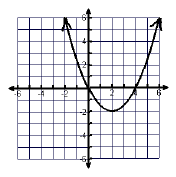
Which graph represents a quadratic relation?


Which of the following equations represents a quadratic relation?
y=3x+1
2x+y =3
y=2x3
y=2x2+1


What is the first finite difference in the table shown?
0.5
0
-1.25
0.25
Which finite difference is constant for a linear relation?
The second finite difference
None of the finite differences
The first finite difference
The third finite difference
If you use a difference table and find that the first differences are not constant and the second differences are not constant, this must mean......
That this is a linear relation
That this is a quadratic relation
That this is neither a linear or a quadratic relation
That you have made a mistake
The function f(x) = x2 + 8x - 2
Vertex form
original form
integer form
standard form
The coordinates of the vertex in this function f(x)= 3 (x+1)2 +4
(1,4)
(3,4)
(-1,4)
(3,1)
The coordinates of the y-intercept in this function f(x) = x2 + 8x - 2
(0,0)
(2,0)
(0,-2)
(-2,0)



Identify the 'b' value: y = 16x2 -8x -24
16
-8
8
-24

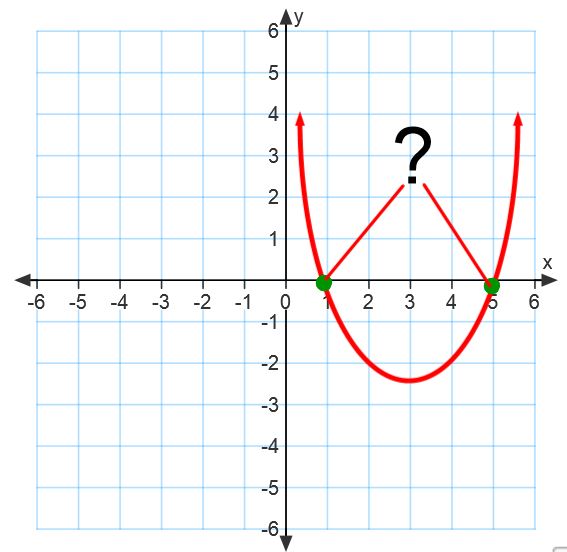
Which quadratic equation models the parabola shown?
y = (x-2)(x+5)
y = (x+2)(x+5)
y = -(x-2)(x-5)
y = -(x+2)(x+5)

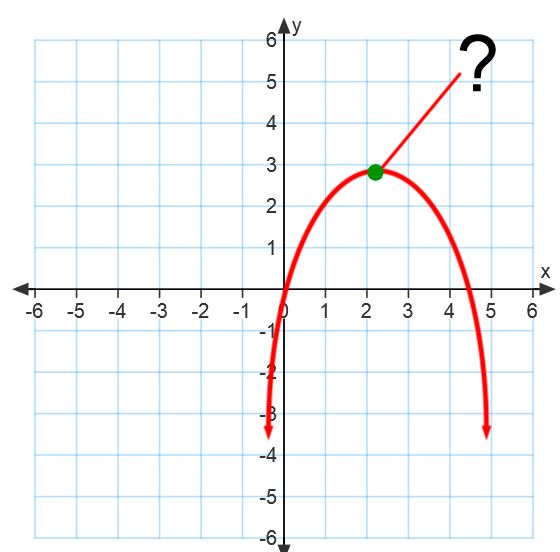
Which quadratic equation models the parabola shown below?
y = 0.25(x-2)(x+2)
y = -0.25(x-2)(x+2)
y = 4(x-2)(x+2)
Which of the following is the Factored Form of a quadratic function?
f(x) = mx + b
f(x) = ax2 + bx + c
f(x) = a(x - m)(x - n)
f(x) = a(x - h)2 + k
What are the x-intercepts of the parabola?
y = ¼(x + 2)(x - 6)
(-2, 0) and (6, 0)
(2, 0) and (-6, 0)
(-2, 6)
(¼, 0) and (-2, 0) and (6, 0)
What are the x-intercepts of the parabola?
y = -3(x + 5)(x - 9)
(-5, 0) and (9, 0)
(5,0) and (-9, 0)
(5, 0) and (9, 0)
(-3, 0) and (5, 0)and (-9, 0)
In f(x) = a(x - p)(x - q), what does "a" tell us?
The slope
If the Parabola opens up or down
x coordinate of the x - intercept
y coordinate of the y - intercept


What steps transform the graph y = x2 to y = 2(x+2)2 - 5?
Compress by 2, shifted 2 units left and 5 down
Stretch by 5, shifted 5 units left and 2 down
Stretch by 2, shifted 2 units left and 5 down
Compress by 5, shifted 2 units left and 2 down
What steps transform the graph y = x2 to y = x2 + 8
shifted up 8 units
shifted down 8 units
shifted left 8 units
shifted right 8 units
What steps transform the graph y = x2 to y = (x-4)2
Shifted down 4 units
Shifted left 4 units
Shifted right 4 units
Shifted up 4 units
f(x)=4(x-2)2 + 3
open up or down?

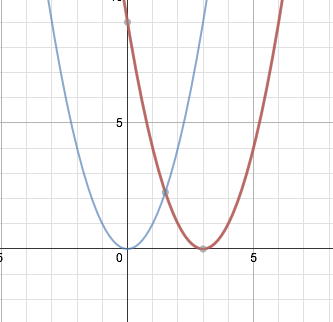
How did we transform from y=x2?
y = -3x2
vertical reflection and vertical shift down
vertical reflection and vertical stretch
horizontal stretch
vertical reflection and vertical compression
In the vertex form f(x) = a(x - h)² + k , what does the 'k' value do?
Shifts the function left or right
Reflects over the x-axis
Vertical stretch or compression
Shifts the function up or down
In the vertex form f(x) = a(x - h)² + k , what does the 'h' value do?
Shifts the function left or right
Reflection over the x-axis
Vertical stretch or compression
Shifts the function up or down
Given f(x) = ax² , if 0 < a < 1 , the graph will transform by
becoming wider or vertically compressed
becoming narrower or vertically stretched
On the May 24th weekend, the The City of Hamilton sets off fireworks at Bayfront Park.
The path of a particular firework rocket is modeled by the relation
h=−4.2(t−3)2+40
where h is the rocket’s height above the water, in metres, and t is the time, in seconds.
What is the maximum height of the rocket?
4.2 metres
3 metres
40 metres
100 metres
On the May 24th weekend, the The City of Hamilton sets off fireworks at Bayfront Park. The path of a particular firework rocket is modeled by the relation
h=−4.2(t−3)2+40
where h is the rocket’s height above the water, in metres, and t is the time, in seconds.
Determine the height of the rocket after 2 seconds.
40 metres
100 metres
35.8 metres
5 metres
A rider on a mountain bike jumps off a ledge. His path is modeled by the relation
h = -0.9d2 + 0.9d + 5.4
In factored form: h = -0.9(d – 3)(d + 2)
Where h is his height above the ground and d is his horizontal distance from the ledge, both in meters.
How far was the rider from the ledge when he landed?
0 metres
1 metre
2 metres
3 metres
In a table of values, if the "first differences" are all equal, this tells us that the relation must be:
(a)
In a table of values, if the "second differences" are all equal, but not zero, this tells us that the relation must be:
(a)
If you graph the quadratic relation y=−5x2+8x−3 , the constant term in the equation (-3) represents the:
x-intercept
y-intercept
vertex
vertical shift
This vertical line can be drawn through the centre of a parabola and cuts the parabola directly in half.
Axis of symmetry
Vertex line
y-axis
Asymptote
The parabola represented by the equation y=−x2+4x−3 :
Opens up
Opens down
Opens left
Opens right
Compared to the parabola y=x2 , which parabola is vertically stretched (narrow)?
y=21x2+4
y=−x2+x−3
y=x2+8x
y=3x2−x+1
Compared to the parabola y=x2 , which parabola is vertically compressed (wide)?
y=21x2+4
y=−x2+x−3
y=x2+8x
y=3x2−x+1
Compared to the parabola y=x2 , which parabola is reflected in the x-axis (opens down)?
y=21x2+4
y=−x2+x−3
y=x2+8x
y=3x2−x+1
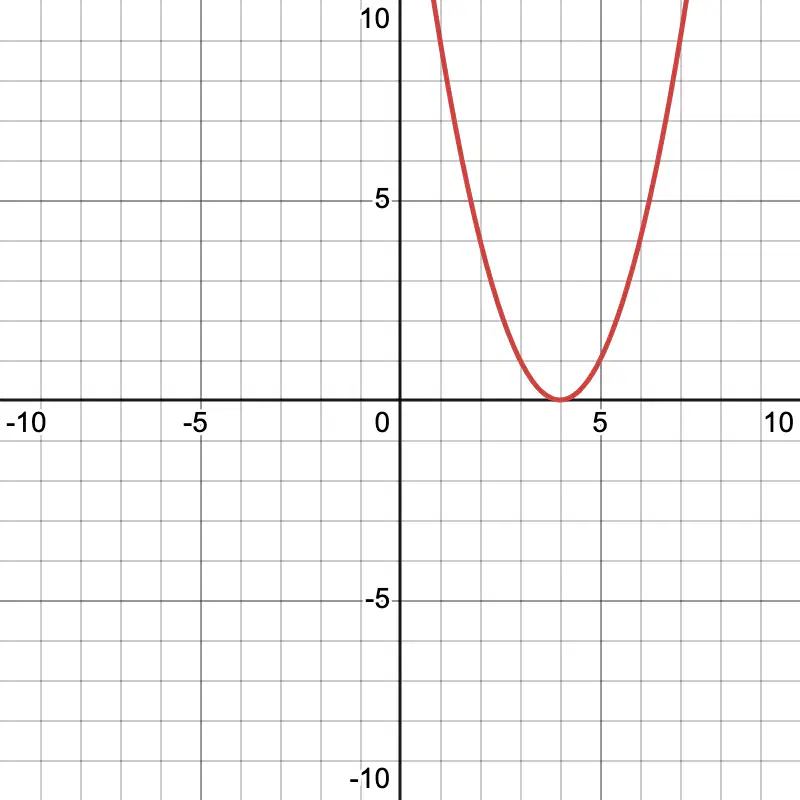
Which equation best represents the parabola shown on the graph?
y=(x+4)2
y=x2+4
y=(x−4)2
y=x2−4
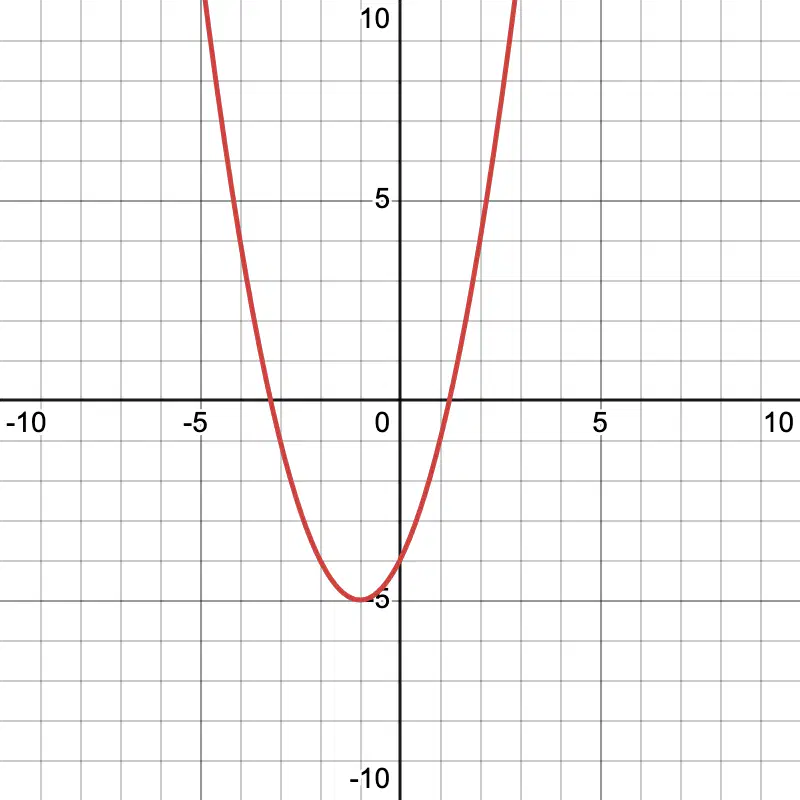
Which equation best represents the parabola shown on the graph?
y=(x−5)2−1
y=(x−1)2−5
y=(x−5)2+1
y=(x+1)2−5
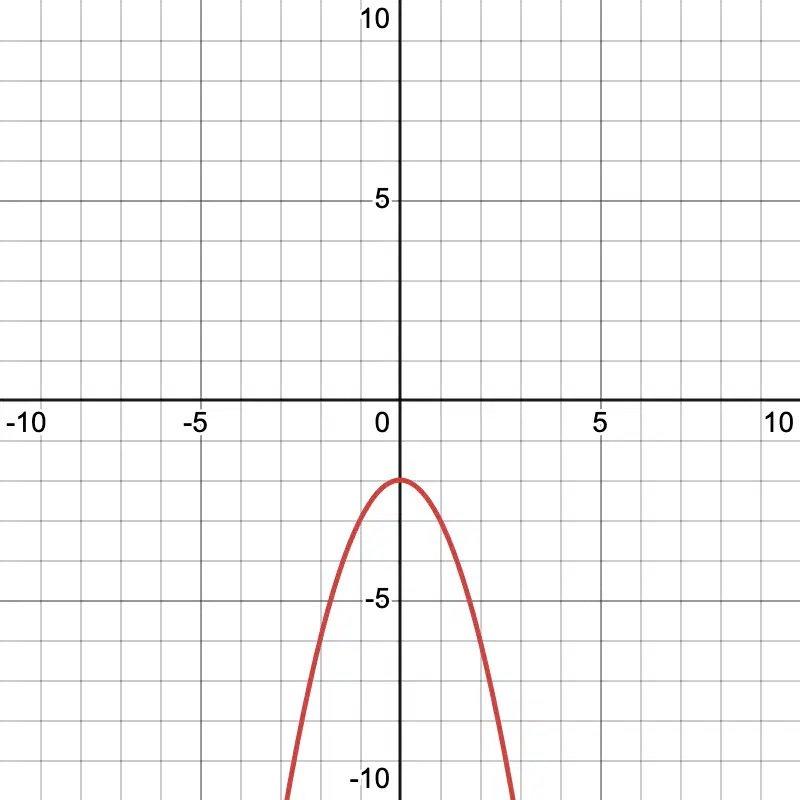
Which equation best represents the parabola shown on the graph?
y=−x2−2
y=−2x2
y=−(x−2)2
y=x2−2
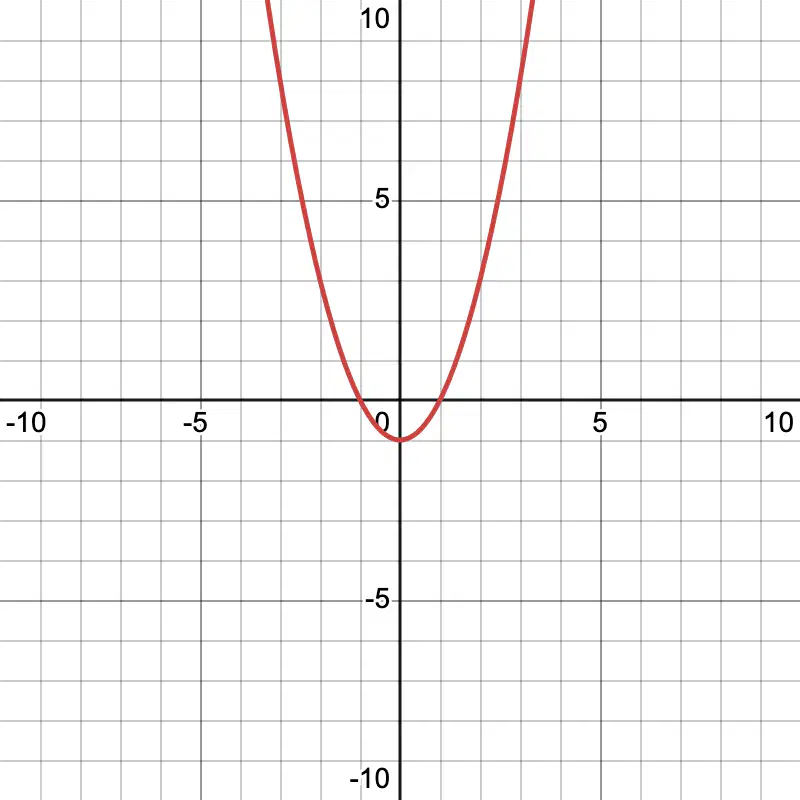
Which equation best represents the parabola shown on the graph?
y=x2+1
y=−x2−1
y=(x−1)2
y=x2−1
Compared to the graph of y=x2 , which parabola is:
reflected in the x-axis AND vertically stretched by a factor of 2 AND shifted 1 unit down?
y=−2(x−1)2
y=−(x−2)2−1
y=−2x2−1
y=−x2−2
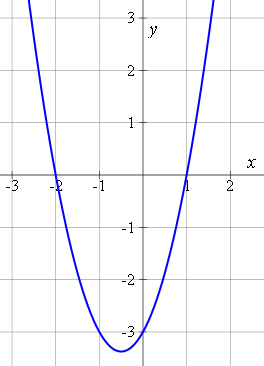
a, b, and c for
the quadratic equation:
4x2 – 8x = 3
This equation is in f(x)= 3 (x+1)2 +4
original form
vertex form
standard form
quadratic form
The coordinates of the vertex in this function f(x)= 3 (x+1)2 +4
(1,4)
(3,4)
(-1,4)
(3,1)
The coordinates of the y-intercept in this function f(x) = x2 + 8x - 2
(0,0)
(2,0)
(0,-2)
(-2,0)

What is the axis of symmetry for the following equation?
y=4x2-8x+9
x = 5
x=1
y = 1
y = 5


