wayground logo

Free Printable Worksheets

Font size

S
M
L
XL
Worksheets

Review for Unit 4 Quiz (#2)

Total questions: 73

Worksheet time: 3hrs 55mins

Name
Class
Date
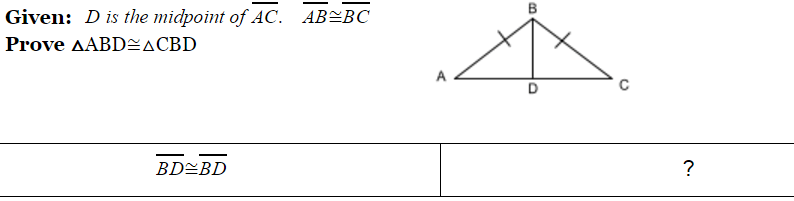
1.
What is the justification (reason)?
a)
reflexive property
b)
definition of segment bisect
c)
definition of a midpoint
d)
substitution property
2.
If <1 and <2 are complementary, then m<1 + m<2 = 90
a)
Addition POE
b)
Subtraction POE
c)
Def of right angle
d)
Def of Complementary Angles
3.
IF <ABC ≅ <DEF, then m<ABC = m<DEF
a)
Reflexive POE
b)
Addition POE
c)
Def. of congruent angles
d)
Def. of right angles
4.
Identify the  missing statement or reason
a)
Reflexive Property
b)
Definition of Midpoint
c)
Given
d)
Vertical Angles Theorem
5.
Identify the  missing statement or reason
a)
Definition of Angle Bisector
b)
Alternate Interior Angles Theorem
c)
Reflexive Property
d)
Definition of Midpoint
6.
What is the "reason" for step 5 of the proof?
a)
Vertical Angle Theorem
b)
proof
c)
def. of angle bisector
d)
CPCTC 
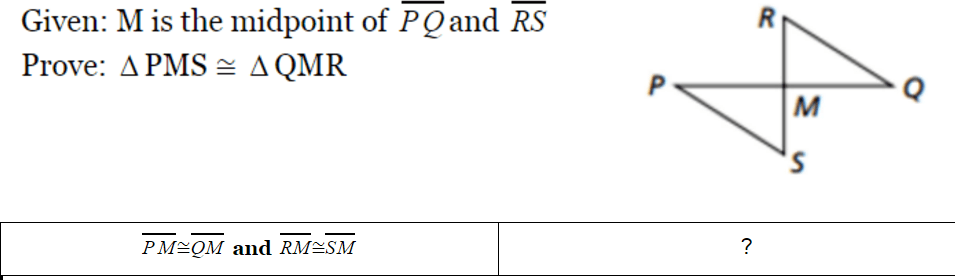
7.
Fill in the missing proofs.
a)
Transitive Property, SAS(Side-Angle-Side)
b)
Reflexive Property, SAS(Side-Angle-Side)
c)
Reflexive Property, Vertical Angles Thm.
d)
Transitive Property, SSS(Side-Side-Side)
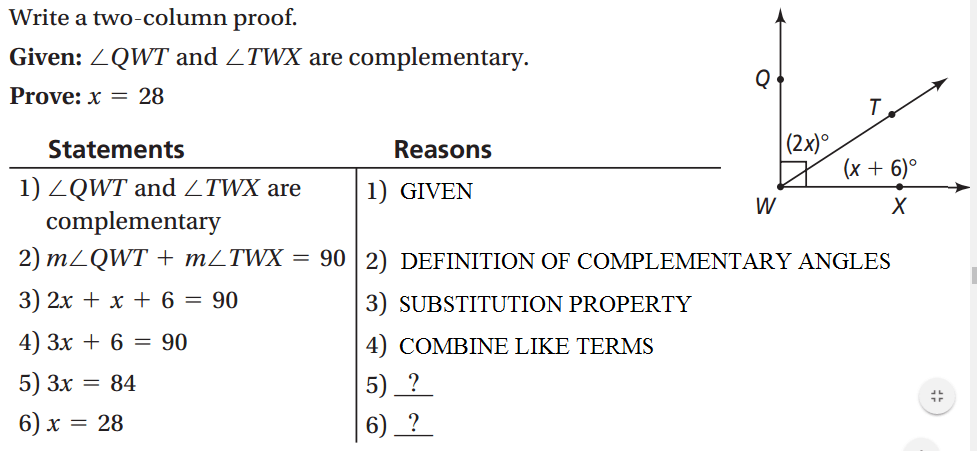
8.
What is the REASON for Statement #5?
a)
Addition Property of Equality
b)
Subtraction Property of Equality
c)
Multiplication Property of Equality
d)
Division Property of Equality
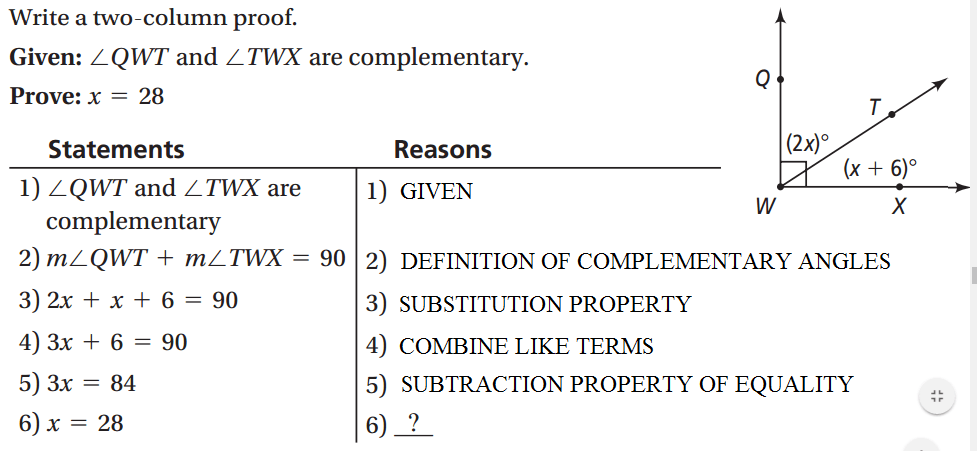
9.
What is the REASON for Statement #6?
a)
Addition Property of Equality
b)
Subtraction Property of Equality
c)
Multiplication Property of Equality
d)
Division Property of Equality
10.
Which is an example of transitive property?
a)
If a=b and b=m, then a = m.
b)
If a=b then b=a.
c)
Given a number a, a=a
d)
If a=5, then 3a-5 = 3(5)-5
11.

Given: 1 and 3 are vertical angles. What should you conclude by the vertical angles theorem?

a)

1\angle1  and 3\angle3  are a linear pair

b)

undefined andundefined are right angles.

c)

23\angle2\cong\angle3  

d)

13\angle1\cong\angle3  

12.

Given: ∠1 and ∠2 are supplementary. What can you conclude?

a)

m1+m2=180°m\angle1+m\angle2=180\degree

b)

m1+m2=90°m\angle1+m\angle2=90\degree

c)

m1=m2m\angle1=m\angle2

d)

Nothing

13.

What does it mean to bisect a segment or an angle?

a)

Split it into 3 equal parts.

b)

Split it into 2 equal parts.

c)

Split into 4 equal parts.

d)

Double it.

14.

If <1 is a right angle, than m<1 = 90o90^o  

a)

Definition of right angle

b)

Definition of supplementary angles

c)

Definition of angle bisector

d)

Definition of midpoint

15.

If m<1 + m<2 = 50 and m<2 = 10, then m<1 + 10 = 50

a)

Transitive property

b)

Substitution

c)

Definition of angle bisector

d)

Subtraction POE

16.

The symbol \cong  means..........

a)

Congruent

b)

transitive

c)

equal sign

d)

supplementary

17.
a)
2x-6=7x+4
b)
2x-6+7x+4=90
c)
2x-6+7x+4=180
d)
2x-6+7x+4=360
18.

Given: B is the midpoint of AC. What should you conclude?

a)

AB + BC = AC

b)

AB = BC

c)

A is the segment bisector of BC

d)

ABC is a straight angle

19.

Given: OR \perp QP.  What should you conclude by definition of perpendicular?

a)

<ORP is a right angle

b)

QR + RP = QP

c)

<ORQ and <ORP are complementary

d)

<QRP = 180 °\degree  

20.

Given: AB is the segment bisector of PQ. What conclusion can you draw?

a)

PF = QF

b)

F is the midpoint of PQ

c)

m<PFA = m<QFA

d)

<PFQ is a straight angle

21.

If an angle is a straight angle, then its measure is 180°180\degree

 Given:  <ABC is a straight angle.
What conclusion can you draw?

a)

<ABC is not an acute angle

b)

<ABC is supplementary to another angle

c)

m<ABC = 180°180\degree  

d)

<ABC is a straight angle

22.

Which of the following conclusions CANNOT be drawn just by looking at the diagram?

a)

GH and AB intersect at D

b)

<GDA and <HDB are vertical angles

c)

D is the midpoint of GH

d)

G, D, and H are collinear

23.

Given: PL is the angle bisector of <RPQ


What can you conclude by definition of angle bisector?

a)

m<RPL = m<LPQ

b)

<RPL + m<LPQ = m<RPQ

c)

<RPQ is acute

d)

m<RPQ = 90

24.
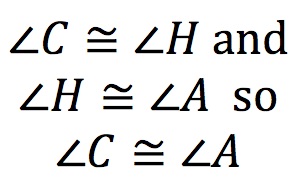
What is the justification?
a)
Symmetric Prop.
b)
Angle addition postulate
c)
Reflexive Prop
d)
Transitive Prop.
25.
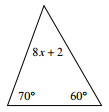
Find the measure of the missing angle.
a)
30o
b)
110o
c)
150o
d)
40o
26.
The Triangle Sum Theorem states that the sum of all angles in a triangle is ______. 
a)
45°
b)
90°
c)
180°
d)
360°
27.
Find the measure of the missing angle.
a)
90o
b)
100
c)
130o
d)
50o
28.
Solve for x.
a)
16
b)
11
c)
50
d)
6
29.

Solve for x.

a)

44o

b)

-14o

c)

-7o

d)

63o

30.
Solve for x.
a)
6
b)
-10
c)
7
d)
-9
31.

Solve for x

a)

49

b)

58

c)

70

d)

94

32.

Solve for x

a)

65

b)

74

c)

37

d)

64

33.

Solve for x

a)

70

b)

23

c)

120

d)

130

34.

Solve for x

a)

105

b)

78

c)

110

d)

25

35.

Solve for x

a)

85

b)

78

c)

95

d)

110

36.

Solve for x

a)

48

b)

85

c)

24

d)

9

37.

Solve for x

a)

3

b)

4

c)

2

d)

1

38.

What is the value of x?

a)

23

b)

32

c)

20

d)

35

39.
Which of the following terms best describes Angle d?
a)
Remote interior angle
b)
Corresponding angle
c)
Exterior angle
d)
Interior angle
40.

Which two angles are the remote interior angles to Angle W?

a)

Angle X and Angle Y

b)

Angle X and Angle Z

c)

Angle Y and Angle Z

d)

Angle Z and Angle W

41.
What angle corresponds to angle 6?
a)
angle 2
b)
angle 4
c)
angle 7
d)
angle 8
42.
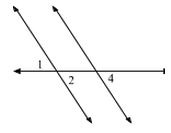
Name the angle relationship.
a)
Alternate Interior
b)
Alternate Exterior
c)
Corresponding
d)
Vertical Angles
43.
What angle pair is pictured?
a)
Alternate Interior Angles
b)
Supplementary Angles
c)
Vertical Angles
d)
Corresponding Angles
44.
What is the relationship of the Angles
a)
Alternate Interior
b)
Alternate Exterior
c)
Corresponding
d)
vertical 
45.
What is the Angle Relationship?
a)
Alternate Interior
b)
Alternate Exterior
c)
Corresponding
d)
Vertical
46.
What is the Angle Relationship
a)
Alternate Interior
b)
vertical 
c)
Corresponding
d)
adjacent 
47.
Angle 1 = 27o
Find the measure of angle 4
a)
27o
b)
153o
c)
63o
d)
90o
48.
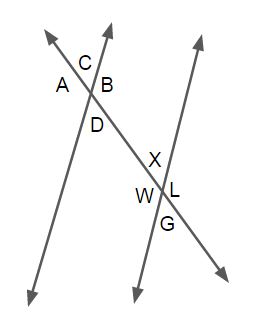
Which pair of angles add up to 180 degrees?
a)
A and W
b)
C and X
c)
D and X
d)
A and G
49.
Vocabulary: Angles that are across from each other 
a)
adjacent
b)
complementary
c)
vertical
d)
corresponding 
50.
Vocabulary: Angles that are next to each other (share a side)
a)
adjacent
b)
complementary
c)
vertical
d)
corresponding 
51.
Which two lines are parallel? (hint: find all of the angles around each intersection, then compare)
a)
Lines M and N
b)
Lines N and P
c)
Lines M and P
52.
What is the value of x?
a)
60
b)
26
c)
14
d)
10
53.
Solve for x.
a)
21
b)
4
c)
8
d)
5
54.
a)
x=29
b)
x=61
c)
x=14
d)
x=20
55.
In the diagram, which of the following statements are false?
a)
∠1 and ∠4 are vertical angles
b)
∠4 and ∠5 are alternate interior angles
c)
∠1 and ∠8 are alternate interior angles
d)
∠2 and ∠6 are corresponding angles
56.
Which pair of angles are congruent?
a)
A and C
b)
C and L
c)
B and W
d)
D and W
57.
Find x.
a)
80
b)
100
58.
What are supplementary angles?
a)
Angles that add up to 180°
b)
Angles that add up to 90°
c)
Angles that are equal to each other
d)
Angles that are opposite of each other when lines intersect
59.

What property states that something is congruent to itself?

a)

Symmetry Property

b)

Congruence Property

c)

Reflexive Property

60.
∠4 = ∠4
a)
Substitution Property of Equality
b)
Reflexive Property of Equality
c)
Symmetric Property of Equality
d)
Transitive Property of Equality
61.
If ∠1 and ∠2 are supplementary,
then m∠1 + m∠2 = 180°.
a)
Definition of Supplementary Angles
b)
Angle Addition Postulate
c)
Vertical Angles Theorem
d)
Definition of Complementary Angles
62.
If ∠1 = ∠2 and ∠2 = ∠3, then ∠1 = ∠3.
a)
Addition Property of Equality
b)
Symmetric Property of Equality
c)
Reflexive Property of Equality
d)
Transitive Property of Equality
63.
If ∠BAT and ∠MAN are vertical angles,
then ∠BAT ≅ ∠MAN.
a)
Vertical Angles Theorem
b)
Definition of Congruent Angles
c)
Angle Addition Postulate
64.
If DB bisects ∠ABC, then ∠ABD = ∠CBD.
a)
Definition of Congruent Angles
b)
Definition of Angle Bisector
c)
Angle Addition Postulate
d)
Definition of Right Angle
65.

If ∠DOG = ∠CAT, then m∠DOG = m∠CAT.

a)

Definition of Congruency

b)
Definition of Congruent Segments
c)

Substitution Property

d)
Vertical Angles Theorem
66.
If x = y, then x + 5 = y + 5.
a)
Addition Property of Equality
b)
Subtraction Property of Equality
c)
Reflexive Property of Equality
d)
Transitive Property of Equality
67.

State the proof reason, given: If AB=BC and BC=CD, then AB=CD

a)

Segment Addition Postulate

b)

Transitive Property

c)

Reflexive Property

d)

Subtraction Property of Equality

68.

What reason supports the statement?

a)

Vertical angles are congruent.

b)

Parallel implies alternate interior angles are congruent.

c)

Parallel implies corresponding angles are congruent.

d)

Reflexive Property

69.

What reasons supports the statement?

a)

Symmetry Property

b)

Reflexive Property

c)

Transitive Property

d)

SSS

70.

What reason supports the statement?

a)

Parallel implies alternate interior angles are congruent.

b)

Parallel implies corresponding angles are congruent.

c)

Vertical angles are congruent.

d)

Reflexive Property

71.

Based on the picture of the Triangle Sum Theorem Proof, what can be used as a Statement in your proof?

Choose ALL that apply.

a)

m4m1m\angle4\cong m\angle1

b)

m5m3m\angle5\cong m\angle3

c)

m2m3m\angle2\cong m\angle3

d)

m4+m2+m5=180°m\angle4+m\angle2+m\angle5=180\degree

e)

m1+m3=90°m\angle1+m\angle3=90\degree

72.

Solve for x

a)

3

b)

4

c)

2

d)

1

73.

Set up an equation to find x.

a)

52 + 5x + 16 + 10x + 8 = 180

b)

52 - 5x + 16

c)

52 + 5x + 16 = 10x + 8

d)

52 + 10x + 8 = 5x +16