wayground logo

Free Printable Worksheets

Font size

S
M
L
XL
Worksheets

Midterm Review Earth Science

Total questions: 50

Worksheet time: 36mins

Name
Class
Date
1.

All the atmospheric phenomena on the Earth like the rains take place in ........... layer.

a)

mesosphere

b)

stratosphere

c)

thermosphere

d)

troposphere

2.
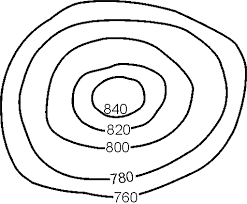
What is the elevation of point B?
a)
800 ft
b)
850 ft
c)
900 ft
d)
1000 ft
3.

When plates come together, we get _______?

a)

mountains

b)

earthquake

c)

geysers

d)

volcano

4.

A ______ detects earthquakes by monitoring Earth's movements.

a)

barometer

b)

particle accelerator

c)

seismograph

d)

telescope

5.
The upper mantle and the crust make up the ______.
a)
mohorovicic discontinuity
b)
lithosphere
c)
outer core
d)
inner core
6.
It is the point within the Earth where an earthquake rupture starts.
a)
focus
b)
epicenter
c)
seismic waves
d)
fault
7.
It is the point at the surface directly above where an earthquake starts.
a)
focus
b)
epicenter
c)
seismic waves
d)
fault
8.

Which object best represents a true scale model of the shape of the Earth?

a)

a Ping-Pong ball

b)

a football

c)

an egg

d)

a pear

9.

How are igneous rocks formed?

a)

Sediment forming together

b)

Heating and pressure

c)

Cooling

d)

Deposition

10.

The Earth is slightly flattened from a perfect spherical shape because of

a)

its rotation

b)

the pull of the sun and moon

c)

storms on the sun's surface

d)

its molten core

11.

For an observer in New York State (NYS), the altitude of Polaris is 43o above the northern horizon. This observer's latitude is closest to the latitude of

a)

New York City

b)

Plattsburgh

c)

Utica

d)

Jamestown

12.

The angle of the star Polaris above the northern horizon can be used to determine an observer's

a)

solar time

b)

latitude

c)

longitude

d)

local time

13.

At which location will an observer see the greatest altitude of Polaris?

a)

A

b)

B

c)

C

d)

D

14.

What is the latitude of the St. Helena Hot Spot?

a)

17 N

b)

17 S

c)

2 E

d)

2 W

15.
About how much of the atmosphere contains nitrogen?
a)
1%
b)
78%
c)
21%
d)
97%
16.
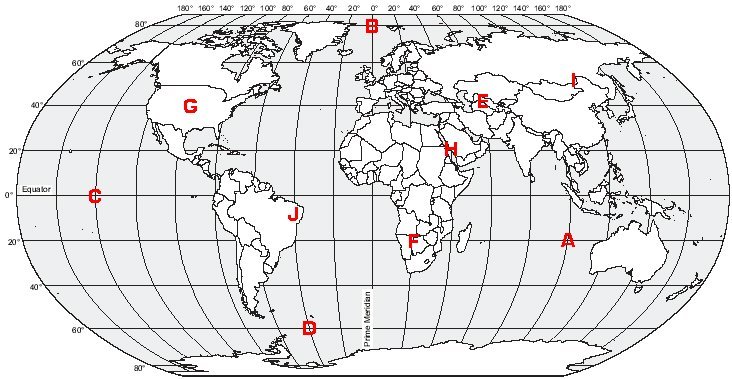
What is the approximate location of G?
a)
100oW, 40oN
b)
40oN, 100oW
c)
40oS, 100oW
d)
40oN, 100oE
17.

What is the approximate latitude and longitude of Slide Mt, NY? Use your Earth Science reference table.

a)

44 N, 80 W

b)

42 N, 75 W

c)

42 N, 79 W

d)

42 W, 75 N

18.

If it is 5:00 pm in Miami, Florida, what time is it in Denver, Colorado?

a)

3:00pm

b)

8:00pm

c)

4:00pm

d)

6:00am

19.

The NFL game starts at 8 p.m. in our time zone. What time will it start in California?

a)

10 p.m.

b)

6 p.m.

c)

5 p.m

d)

11 p.m.

20.

Of the three kinds of sedimentary rocks, a rock that is made up of fragments of older rocks is called

a)

Clastic sedimentary rock

b)

Organic sedimentary rock

c)

Chemical sedimentary rock

21.
The process where rocks are physically broken down is called _________.
a)
Weathering
b)
Erosion
c)
Liquifaction
d)
Sublimation
22.
The physical transportation of rock sediments is called _______.
a)
Chemical Weathering
b)
Deposition
c)
Mechanical Weathering
d)
Erosion
23.
Fossils are found in which rock type(s)?
a)
Sedimentary Only
b)
Metamorphic Only
c)
Igneous Only
d)
All Rock Types
24.
When lava cools quickly, minerals do not have time to crystallize, this creates _______ rock.
a)
Extrusive Igneous
b)
Chemical Sedimentary
c)
Organic Sedimentary
d)
Intrusive Igneous
25.
What texture best describes an igneous rock that formed deep underground?
a)
glassy
b)
vesicular
c)
fine grained
d)
coarse grained
26.
The color of a mineral in powder form is called the mineral's 
a)
hardness
b)
specific gravity
c)
luster
d)
streak
27.
How light reflects off of a mineral is called the mineral's 
a)
luster
b)
streak
c)
cleavage
d)
fracture
28.
What mineral is used for pencils?
a)
Graphite
b)
Galena
c)
Magnetite
d)
Quartz
29.
Breakage along smooth, flat planes
a)
fracture
b)
cleavage
c)
streak
d)
ore
30.
How do metamorphic rocks form? 
a)
Heat and Pressure
b)
Compaction & Cementation
c)
Cooling of Magma
d)
Sediments & Glue
31.
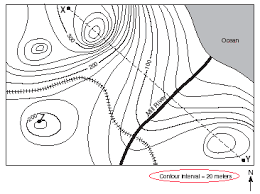
Determine the contour interval:
a)
5 m
b)
10 m
c)
15 m
d)
20 m
32.
__________ metamorphism occurs when magma heats the surrounding rock and changes it.
a)
Regional
b)
Forced
c)
Igneotrophic
d)
Contact
33.
__________ metamorphism occurs when rock formations in the crust collide and build pressure
a)
Regional
b)
Forced
c)
Igneotrophic
d)
Contact
34.

What two plate boundaries created the mountain range?

a)

Convergent

b)

Divergent

c)

Transform

d)

Subducting

35.

Where do mid-ocean ridges occur?

a)

at divergent boundaries

b)

below the lithosphere

c)

at convergent boundaries

d)

at transform boundaries

36.

Where does the San Andreas Fault occur?

a)

at a divergent boundary

b)

in a rift

c)

at a convergent boundary

d)

at a transform boundary

37.

Which of the following are NOT a characteristic of P-waves?

a)

They are faster than S-saves.

b)

They pass through liquids and solids.

c)

They are slower than S-waves.

d)

They cause the ground to go up and down.

38.
Why is coal not a mineral?
a)
It's not a solid
b)
It is man-made
c)
It is not inorganic
d)
It is made of carbon
39.
Which side of Holland Hill is the steepest?
a)
North
b)
South
c)
East 
d)
West
40.
Which topographic map matches formation C?
a)
1
b)
2
c)
3
d)
4
41.
How many peaks are on the map? (hill tops)
a)
4
b)
3
c)
2
d)
1
42.

Where can you find the convection (magma) currents?

a)

inner core

b)

outer core

c)

asthenosphere

d)

solid upper mantle

43.

Granite is .... rock.

a)

sedimentary

b)

plutonic or intrusive igneous

c)

effusive igneous

d)

clastic

44.
Igneous rock #2
*non-crystaline
*vesicular
*higher density
*more mafic
a)
pumice
b)
obsidian
c)
scoria
d)
vesicular basalt
45.

Which of the following are evaporites?

a)

Rock Salt

b)

Dolomite

c)

Siltstone

d)

Limestone

46.

What rock is the result of the metamorphism of sandstones?

a)

Slate

b)

Schist

c)

Marble

d)

Phyllite

47.

Which crust is denser but thinner and subduct beneath the other at convergent boundaries?

a)

CONTINENTAL

b)

OCEANIC

48.
A stream flowing at 0.3 cm/s can erode what type of sediment?
a)
Pebbles, sand, silt, and clay
b)
Sand, silt, and clay
c)
Silt and clay
d)
Clay Only
49.

What type of chemical weathering created this feature?

a)

Hydrolysis

b)

Carbonation

c)

Oxidation

d)

Biological

50.

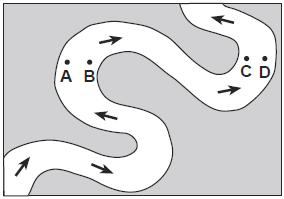
Which two locations have the greatest stream velocities?

a)

A and B

b)

B and C

c)

C and D

d)

D and A