
NEW
Font size
 Worksheets
Simple Harmonic Motion Quiz I
Total questions: 17
Worksheet time: 26mins
When is the pendulum at maximum velocity
At its lowest point
At its highest point
It moves at a constant velocity
It is at rest
When does the mass move at maximum velocity in a mass-spring system?
At equilibrium
At the farthest point from the equilibrium
At its hightest point
At its lowest point
What are the two requirements for a simple harmonic oscillator?
The object vibrates about the equilibrium point and the restoring force is proportional to the displacement
The object moves left to right and the restoring force is proportional to the displacement
The object vibrates about the equilibrium and the restoring force is greater than the displacement
The object moves left to right and the restoring force is greater than the displacement
When is the pendulum at 0 velocity
At its lowest point
At its highest point
It moves at a constant velocity
It is at rest
When does the mass move at 0 velocity in a mass-spring system?
At equilibrium
At the farthest point from the equilibrium
At its hightest point
At its lowest point
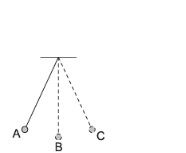
A pendulum oscillates as shown. At which of the following positions is the kinetic energy equal to the total energy?
A
B
C
Not enough information given.
Position at which the body would come to rest if it were to lose all of its energy refers to
equilibrium position
maximum displacement / amplitude
periodic position
good position
When we're talking about a pendulum, what does T stand for?
pi
period
length
gravity
What is the unit for the period of a pendulum?
second
meter
m/s/s
Newton
As a pendulum gets longer, what happens to the period?
doesn't change
decreases
increases
What is a mass that hangs from a fixed point and swings to and fro?
pencil
x axis
pendulum
variable

