wayground logo

Free Printable Worksheets

Font size

S
M
L
XL
Worksheets

S30 - so you think you know your science? w2023 145Qs cx

Total questions: 145

Worksheet time: 4hrs 38mins

Name
Class
Date
1.
How many electrons does Si contain? (click to see image)
a)
14
b)
28
c)
2
d)
None of these
2.
How many electrons does potassium K contain? (click to see image)
a)
19
b)
39
c)
20
d)
40
3.
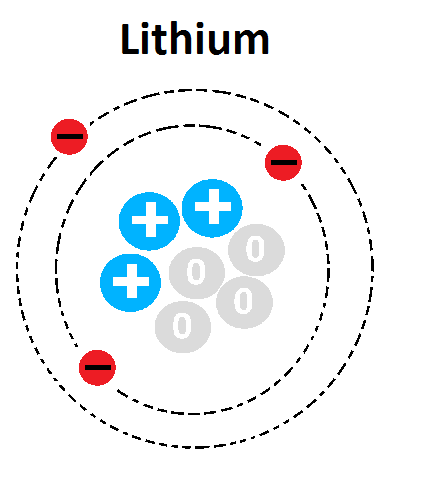
What element is represented in this Bohr Model? 
a)
Carbon
b)
Hydrogen
c)
Aluminum
d)
Lithium
4.
What is the mass number of this atom?
a)
1
b)
3
c)
4
d)
7
5.
What group does this element belong to?
a)
Group 1: Alkali metals
b)
Group 18: Noble Gases
c)
Group 2: Alkaline-Earth Metals
d)
Group 17: Halogens
6.
Carbon-12 has 6 protons and 6 neutrons. How many electrons will orbit the nucleus?
a)
12
b)
6
c)
3
d)
18
7.
What is the charge of a neutron?
a)
Positive
b)
Negative
c)
Neutral/no charge
8.
What is the center of the atom called?
a)
Orbital
b)
Nucleus
c)
Proton
d)
Electron shell
9.
What's a valence electron?
a)
electrons in the second energy level
b)
electrons in the outermost energy level
c)
the atomic number
d)
electrons in the first level
10.
Identify the element in the picture
a)
Boron
b)
Carbon
c)
Nitrogen
d)
Lithium
11.

Name the compound AlBr3

a)

aluminum bromide

b)

aluminum tribromide

c)

aluminum bromine

d)

aluminum boride

12.

Name the compound MgF2

a)

magnesium fluoride

b)

manganese fluoride

c)

magnesium(III) fluoride

d)

magnesium floride

13.

Name this compound:

NaBr

a)

sodium bromine

b)

sodium bromide

c)

sodium bromate

d)

sodium bromite

14.

Name this compound:

KI

a)

potassium iodide

b)

potassium iodite

c)

iodine potasside

d)

potassium iodine

15.

Li2O

a)

dilithium oxide

b)

lithium oxide

c)

lithium dioxide

d)

lithium lithium oxide

16.

Al2S3

a)

dialuminum trisulfide

b)

aluminum sulfide

c)

aluminum sulphide

d)

aluminum 2 sulfur 3

17.

CaO

a)

calcium oxyde

b)

carbon monoxide

c)

calcium oxide

d)

carbon oxide

18.

Cs3N

a)

cesium nitride

b)

cerium nitride

c)

cesium nitrogenide

d)

cerium nitrogenide

19.

Ba3P2

a)

barium phosphite

b)

barium phosfide

c)

barium potasside

d)

barium phosphide

20.

What is the name of Ag2S?

a)

silver (II) sulfide

b)

silver (I) sulfide

c)

silver sulfide

d)

silver sulfate

21.

Which of these combinations is an ionic compound made of?

a)

Metal and Metal

b)

Nonmetal and Nonmetal

c)

Metal and Nonmetal

d)

Cation and Cation

22.

Which of the following combinations would need roman numerals in the name?

a)

potassium + fluorine

b)

beryllium + oxygen

c)

boron + iodine

d)

gold + oxygen

23.

HCl- name?

a)

hydrogen chloride

b)

chlorine hydrogen

c)

hydrogen chlorine

d)

hydrogen chlorate

24.
diphosphorus pentoxide
a)
P2O5
b)
PO5
c)
P5O2
d)
P2O6
25.
The name of P₄S₁₀ is
a)
phosphorous sulfide
b)
phosphorus sulfide
c)
tetraphosphorus decasulfide
d)
phosphorus (X) sulfide
26.
SiCl4
a)
silicon tetrachloride
b)
silicon quadchloride
c)
monosilicon tetrachloride
d)
silicon chloride
27.
The name of SO₃ compound is
a)
sulfate
b)
sulfur oxide
c)
sulfur trioxide
d)
monosulfur trioxide
28.
What is the correct formula for the compound, lithium oxide?
a)
LiO
b)
Li2O
c)
LiO2
d)
Li2O2
29.
What is the formula for manganese(III) oxide?
a)
MgO
b)
Mg2O3
c)
MnO
d)
Mn2O3
30.
How do the following two elements bond together?
Cr3+  O2-         
a)
CrO
b)
Cr3O2
c)
Cr2O3
d)
CrO3
31.
How do the following two elements bond together?
K1+  S2- 
a)
KS
b)
K8S
c)
K6S3
d)
K2S
32.

Which formula is for hydrochloric acid

a)

HCl

b)

H2Cl

c)

H2SO4

d)

HNO3

33.

What is the name for this acid H2SO4

a)

hydrochloric acid

b)

phosphorus acid

c)

sulfuric acid

d)

nitric acid

34.

What is the name for this acid HNO2

a)

hydronitric acid

b)

nitrous acid

c)

nitric acid

d)

nitrate acid

35.

What is the name for this acid HNO2

a)

hydronitric acid

b)

nitrous acid

c)

nitric acid

d)

nitrate acid

36.

what is the name for this acid HF

a)

fluoric acid

b)

hydrofluoric acid

c)

fluorous acid

37.

The correct formula for hydrobromic acid is

a)

HCl

b)

HBe

c)

HBr

d)

H2Br

38.

The correct formula for carbonic acid is

a)

HCl

b)

H2CO2

c)

HCO3

d)

H2CO3

39.

The correct name for this acid H2SO3 is

a)

Hydrosulfiric acid

b)

Sulfurous acid

c)

Sulfiric acid

d)

Sulfate acid

40.

The correct formula for phosphoric acid

a)

HPO4

b)

H2PO4

c)

H2PH4

d)

HPO3

41.

The correct name for this acid CH3COOH is

a)

hydrochloric acid

b)

acetic acid

c)

hydroacetic acid

d)

acetate acid

42.

the anion part in HNO2 is

a)

nitrite ion

b)

nitric ion

c)

nitrate ion

d)

nitrogen ion

43.

The anion part in this H2PO4 acid is

a)

nitrate ion

b)

phosphate ion

c)

phosphite ion

d)

nitrous ion

44.
What is the pigment in chloroplasts that performs photosynthesis?
a)
Chlorosynthesis
b)
Chlorophyll
c)
ADP
d)
Electron Transport
45.

Which of the following equations represents the overall chemical reaction for photosynthesis?

a)

6O2+ 6H2O → C6H12O6+ 6O2

b)

C6H12O6 + 6H2O→ 6O2+ 6O2

c)

6CO2+ 6H2O→ C6H12O6+ 6O2

d)

6O2 + 6H2O→ C6H12O6 + 6CO2

46.

The rate of photosynthesis can be influenced by...

a)

Temperature

b)

Carbon dioxide levels

c)

Light intensity

d)

Oxygen concentration

47.
Glucose is a ...
a)
sugar
b)
carbohydrate
c)
source of quick energy
d)
all are correct
48.
Leaves look green because.....
a)
they eat their vegetables
b)
to blend into their environment
c)
they contain a molecule named chlorophyll
d)
they are sick
49.
How many carbon atoms are in propane
a)
1
b)
2
c)
3
d)
4
50.
What is the general formula of an alkane
a)
2n+2
b)
CnH2n+2
c)
CnH2n
d)
CnHn
51.
Hydrocarbons are compounds that contain
a)
Carbon, only
b)
Carbon and Hydrogen, only
c)
Carbon, Oxygen, and Hydrogen, only
d)
Carbon, Oxygen, Hydrogen, and Nitrogen, only
52.
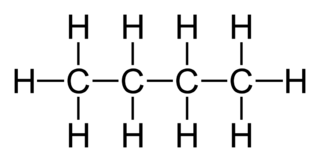
Name this alkane
a)
Methane
b)
Ethane
c)
Propane
d)
Butane
53.
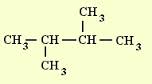
Name the compound.
a)
hexane
b)
2,3-dimethylbutane
c)
ethylbutane
d)
2,2-dimethylbutane
54.
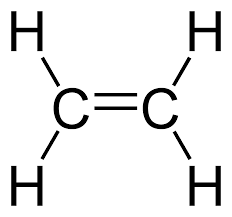
Classify the compound based on the functional group present.
a)
alkane
b)
alkene
c)
alkyne
d)
aromatic
55.

Select the formula for the following name: Octene

a)

C8H16

b)

C8H14

c)

C8H18

d)

C8H15OH

56.
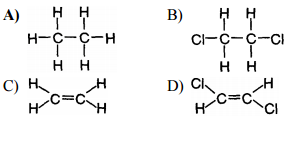
Which formula represents a saturated hydrocarbon?
a)
A
b)
B
c)
C
d)
D
57.
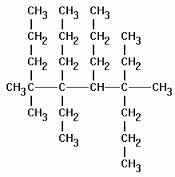
How many carbons are in the longest chain of the following molecule:
a)
11
b)
10
c)
9
d)
8
58.
What colour does bromine water turn in the presence of an alkene
a)
Orange
b)
Blue
c)
Colourless
d)
Green
59.

What is the observation obtained when alkene react with acidified KMnO4

a)

decolourize purple solution

b)

decolourize reddish brown solution

c)

decolourize blue solution

d)

yellow precipitate formed

60.

For a compound to be considered an organic compound it must contain

a)

Carbon

b)

Hydrogen

c)

Oxygen

d)

Nitrogen

61.

When heat is applied to a hydrocarbon and it melts, the energy is being used to...

a)

Break covalent bonds

b)

Overcome intermolecular forces

c)

Break a molecule

d)

Separate atoms

62.

What is a functional group?

a)

Group of atoms that give specific characteristics to a molecule

b)

Group of molecules that give specific characteristics to an atom

c)

Group of molecules that make up a group of atoms

d)

Group of atoms that give specific characteristics to an element
63.
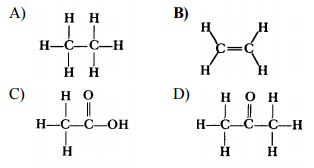
Which formula represents an unsaturated hydrocarbon?
a)
A
b)
B
c)
C
d)
D
64.

Unsaturated molecules contain...

a)

A carbon to carbon double bond

b)

Only single bonds between carbon atoms

c)

A water molecule

d)

A hydroxyl group

65.
Which substance is MOST soluble at 0 ºC?
a)
KI
b)
NaNO3
c)
NaCl
d)
Ce2(SO4)3
66.
Which solute is the most soluble at 10 ⁰C?
a)
KI
b)
KClO3
c)
NH4Cl
d)
NH3
67.
Which solute does not increase in solubility as temperature rises?
a)
NH3
b)
NaNO3
c)
KNO3
d)
NaCl
68.
An ______ is a compound that breaks apart in water, forming charged particles (ions) that can conduct electricity.
a)
electrolyte
b)
nonelectrolyte
c)
polar molecule
d)
non polar molecule
69.
Solubility refers to the ____ of solute that can dissolve in a certain volume or mass of solvent, at a certain temperature.
a)
Volume
b)
Proportion
c)
Mass
d)
Particles
70.
How many grams of SOcan dissolve at 50 ⁰C?
a)
5 g
b)
10 g
c)
20 g
d)
39 g
71.
Describe a solute.
a)
part of solution present in largest amount
b)
the substance that gets dissolved
c)
the substance that does the dissolving
d)
surrounds and breaks apart
72.
What is a precipitate?
a)
an insoluble reactant formed during a chemical reaction
b)
an insoluble product formed during a chemical reaction
c)
a soluble solvent in a saturated solution
d)
a soluble solute in a saturated solution
73.
Describe a solute.
a)
part of solution present in largest amount
b)
gets dissolved
c)
water
d)
surrounds and breaks apart
74.
Define solubility
a)
how much pressure is in an object has
b)
Surface Area per Temperature
c)
how much solute can dissolve in a solvent
d)
it is a made up word
75.
What will allow more solute to be dissolved in a solvent.
a)
adding more solute
b)
stiring
c)
cooling solution
d)
heat
76.

What motion of the Earth takes 365 days?

a)

Rotation

b)

Revolution

c)

Elliptical motion

d)

Circular orbit

77.

Earth's rotation on its axis causes

a)

tides

b)

seasons

c)

moon phases

d)

day and night

78.

The MOON REVOLVES around the:

a)

sun

b)

earth

c)

sun and earth

d)

all planets

79.

The Earth's _______ is an imaginary line that goes from the North Pole to the South Pole.

a)

axis

b)

equinox

c)

solstice

d)

equator

80.

Which body has the greater effect on Earth's tides?

a)

sun

b)

jupiter

c)

moon

d)

mars

81.

Andrea is making a computer animation to model the motions of the Sun, Earth, and Moon. Which orbit should happen most often in her model?

a)

the Sun orbiting Earth

b)

the Sun orbiting the Moon

c)

the Moon orbiting the Sun

d)

the Moon orbiting Earth

82.

When daylight hours are almost equal to night time hours, it is called

a)

equinox

b)

winter solstice

c)

summer solstice

d)

spring

83.

On the day that the northern hemisphere has it's longest day, the southern hemisphere will have it's shortest day.

a)

true

b)

false

c)

maybe

d)

it depends

84.

The primitive atmosphere of Earth was deficient in free oxygen. What process was primarily responsible for the development of the present percentage of free oxygen in the Earth’s atmosphere?

a)

volcanic eruptions

b)

photosynthesis

c)

outgassing

d)

human activity

85.

Which of these characteristics determines if a planet will have temperatures that are suitable for life?

a)

The amount of clouds in its atmosphere

b)

The angle of tilt of its axis

c)

The number of volcanoes on its surface

d)

The distance or proximity to its star

86.

How does the ozone (O3) layer in the Earth's atmosphere help make life possible?

a)

It gives animals more oxygen to breathe.

b)

It blocks harmful UV rays from the Sun.

c)

It speeds up the water cycle.

d)

It protects us from electrically-charged particles in solar winds.

87.

How does the Earth's magnetic field help make life possible?

a)

It gives the Earth its gravity.

b)

It makes the Earth rotate at the right speed.

c)

It blocks electrically-charged particles in solar winds.

d)

It protects us from meteors.

88.

What keeps the atmospheric gases that surround Earth from escaping into space?

a)

The rotation speed of the Earth

b)

The Earth's gravity

c)

The magnetic field of the Earth

d)

The ozone layer around the Earth

89.

How are the gases in Earth's atmosphere like a blanket?

a)

They are colorful and soft.

b)

They hold Earth's water and prevent it from escaping.

c)

They sometimes wrinkle and fold to cause tornadoes.

d)

They hold in heat and keep temperatures stable.

90.

Which of the following greenhouse gases enters our atmosphere through evaporation?

a)

water

b)

methane

c)

carbon dioxide

d)

ozone

91.

Which property of light is being demonstrated in this image?

a)

refraction

b)

reflection

c)

absorption

d)

emission

92.

What would happen if greenhouse gases increase and build up in our atmosphere?

a)

They trap more heat and global temperatures decrease.

b)

They trap more heat and global temperatures rise..

c)

They trap less heat and global temperatures rise.

d)

They trap less heat and global temperatures decrease.

93.

What percentage of the Sun's energy is reflected back into space?

a)

100%

b)

About 30%

c)

About 50%

d)

It depends on the weather.

94.

When solar energy hits the earth, it _____

a)

can be reflected by light colored surfaces like ice.

b)

can be reflected by dark colored surfaces like asphalt.

c)

can be absorbed by light colored surfaces by ice.

d)

is all absorbed by clouds

95.

Heat is radiated back to space from earth as

a)

ultraviolet radiation

b)

visible light

c)

infrared radiation

d)

gamma rays

96.
Besides coal and natural gas, another fossil fuel  is
a)
petroleum/oil
b)
biomass
c)
electricity
d)
uranium
97.
Fossil fuels are nonrenewable  resources because they
a)
take millions of years to form
b)
are easily replaced
c)
are in high demand
d)
don't pollute the air
98.
Besides coal and natural gas, another fossil fuel  is
a)
petroleum/oil
b)
biomass
c)
electricity
d)
uranium
99.
Fossil fuels are nonrenewable  resources because they
a)
take millions of years to form
b)
are easily replaced
c)
are in high demand
d)
don't pollute the air
100.
Which of the following is an example of biomass?
a)
food crops
b)
flowing water
c)
coal
d)
uranium
101.
The source of energy that comes from the intense heat beneath Earth's surface is
a)
nuclear fusion
b)
geothermal energy
c)
solar energy
d)
chemical energy
102.
All of the following store chemical energy except
a)
match
b)
battery
c)
fossil fuels
d)
electricity
103.
An example of electromagnetic energy is
a)
visible light
b)
electricity
c)
biomass
d)
match
104.
All of the following are renewable except
a)
uranium
b)
solar
c)
hydropower
d)
food crops (biomass)
105.
The original source of energy for fossil fuels comes from the
a)
sun
b)
Earth's crust
c)
geothermal energy
d)
oceans
106.
Moving water, tides, and dams are examples of
a)
hydropower
b)
fossil fuels
c)
geothermal energy
d)
radiant energy
107.
Moving electrons is ____ energy.
a)
electrical
b)
chemical
c)
nuclear
d)
mechanical
108.
This fossil fuel releases the least amount of air pollution
a)
natural gas
b)
coal
c)
nuclear
d)
oil
109.
When chemical bonds break or form this is ____ energy
a)
chemical
b)
motion
c)
electrical
d)
electromagnetic
110.
When steam or water are used to turn a turbine, it can generate
a)
electricity
b)
oil
c)
geothermal energy
d)
uranium
111.
According to the graph, what sector is the greatest user of energy?
a)
industry
b)
commercial
c)
transportation
d)
residential
112.
Approximately how much energy does the transportation sector use?
a)
27%
b)
52%
c)
14%
d)
8%
113.
What is the best title for the following?
geothermal
solar
wind
a)
fossil fuels
b)
nonrenewable energy
c)
heat energy
d)
renewable energy
114.

____________is the fundamental quantity

a)

length

b)

area

c)

volume

d)

none

115.

Physical quantity are_______________

a)

quantity that are being measured

b)

comparing unknown quantity with quantity

c)

dependent on each other

d)

none

116.

SI unit of mass is_______________

a)

kilogram

b)

newton

c)

metre

d)

none

117.

SI unit of time is_____________

a)

second

b)

metre

c)

kg

d)

none

118.

________________is the device used to measure perimeter of play ground

a)

beam balance

b)

measuring tape

c)

ruler

d)

none

119.

Particles possess ___________energy due to constant random motion

a)

Potential

b)

Chemical

c)

Kinetic

d)

Electric

120.

During a change in state of matter, the amount of heat energy absorbed causes a change in temperature

a)

True

b)

False

121.

The specific latent heat of fusion of ice is 336000 J/kg

a)

True

b)

False

122.

Soft drinks are cooled faster by placing them in ice rather than in water at 0oC.

a)

True

b)

False

123.

A burn caused by boiling water is more serious than a burn caused by steam.

a)

True

b)

False

124.

The picture is an example of

a)

Evaporation

b)

Deposition

c)

Sublimation

d)

Condensation

125.

Jack keeps a bowl of water outside in the morning, in the afternoon he realises that the level of water in the bowl has reduced. This is due to

a)

Boiling

b)

Freezing

c)

Evaporation

d)

Sublimation

126.

How long does it take for thunder to reach you from a lightning bolt that is 2.7x10³ m away if the speed of sound in air is 344 m/s?

a)

7.8 s

b)

9.3x10⁵ s

c)

0.13 s

d)

3.9 s

127.

How far does the Prime Minister's personal jet accelerate on a runway if it starts at 5.5 m/s and lifts off at 81.9 m/s in 13.4 s?

a)

5,9x10² m

b)

3.3 m

c)

1.2x10³ m

d)

1.0x10³ m

e)

1,1x10³ m

128.

Robin Hood's arrow, travelling at 95.0 m/s, hits a tree and stops in a distance of 0.115 m in the tree. What was its acceleration?

a)

-3.93 x 10⁴ m/s2

b)

-8.26 x 10² m/s2

c)

-10.9 m/s2

d)

-9.80 m/s2

e)

-1.04 x 10³ m/s2

129.

Convert:

GARDEN SNAIL top speed is

0.0470 km/h = x m/s

PEREGRINE FALCON top speed is

83.3 m/s = y km/h

a)

x = 0.169 y = 23.1

b)

x = 0.0131 y = 300.

c)

x = 47.0 y = 0.0833

d)

x = 4.70x10⁻⁵ y = 8.33x10⁴

e)

x = 0.0470 y = 83.3

130.
What is speed?
a)
how far you go
b)
how much distance is covered over a period of time
c)
how fast you accelerate
d)
the change in the location of a object
131.
What is velocity?
a)
the quickness of an object
b)
the location of an object
c)
acceleration
d)
speed in a specific direction
132.
A change in velocity over time is known as:
a)
acceleration
b)
constant speed
c)
average speed
d)
displacement
133.
Velocity is both ____ and _____. 
a)
speed , direction 
b)
direction, mass
c)
volume, density 
d)
direction, magnitude 
134.
The unit we use to measure acceleration is ___. 
a)
meters / second 
b)
meters 
c)
seconds 
d)
meters / second / second 
135.
The speedometer on your car tells you
a)
average velocity
b)
instantaneous velocity
c)
average speed
d)
instantaneous speed
136.
What is this graph representing?
a)
Constant Speed
b)
Acceleration (speeding up)
c)
Deceleration (slowing down)
d)
No motion
137.
What two measurements are necessary for calculating speed?
a)
Mass and time
b)
Temperature and mass
c)
Mass and distance
d)
Distance and time
138.
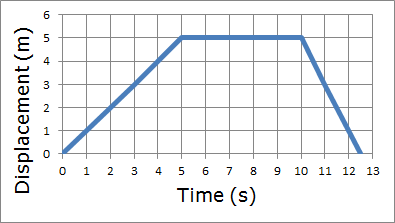
At 60 seconds, how far had this object traveled? 
a)
0 m
b)
10 m
c)
20 m
d)
40 m
139.
What is the person doing from 5 seconds to 10 seconds?
a)
Walking 
b)
Running
c)
Standing Still 
d)
Walking Fast
140.
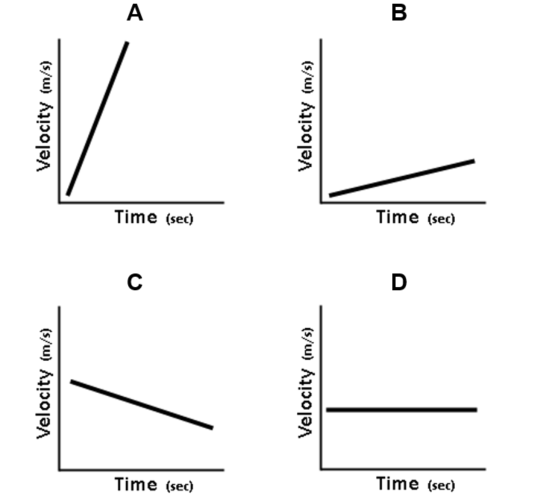
Which graph represents zero acceleration (constant velocity)?
a)
A
b)
B
c)
C
d)
D
141.
You run from your house to a friend's house that is 3 km away. You then walk home. The distance you traveled is 6 km. What is your displacement? 
a)
6  km
b)
0 km
142.
The fastest trains are magnetically levitated above the rails to avoid friction (and are therefore called
MagLev trains...cool, huh?). The fastest trains travel about 250 km in a half an hour. What is their
average speed in km/hour?
a)
250 km/hr
b)
500 km/hr
c)
125 km/hr
143.
A car slows down from +32 m/s to +8 m/s in 4 s. The acceleration is 
a)
6 m/s/s opposite the motion
b)
2m/s/s in the direction of motion
c)
8 m/s/s opposite the motion
144.
A cheetah travels 75 m in 3 s. What is her velocity over the interval?
a)
225 m/s
b)
25 m/s 
c)
0.04 m/s
145.

Which of the following terms describes a Vector and it's proper units?

a)

position in seconds

b)

distance in meters

c)

speed in hours

d)

velocity in m/s