
 Worksheets
Light
Total questions: 140
Worksheet time: 2hrs 42mins
Which of the following is a source of light
Eye
Mirror
Fire
the moon
When light bounces of a mirror,it is
Reflected
Corrected
Absorbed
Refracted

The picture shows an area of Yosemite National Park.Which statement about light is supported by this picture?
Light travels in a straight line until it enters a definite material like water in a lake
Light can refract in air and in clean water
The water in a lake is blue because light forms an image
Light is reflected off the smooth surface of the lake

This is an example of
Reflection
Refraction
Absorption
None of the above

What happen to the light as it passess from air to the transparent window
Light changes speed but not direction
All light is reflected
Light changes speed and direction
All light pass through
Latif wakes up one morning and sees that it is foggy outside.Whcih term best describe the fog he sees
Opaque
Reflective
Transparent
Translucent
During a thunderstorm, Sanjay saw lightning and then heard thunder 5s later.Why did he see the lightning before he heard the thunder
Sound travel faster than light
Light travel faster than sound
He would have seen the thunder and lightning at the same time
There is no reason
Which of the following allow light to pass through it easily
A metal plate
Glass tumbler
Book
A wooden block
The property of light by which it travels in a straight line is known as
Rectilinear propagation of light
lateral inversion
Circular motion
random motion
Example of a luminous object
Sun
Moon
Pencil
Wall
Light travels in straight lines until reflected by another object. Which illustration best shows the light being reflected?


Which of the following is the best example of an object absorbing light?
A black sweater in the sun.
A clean window in the sun.
A curved mirror in the sun.
A long shadow in the sun.
Which illustration best shows light being refracted?


Which object refracted the laser beam?
Silver locket
Picture frame
Glass marble
Notebook
Which of the following is demonstrated when light bounces off mirrors or shiny surfaces?
Scattering
Refraction
Absorption
Reflection

Which of these provides the best explanation for why the pencil appears broken?
The pencil absorbs the light rays that hit it.
Water reflects light rays away from the pencil.
Light rays are bent by the water in the glass.
The surface of the water reflects the light rays.
The two kinds of reflection are:
transparent and translucent.
opaque and translucent.
regular and diffuse.
What type of surface best reflects light?
Dull
Shiny
Clear
Black

__________ objects blur light as it passes through them.
Transparent
Translucent
Opaque
Refraction
When an object moves closer to a light source, its shadow...
Gets smaller
Gets bigger
Changes shape
Stays the same size
Which light source causes shadows in the outdoor environment ?
The sun
The light bulb
The house
The school

Why is the spectrum of light seperated into its components of colour when white light is directed to a prism?
The different colours in the white light bend away from the normal line at different angles when entering prism
The different colours in the white light bend towards the normal line at different angles when entering prism
The different colours in the white light bend away from the normal at same speed to each other when entering prism
The different colours in the white light bend towards the normal at same speed to each other when entering prism
This is the example of dispersion of light
sky looks bright orange in the evening
shadow
Pool seems shallower
rainbow
These are all colours of spectrum except
indigo
blue
purple
green

Why is red light is at the top whileviolet at the bottom of the spectrum?
Violet light has the medium speed so it is refracted the least.
Violet light has the highest speed so it is refracted the least
Red light has the slowest speed so it is refracted the least
Red light has the highest speed so it is refracted the least.
As you look at a rainbow, the colors go from top to bottom in what order?
ROYGBIV
VIBGYOR
GYORVIB
pretty to beautiful
Bouncing of a light ray when it strikes a reflecting surface is called.........
Refraction
Dispersion
Reflection
Diffraction
which of the following is not a property of the image formed by a [lane mirror?
virtual and erect
Object size = image size
object distance = image distance
Real and inverted
Which of the following is a concave mirror?


Four students A, B, C and D performed the experiment to determine the focal length of a concave mirror by obtaining the image of a distant tree on a screen. They measured the distances between the screen and the mirror as shown in the above figure.
The correct way of measuring accurate focal length of the mirror is
A
B
C
D

which of the following ray diagrams is correct for the ray of light incident on a concave mirror as shown in the figure 10.6?
A
B
C
D
Convex mirror is also called as
converging mirror
diverging mirror
plane mirror
silver mirror
The relation between focal length and radius of curvature is
R = 2f
1/f = 2R
f = R/2
R = 2/f
The point on the spherical mirror at the middle of the surface is called
focus
centre of curvature
pole
radius of curvature
The focal length of a plane mirror is ........
infinite
zero
1m
100m
A convex mirror has a focal length 12 cm. Then its radius of curvature is ........ cm
24
12
6
1.2
When the object is in between the centre of curvature (C) and focus (F) of a concave mirror, then the position of the image is ...........
At focus
At the centre of curvature
at infinity
beyond the centre of curvature
Which of the following characteristic of an image formed for a convex mirror?
Enlarged size
virtual image
Real image
inverted image

Which mirror is shown in the figure?
convex mirror
concave mirror
plane mirror
silver mirror

Mirror formula is defined as ........
A
B
C
D
When the object is at infinity, a point sized image is formed at ................ by the convex mirror
focus behind the mirror
focus in front of the mirror
radius of curvature
principal axis
The image formed by a concave mirror when the object is placed between the pole and the focus is ......
virtual, erect and magnified
virtual, erect and diminished
real, inverted and magnified
real, inverted and diminished
The angle of incidence of a ray of light passing through the centre of curvature of a concave mirror is ........... degree
105
180
90
0
According to laws of reflection,
angle of incidence > angle of reflection
angle of incidence < angle of reflection
angle of incidence = angle of reflection
both 1 and 2
Where will be the images of the Sun or the moon are formed by a concave mirror?
Focus
Pole
centre of curvature
beyond centre of curvature
What is the size of the image formed when an object is kept at the focus in front of concave mirror?
enlarged
diminished
highly enlarged
highly diminished
Which of the the following mirror is used in search lights ?
Plane mirror
Converging mirror
Diverging mirror
Convex mirror
Identify the mirror which forms always a virtual and diminished image .
Concave mirror
Converging mirror
Plane mirror
Convex mirror
Where would an object be placed to get an image at the centre of the curvature of a concave mirror ?
At focus
At infinity
At centre of the curvature
Between F and C
which of the following quantity remain constant during the reflection of light ?
Amplitude
Wavelength
Velocity
Phase
The image formed by the concave mirror, which is focused the tree located at infinite distance is -----'
At C
At F
At 2C
At 2F
In which of the following condition concave mirror forms a virtual image ?
When an object is placed at C
When an object is placed at F
When an object is placed at 2C
When an object is placed in between F and P
The mirror which forms virtual,erect and magnified image is .....
Converging mirror
Convex mirror
Plane mirror
Diverging mirror
------ is a mid point of the pole and the centre of the curvature .
Focus
Centre
Focal length
Radius of creature
Which mirror forms always a virtual image and same size as an object .
Concave
Convex
Plane
Converging
From where to draw the normal line to the point of incident, in case of spherical mirrors.
From C
From F
From infinity
From P
The mirror whose focal length is negative is ?
Concave mirror
Convex mirror
Diverging mirror
Plane mirror
Which of the following mirror has infinite focal length .
Concave mirror
Convex mirror
Converging mirror
Plane mirror
convex mirror is used as a rear view mirror because ......
If forms an erect image
It forms the diminished image
It forms the virtual image
All the above reasons
The mirror which forms the image whose magnification always positive is....
Convex
Concave
Converging
Plane
The magnification is negative for .....
Virtual image
Real image
Erect image
Upright image

Diagram shows a phenomenon occurs when the spotlight is directed onto a mirror surface. What is the principle of light shown in the situation?
Light travels in a straight line
Refraction of light
Reflection of light
Light travels in parallel
When does the light is refracted?
When light travels in a straight line
When light is bounced
When light travels in two different mediums
When light cannot pass through an opaque object

Diagram shows the condition of a spoon in a glass of water.
What can be observed about the spoon?
The spoon looks bent.
The water is clearer.
The water level rises.
Light is refracted.

What is the conclusion from your observation in this picture?
Light travels in a straight line
Light can be refracted
Light can be reflected
Light can pass through a transparent material

What causes the formation of a rainbow?
Light travels in a straight line
Reflection of light
Refraction of light
Light in bounced in two different mediums

Which of the following shows that light travels in a straight line? Tick the correct answers.
A
B
C
D
E

Which of the following shows the principle of light refraction? Tick the correct answers.
A
B
D
E
F

Which of the following shows the principle of light reflection? Tick the correct answers.
A
B
D
E
F

What is it called when light bends as it moves from one substance to another?
Absorption
Reflection
Refraction
Incidence


Refraction is when light__________.
Is bounced by an object or material.
Changes speed as it travels in different materials which causes bending.
When light speeds up to over 300,000 km/s
Light emerging from water to air will bend ______ due to the change of speed as it crosses the boundary.
toward the normal
away from the normal
along the normal
Light travels through air, water, glass and many other materials. What path does it travel to get from one place to another?
sideways
back and forth
straight
up and down


What happens to light passing through a hand lens that makes the image of the penny appear larger? The light is-
Beam of light striking the reflecting surface is called (a) reflecting ray (b) incident ray (c)
reflecting ray
emerging ray
incident ray
normal ray
In case of reflection of light, the angle of incidence (i) and the angle of reflection (r) are related as
∠ i>∠ r
∠ i < ∠ r
∠ i =∠ r
∠ r = ∠ e
Light passing through a prism splits into seven colours. This is called
refraction
reflection
dispersion
none of these
The angle between reflected ray and incident ray is called (a)
The nature of image formed by a plane mirror is
real and erect
Virtual and erect
real and inverted
virtual and enlarged
The more is the optical density of a given medium, the (a) is the speed of light through it.
A toy is placed at 10 cm in front of a plane mirror. What is the distance of image from the mirror?
20 cm
40 cm
15 cm
10 cm
Which of the following works on the concept of multiple reflections?
Periscope
Kaleidoscope
Telescope
microscope
The property of a plane mirror to make ‘right appear as left’ and vice versa, is called
Lateral reflection
Lateral inversion
total reflection
refraction
The size of image formed by the plane mirror is (a) as size of object.
The critical angle is the angle of refraction in denser medium in which the angle of incidence in less dense medium is 90º.
True
False
If the angle of incidence is larger than the critical angle of a medium, total internal reflection occurs.
True
False

Which diagram correctly describes the critical angle c for air-water surface?
A
B
C
D

Light travels through a glass block as shown. Which angle is the critical angle for light in the glass?
A
B
C
D

In which diagram is the path of the light ray NOT correct?
(Determine if the light ray is correctly bending towards or away from normal at each boundary)
P/S: Perspex is acrylic plastic.
A
B
C
D
The refractive index of a glass prism is 1.9. Determine its critical angle.
23o
30o
32º
35o

What happens to light during total internal reflection?
The light reflects back into the original medium at the same angle.
The light refracts closer to the normal line.
The light refracts farther away from the normal line.
The light reflects at the angle it would have refracted at.
When angle of incident (i) equals to critical angle (c) if light is traveled from a denser medium to a less dense medium,
total internal reflection occurs.
angle of refraction is equal to 90 degree.
light is refracted out
light travel in straight line

Why does the pencil appear bent?
Light rays travelling from parts of the pencil above the water bend away from the normal and appear closer to the horizontal surface, thus making the pencil appear broken.
Light rays travelling from parts of the pencil above the water bend towards from the normal and appear closer to the horizontal surface, thus making the pencil appear broken.
Light rays travelling from parts of the pencil under the water bend away from the normal and appear closer to the horizontal surface, thus making the pencil appear broken.
Light rays travelling from parts of the pencil under the water bend towards from the normal and appear closer to the horizontal surface, thus making the pencil appear broken.
What is total internal reflection
Where a wave is refracted at the boundary between a dense medium and a less dense medium when the angle of incidence is greater than the critical angle.
Where a wave is refracted at the boundary between a dense medium and a less dense medium when the angle of incidence is smaller than the critical angle.
Where a wave is reflected at the boundary between a dense medium and a less dense medium when the angle of incidence is greater than the critical angle.
Where a wave is reflected at the boundary between a dense medium and a less dense medium when the angle of incidence is smaller than the critical angle.
What happens to the speed of light in a more optically dense medium?
it slows down
it speeds up
stays the same because all light travels at the speed of light
What is total internal reflection
Where a wave is refracted at the boundary between a dense medium and a less dense medium when the angle of incidence is greater than the critical angle.
Where a wave is refracted at the boundary between a dense medium and a less dense medium when the angle of incidence is smaller than the critical angle.
Where a wave is reflected at the boundary between a dense medium and a less dense medium when the angle of incidence is greater than the critical angle.
Where a wave is reflected at the boundary between a dense medium and a less dense medium when the angle of incidence is smaller than the critical angle.
When the angle of refraction is 90 ° the angle of incidence is called the...
Angle of incidence
Critical angle
Angle of total internal reflection
Angle of refraction
For total internal reflection to occur, light must
travel from a more dense to a less dense medium
travel from a less dense to a more dense medium

What is the refractive index of a fibre optic pipe if the critical angle is 30 degree?
Outside is air.
2.0
1.7
2.4
Choose the correct statement that describes what happens to the ray of light if the critical angle is 48o and the angle of incidence is 48o
refract
totally internally reflect
travel along the boundary
The speed of light in a vacuum is _______ m.s−1
3x10⁸
3x10¹²
3x10⁶
3x10¹⁰

What happens when light hits a shiny or smooth surface?
It disappears.
It is refracted.
It is absorbed.
It is reflected.
An image behind the mirror is...
virtual
real
inverted
upright
An image that points below the principal axis is (choose 2)...
virtual
real
upright
inverted
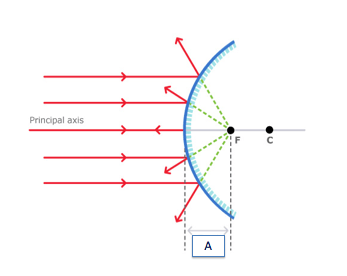
This image is showing a convex mirror because the image is (choose 2 answers)
real light rays meet behind the mirror
real light rays don't meet
the focal point is in front of the mirror
the focal point is behind the mirror
A dentist uses a small dental mirror to help magnify teeth in your mouth. What type of mirror is this?
a convex mirror
a concave mirror
a convex lens
a concave lens
This type of mirror is used in supermarkets to see around bends
concave
convex
plane
window
An image that forms when light rays actually meet
virtual image
real image
diffuse reflection
regular reflection
Virtual images are
always upright
can be obtained on screen
always smaller
An object is at a distance of 36cm from a concave mirror of focal length 12 cm. Find the image distance
18cm
-18cm
12 cm
-12 cm
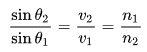
If light travels from a lower to a higher index of refraction medium the light will
bend away from the normal line
bend closer to the normal
not bend
answer is not here
A higher index of refraction means that the wave travels _____________ the speed of light in a vacuum in that medium.
Faster than
Slower than
Equal to
Answer is not here
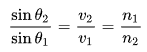
Light travels from air (n = 1.000) into an optical fiber. If the angles of incidence and refraction are 22oand 15º respectively. what is the index of refraction inside the fiber? Round off your values to 3 sig. figs.
1.45
1.44
0.69
0.70
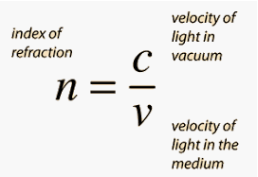
The index of refraction, is defined as the ratio of the speed of light in a vacuum (c = 3x10^8 m/s) to the speed of light in a medium. What is the index of refraction of a medium where the speed of light is 0.7c ? Round off your values to 3 sig. figs.
1.42
1.43
1.28
1.29

In the given figure, which of the following holds TRUE?
The angle of incidence is 10°.
The angle of incidence is 80°.
The angle of reflection is 10°.
The angle of reflection is 90°.
Which of the following is TRUE about spherical mirrors?
They don't obey the Law of Reflection.
They have a flat, planar surface.
Their surface either bulges outward or inward.
They always give images that are of the same size as the object.
In a ray diagram, which term refers to the distance from the vertex to the center of curvature?
focal point
focal length
radius of curvature
diameter

In the ray diagram shown, which set of descriptions of the image formed is completely accurate?
The image is minimized, inverted, and real.
The image is magnified, inverted, and real.
The image is minimized, inverted, and virtual.
The image is magnified, inverted, and virtual.

In the ray diagram shown, which set of descriptions of the image formed is completely accurate?
The image is minimized, upright, and real.
The image is magnified, inverted, and real.
The image is minimized, upright, and virtual.
The image is magnified, inverted, and virtual.
In ray diagram for concave mirrors, if an incident ray passes through the focal point, how does the reflected ray look like?
It reflects back on itself.
The reflected ray bounces vertically upward.
The reflected ray will be parallel to the principal axis.
The reflected ray gets projected vertically downward.
Which of the following correctly describes the image characteristics formed in plane mirrors?
virtual, upright, diminished
virtual, upright, same size
real, inverted, diminished
real, upright, same size
In ray diagrams for spherical mirrors, which term refers to the distance between the mirror and the focal point?
focal length
principal axis
radius of curvature
vertex
For convex mirrors, what will be the resulting reflected ray an incident ray that that travels parallel to the principal axis?
The reflected ray will pass through the focal point.
The extension of the reflected ray will pass through the focal point.
The reflected ray will pass through the center of curvature.
The extension of the reflected ray will pass through the center of curvature.

For concave mirrors, what are the image characteristics for an object placed between the center of curvature and focal point?
enlarged, inverted, real
enlarged, inverted, virtual
diminished, inverted, real
diminished, upright, virtual

