wayground logo

Free Printable Worksheets

Font size

S
M
L
XL
Worksheets

Intro Physics Final Exam Review

Total questions: 142

Worksheet time: 3hrs 27mins

Name
Class
Date
1.
The number of wavelengths that pass a point each per second is:
a)
frequency
b)
period
c)
longitudinal 
d)
transverse wave 
2.
Which vocabulary term is used to identify the distance between points C & G?
a)
Amplitude
b)
Crest
c)
Frequency
d)
Wavelength
3.
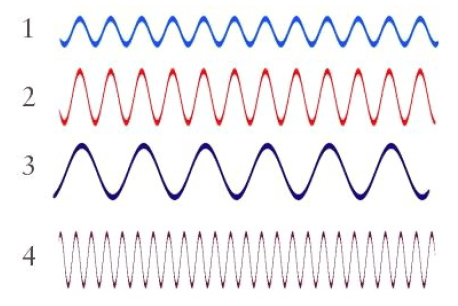
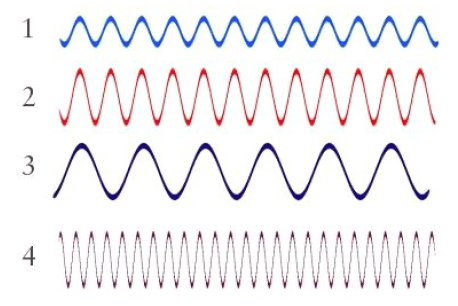
Which wave in the diagram has the greatest frequency?
a)
1
b)
2
c)
3
d)
4
4.
Which wave in the diagram has the greatest wavelength?
a)
1
b)
2
c)
3
d)
4
5.

All of the following are types of electromagnetic waves EXCEPT

a)

radio waves

b)

X-rays

c)

sound waves

d)

microwaves

6.

regular disturbances that transfer energy without the transfer of matter

a)

crest

b)

energy

c)

wave

d)

trough

7.

When a wave changes direction as it changes speed passing from one medium to another. (example: pencil in a glass of water)

a)

medium

b)

refraction

c)

reflection

d)

interference

8.
This type of Electromagnetic wave shows a break in bones.
a)
gamma ray
b)
x-ray
c)
brokenometer
d)
radio wave
9.

_______ are the highest frequency and carry the greatest amount of energy. 

a)

x-rays

b)

gamma rays

c)

infrared rays

d)

visible light

10.
How much of the electromagnetic spectrum is visible?
a)
All of it
b)
None of it
c)
Most of it
d)
Only a small part
11.
Sound is caused by? 
a)
force
b)
vibrations
c)
instruments
d)
medium
12.
What kind of wave is pictured below?
a)
compressional wave
b)
transverse wave
c)
sound wave
d)
mechanical wave
13.
#3
a)
Trough
b)
Crest
c)
Amplitude
d)
Wavelength
14.
A
a)
Rarefaction
b)
Compression
c)
Crest
d)
Wavelength
15.
B
a)
Rarefaction
b)
Compression
c)
Crest
d)
Wavelength
16.
When you hear a racecar have a higher pitch as it approaches you, and a lower pitch as it moves away from you, you are experiencing what phenomenon?
a)
Transverse Waves
b)
Doppler Effect
c)
Increased Amplitude
d)
Increased Volume
17.
When two waves grow larger in amplitude as they overlap (e.g. crest and crest).
a)
Constructive Interference
b)
Destructive Interference
c)
Passing Interference
18.
When two waves decrease in amplitude as they overlap (e.g. crest and trough).
a)
Constructive Interference
b)
Destructive Interference
c)
Passing Interference
19.
Wavelength and frequency have what relationship?
a)
Direct - when one increases, so does the other
b)
Inverse - when one increases, the other decreases
c)
Unrelated - sometimes they both change in the same way, and sometimes they don't
20.
A wave that has a frequency of 10 Hz,  a wavelength of 3m, and an amplitude of 2m, would have which speed?
a)
6 m/s
b)
20 m/s
c)
30 m/s
d)
60 m/s
21.

The height of a wave - from equilibirium to the crest or equilibrium to the trough

a)

Amplitude

b)

Wavelength

c)

Compressions

d)

Rarefactions

22.

The properties of the medium (tension, air density, etc) through which a wave travels affect its...

a)

Frequency

b)

Speed

c)

Amplitude

23.
Echoes are which type of wave interaction
a)
Reflection
b)
Rarefaction
c)
Refraction
d)
Diffraction
24.
Which feature of sound is determined by amplitude?
a)
Pitch
b)
Smoothness
c)
Loudness
25.

These types of waves DO NOT require a medium

a)

Transverse

b)

Longitudinal

c)

Mechanical

d)

Electromagnetic

26.
When light travels through water droplets and bends to produce different colors.
a)
Refraction
b)
Diffraction
c)
Reflection
d)
Resonance
27.

S8P4 d.Refraction makes an object appear bent and occurs when a wave

a)

Changes medium

b)

Bounces back

c)

Spreads out

d)

Interferes

28.

S8P4 d Which of the following ray diagram best illustrates refraction?

a)
b)
c)
d)
29.

S8P4 a. When a mechanical wave travels through a medium,

a)

energy and matter remain in one place.

b)

matter is transferred from one place to another.

c)

energy is transferred from one place to another.

d)

matter and energy move from one place to another.

30.

S8P4 a. When sound travels through air, the air particles vibrate

a)

in the direction of the wave.

b)

in all different directions.

c)

perpendicular to the wave.

d)

in a circular motion.

31.

S8P4 e.Sound waves travel faster in

a)

solids as compared to liquids

b)

gases as compared to solids.

c)

gases as compared to liquids.

d)

solids as compared to plasma.

32.

S8P4 d. The tuning fork shown in the diagram below produces a constant frequency. The tuning fork is moving to the right at a constant speed, and observers are located at points W, X, Y, and Z. Which observer hears the lowest frequency?

a)

W

b)

X

c)

Y

d)

Z

33.

S8P4 d An observer detects an apparent change in the frequency of sound waves produced by an airplane passing overhead. This phenomenon illustrates

a)

wave amplitude increase.

b)

wave intensity increase.

c)

the Franssen effect.

d)

the Doppler effect.

34.
One end of the rope is vibrated to produce a wave with a wavelength of .25 m.  The Frequency of the wave is 3.0 Hz.  What is the speed of the wave?
a)
3.00 m/s
b)
2.50 m/s
c)
.75 m/s
d)
1.25 m/s
35.
 A wave has frequency of 50 Hz and a wavelength of 10 m. What is the speed of the wave?
a)
500 m/s
b)
50 m/s
c)
5 m/s
d)
0.5 m/s
36.
A wave has wavelength of 10 m and a speed of 340 m/s. What is the frequency of the wave?
a)
34 m/s
b)
3400 Hz
c)
3400 m/s
d)
34 Hz
37.
What is a medium?
a)
something between a small and a large?
b)
the substance through which a wave can travel
c)
a pattern of vibration that simulates when a wave is standing still
d)
the distance from any point on a wave to an identical point on the next wave
38.
All electromagnetic waves have the same...
a)
frequency
b)
speed
c)
wavelength
d)
energy
39.
How are electromagnetic waves different from other waves? 
a)
They have very short wavelengths 
b)
They transmit energy instead of matter 
c)
They can travel through a vacuum 
d)
They can change direction by reflection 
40.
How is the teapot being heated? 
a)
condensation
b)
conduction
c)
convection
d)
radiation
41.
How is the cat being heated?
a)
condensation
b)
conduction
c)
convection
d)
radiation
42.
Heat always moves from an object of __________ temperature to an object of _________ temperature.
a)
moderate, high
b)
higher, lower
c)
lower, higher
d)
zero, high
43.

_______________ describes how much energy is required to raise an object's temperature.

a)

Conduction

b)

Convection

c)

Specific Heat

d)

Radiation

44.

Calculate the heat transferred when raising the temperature of 1600g of water by 3˚C (c=4.186 J/(g˚C))

a)

785 J

b)

1.26*10^5 J

c)

2.2 kJ

d)

2.0*10^5 J

45.
A pot of 2400g of water at a temperature of 25˚C is heated on a stove until the water boils (100˚C).  The specific heat of water is 4.18 J/(g˚C).
Determine the heat energy needed to heat the water in the pot to boiling.
a)
133.76J
b)
43,062.2J
c)
752,400J
d)
1,003,200J
46.
A group of friends gather around a fire to stay warm.
a)
conduction
b)
convection
c)
radiation
47.
Which of the following substances is the best conductor of transferring energy as heat?
a)
Carbon dioxide gas
b)
Water
c)
Iron
d)
Rubber
48.
Select the temperature in °C
a)

50°C

b)

12°C

c)

20°C

d)

60°C

49.
What happens to particles as they heat up?
a)
They slow down
b)
Nothing
c)
They don't move
d)
They speed up
50.
What happens to particles as they cool down?
a)
They slow down
b)
Nothing
c)
They don't move
d)
They speed up
51.
Movement of thermal energy from a warmer object to a cooler object
a)
Specific Heat
b)
Heat
c)
Freezing Point
d)
Boiling Point
52.

Water has a specific heat of 4.18 J/gºC. Wood has a specific heat of 1.76 J/gºC. What material needs more energy to raise the temperature 1ºC

a)

Wood

b)

Water

c)

Both are the same

53.

Heat is measured in ___________

a)

Celcius

b)

Joules

c)

Grams

54.

Copper, Stainless Steel, Carbon Steel, and Zinc were all heated using the same thermal energy. What material would be the coolest after being heated?

a)

Copper

b)

Carbon Steel

c)

Zinc

d)

Stainless Steel

55.
What does temperature measure?
a)

Heat

b)

ºC

c)

Molecular Kinetic Energy

d)

Thermal Energy

56.
When a  piece of aluminum foil is taken out of the oven and cools from 100° to 50°, What is the change in temperature?
a)

-50°

b)

+50°

c)

+100°

d)

+150°

57.

Compared to metal, water has a ___________ specific heat.

a)

High (it takes a lot of energy to change temperature)

b)

Low (it does not require a lot of energy to change temperature)

58.
The temperature of a substance increases as___.
a)
the substance expands
b)
the average kinetic energy of its particles increases
c)
the substance's volume increases
d)
the substance's mass increases
59.
While rubbing your hands together on a cold day, you use friction to trasnform
a)
thermal energy into nuclear energy
b)
nuclear energy into electrical energy
c)
mechanical energy into thermal energy
d)
mechanical energy into electrical
60.
LT3: If two objects have different temperatures, heat will flow from the warmer object to the cooler one UNTIL ____________
a)
one reaches a temperature of zero
b)
they both have an equal temperature
c)
one runs out of energy
61.
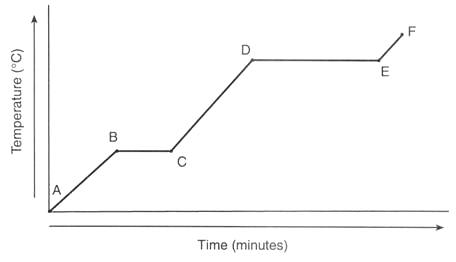
What line segment represents only the solid state?
a)
A-B
b)
B-C
c)
C-D
d)
D-E
62.
What state(s) of matter are present at D-E?
a)
Solid-liquid
b)
Liquid
c)
Liquid-gas
d)
Gas-Solid
63.
Between which points is the temperature of the substance remaining constant?
a)
A-B only. 
b)
A-B, C-D, E-F
c)
B-C only. 
d)
B-C, D-E
64.
True or false: melting and freezing occur at the same temperature!
a)
True
b)
False
c)
I don't know
65.
A substance's heating curve is shown in the graph.  What is its boiling point?
a)
100 C
b)
60 C
c)
80 C
d)
20 C
66.
What is the equation to measure change in Thermal Energy?
a)
Q=mc∆t
b)
Q=mc
c)
Q= ∆mct
d)
m=QC
67.
If the specific heat of water is 4,186 J/kg∙°C, how much heat is required to increase the temperature of 1.2 kg of water from 23 °C to 39 °C? 
a)

-80,371.2 cal

b)

44,938.6 J

c)

80,371.2 J

d)

112,575.9 J

68.

The specific heat of aluminum is 0.21 cal/g°C. How much heat(Q) is released when a 10 g piece of aluminum foil is taken out of the oven and cools from 100° to 50°?

a)

105 cal

b)

10.5 cal

c)

1.05 cal

69.
The type of heat transfer that happens through direct contact of molecules or particles with each other is ___________________.
a)
Convection
b)
Conduction
c)
Radiation
d)
insulation.
70.
The kind of heat transfer that travels through space in electromagnetic waves is ______________________.
a)
insulation.
b)
Radiation
c)
Conduction
d)
Convection
71.
___________________ is the type of heat transfer that occurs in fluids, such as warm air rising and cold air sinking; creating wind.
a)
Convection
b)
Conduction
c)
Radiation
d)
insulation.
72.
When you use a microwave, what is the main way that heat is transferred?
a)
Convection
b)
Conduction
c)
Radiation
d)
insulation.
73.
Which of the following is the best example of conduction?
a)
A light bulb warming a lampshade
b)
An egg cooking in a frying pan
c)
Water boiling in a pot
d)
Gases circulating in the atmosphere
74.
What is the unit of electric charge?
a)
Volts
b)
Amps
c)
Coulombs
d)
Ohms
75.

Which part of the atom is able to move to create electricity?

a)

Proton

b)

Neutron

c)

Electron

76.
Which part of the atom is positively charged?
a)
Proton
b)
Neutron
c)
Electron
77.
Which part of the atom is negatively charged?
a)
Proton
b)
Neutron
c)
Electron
78.
An atom that has more protons than electrons would have what charge?
a)
Positive
b)
Negative
c)
Neutral (Zero)
79.
An atom that has more electrons than protons would have what charge?
a)
Positive
b)
Negative
c)
Neutral (Zero)
80.

An objective with a negative charge would _______ an object with a positive charge

a)

Attract

b)

Repel

c)

Do nothing

81.

An object with a positive charge would ______ an object with a positive charge

a)

Attract

b)

Repel

c)

Do nothing

82.

Which of the following is the process intentionally splitting up large nucleus (like Uranium) into a smaller nucleus and other particles like neutrons while releasing energy?

a)

The photoelectric effect

b)

Nuclear fission

c)

Nuclear fusion

83.

Which of the following is the process of an unstable nucleus spontaneously dividing into a smaller nucleus and an alpha particle

a)

Radioactive decay

b)

Nuclear fusion

c)

The photoelectric effect

84.

If BOTH of the charges double, what happens to the force between them?

a)

Quadruples

b)

Doubles

c)

Stays the same

d)

Reduced by half

85.

If the distance between two charges doubles, what happens to the force between them?

a)

Reduced by half

b)

Reduced by 1/4

c)

Stays the same

d)

Quadruples

86.

If the distance between two charges is divided by 3, what happens to the force between them?

a)

Increases x 9

b)

Doubles

c)

Triples

d)

Reduces by 1/3

87.
Electrostatic force F is directly proportional to:
a)
r^2 (distance squared)
b)
q1
c)
q2
d)
both q1 and q2
88.

When distance increases, electrostatic force decreases; we call this relationship ____________ proportional

a)

directly

b)

inversely

89.
A material in which electrons are able to move easily
a)
Circuit
b)
Insulator 
c)
Resistance 
d)
Conductor 
90.
Compared to insulators, metals are better conductors of electricity because metals contain more free
a)
protons
b)
electrons
c)
positive ions
d)
negative ions
91.

Q1=+1 C and is placed at the origin. Q2=+2 C and is placed 1m to the right of Q1. Which of the following is true about the force that Q1 feels?

a)

It is attractive and directed to the right

b)

It is attractive and directed to the left

c)

It is repulsive and directed to the right

d)

It is repulsive and directed to the left

92.

Which part of Coulomb's Law is squared, and therefore has the greatest effect on the electrostatic force?

a)

distance between charges

b)

charge of one object

c)

Coulomb's constant

d)

force

93.
In a parallel circuit if one light bulb goes OUT; then they ALL go out. TRUE OR FALSE?
a)
TRUE
b)
FALSE
94.
What is a Parallel circuit? 
a)
Has only one path 
b)
Has more than one path 
c)
Allows energy to travel through easily 
d)
Has only one light bulb
95.
Which best describes a simple series circuit?
a)
Electricity flows along one pathway.
b)
The flow of electricity comes from the switch.
c)
Electricity flows along many pathways.
d)
The flow of electricity comes from the light bulb.
96.
Silver is a _____?
a)
insulator
b)
conductor
97.
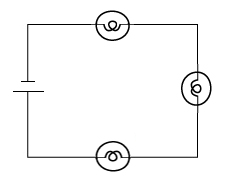
What kind of circuit is this?
a)
series
b)
parallel
98.
Would would best complete this circuit?
a)
A wire
b)
A switch
c)
A battery
d)
A light bulb
99.
This image represents what type of circuit?
a)
open
b)
closed
c)
series
d)
parallel
100.
What size resistor would produce a 3 Amp current flow with a 12 Volt battery
a)
1 Ohm
b)
3 Ohms
c)
4 Ohms
d)
12 Ohms
101.
What size resistor would produce a current flow of 5 Amps with a battery voltage of 12.6 volts
a)
60 Ohms
b)
2.52 Ohms
c)
1.71 ohms
d)
5.04 Ohms
102.
What is current measured in?
a)
Ω (Ohms)
b)
V (Volts)
c)
A (Amps)
d)
W (Watts)
103.
What is resistance measured in?
a)
Ω (Ohms)
b)
V (Volts)
c)
A (Amps)
d)
W (Watts)
104.
What is Resistance?
a)
The flow of electrons
b)
Electric potential difference
c)
A battery
d)
The ability to reduce the flow of electrons
105.
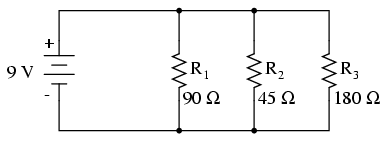
The current through the battery of this circuit is
a)
0.02 amps
b)
0.09 amps
c)
50 amps
d)
9 amps
106.
The voltage drop across the 180 ohm resistor is 
a)
9 V
b)
6 V
c)
2 V
d)
12 V
107.
The current going through the 180 ohm resistor is 
a)
0.05 amps
b)
0.2 amps
c)
0.1 amps
d)
20 amps
108.
The current going through the 45 ohm resistor is 
a)
0.05 amps
b)
0.2 amps
c)
0.1 amps
d)
5 amps
109.

The equivalent (total) resistance in this circuit is

a)

100 ohms

b)

450 ohms

c)

400 ohms

d)

30 ohms

110.

What remains the same in a series circuit?

a)

Resistance

b)

Power

c)

Current

d)

Voltage

111.
When voltage is increased and resistance is constant, current...
a)
increases 
b)
decreases 
c)
is constant 
d)
cannot be determined 
112.
A circuit in which all parts are connected in a single loop is called a(n)...
a)
open circuit 
b)
open load 
c)
series circuit
d)
parallel circuit 
113.

Determine the value of the highest resistor from the graph

a)

36 Ω

b)

21Ω

c)

30 Ω

d)

81 Ω

114.

According to the junction rule, what must I1 be?

a)

3.5 A

b)

7.5 A

c)

2 A

d)

5.5 A

115.

If both light bulbs are identical and both switches were in the on position, how would the brightness of both bulbs change if one switch were turned off?

a)

One bulb would go off and the other would remain the same brightness

b)

No change in either bulb

c)

Both bulbs would go off

d)

One bulb would go off and the other would become brighter

116.

Which image shows the correct placement of meters to measure the current and voltage for the resistor?

a)

1

b)

2

c)

3

d)

4

117.

As resistors are added to a parallel branch in a circuit, the total current in the circuit will______________.

a)

increase

b)

decrease

c)

remain the same

d)

fluctuate wildly

118.
Which of these symbols represents a switch? Select the symbol for a switch from the choices provided. 
a)
A
b)
B
c)
C
d)
D
119.
Which circuit diagram matches this picture of a circuit?
a)
A
b)
B
c)
C
d)
D
120.
A flow of electrons through a conductor is called:
a)
A river
b)
A spark
c)
An electron flow
d)
A current
121.

The picture shows an electrical circuit. This circuit is a series circuit because:

a)

It has 3 light bulbs.

b)

The same current flows through all three light bulbs.

c)

The total voltage of the battery is applied to all three bulbs.

d)

The electrical current is divided between the three light bulbs.

122.
What is this symbol for?
a)
light bulb
b)
switch
c)
battery
d)
resistor
123.
The image is showing a....
a)
overloaded circuit
b)
parallel circuit
c)
short circuit
124.

A device that contains a thin strip of metal for charges to flow is called a ______. This device's job is to protect the circuit and break if there is too much current.

a)

fuse

b)

circuit

c)

switch

125.

A device that converts electrical energy into kinetic energy by running current through a loop of wire near magnets.

a)

A. electromagnet

b)

B. electromagnetic induction

c)

C. electric motor

d)

D. electromagnetism

126.

A device that converts kinetic energy into electrical energy by moving magnets near a coil of wire.

a)

A. electric generator

b)

B. electric motor

c)

C. electromagnetic induction

d)

D. electricity

127.

Where does the car have the most gravitational PE?

a)

A

b)

B

c)

C

d)

D

128.

The car has 200 J of PE at point A and is not moving. What is the total ME at point A?

a)

200 J

b)

150 J

c)

100 J

d)

50 J

e)

0 J

129.

A 1000kg car is moving at 5m/s, what is the Kinetic Energy of the car?

a)

6250000 J

b)

25000 J

c)

12500 J

d)

2500 J

130.

A 7.14 kg object has 700 J of stored gravitational potential energy. How high above the ground is the object?

a)

0.9m

b)

7.14m

c)

10m

d)

20m

131.

A 2kg ball rolls with a KE of 36 J - what is the speed of the ball?

a)

6m/s

b)

7.4m/s

c)

18m/s

d)

None of these

132.

If a person lifts a 150 Newton ball 1.5m.  And it takes him 17 seconds.  How much work did he do?  

a)
225 Joules
b)

3876 Joules

c)
13 Joules
d)
387.6 Watts
133.
What unit is energy measured in?
a)
Newtons 
b)
Joules 
c)
Grams 
d)
Volts
134.
When my velocity triples, my kinetic energy increases by ______ times.
a)
9
b)
 3 
c)
1.5
d)
4.5
135.

If 40N of force is applied to Rollo Koster's 10 kg cart over a distance of 50 meters, how much work is done?

a)

8000J

b)

8000N

c)

4000J

d)

2000J

136.
Which of the following objects has the most kinetic energy?
a)
A 20 kg toddler running at 5 m/s
b)
A 50 kg toddler running at  30 m/s
c)
A 90 kg toddler running at 30 m/s
d)
A 100 kg  toddler running at 2 m/s
137.

The potential energy of an object increases 50 J. If there is no friction or any other work done, by how did the kinetic energy decrease?

a)

100 JOULES

b)

0 JOLUES

c)

50 JOULES

d)

200 JOULES

138.

Starting from rest, a marble first rolls down a steeper hill, then down a less steep hill of the same height. Ignoring friction, for which is it going faster at the bottom?

a)

Faster at the bottom of the steeper hill

b)

Faster at the bottom of the less steep hill

c)

Same speed at the bottom of both hills

d)

Can’t say without knowing the mass of the marble

139.

In the equation PE = mgh, what does the “g” mean?

a)

Acceleration due to gravity

b)

Force of gravity

c)

Weight of the object

140.

A baguette is dropped off the top of the Eiffel Tower. What is true concerning of the mechanical energy of the ball as it falls?

a)

The potential energy of the baguette is conserved as it falls.

b)

The sum of the kinetic and potential energies of the baguette is a constant.

c)

The kinetic energy of the baguette is conserved as it falls.

d)

A) The total energy of the object increases as it falls since it gains speed.

141.

S8P4 d Which of the following ray diagram best illustrates reflection?

a)
b)
c)
d)
142.

S8P4 d Which of the following ray diagram best illustrates diffraction?

a)
b)
c)
d)