wayground logo

Free Printable Worksheets

Font size

S
M
L
XL
Worksheets

Physical Science Final Review - Unit 1 Physics

Total questions: 141

Worksheet time: 5hrs 42mins

Name
Class
Date
1.

How are observations made?

a)

Only with your eyes.

b)

By trying to explain what you see.

c)

Using your 5 senses

d)

Just making a good guess.

2.

What kind of observation is this?


The table top is smooth.

a)

Qualitative Observation

b)

Quantitative Observation

c)

Hypothesis

d)

Inference

3.

These kind of observations are made using instruments such as rulers, balances and thermometers.

a)

Qualitative Observations

b)

Quantitative Observations

c)

Scientific Observations

d)

Measured Observations

4.
Which of the following statements is an inference about the picture
a)
The vase is broken.
b)
The girls' bow is blue and purple.
c)
The girl broke the vase.
d)
The girl has blonde hair.
5.
What is an inference? 
a)
Just a guess.
b)
A statement based off of your observations. 
c)
The same as an observation. 
d)
Examples of something. 
6.
Which observation is quantitative?
a)
It is 5 cm long
b)
It is smooth
c)
It looks red
d)
It is dry
7.
Which statement is an inference about this picture?
a)
The van is tan.
b)
The  van ran into KFC. 
c)
The driver was hungry. 
d)
An ambulance may be on the way. 
8.
Which of the following is an observation about this picture?
a)
The boy has fallen off his bike.
b)
The boy is in a lot of pain.
c)
The boy has injuries to his knees
d)
The boy learned his lesson about wheelies
9.
Observation or Inference?
The girl has hurt her knee
a)
observation
b)
inference
10.

1 meter = __ centimeter

a)

100 centimeter

b)

1 centimeter

c)

1 millimeter

d)

100 millimeter

11.
What measurement is not part of the metric system?
a)
millimiter
b)
centimeter
c)
meter
d)
inch
12.

Convert 300 meters to centimeters:

a)

3000 cm

b)

0.3 cm

c)

30,000 cm

d)

3 cn

13.
The metric unit for mass is 
a)
newton
b)
kilogram
c)
joule
d)
g/ml
14.
The appropriate abbreviation of centimeter is..
a)
cm
b)
Cm
c)
cM
d)
CM
15.

There are ___ meters in 25 kilometers (km)

a)

250 m

b)

2500 m

c)

25000 m

d)

.025 m

16.
The base unit for length is the
a)
second
b)
gram
c)
meter
d)
liter
17.
The basic unit of metric volume is called a_____.
a)
Kilogram
b)
milligram
c)
Liter
d)
milliliter
18.
The base for mass is the
a)
meter
b)
gram
c)
kilogram
d)
liter
19.
What is the length of the key?
a)
2 cm
b)
0 cm
c)
4 cm
d)
2 inches
20.
What is the length of the ribbon?
a)
9 cm
b)
2 cm
c)
7 cm
d)
11 cm 
21.
What is the correct volume of the blue liquid?
a)
5 ml
b)
15 ml
c)
20 ml
d)
25 ml
22.

20 cm = ______ m

a)

20 m

b)

0.2 m

c)

0.002 m

d)

2,000

23.

19 ml = _______ cl

a)

1.9 cl

b)

19 cl

c)

190 cl

d)

0.19 cl

24.

Convert 2387 centimeters into meters

a)

2.387 meters

b)

238700 meters

c)

23.87 meters

d)

238.7 meters

25.
This variable in an experiment is the one being deliberately changed by the scientist. 
a)
dependent variable
b)
independent variable
c)
data
d)
control group
26.
When experimenting with the growth of a plant, a scientist uses three (of the same type of) plants, two different fertilizers, equal light, and equal water. What type of variable is the fertilizer?
a)
Dependent
b)
Independent
c)
Control
d)
Compound
27.

What kind of graph is this?

a)

line graph

b)

bar graph

c)

circle graph

28.
What type of graph shows change over time?
a)
Circle Graph
b)
Bar Graph
c)
Trend Graph
d)
Line Graph
29.
What is speed?
a)
how far you go
b)
how much distance is covered over a period of time
c)
how fast you accelerate
d)
the change in the location of a object
30.
A runner races in the 100 meter dash.  It takes her 10 seconds to finish.  What is her average speed?
a)
10 m/s
b)
1000 m/s
c)
100 seconds
d)
10 seconds
31.
Total distance divided by total time is
a)
average speed
b)
constant speed
c)
instantaneous speed
d)
acceleration
32.
Velocity is both ____ and _____. 
a)
speed , direction 
b)
direction, mass
c)
volume, density 
d)
direction, magnitude 
33.
Which of the following represents a velocity?
a)
40 m
b)
40 m north
c)
40 m/s
d)
40 m/s north
34.

Which statement is true about velocity?

a)

Must have measurement of speed.

b)

Must have a measurement of speed and direction.

c)

Must have only direction.

d)

Has neither a measurement of speed or direction.

35.
How do you calculate distance?
a)
Distance divided by time.
b)
Displacement divided by time.
c)
Speed multiplied by time.
d)
Displacement divided by velocity.
36.
A car moves a distance of 1000 m with an average speed of 28 m/s.   Calculate the time.
a)
36 seconds
b)
28,000 seconds
c)
28 seconds
d)
972 seconds
37.
A cheetah runs with an average speed of 32 m/s for 30 seconds.  How far did the cheetah run?
a)
960 m
b)
1.07 m
c)
0.94 m
d)
62 m
38.
Acceleration is a change in ________. 
a)
direction 
b)
speed 
c)
velocity 
d)
distance 
39.
You are walking in a straight line at a consistent speed. Do you have acceleration? 
a)
no
b)
yes 
40.
You are walking and start to slow down. Do you have acceleration? 
a)
yes
b)
no 
41.
A golf ball accelerates off a tee at 15m/s2, changing its velocity from 0m/s to 50 m/s down the fairway. How long did it take the golf ball to accelerate?
a)
750 seconds
b)
35 seconds
c)
0.3 seconds
d)
3.3 seconds
42.
Acceleration is defined as the CHANGE in 
a)
time it takes for one place to move to another place. 
b)
velocity of an object.
c)
distance divided by the time interval 
d)
velocity divided by the time interval 
43.
The SI unit for acceleration is
a)
mph
b)
ft/sec2
c)
m/s2
44.
A negative acceleration means that your object is _____. 
a)
not accelerating
b)
not moving
c)
speeding up 
d)
slowing down 
45.
What law is best described by inertia?
a)
1st
b)
2nd
c)
3rd
d)
law of conservation of mass
46.
a)

Newtons 1st Law

b)

Newtons 2nd Law

c)

Newtons 3rd Law

d)

Law of Motion

47.
A person not paying attention while skateboarding hits a rock. The skateboard stops...they don't.
a)
The Law of Inertia (1st law)
b)
The Law of Acceleration (2nd law)
c)
The Law of Conservation of Momentum
d)
Action Reaction Law (3rd law)
48.
What Unit do we Measure Force in? 
a)
Newtons
b)
Joules
c)
Force
d)
Kilograms
49.
With unbalanced forces, the object will move in the direction that the _______ force is being applied.
a)
larger 
b)
smaller 
c)
equal 
d)
less
50.
What is Newton's First Law
a)
F=ma
b)
Every action has an equal and opposite reaction
c)
An object at rest stays at rest, an object in motion stays in motion. 
d)
Friction 
51.
Which type of force(s) will cause a change in an object's motion?
a)
gravity
b)
zero net force
c)
balanced forces
d)
unbalanced forces
52.
A 20 kg bike accelerates at 10 m/s2.  what was the force
a)
25 Newtons
b)
20 Newtons
c)
200 Newtons
d)
10 Newtons
53.
Newton's third law states that any action will have a(n) _______ and ______ reaction
a)
Equal and similar
b)
Equal and opposite
c)
Equal and different
d)
Greater and opposite
54.
Newton's third law states that any action will have a(n) _______ and ______ reaction
a)
Equal and similar
b)
Equal and opposite
c)
Equal and different
d)
Greater and opposite
55.
What is a PUSH or PULL of an object?
a)
Motion
b)
Force
c)
Friction
d)
Gravity
56.
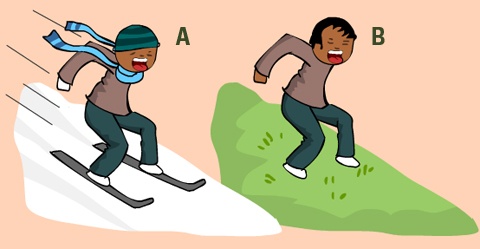
Why is it harder for the boy in Image B to get down the hill?
a)
Motion
b)
Friction
c)
Work
d)
Displacement
57.
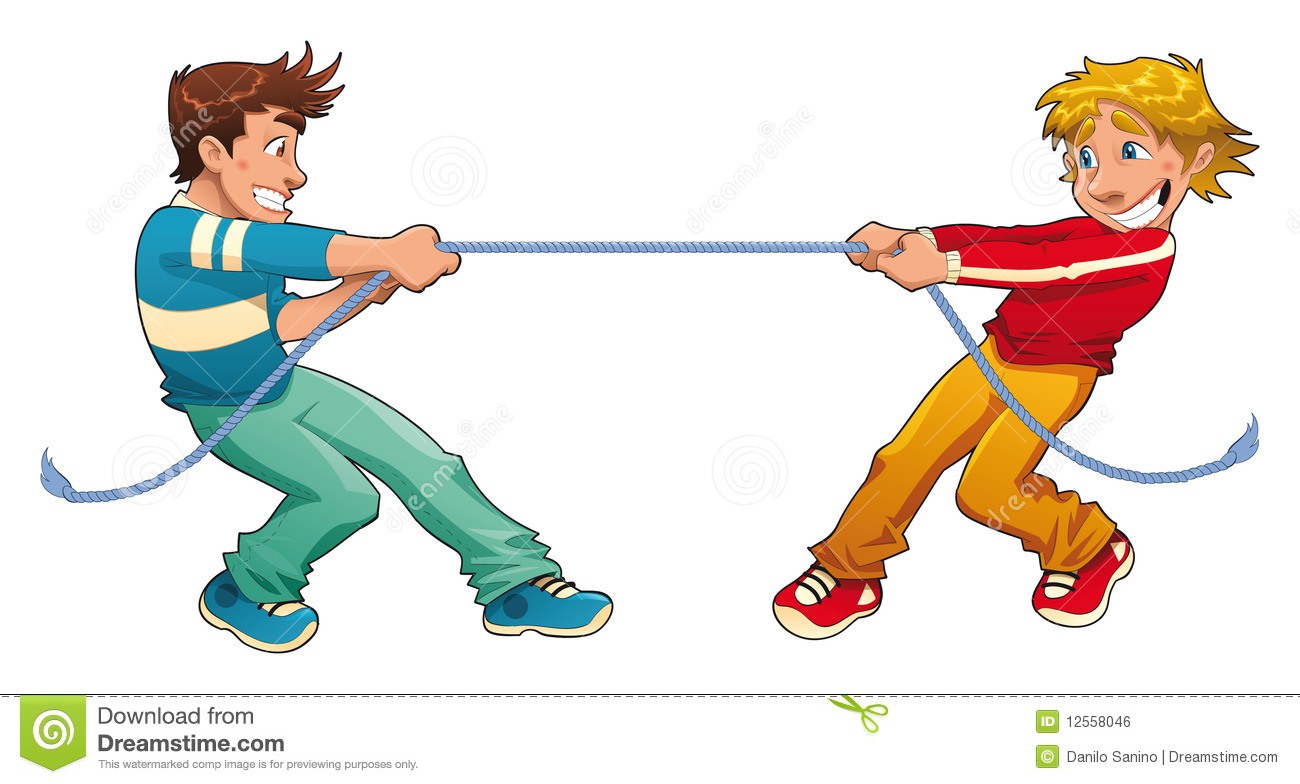
If these boys are pulling with the same amount of force.  What will happen?
a)
The boy in blue will win.
b)
They will not move at all.
c)
The boy in red will win.
d)
Both will fall down.
58.
Which force produces a change in motion?
a)
unbalanced force
b)
balanced force
c)
gravitational force
d)
frictional force
59.
One object has twice as much mass as another object. The first object also has also twice as much...
a)
velocity
b)
gravitational acceleration
c)
inertia
d)
all of these
60.
What do each of the letters correctly represent?
a)
Funny, Monkeys, Arrive
b)
Force, Mass, Acceleration
c)
Free, Mass, Access
d)
Force, Magnesium, Arsenic
61.
Which is always a contact force?
a)
electric
b)
friction
c)
magnetic
d)
gravity
62.
What is the SI unit used to measure force? 
a)
pounds 
b)
grams 
c)
newtons 
d)
kg/ m2
63.
Gravity attracts all objects towards one another.
a)
False
b)
True
c)
It depends
d)
I don't care
64.
Any object with mass is surrounded by a gravitational field.
a)
True
b)
Sometimes
c)
False
d)
Never
65.
An object is falling but is not accelerating. What do you know?
a)
Gravity is stronger than air resistance
b)
Air resistance is stronger than gravity
c)
Air resistance is equal to gravity
d)
Forces are unbalanced
66.
When does a falling object experienced balanced forces?
a)
Terminal velocity
b)
During free fall
c)
When it first starts to fall
d)
Just before it hits the ground
67.

If an object has more mass, it also has more

a)

Acceleration

b)

Velocity

c)

Speed

d)

Inertia

68.

You take a ball to a perfect vacuum with no gravity and throw it. The ball will move in the direction of the throw at a(n)

a)

increasing speed

b)

decreasing speed

c)

constant speed

d)

stop

69.

The numerical constant "g" is equal to 9.8 m/s2 and it represents:

a)

Gravitational acceleration

b)

Speed

c)

Force and inertia

d)

Inertia

70.

A falling object will continue to fall faster and faster until

a)

it hits the ground

b)

gravity wears off

c)

inertia kicks in

d)

Fair=FgravF_{air}=F_{grav}

71.

The reason that a feather will fall slower than a bowling ball (unless you are in a vacuum) is because it has:

a)

More inertia

b)

More air resistance

c)

Less air resistance

d)

Lower gravity

72.

When something is in motion it means that it is changing:

a)

Position

b)

Speed

c)

Time

d)

Gravity

73.

The equation for work is

a)

work = power x mass

b)

work = power / time

c)

work = force x distance

d)

work = distance x time

74.

The equation for POWER is

a)

power = mass x time

b)

power = work / time

c)

power = time / work

d)

power = work x time

75.

The equation for POTENTIAL ENERGY is

a)

PE = mass x gravity x height

b)

PE = gravity x weight

c)

PE = height / work

d)

PE = work / time

76.

The equation for KINETIC ENERGY is

a)

KE = mass x gravity

b)

KE = 1/2 height x speed

c)

KE = mass2

d)

KE = 1/2 mass x speed2

77.

The product of the net force on an object and the distance through which the object is moved

a)

joule

b)

power

c)

work

d)

energy

78.

_______________ is done when a force acts on an object and the object moves in the direction of the force.

a)

Work

b)

Kinetic energy

c)

Watt

d)

Joule

79.

The unit for work (aka Newton-meter)

a)

Watt

b)

Power

c)

Work

d)

Joule

80.

________________ is the rate at which work is done.

a)

Power

b)

Work

c)

Time

d)

Energy

81.

The unit of power (aka Joule per second)

a)

Joule

b)

Minute

c)

Watt

d)

Pound

82.

The property of an object or system that allows it to do work is ________________.

a)

Work

b)

Energy

c)

Power

d)

Distance

83.

______________ energy is due to the position of something or the movement of something.

a)

Kinetic

b)

Potential

c)

Mechanical

d)

Work

84.

Energy that is stored and held in readiness

a)

Kinetic

b)

Mechanical

c)

Work

d)

Potential

85.

Kinetic energy is the energy of ___________.

a)

Distance

b)

Motion

c)

Work

d)

Roman

86.

Energy cannot be ________ or ___________.

a)

big/small

b)

left/right

c)

created/destroyed

d)

made/transferred

87.

Energy can be transformed from one form into another, but the total amount of energy never changes.

a)

Work-energy theorem

b)

Law of conservation of energy

c)

Newton's second law of motion

d)

King's theorem of energy

88.

What is the kinetic energy of an 9 kg bowling ball rolling at 3.30 m/s?

a)

29.7 J

b)

323.4 J

c)

49.005 J

d)

14.85 J

89.

If you hold a 20 N object 2 m off of the ground, how much work have you done?

a)

40 J of Work

b)

10 J of Work

c)

No Work

d)

18 J of Work

90.

What is the kinetic energy of a 4 kg rock falling through the air at 5 m/s?

a)

10 J

b)

50 J

c)

20 J

d)

200 J

91.

If two rocks are launched through the air at the same speed, but one has twice as much mass as the other, how do their kinetic energies compare?

a)

The kinetic energy of the two rocks is the same because they have the same speed

b)

The rock with the greater mass will only move a small distance and then fall straight to the ground

c)

The two rock could not have the same speed if they have different masses

d)

The rock with the greater mass has more kinetic energy than the rock with less mass even though they are traveling at the same speeds because both mass and speed affect kinetic energy.

92.

Where would a car traveling on a roller coaster track have the most potential energy?

a)

At the bottom

b)

Halfway to the top

c)

at the top

d)

halfway to the bottom

e)

It is always the same

93.

What would happen to the kinetic energy of an object if you doubled the mass?

a)

The kinetic energy would be cut in half

b)

The kinetic energy would double

c)

The kinetic energy would triple

d)

It would stay the same because mass does not effect kinetic energy

94.

If a 2 kg ball is traveling at 4 meters per second, what is its kinetic energy?

a)

1 J

b)

2 J

c)

4 J

d)

8 J

e)

16 J

95.

As a pendulum swings from its highest to lowest position, what happens to its kinetic and potential energy?

a)

Both the potential energy and kinetic energy decrease

b)

The potential energy decreases while the kinetic energy increases

c)

The kinetic energy decreases while the potential energy increases

d)

Both the potential energy and kinetic energy increase

96.

Which point has the most kinetic energy?

a)

Ball G

b)

Ball F

c)

Ball E

d)

Ball D

e)

Ball A

97.

For work to be done on an object,

a)

some force need only be exerted on the object.

b)

the object must move some distance as a result of a force.

c)

the object must move, whether or not a force is exerted on it.

d)

the object must not move.

98.

Energy is the rate at which work is done

a)

True

b)

False

99.

A 35 kg chair is lifted 5 m off the ground. What is its potential energy?

a)

175 J

b)

30 J

c)

1715 J

d)

40 J

100.

What is the potential energy of a 3 kilogram-ball that is on the ground?

a)

9.8 J

b)

3 J

c)

1 J

d)

0 J

101.
When a ball accelerates down a slope, it _________________
a)
gains both kinetic energy and potential energy
b)
gains kinetic energy but loses potential energy
c)
gains potential energy but loses kinetic energy
d)
neither gains nor loses both kinetic energy and potential energy     
102.
A man of weight 900 N walks up a hill of height 10 m. What is the total work done?
a)
0 J       
b)
90 J
c)
900 J   
d)
9000 J             
103.
What is the formula for K.E.?
a)
(1/2)mv
b)
(1/2)m2v
c)
(1/2)mv2
d)
mv2
104.
The sun shines down on this family as the play on the beach.
a)
conduction
b)
convection
c)
radiation
105.
A group of friends gather around a fire to stay warm.
a)
conduction
b)
convection
c)
radiation
106.
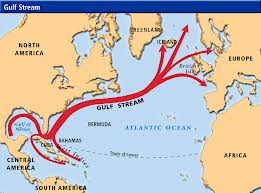
The Gulf Stream is a current that brings warm ocean water from the south to the north.
a)
conduction
b)
convection
c)
radiation
107.
Walking on the warm sand sand with your bare feet.
a)
conduction
b)
convection
c)
radiation
108.
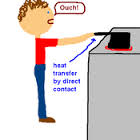
The man goes to take the hot pot off the stove with his bare hands.
a)
conduction
b)
convection
c)
radiation
109.
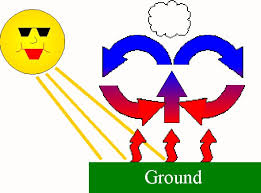
Warm air rises and the cool air sinks.
a)
conduction
b)
convection
c)
radiation
110.
Johnny accidentally grabbed the handle of the hot pot.
a)
conduction
b)
convection
c)
radiation
111.
Hot air moving up is an example of 
a)
Radiation
b)
Conduction
c)
Magic
d)
Convection
112.
Molecules in cold things move more _________
than in hot things.
a)
quickly
b)
slowly
c)
happily
d)
merrily
113.
The transfer of heat by currents through liquids of gases is called
a)
Perspiration
b)
Radiation
c)
Conduction
d)
Convection
114.
Conduction occurs in...
a)
solids
b)
liquids
c)
gases
115.

100 joules of electrical energy go into a light bulb. How much energy comes out?

a)

100 joules total

b)

75 joules total

c)

50 joules total

d)

25 joules total

116.

Some energy will always be transformed into a less desired form of energy. This has to do with the _____ of a system never being perfect.

a)

Convection

b)

Energy

c)

Efficiency

d)

Power

117.

The units for work are called joules and can also be called_______

a)

Newtons

b)

Watts

c)

Force*seconds

d)

Newton*meters

118.
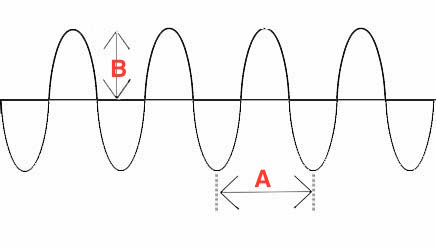
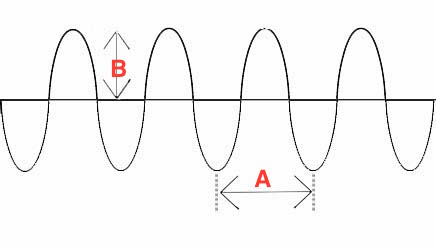
What property of this wave is represented by the letter "A"
a)
amplitude
b)
crest
c)
trough
d)
wavelength
119.
What property of the wave is represented by the letter "B"?
a)
amplitude
b)
crest
c)
trough
d)
wavelength
120.
The highest point on a wave is:
a)
the crest
b)
the trough
c)
the top
d)
the coast 
121.
The lowest point on a wave is the:
a)
Amplitude
b)
Crest
c)
Trough
d)
Wavelength
122.
The number of wavelengths that pass a point each per second is:
a)
frequency
b)
period
c)
longitudinal 
d)
transverse wave 
123.
The type of waves that require medium to pass:
a)
Mechanical Waves
b)
Electromagnetic Waves
124.
A mechanical wave cannot travel through...
a)
a vacuum(empty space).
b)
water.
c)
air. 
d)
glass.
125.
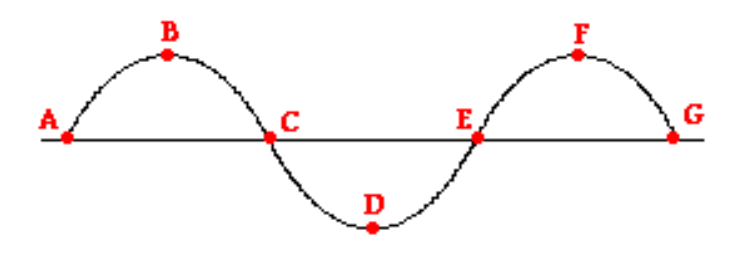
Which letter(s) represent the crest of the wave?
a)
A
b)
B & D
c)
B & F
d)
F
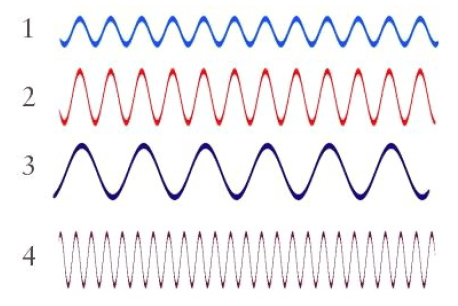
126.
Which wave in the diagram has the greatest frequency?
a)
1
b)
2
c)
3
d)
4
127.
Which of the following can sound travel through?
a)
solid
b)
liquid
c)
gas
d)
all of the above
128.
crest to crest or trough to trough
a)
crest
b)
trough
c)
amplitude
d)
wavelength
129.
Electromagnetic waves include the following except
a)
radio waves
b)
X-rays
c)
doing the wave at a football game
d)
microwaves
130.
When a wave strikes and object and bounces off. (example echo)
a)
medium
b)
refraction
c)
reflection
d)
interference
131.
When a wave bends as it passes through at an angle from one medium to another.(example: pencil in a glass of water-)
a)
medium
b)
refraction
c)
reflection
d)
interference
132.
Which wave is pictured?
a)
Transverse
b)
Longitudinal
c)
Both
d)
Neither
133.
What are the parts of a longitudinal wave?
a)
Compressions and rarefactions
b)
Crests and troughs
c)
Compressions and crests
d)
Rarefactions and troughs
134.
The most dense part of a longitudinal wave.
a)
Density
b)
Compression
c)
Rarefaction
d)
Amplitude
135.
Sound needs a medium to travel through.  What is a medium?
a)
solid, liquid, gas
b)
open space
c)
waves
d)
nothing
136.

A wave is traveling at 30 m/s. If it has a frequency of 2 Hz, what is its wavelength?

a)

32 m

b)

60 m

c)

120 m

d)

15 m

137.

When a wave travels through a medium, the wave transfers:

a)

Matter only

b)

Energy only

c)

Both matter and energy

d)

Neither mass nor energy

138.

A wave has a frequency of 6 Hz and a wavelength of 3 meters. How fast is it traveling?

a)

2 m/s

b)

18 m/s

c)

3 m/s

d)

180 m/s

139.

What type of interference is represented in this diagram?

a)

Constructive

b)

Destructive

140.

What type of interference is represented in the diagram?

a)

Constructive

b)

Destructive

141.

What are waves?

a)

Mass

b)

Force

c)

Energy

d)

Matter