wayground logo

Free Printable Worksheets

Font size

S
M
L
XL
Worksheets

Electricity Exam Review

Total questions: 145

Worksheet time: 2hrs 38mins

Name
Class
Date
1.

What parts of an atom are in the nucleus?

a)

Protons

b)

Neutrons

c)

Electrons

d)

Protons and Neutrons

2.
Protons are located in the nucleus of the atom.
A proton has _______________.
a)
No charge
b)
 A negative charge
c)
A positive charge
3.
A cloth has a positive charge and can attract some paper scraps when held near them, what kind of charge can the paper scraps NOT have?
a)
Positive
b)
Negative
c)
Neutral 
4.

Atoms contain charged particles called:

a)

Protons, neutrons and electrons

b)

Protons and electrons

c)

Protons and neutrons

d)

Electrons and neutrons

5.
The negatively charged particles in an atom are called _____.
a)
electrons
b)
neutrons
c)
negatrons
d)
protons
6.
The charge of an electron is:
a)
Positive. 
b)
Negative. 
c)
Electrons have no charge
7.
Two like charges:
a)
 neutralize each other.
b)
repel each other. 
c)
must be neutrons. 
d)
attract each other.
8.
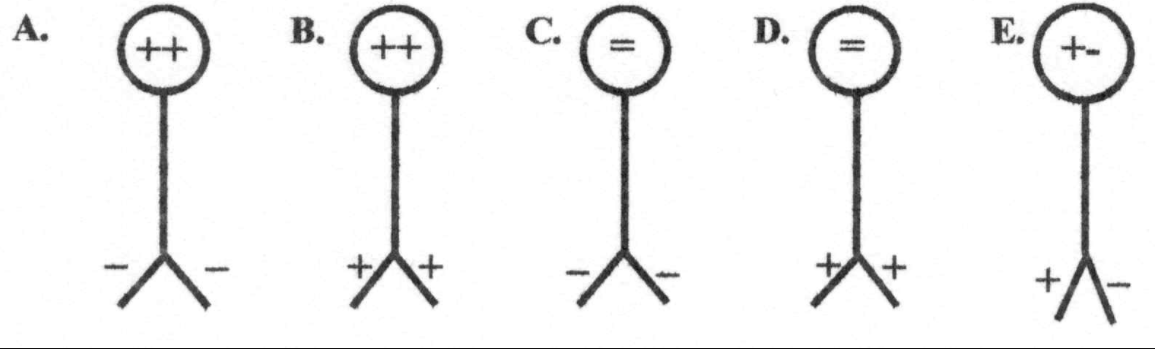
Which of these is the electron?
a)
A
b)
B
c)
C
9.

What types of charges attract?

a)

Positive and Positive

b)

Positive and Neutral

c)

Negative and Neutral

d)

Positive and Negative

10.
Electric charges that are alike _______ each other.
a)
Attract
b)
Repel
11.
If a substance has a higher number of electrons than protons on its surface, what type of charge does it have?
a)
A positive charge.
b)
A negative charge.
c)
A neutral charge
d)
No charge at all
12.
The subatomic particle with a neutral charge is:
a)
protons
b)
electrons
c)
neutrons
d)
cloud
13.
When objects have equal numbers of positive and negative charges, they are
a)
positively charged
b)
negatively charged
c)
electrically neutral
d)
unbalanced
14.
Which type of charges do these balloons have?
a)
like charges
b)
opposite charges
15.
What type of charge do these balloons have?
a)
like charges
b)
opposite charges
16.
If a negatively charged rod touches a conductor, the conductor will be charged by what method? 
a)
Friction
b)
Conduction
c)
Induction
d)
Convection
17.
The process of transferring charge between objects by touching or rubbing
a)
charging by induction
b)
static discharge
c)
charging by contact
d)
proton
18.
An object becomes negatively charged by
a)
losing protons
b)
gaining electrons
c)
losing electrons
d)
gaining protons
19.
An object becomes positively charged by
a)
losing protons
b)
gaining electrons
c)
losing electrons
d)
gaining protons
20.
Charging by friction requires rubbing. Charging by contact requires ...
a)
rubbing
b)
touching
c)
no contact
21.
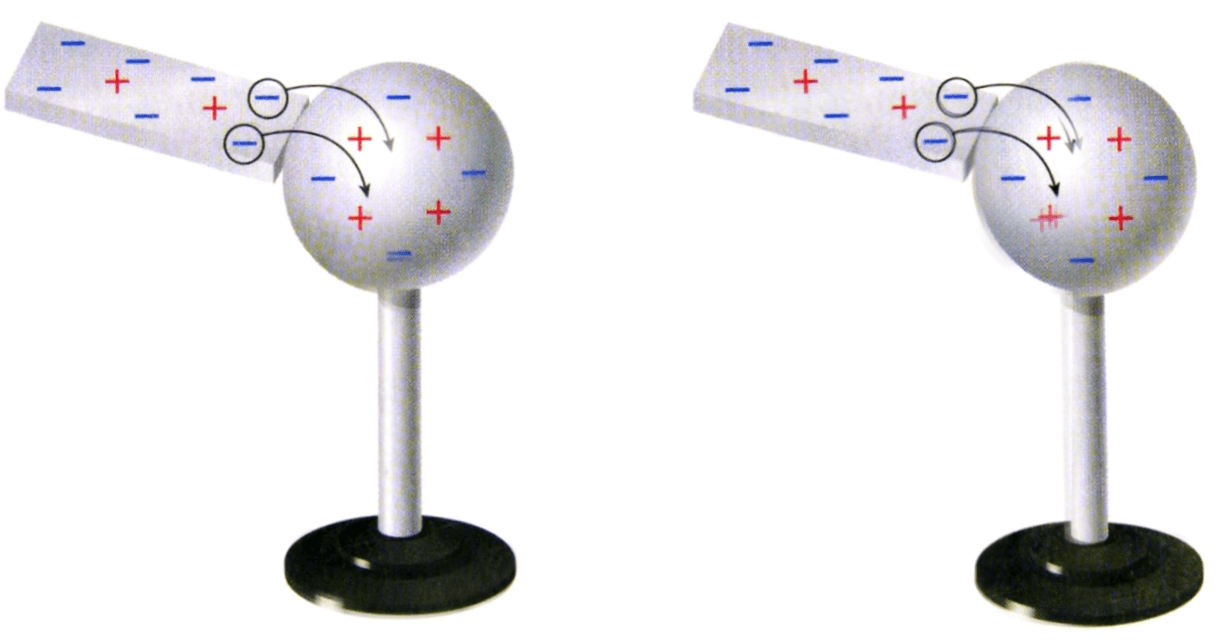
What method of static charging is shown in this picture
a)
Polarization
b)
Friction
c)
Induction
d)
Conduction
22.
If you rub a glass rod with a piece of silk, the rod becomes positively charged. This means that
a)
friction destroyed electrons in the rod.
b)
the silk has become negatively charged.
c)
protons have moved to the rod.
d)
glass attracts more protons.
23.
A negatively charged rod is touched to the top of an electroscope
a)
A
b)
B
c)
C
d)
D
24.
Charging by contact results in both objects having the same charge.
a)
True
b)
False
25.
Charging by Friction results in two objects with the same charge.
a)
True
b)
False
26.
Only the __ move to create unbalanced charges.
a)
Neutrons
b)
Protons
c)
Electrons
d)
Static Electricity
27.
Removing a static charge by providing a path to the ground is called __.
a)
electric transfer
b)
grounding
c)
switching
d)
seperation
28.
___ are good conductors because they have loose electrons.
a)
copper
b)
aluminum 
c)
metals
d)
all of the above
29.
Transferring a charge without touching is ___
a)
conduction
b)
induction
c)
grounding 
d)
Newtons 3rd law
30.
Charge is not permanent in ___
a)
conduction
b)
induction
31.
Rubbing a balloon on hair is an example of static charge build up created by....
a)
conduction
b)
friction
c)
induction
d)
hairduction
32.
A charged balloon is brought near an electroscope but DOES NOT touch the electroscope.  This is an example of charging by
a)
Conduction
b)
Convection
c)
Friction
d)
Induction
33.
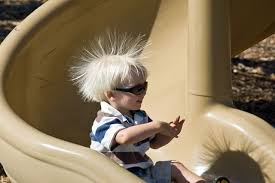
Your arm hair raising as you approach a television is an example of charging by induction
a)
true
b)
false
34.
Your hair sticking up after removing your toque is an example of charging by induction.
a)
True
b)
False
35.
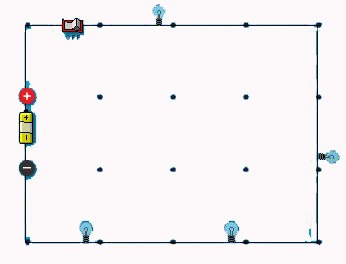
The picture shows an electrical circuit. This circuit is a series circuit because: 
a)
It has 3 light bulbs.
b)
The same current flows through all three light bulbs.
c)
It uses a single battery.
d)
The electrical current is divided between the three light bulbs.
36.
This is the symbol for a _____?
a)
switch
b)
light 
c)
battery
d)
wires
37.
This is the symbol for a _____?
a)
an AC current source
b)
a DC current source
c)
a battery
d)
a single cell
38.
This is the symbol for a _____?
a)
an AC current source
b)
a DC current source
c)
a battery
d)
a single cell
39.
This is the symbol for a _____?
a)
Lamp
b)
Water wheel
c)
Loudspeaker
d)
Motor
40.
a)
Closed push switch
b)
Pressure pad
c)
Weighing scales
d)
Fuse
41.
a)
Motor
b)
Milliammeter
c)
Machine
d)
Microphone
42.
This type of circuit only has one path for current to flow. 
a)
series
b)
parallel
c)
combination
d)
split
43.
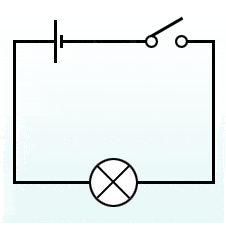
this circuit is .....?
a)
open
b)
parallel
c)
closed
d)
The cutest little circuit evah!
44.
Which best describes a parallel circuit?
a)
Electricity flows along one pathway.
b)
The flow of electricity comes from one source. 
c)
Electricity flows along more than one pathway. 
d)
The flow of electricity comes from more than one source. 
45.
What is one problem with using a series circuit? 
a)
It has a lot of series. 
b)
If one goes down, they all go down! 
c)
It doesn't work properly.
d)
There are no problems. 
46.
What is one benefits of using a parallel circuit?  
a)
It gets confusing.
b)
There are no problems.
c)
If one goes down, it does not affect the others. 
d)
Porque es para llelio. 
47.
In a parallel circuit if one of the light bulbs burns out the rest _________.
a)
stop the flow of electricity
b)
 can still light up
c)
 will go out
d)
of the light bulbs burn out also
48.
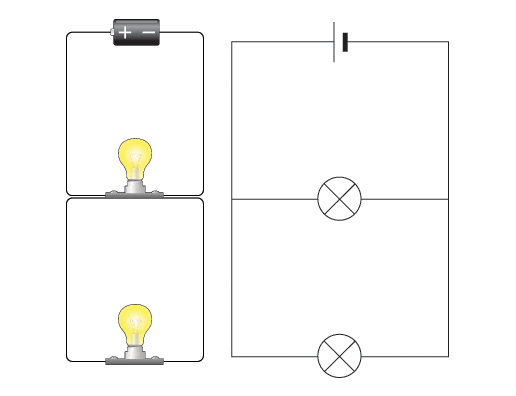
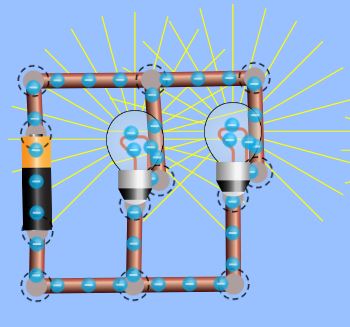
Does this diagram represent a series or parallel circuit?
a)
series circuit
b)
parallel circuit
49.
What kind of circuit is this?
a)
Series
b)
Consecutive
c)
Parallel
d)
Training
50.
Why are metals useful for making electrical wire?
a)
Metals do not bend.
b)
Metals hold much heat.
c)
Metals are insulators.
d)
Metals are conductors.
51.
Which is NOT an insulator.
a)
Wool
b)
Plastic
c)
Copper
d)
Glass
52.
Something electricity can't move through is called a(n) ______.
a)
conductor
b)
wire
c)
shoe
d)
insulator
53.
What is a example of a conductor?
a)
wood 
b)
metal
c)
rubber
d)
rock
54.
What is a example of a insulator?
a)
metal 
b)
rubber
c)
water
55.
Rubber is a insulator.
a)
true
b)
false
56.
You know that the object connected to the wires is a conductor because:
a)
The light bulb is glowing bright.
b)
It's a complete circuit.
c)
It's a closed circuit.
d)
The object is shiny.
57.
Why is electrical wiring usually made from copper?
a)
Because copper is shiny
b)
Because copper conducts electricity
c)
Because copper is not magnetic
58.
Glass
a)
Insulator
b)
Conductor 
59.

Salt Water

a)

Insulator

b)

Conductor

60.
this is the symbol for a _____?
a)
switch
b)
light 
c)
battery
d)
wires
61.
what is this symbol for?
a)
light bulb
b)
cell
c)
battery
d)
resistor
62.
This is the symbol for a ...
a)
Bulb
b)
Battery
c)
Horn
d)
Fuse
63.
This is the symbol for a ...
a)
Wire
b)
Battery
c)
Buzzer
d)
Fuse
64.
This is the circuit symbol for ...
a)
an AC current source
b)
a DC current source
c)
an ammeter
d)
a voltmeter
65.
This is the circuit symbol for ...
a)
an AC current source
b)
a DC current source
c)
an ammeter
d)
a voltmeter
66.
This is the circuit symbol for ...
a)
an AC current source
b)
a DC current source
c)
a battery
d)
a single cell
67.
This is the symbol for 
a)
An Ammeter
b)
A Voltmeter
c)
A Meter
d)
A Motor
68.
This is the symbol for a _____?
a)
Lamp
b)
Water wheel
c)
Loudspeaker
d)
Motor
69.
a)
Closed switch
b)
Push switch
c)
Trap door
d)
AC Power supply
70.

What is the following symbol represent?

a)

Wire

b)

Resistor

c)

Battery

d)

Switch

71.
a)
push switch
b)
diode
c)
circuit breaker
d)
fuse
72.
Pick the correct sentence.
a)
This circuit will work because it is a closed circuit.
b)
Energy will freely flow in this circuit.
c)
This circuit will not work because there is no energy source.
d)
This circuit will not work because there is no switch.
73.
The picture shows an electrical circuit. This circuit is a series circuit because: 
a)
It has 3 light bulbs.
b)
The same current flows through all three light bulbs.
c)
It uses a single battery.
d)
The electrical current is divided between the three light bulbs.
74.
What will happen if one light bulb is removed from this circuit?
a)
The other bulbs will go out.
b)
The other bulbs will stay on
c)
The other bulbs will get dimmer.
d)
The battery will become stronger.
75.
The current has only has one loop to flow through in this circuit. 
a)
Series Circuit 
b)
Parallel Circuit 
76.
Which of the two circuits would have the brightest bulbs? 
a)
A
b)
B
77.
When you remove a bulb from a three bulb circuit, and the other two bulbs go off, then the bulbs must have been connected in __________.
a)
parallel
b)
series
c)
open
d)
closed
78.
Does this statement best describe a parallel or a series circuit.
 
When more light bulbs are added they all remain bright. 
a)
Parallel circuit
b)
Series circuit
79.
Does this diagram represent a series or parallel circuit?
a)
series circuit
b)
parallel circuit
80.
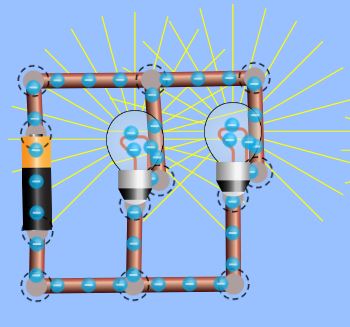
What kind of circuit is this?
a)
Series
b)
Consecutive
c)
Parallel
d)
Training
81.
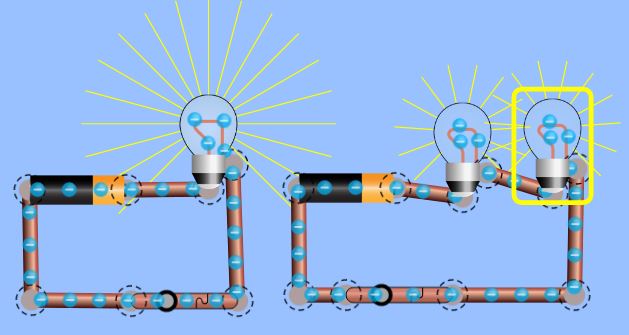
What kind of circuit is this?
a)
series
b)
parallel
82.
a)
Series circuit - Bulbs are lit
b)
Series circuit - Bulbs are off
c)
Parallel circuit - Bulbs are lit
d)
Parallel circuit - Bulbs are off
83.
This circuit does not work because…
a)
the bulbs are not connected properly
b)
the single cell is not powerful enough
c)
there is a break in the circuit
d)
there is a short crcuit
84.
How many different types of circuits are there? 
a)
1
b)
3
c)
2
d)
4
85.
what is this symbol for?
a)
light bulb
b)
switch
c)
battery
d)
resistor
86.
a)
closed series
b)
open series
c)
open parallel
d)
closed parallel
87.
A term used to describe the number of electrons moving past a fixed point in a conductor in one second is called________.
a)
Amperage
b)
Molecule
c)
Current
d)
Ohms
88.
The actual flow of electrons is called _______.
a)
Molecule
b)
Magnetism
c)
Current
d)
Electrica
89.
What is current measured in?
a)
Inches
b)
Amperes
c)
Centimeters
d)
Newtons
90.
Current is...
a)
moving protons
b)
moving electrons
c)
measured in volts
d)
measured in ohms
91.
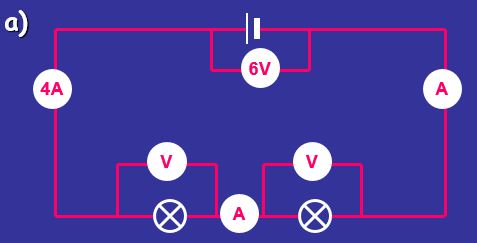
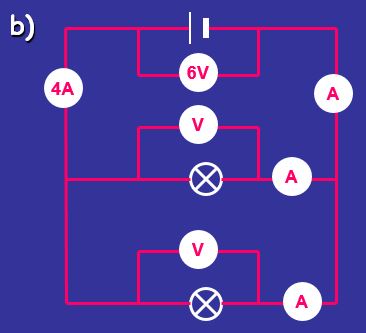
What is the current reading at the two question marks in the diagram?
a)
12 A
b)
8 A
c)
4 A
d)
1 A
92.
Assuming the lamps are identical, what is the current running though each lamp?
a)
3 A
b)
2 A
c)
1 A
d)
0 A
93.
What would the current reading be on the ammeter returning to the cell?
a)
1 A
b)
2 A
c)
3 A
d)
6 A
94.
What would the current be on the second resistor?
a)
9 A
b)
15 A
c)
6 A
d)
1 A
95.
What is the current after the first resistor?
a)
6 A
b)
4 A
c)
2 A
d)
0 A
96.
What is the current on the top branch of the parellel portion of this circuit?
a)
6 A
b)
4 A
c)
2 A
d)
0 A
97.
Voltage is measured in __.
a)
volts.
b)
watts.
c)
coulombs. 
98.
If the voltage across the battery was 10V in this diagram. What would the voltage across each bulb be?
a)
10V
b)
5V
c)
20V
d)
0V
99.
What is the rule for voltage in a parallel circuit?
a)
stays the same
b)
adds up
c)
inverse of the sum of the reciprocals
100.
The difference in electrical potential energy between two places is called
a)
resistance
b)
friction
c)
induction
d)
voltage
101.
Adding more bulbs to a series circuit will make each bulb burn less brightly.
a)
True
b)
False
102.
Adding more bulbs to a parallel circuit will make each bulb burn less brightly.
a)
True
b)
False
103.
The lamps are identical.  What is the voltage across each lamp?
a)
6 V
b)
12V
c)
3 V
d)
2.5 V
104.
If the cell provides 12 volts and there are four identical bulbs, each bulb will use ___ volts.
a)
12
b)
1
c)
4
d)
3
105.
The voltage across each bulb is 9V.  What is the voltage across the cell?
a)
4.5
b)
9
c)
18
d)
27
106.
What is the voltage across the bottom lamp?
a)
3 V
b)
6 V
c)
12 V
d)
18 V
107.
What is the popular name for an electrochemical cell? Choose one answer. 
a)
 A fuel cell.
b)
A catalytic cell. 
c)
A battery.
d)
A galvanometer
108.
A battery is 
a)
Electricity generated from water
b)
Electricity created from wind
c)
one or more cells that supply energy
d)
Can only be used once
109.
A primary cell is 
a)
a rechargeable battery
b)
a non-rechargeable battery
c)
a flow of electricity
d)
device that stops the flow of electricity
110.
A secondary cell is
a)
Electricity that flows
b)
recharegable battery 
c)
non-rechargeable battery
d)
electricity that flows
111.
Fuel cells produce
a)
Fossil Fuels
b)
Hydrogen gas
c)
Electricity
d)
Gasoline
112.
Can people drink the exhaust from a hydrogen fuel cell?
a)
Yes
b)
No
113.
What is the waste (exhaust) from a hydrogen fuel cell?
a)
electricity
b)
water
c)
oxygen
d)
hydrogen
114.
The reactants in a hydrogen fuel cell are _________ and _________.
a)
hydrogen and oxygen
b)
water and electrons
115.
A hydrogen atom has _____ electron(s).
a)
1
b)
2
c)
3
116.
What moves through a conductor in the fuel cell to provide electricity?
a)
neutrons
b)
electrons
117.
In a hydrogen fuel cell, free electrons create electricity.
a)
True
b)
False
118.
In a hydrogen fuel cell, electrons create solar power.
a)
True
b)
False
119.
2 different metals that lose or gain electrons in a battery (zinc and copper
a)
wet cells
b)
dry cells
c)
electrolytes
d)
electrodes
120.
liquid in a battery that allows electrons to move from one metal to the other (fruit juice, vinegar)
a)
Wet Cells
b)
Dry Cells
c)
Electrolyte
d)
Electrodes
121.
a type of cell that contains solid or pastelike electrolytes
a)
Wet Cells
b)
Dry Cells
c)
Electrolytes
d)
Electrodes
122.
a cell that has a liquid electrolyte
a)
wet cells
b)
dry cells
c)
electrolytes
d)
electrodes
123.

The electricity generated from the power plant is

a)

Alternating Current

b)

Direct Current

c)

Delayed Current

d)

Alternating Voltage

124.

Super heated steam is used to turn a ______________?

a)

Transformer

b)

Battery

c)

Turbine

d)

Toothed Gear

125.
What is meant by fossil fuels?
a)
Fuels that are derived from fossils
b)
Fuels that are derived from old people
c)
Fuels that are derived from using plant material
d)
Fuels that are derived from the decomposition of faeces
126.
Most forms of electrical generation rely on a turbine. Which form doesn't?
a)
Tidal
b)
Hydro
c)
Solar
d)
Wind
127.
Biodiesel can be considered ...
a)
Finite
b)
Infinite
c)
Renewable
d)
Recycled
128.

How is electricity measured and billed by the power company?

a)

watts

b)

kilowatts

c)

watt hours

d)

kilowatt hours

129.

which type of renewable energy is currently creating the most electricity generation?

a)

geothermal

b)

hydroelectric

c)

solar

d)

wind

130.

What is given off as waste in a hydrogen fueled car?

a)

H2

b)

O2

c)

H2O2

d)

H2O

131.

which of the following is not a biofuel or a biomass?

a)

wood

b)

ethanol from corn

c)

dung

d)

methane

132.

fuel cells that use a chemical reaction to generate electricity are using

a)

hydrogen gas

b)

methane gas

c)

water

d)

oil

133.

Which of the following are the most energy efficient light bulbs?

a)

incandescent

b)

compact florescent

c)

LED

d)

halogen

134.

which of the following is the least energy efficient light bulbs?

a)

incandescent

b)

compact fluorescent

c)

LED

d)

halogen

135.

if a tractor trailer truck is 20% efficient, what happened to the other 80%

a)

energy is destroyed

b)

energy is lost as heat

c)

the 80% is still in the gas tank

d)

energy is converted into matter

136.

You use an LED light bulb that consumes 7 watts that you use for 8 hours in a day. How much would it cost you to run for a month (30 days) if the energy company charges $.15 per KwHr?

a)

$.056

b)

$.0084

c)

$.25

d)

$8.4

137.
All could be used for biofuels except
a)
compost waste
b)
uranium waste
c)
animal waste
d)
human waste
138.
Where does geothermal energy come from?
a)
The Earth's atmosphere
b)
The Earth's asthenosphere
c)
The Earth's crust
d)
The Earth's troposphere
139.
What is a liquid fuel created from biomass?
a)
methane
b)
ethanol
c)
gasohol
d)
electrons
140.
How is energy transported in a circuit with a solar panel and an electronic device?
a)
neutrons
b)
electrons
c)
protons
d)
nucleus
141.
What does bio mean
a)
life
b)
living
c)
animals
d)
plants
142.
What does geo mean
a)
minerals
b)
rock
c)
earth
d)
crust
143.
Which is the BEST definition for hydroelectricity
a)
energy from water
b)
electricity from  water
c)
electricity generated from moving water
d)
moving water that creates energy
144.
Which of the following is an advantage of nuclear energy?
a)
does not produce solid waste
b)
does not produce air pollution
c)
it is cost effective
d)
can convert uranium into natural gas
145.
Petroleum and natural gas form from...
a)
strong winds
b)
cooled magma
c)
radioactive materials
d)
remains of plants and animals