
 Worksheets
Unit 4 Test Bank
Total questions: 137
Worksheet time: 6hrs 0mins
According to Newton's first law of motion, an object at rest will remain at rest and an object in motion will continue in motion with constant velocity, unless acted upon by a ________.
force
acceleration
friction
gravity
What is the other name for Newton's first law of motion?
law of motion
law of inertia
law of gravity
law of acceleration
According to Newton's second law of motion, the acceleration of an object is directly proportional to the ________ applied to it and inversely proportional to its ________.
force, mass
speed, acceleration
velocity, time
distance, time
What is the formula for Newton's second law of motion?
F = mv
F = ma
F = ma^2
F = m/a
According to Newton's third law of motion, for every action, there is an equal and opposite ________.
energy
motion
force
reaction
What is the other name for Newton's third law of motion?
law of inertia
law of action and reaction
law of conservation of momentum
law of motion
What is a free body diagram?
A free body diagram is a visual representation of the forces acting on an object.
A free body diagram is a tool used to measure the weight of an object.
A free body diagram is a mathematical equation that describes the forces on an object.
A free body diagram is a graph showing the motion of an object.
In a free body diagram, what do arrows represent?
Mass
Velocity
Energy
Forces
What is the net force acting on an object in equilibrium?
zero
positive
negative
unknown
What is the net force acting on an object in motion?
The net force is the difference between the largest and smallest forces.
The net force is the average of all the individual forces.
The net force is the vector sum of all the individual forces.
The net force is the result of adding all the forces together.
What is the net force acting on an object at rest?
zero
negative
positive
undefined
What is the unit of force?
Newton
Second
Meter
Kilogram
What is the symbol for force?
T
S
A
F
What is the SI unit of mass?
pound
liter
gram
kilogram
What is the symbol for mass?
m
l
g
kg

What is inertia?
the force that opposes motion
the force of attraction between 2 objects
an object's tendency to stay in its state of motion
a change in an object's speed and/or direction
Which of the objects listed below have the greatest inertia?
A 500 kg object that is not moving.
A 300 kg object that is not moving on the Moon.
A 250 kg object moving at 25 m/s.
A 700 kg object moving at 3 m/s.
Which of the following forces acts against the motion of an object? (NOTE: there are two correct answers to this question.)
Air resistance (Drag)
Normal force
Imaginary Force
Friction force
Magnitude


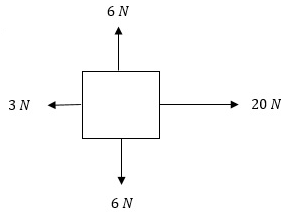
What is the NET FORCE of this diagram?
17 N, right
17 N, left
23 N, right
12 N, up
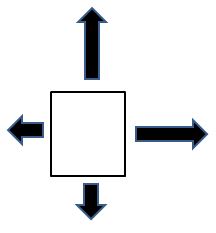
The net forces on this object are pushing or pulling in these directions: (pick all that are correct)
up
down
left
right

Determine the force at G:
30 N
20 N
50 N
0 N

What is the NET FORCE of this diagram?
17 N, right
17 N, left
23 N, right
12 N, up
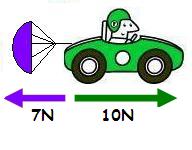

What is Newton's First Law?
The restoring force of a spring is proportional to the displacement of the spring
An object in motion will stay in motion unless acted on by an external force
F = ma
For every force, there's a force equal in magnitude but opposite in direction.
What is Newton's Second Law
F = -kx
F = ma
F = mg
F = mad
What is Newton's Third Law?
The restoring force of a spring is proportional to the displacement of the spring
An object in motion will stay in motion unless acted on by an external force
Object's have a tendency to resist changes in their motion
For every force, there's a force equal in magnitude but opposite in direction.
What is the weight of a person whose mass is 75 kg?
736 N
84.8 N
750 N
368 N

Based on the free-body diagram, which statement is true?
The object is moving to the left
The object is accelerating to the right
The object is accelerating to the left
The object is moving to the right

Block of cheese, B, has a mass of 0.5 kg and the wheel of cheese, W, has a mass of 0.4 kg. What is the tension in rope 1? Assume the acceleration is 0 m/s2
4.91 N
8.83 N
3.92 N
0.981 N

Based on this free-body diagram, which statement can you be sure is true?
This object is not moving
This object is moving to the right
This object is accelerating to the left
This object is accelerating to the right
Which equation is Hooke's Law?
F = ma
F = -kx
F = mg
F = -k / x

You place 16 N worth of bananas on the scale at the store. The scale drops 4 cm once it stops moving. What is the spring constant of this scale?
100 N/cm
300 N/m
400 N/m
400 N/cm
Hooke's Law states that the restoring force is (a) to the displacement of the spring.


When determining the NET force on an object you should (TWO correct answers)
subtract forces in opposite directions
add forces in the same direction
divide by velocity
multiply by acceleration
While you are driving, a kid runs into the street. If your car has a mass of 900 kg and there's a net braking force of 2700 N, what is the acceleration?
3 m/s2
1800 m/s2
12 m/s2
900 m/s2
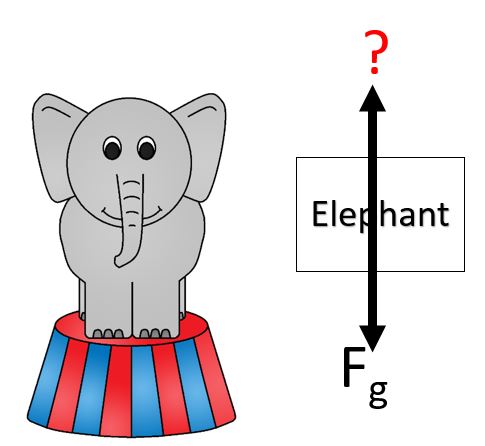
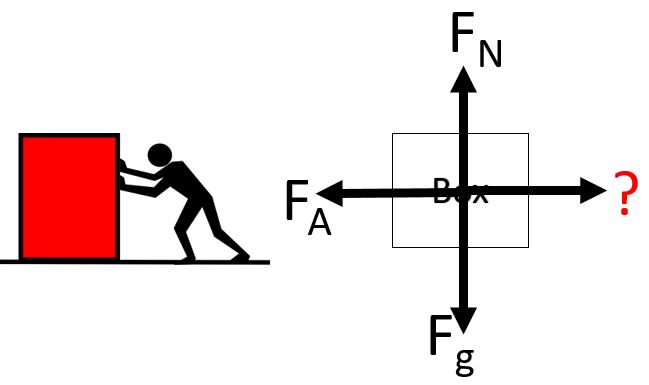

A leftward force is applied to a crate to push it across the floor at a constant speed. Which is the correct force diagram?


A rightward force is applied to a dresser to accelerate it to the right across the bedroom floor.


A downward-moving skydiver who has just opened the parachute is slowing down.


What is the Net Force and the direction of the object's movement as a result of the net force?
5N, Right
5N, Left
9N, Right
9N, Left

What is the Net Force and the direction of the object's movement as a result of the net force?
9N, Right
9N, Left
3N, Right
3N, Left

What is the Net Force and the direction of the object's movement as a result of the net force?
11N, Right
11N, Left
1N, Left
1N, Right
If the net force (Fnet) is 0, _____
the forces are balanced.
All of these are correct!
the object maintains its same speed and direction.
the object maintains its velocity.
the object does not speed up, slow down, or turn.

What is the NET FORCE of this diagram?
17 N, right
17 N, left
23 N, right
12 N, up
An object resting on a surface experiences +980 N of Normal force. What is the mass of the object?
W=mg
-98 kg
9.8 kg
100 kg
-100 kg
Determine the force at G:
30 N
20 N
50 N
0 N

What can you tell about the forces on F and H?
They must be unbalanced.
They are negative.
They must be the same.
They are equal to the net force.

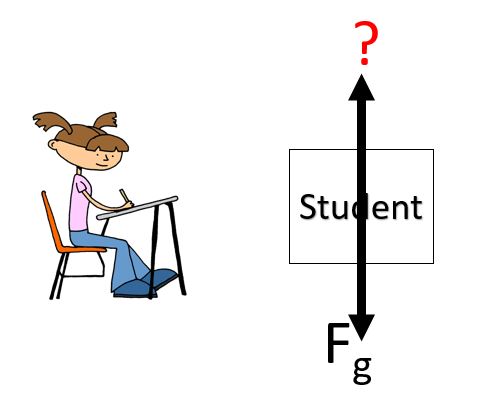
The Coffee cup in the picture is resting on a table. What force(s) are missing from the free body diagram?
No forces are missing
The normal force from the table pushing the cup up.
The normal force form the table pushing the cup down.
The friction force from the table pushing the cup left and right.

The coffee cup in the picture is at rest on the table. What is true about the Normal force?
The normal force is exactly 15
The normal force is less than 15
The normal force is more than 15
The normal force is -10

The hockey puck is moving at a constant velocity across the ice. What forces does the puck experience at this moment?
None
Gravity
Gravity and Normal
Gravity, Normal, and Friction
Gravity, Normal, Friction, and Applied
The hockey puck is moving at a velocity of 20 m/s. If the forces on the puck are in equilibrium, what will the puck's velocity be 2 seconds later?
0 m/s
1 m/s
2 m/s
10 m/s
20 m/s

Which equation would accurately describe the forces on this cup of coffee?
Fn − Fg = 0
Fn×Fg = 0
Fn−10Fg
Fn−Fg = −10

The forces on this chandelier are...
Gravity
Gravity and Normal
Gravity and Tension
Gravity, Tension, Friction, and Applied

A chandelier is hanging from the ceiling. If the force of gravity on the chandelier is 120 N, the force of tension must be ...
0 N
12 N
60 N
120 N

A squirrel sits on the ground and eats a donut. We know the forces on him must be balanced because...
Forces are always balanced
the squirrel is not accelerating
squirrels are projectiles
he's eating a donut

A squirrel sits on the ground and eats a donut. If the ground pushes up on the squirrel with a force of 11 N, The squirrel and donut together weigh ...
less than 11 N
Exactly 11 N
More than 11 N

The car in the picture is moving at a constant velocity. What forces does the car experience?
Gravity
Gravity and Normal
Gravity, Normal, and Friction
Gravity, Normal, Friction, and Applied

The Car in the picture is moving to the right at a constant velocity. Any friction present would be pushing the car to the ...
Up
Right
Down
Left
Two books rest on the same table. Book A weighs 20 N. Book B has a mass of 3 kg. Which one has a greater force of gravity on it?
The same
Book A
Book B

A man pushes a box across the floor at a constant velocity. There is a force on the box pulling it toward the center of the earth. This is called the
force of gravity
normal force
friction force
applied force
A man pushes a box across the floor at a constant velocity. There is a force on the box from the floor pushing the box up. This is the ...
force of gravity
normal force
force of friction
applied force
A man pushes a box across the floor at a constant velocity. There is a force on the box resisting its motion. This is the ...
force of gravity
normal force
force of friction
applied force
A man pushes a box across the floor at a constant velocity. There is a force from the man pushing on the box. This is the ...
force of gravity
normal force
force of friction
applied force
A man pushes a box across the floor at a constant velocity. There is a force on the box pulling it toward the center of the earth. This is called the
force of gravity
normal force
force of friction
applied force
A man pushes a box across the floor at a constant velocity. Which formula describes the horizontal forces on the box?
FP − Ff = 0
Fp+Fg − Ff = 0
FP −10Fg = 0
Fp ×Ff=0
A man pushes a box across the floor at a constant velocity. Which formula describes the vertical forces on the box?
FP − Fg = 0
Fp+Fg − Ff = 0
Fn −10Fg = 0
Fn−mg = 0
A man pushes a box across the floor at a constant velocity. If another box were put on top of this box, what would happen to the force of friction?
It would increase
It would decrease
It would remain unchanged
The force that opposes motion because of resistance between bodies in contact
Tension
Applied
Friction
Spring
The force you get when a material like a rope or string is being
stretched
Friction
Gravity
Tension
Normal
The force that enables compasses to work
Friction
Compression
Tension
Magnetism
The force you get when an object moves
through air
Gravity
Nuclear
Air resistance
Electrostatic
The force that exists between all objects
with mass
Gravity
Nuclear
Air resstance
Electrostatics
The sum of all forces acting on an object and direction is called the
Balanced Force
Net Force
Unbalanced Force
Contact Force

Are the forces balanced or unbalanced?
Balanced
Unbalanced
Forces have both ________ and direction.
Magnitude
Velocity
Gravity
Acceleration

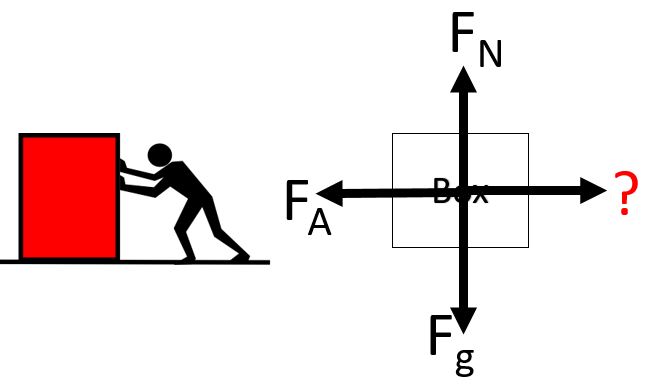
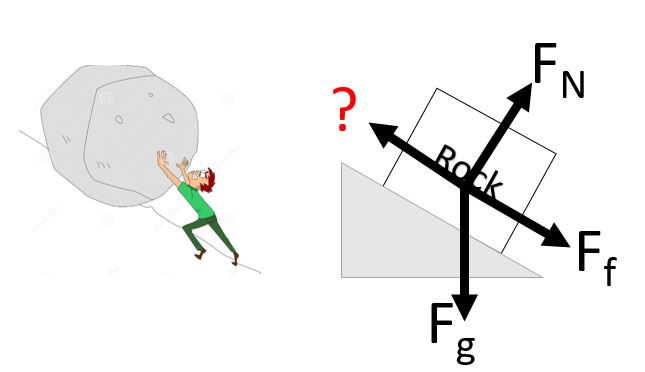
Name the missing force.
Gravitational Force
Normal Force
Friction Force
Applied Force

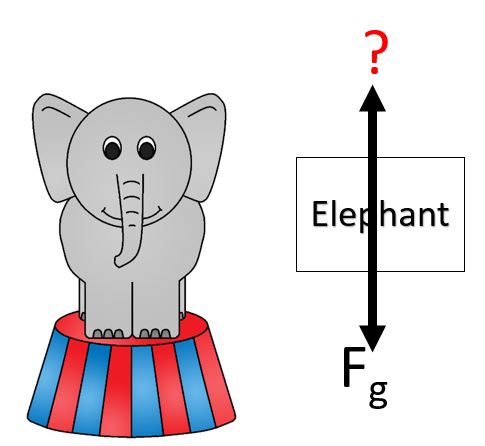
Name the missing force.
Normal Force
Push/Pull Force
Friction Force
Tension Force

Name the missing force.
Gravitational Force
Normal Force
Tension Force
Friction Force

This diagram can be used to indicate which of the following? Select ALL that apply.
An object at rest
An object speeding up
An object slowing down
An object moving at a constant velocity (speed)
An object with constant acceleration
A leftward force is applied to a crate to push it across the floor at a constant speed. Which is the correct force diagram?


A rightward force is applied to a dresser to accelerate it to the right across the bedroom floor.


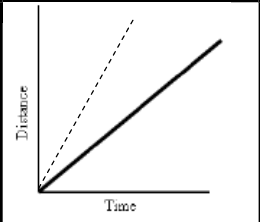
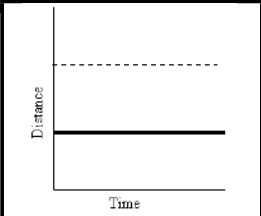

Which graph BEST represents the motion of an object that was initially at rest and is accelerating uniformly?


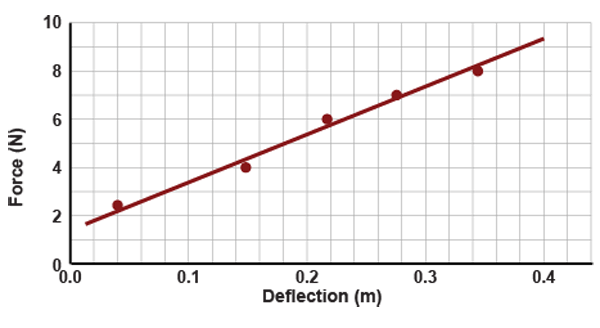
What is the extension of the spring?
4 cm
7 cm
3 cm
11 cm

The spring constant of an object tells you?
What type of spring you are dealing with
How long the spring will stretch or compress
It gives you a value on how easy or hard it is to change the objects length.
A spring constant gives you a number which tells you what material the spring is made of.
For two or more springs with spring laid in SERIES, the resulting spring constant k is given as:
k1=k11+k21+...
k=k1+k2+...
k=k11+k21+...
k1=k1+k2+...
For two or more springs in PARALLEL, the resulting spring constant is given as:
k1=k11+k21+...
k=k1+k2+...
k=k11+k21+...
k1=k1+k2+...

Which collection of springs has the largest spring constant?
A
B
C
D
E

A single spring is stretched by x when a mass m is attached. An identical spring is joined in parallel to the first spring. How much will the two springs stretch when a mass m is attached to both springs simultaneously? (Assume the springs have negligible mass)
The spring will stretch by 2x since each spring stretches by x
The spring will stretch by x since the spring constant remains the same
The spring will stretch by 0.5x since there are 2 springs holding the mass m

