
 Worksheets
Motion at Constant Velocity
Total questions: 134
Worksheet time: 3hrs 50mins
Name
Class
Date
1.

What is happening at A?
a)
At rest, not moving
b)
Accelerating
c)
Slower steady speed; moving away from the starting position
d)
Steady speed; returning to start position
2.

What is happening at B?
a)
Stationary
b)
Accelerating
c)
Slower steady speed; moving away from the starting position
d)
Steady speed; returning to start position
3.

Which runner had a head start?
a)
A
b)
B
c)
C
4.

At what time did runner A pass runner B?
a)
0 seconds
b)
1 second
c)
2 seconds
d)
3 seconds
5.

Every morning, Tom walks along a straight road from his home to school. Below, is a graph representing Tom’s trip showing that he starts at home which is at 0 meters. His school is 100 meters away.
When does Tom reach school?
When does Tom reach school?
a)
50 seconds
b)
1 minute
c)
100 seconds
d)
120 seconds
6.

Every morning, Tom walks along a straight road from his home to school.. Below, is a graph representing Tom’s trip to school.
- What is the distance covered through the second segment, which is between 50 seconds, and 70 seconds?
- What is the distance covered through the second segment, which is between 50 seconds, and 70 seconds?
a)
40 meters
b)
60 meters
c)
80 meters
d)
20 meters
7.

During the second segment, which is between 50 seconds and 70 seconds, which direction as Tom moving?
a)
Tom was moving back towards his house
b)
Tom was moving down a hill
c)
Tom was moving towards school.
d)
Tom was not moving
8.

This is a Velocity vs. Time Graph.
During which interval is the object traveling at a constant velocity?
During which interval is the object traveling at a constant velocity?
a)
B to C
b)
D to E
c)
F to G
d)
it traveling at a constant velocity during all of the intervals shown.
9.

During which interval is the object speeding up?
a)
A to B
b)
B to C
c)
D to E
d)
E to F
10.

Which runner stopped for a rest?
a)
Albert
b)
Bob
c)
Charlie
11.

Which runner won the race?
a)
Albert
b)
Bob
c)
Charlie
12.

How long did one of the runner's rest?
a)
8 seconds
b)
13 seconds
c)
5 seconds
d)
50 seconds
13.

This is a velocity-time graph. What is the object doing in segment B?
a)
Positive acceleration
b)
Negative acceleration
c)
Constant Velocity
d)
Not moving
14.
A car driving at 50 miles per hour drives for 2 hours. What distance did it cover?
a)
50 miles
b)
25 miles
c)
100 miles
d)
75 miles
15.
A truck driving at 60 miles per hour travels 150 miles. How long is it driving for?
a)
9000 hours
b)
0.4 hours
c)
210 hours
d)
2.5 hours
16.
Velocity is
a)
speed and acceleration
b)
constant speed
c)
a frame of reference
d)
speed in a given direction
17.
What is velocity?
a)
the quickness of an object
b)
the location of an object
c)
the acceleration of an object
d)
the speed in a specific direction
18.
Suppose you take a trip that covers 180 km in 3 hours. Your average speed is...
a)
30km/hr
b)
360km/hr
c)
180 km/hr
d)
60km/hr
19.
Which of the following is related to motion?
a)
speed
b)
density
c)
volume
d)
electricity
20.
Find the speed of a person who covers 20 km in 5 hours.
a)
4 km/hr
b)
100 km/hr
c)
0.25 km/hr
d)
5 km/hr
21.
Velocity is:
a)
speed and a specific direction
b)
the same as speed
c)
just a direction
d)
acceleration and a specific direction
22.
meters per second (m/s) is a unit of:
a)
speed
b)
distance
c)
acceleration
d)
gravity
23.

What is the speed of an object that travels 60 meters in 4 seconds?
a)
240 m/s
b)
15 m/s
c)
0.067 m/s
d)
15 mph
24.

What two measurements are necessary for calculating speed?
a)
Mass and time
b)
Temperature and mass
c)
Mass and distance
d)
Distance and time
25.

What is the formula to calculate speed?
a)
S = t/d
b)
S = d/t
c)
S = d x t
d)
S = t x d
26.
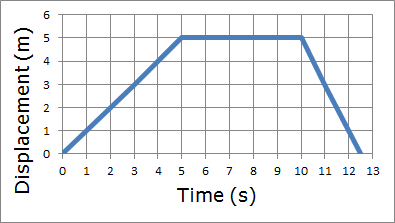
According to the graph how far does the person travel in the first 5 seconds?
a)
2 m
b)
10 m
c)
0 m
d)
5 m
27.

What is the person doing from 5 seconds to 10 seconds?
a)
Walking
b)
Running
c)
Standing Still
d)
Walking Fast
28.

How far is the person from the starting point after 3 seconds?
a)
0 m
b)
2 m
c)
3 m
d)
6 m
29.
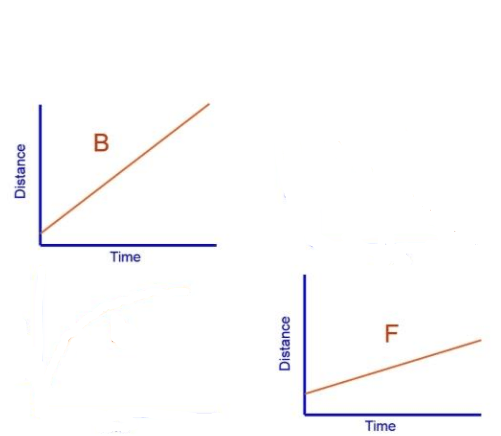
Which graph is showing a faster constant speed?
a)
B
b)
F
c)
They show the same speed
30.
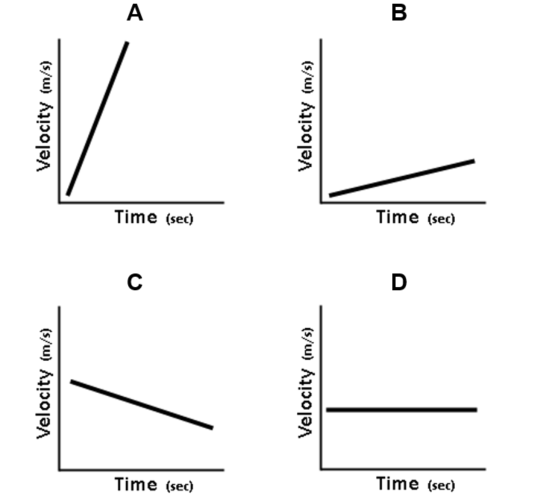
These are Velocity Time graphs.
Which graph represents zero acceleration (constant velocity)?
Which graph represents zero acceleration (constant velocity)?
a)
A
b)
B
c)
C
d)
D
31.

Which graph shows the object standing still?
a)
A
b)
B
c)
C
d)
D
32.

How many times does this object STOP moving?
a)
None
b)
Once
c)
Twice
d)
Three times
33.
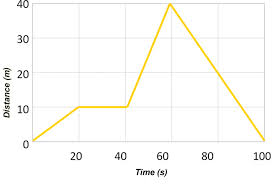
How long did it take this object to travel back to its reference/starting point?
a)
20 s
b)
30 s
c)
60 s
d)
100 s
34.

Motion sensors recorded the following data about a runner during a cross-country race. What is the velocity between 2.5 and 3.5 seconds?
a)
v = (7m-4m) / (3.5s-2.5s) = 3 m/s
b)
v = (4m-7m) / (3.5s-2.5s) = -3 m/s
c)
v = (3.5s-2.5s)/ (7m-4m) = 0.333 m/s
d)
v = (7m-3.5m) / (4s-2.0s) = 2 m/s
35.

During what interval is the car's velocity negative?
a)
A
b)
B
c)
C
d)
D
36.

During what interval is the car's velocity the greatest?
a)
A
b)
B
c)
D
d)
D
37.

During what interval is the car's velocity zero?
a)
A
b)
B
c)
C
d)
D
38.

Using the graph, what is the man's displacement?
a)
7 meters, backwards
b)
7 meters, forward
c)
15 meters, backwards
d)
15 meters, forward
39.
Which of the following is a vector?
a)
Distance
b)
Speed
c)
Time
d)
Velocity
40.
The SI unit for length or distance is
a)
foot (ft)
b)
inch (in)
c)
mile (mi)
d)
meter (m)
41.
A horizontal (flat) line on a distance vs. time graph means the object's speed is
a)
increasing
b)
decreasing
c)
zero
42.
On a distance-versus-time graph, a straight line ALWAYS indicates that an object’s speed is _____.
a)
constant
b)
zero
c)
increasing
d)
decreasing
43.
On a distance vs. time graph, the steeper the slope _____
a)
the slower the speed
b)
the faster the speed
c)
less acceleration
d)
greater acceleration
44.
A value with magnitude and direction
a)
Scalar
b)
Speed
c)
Velocity
d)
Vector
45.

This is a Velocity Time Graph.
Which lines show a constant velocity?
Which lines show a constant velocity?
a)
pink
b)
green
c)
blue
d)
red
46.
Bill runs 400 meters to Andy's house, turns around, and runs 400 meters back home. What is Bill's distance?
a)
0 meters
b)
400 meters
c)
800 meters
d)
1600 meters
47.
Bill runs 400 meters to Andy's house, turns around, and runs 400 meters back home. What is Bill's displacement?
a)
0 meters
b)
400 meters
c)
800 meters
d)
1600 meters
48.
Jermaine runs exactly 2 laps around a 400 meter track. What is the displacement?
a)
800
b)
400
c)
0
d)
200
49.
David walks 3 km north, and then turns east and walks 4 km. What is the distance?
a)
7 km
b)
3 km
c)
4 km
d)
1 km
50.
Vector quantities need both a magnitude and a _____.
a)
distance
b)
displacement
c)
direction
d)
velocity
51.
Total distance divided by total time is
a)
average speed
b)
constant speed
c)
instantaneous speed
d)
acceleration
52.
Shona cycles at an average speed of 8km/h. How far has she travelled if she cycles for 4 hours?
a)
55km
b)
32km
c)
43km
d)
32miles
53.
How far will a person go if they jog for 2 hours at a speed of 12 km/hr?
a)
6 km
b)
0.5 km
c)
10 km
d)
24 km
54.

Calculate the average speed (in meter/sec) if a cheetah runs 180 meters in 10 seconds.
a)
198 m/sec
b)
170 m/sec
c)
12 m/sec
d)
18 m/sec
55.

According to the graph how far does the person travel in the first 5 seconds?
a)
2 m
b)
10 m
c)
0 m
d)
5 m
56.
Speed is always positive.
a)
True
b)
False
57.
"Displacement" is
a)
distance and direction
b)
distance only
c)
direction only
d)
speed
58.
Which of the following could never be negative?
a)
a distance
b)
a velocity
c)
a displacement
d)
a vector
59.
What would your DISTANCE traveled be if you walked 30 meters north then 30 meters south?
a)
60 meters
b)
30 meters
c)
15 meters
d)
0 meters
60.
"5 meters south" is an example of displacement
a)
True
b)
False
61.
Which units are most appropriate to measure displacement?
a)
kilograms
b)
seconds
c)
meters
d)
meters/second
62.
A car drives 84 meters forward. It's displacement and distance would be the same.
a)
True
b)
False
63.
A car travels 90 meters due north in 15 seconds. Then the car turns around and travels 40 meters due south. What is the magnitude and direction of the car's resultant displacement?
a)
40 metres, South
b)
50 metres, South
c)
50 metres, North
d)
40 metres, North
64.
Which statement describes a vector?
a)
It has magnitude but no direction
b)
It has direction but no magnitude
c)
It has both direction and magnitude
d)
It has constant magnitude but no
direction
direction
65.
What is speed?
a)
how far you go
b)
distance travel over a certain time
c)
how fast you accelerate
d)
the change in the location of a object
66.

At 60 seconds, how far had this object traveled?
a)
0 m
b)
10 m
c)
20 m
d)
40 m
67.

How long did it take this object to travel 10 m?
a)
0 s
b)
10 s
c)
15 s
d)
20 s
68.
Which one of these is a measurement of speed?
a)
5 seconds
b)
5 meters
c)
5 meters/second
69.
Which one is a measurement of velocity?
a)
5 m/s south
b)
5 m/s
70.
Calculate the speed of a caterpillar that moves 10cm in 5 seconds.
a)
0.5 cm/s
b)
50 cm/s
c)
2 cm/s
71.

Which quantity is a vector?
a)
Displacement
b)
Distance
72.

A proper quantity showing velocity would be
a)
25 m/s.
b)
30 m south.
c)
15 m/s north.
d)
10 m.
73.
Speed is different from velocity because
a)
Velocity has a direction
b)
Speed uses Distance /Time
c)
Velocity doesn't include time
d)
Velocity doesn't include distance
74.

Which graph demonstrates the greatest positive speed?
a)
A
b)
B
c)
C
d)
D
75.
Distance (d) is always _____________ Displacement (Δx).
a)
equal to
b)
greater than or equal to
c)
less than or equal to
d)
different than
76.

What is variable for the initial position?
a)
A
b)
B
c)
C
d)
D
77.
What is variable for the final position?
a)
A
b)
B
c)
C
d)
D
78.
What is variable for the change in position?
a)
A
b)
B
c)
C
d)
D
79.

Find the Velocity between 1.0 and 3.0 seconds.
a)
+ 0.4 m/s
b)
+ 4.0 m/s
c)
+ 2.0 m/s
d)
0 m/s
80.
Find the Velocity between 3.0 and 5.0 seconds.
a)
+ 4 m/s
b)
+ 8 m/s
c)
+ 2 m/s
d)
0 m/s
81.
Find the Velocity between 5.0 and 7.0 seconds.
a)
- 0.25 m/s
b)
- 0.5 m/s
c)
- 2.5 m/s
d)
0 m/s
82.
Find the displacement between 5.0 and 7.0 seconds.
a)
- 0.25 m
b)
- 0.5 m
c)
- 1 m
d)
0 m
83.

What is happening in the first 2 seconds?
a)
The object is at rest.
b)
The object moves backward.
c)
The object moves forward.
d)
The object goes downhill.
84.
What is happening from 2 to 5 seconds?
a)
The object is at rest.
b)
The object moves backward.
c)
The object moves forward.
d)
The object goes downhill.
85.
What is happening from 5 to 7 seconds?
a)
The object is at rest.
b)
The object moves backward.
c)
The object moves forward.
d)
The object goes downhill.
86.
What is the velocity from 5 to 7 seconds?
a)
- 3 m/s
b)
+ 2.5 m/s
c)
+ 2 m/s
d)
+ 5 m/s
87.
What is the displacement from 5 to 7 seconds?
a)
- 3 m
b)
+ 5 m
c)
+ 2 m
88.
What is happening from 7 to 12 seconds?
a)
The object is at rest.
b)
The object moves backward.
c)
The object moves forward.
d)
The object goes downhill.
89.
What is the velocity from 7 to 12 seconds?
a)
0 m/s
b)
+ 5 m/s
c)
+ 7 m/s
d)
+ 12 m/s
90.
What is happening from 12 to 14 seconds?
a)
The object is at rest.
b)
The object moves backward.
c)
The object moves forward.
d)
The object goes downhill.
91.
What is the velocity from 12 to 14 seconds?
a)
- 4 m/s
b)
- 2 m/s
c)
- 8 m/s
d)
- 6 m/s
92.
What is the displacement from 12 to 14 seconds?
a)
- 4 m
b)
- 2 m
c)
- 8 m
d)
- 6 m
93.
What is happening from 14 to 16 seconds?
a)
The object is at rest.
b)
The object moves backward.
c)
The object moves forward.
d)
The object goes downhill.
94.
What is the velocity from 14 to 16 seconds?
a)
- 4 m/s
b)
- 8 m/s
c)
+ 4 m/s
d)
+ 8 m/s
95.
What is the displacement from 14 to 16 seconds?
a)
- 2 m
b)
- 8 m
c)
+ 4 m
d)
+ 8 m
96.
What is happening from 16 to 18 seconds?
a)
The object is at rest.
b)
The object moves backward.
c)
The object moves forward.
d)
The object goes downhill.
97.
What is the velocity from 16 to 18 seconds?
a)
0 m/s
b)
- 2 m/s
c)
+ 2 m/s
d)
+1 m/s
98.
What is the distance covered over 20 seconds?
a)
+ 18 m
b)
0 m
c)
+ 10 m
d)
+ 2 m
99.
What is the displacement covered over 20 seconds?
a)
+ 18 m
b)
0 m
c)
+ 10 m
d)
+ 2 m
100.
What is the distance covered over 20 seconds?
a)
+ 18 m
b)
0 m
c)
+ 10 m
d)
+ 2 m
101.
What is the displacement from 18 to 19 seconds?
a)
0 m
b)
- 2 m
c)
+ 2 m
d)
+1 m
102.
What is happening from 18 to 19 seconds?
a)
The object is at rest.
b)
The object moves backward.
c)
The object moves forward.
d)
The object goes downhill.
103.
What is the velocity from 18 to 19 seconds?
a)
+ 1 m/s
b)
- 1 m/s
c)
+ 2 m/s
d)
- 2 m/s
104.

What is happening in section A?
a)
positive constant velocity
b)
negative constant velocity
c)
Velocity is zero
105.
What is happening in section B?
a)
positive constant velocity
b)
negative constant velocity
c)
Velocity is zero
106.
What is happening in section C?
a)
positive constant velocity
b)
negative constant velocity
c)
Velocity is zero
107.
What is happening in section D?
a)
positive constant velocity
b)
negative constant velocity
c)
Velocity is zero
108.
When does the object turn around?
a)
10 seconds
b)
30 seconds
c)
60 seconds
109.
What is the velocity in section A?
a)
+ 6 m/s
b)
+ 60 m/s
c)
+ 10 m/s
d)
0 m/s
110.
What is the displacement in section A?
a)
+ 60 m
b)
+ 10 m/s
c)
+ 10 m/s
d)
0 m
111.
What is the velocity in section B?
a)
+ 6 m/s
b)
+ 60 m/s
c)
+ 10 m/s
d)
0 m/s
112.
What is the displacement in section B?
a)
+ 10 m
b)
+ 60 m
c)
0 m
d)
0 m/s
113.
What is the velocity in section C?
a)
- 1.3 m/s
b)
- 1.5 m/s
c)
- 2.0 m/s
d)
0 m/s
114.
What is the displacement in section C?
a)
- 20 m
b)
- 40 m
c)
- 20 m/s
d)
0 m/s
115.
What is the velocity in section D?
a)
+ 4 m/s
b)
+ 3 m/s
c)
+ 40 m/s
d)
+ 6 m/s
116.
What is the displacement in section D?
a)
+ 60 m
b)
+ 40 m
c)
+ 50 m
d)
+ 30 m
117.
What is the distance covered in 60 seconds?
a)
+ 60 m
b)
+ 100 m
c)
+ 120 m
d)
+140 m
118.
When is the object at rest?
a)
Section A
b)
Section B
c)
Section C
119.

What is the initial position for this graph?
a)
0 m
b)
15 s
c)
40 m
120.
What is the final position for this graph?
a)
0 m
b)
15 s
c)
40 m
121.
The velocity is:
a)
constant and positive.
b)
constant and negative.
c)
zero
122.
The magnitude of the velocity is about :
a)
+ 2.7 m/s
b)
+ 2 m/s
c)
+ 3 m/s
d)
+ 3.5 m/s
123.

What is the initial position for this graph?
a)
0 s
b)
0 m
c)
1 s
d)
1 m
124.
What is the final position for this graph?
a)
5 s
b)
0 m
c)
1 m
d)
6 m
125.
What is the displacement over 5 seconds?
a)
+ 5 m
b)
0 m
c)
+ 1 m
d)
+ 6 m
126.
What is the velocity over 5 seconds?
a)
+ 5 m/s
b)
0 m/s
c)
+ 1 m/s
d)
+ 6 m/s
127.
What is the velocity over 5 seconds?
a)
constant and positive
b)
zero
c)
constant and negative
128.

What is the initial position for this graph?
a)
+ 10 m
b)
0 m
c)
0 s
129.
What is the final position for this graph?
a)
+ 40 m
b)
+ 10 m
c)
+ 50 m
d)
0 m
130.
What is the displacement over 50 seconds for this graph?
a)
+ 30 m
b)
+40 m
c)
+ 50 m
d)
0 m
131.
What is the velocity over 50 seconds for this graph?
a)
+ 0.60 m
b)
+ 0.40 m
c)
+ 0.30 m
d)
0 m
132.
Is this object at the starting line ( x = 0 ) at the beginning?
a)
no
b)
yes
133.
When displacement is positive, velocity is _________.
a)
positive
b)
negative
c)
positive or negative
d)
zero
134.
When displacement is negative, velocity is _________.
a)
positive
b)
negative
c)
positive or negative
d)
zero
100 %

